PAPER DEEP DIVE
Reinforcement Learning Based Multi-Terrain Adaptive Whole-Body Control for a Quadruped Manipulator
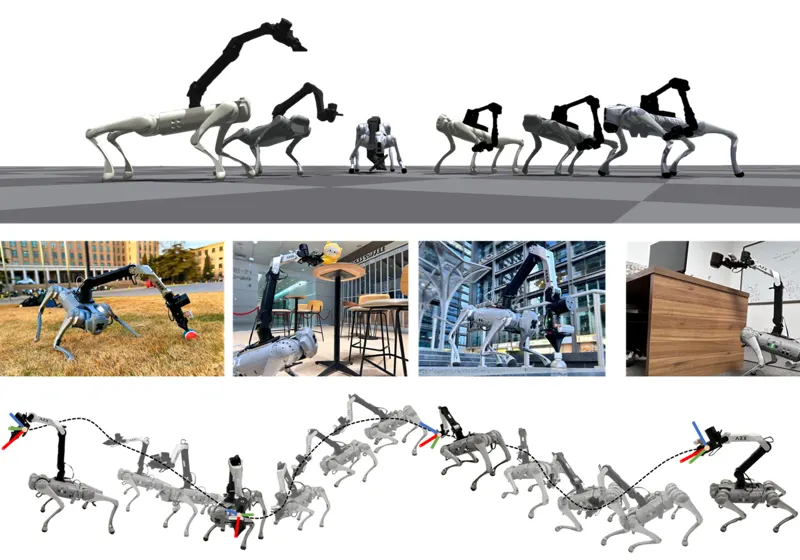
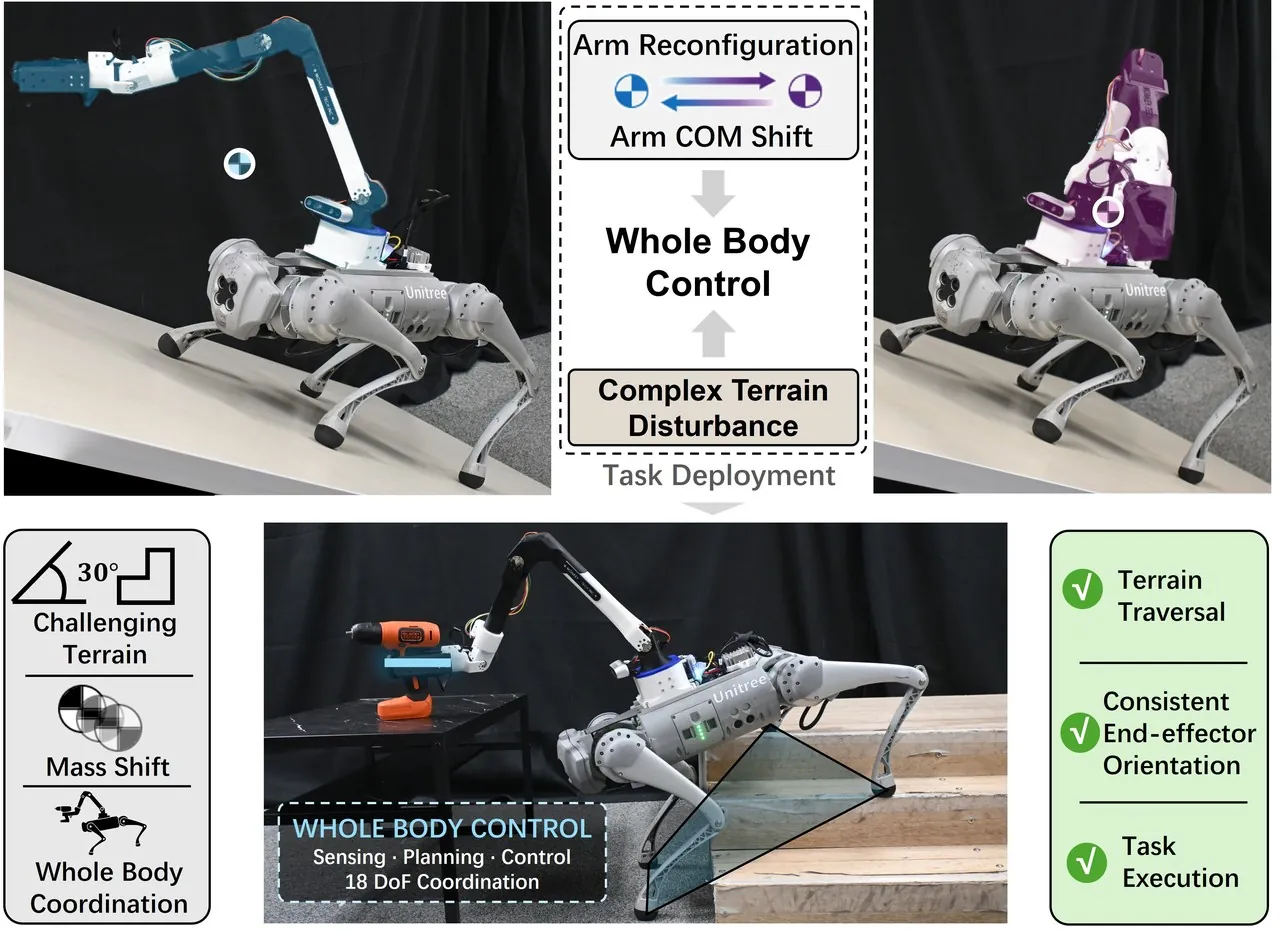
Legged robots equipped with manipulators offer promising capabilities for loco-manipulation tasks in unstructured environments. However, achieving task-consistent end-effector behavior during locomotion remains challenging due to terrain-induced disturbances and the strong coupling between locomotion and manipulation, particularly for small-scale quadruped platforms. A reinforcement-learning based whole-body control framework is proposed for quadruped loco-manipulation on complex terrain. The proposed framework combines a hybrid task representation with task-prioritized whole-body learning to coordinate locomotion and manipulation while preserving task-consistent end-effector behavior. A lightweight quadruped manipulator platform is further developed to validate the proposed framework on a small-scale quadruped system. Real-world experiments demonstrate successful deployment on complex terrains such as slopes up to 30 degrees, stairs, and deformable terrain. These results demonstrate the feasibility of deploying learned whole-body control policy for quadruped loco-manipulation in real-world environments and highlight the importance of task-consistent whole-body coordination for terrain-adaptive loco-manipulation.
One-sentence summary: The paper combines a body-frame end-effector position command with a gravity-referenced orientation command and a soft priority schedule from body regulation to locomotion to manipulation, allowing a 13.5 kg Unitree Go1 with a lightweight six-degree-of-freedom arm to traverse difficult terrain while preserving task-relevant end-effector behavior.
1. Background and Problem Formulation
A quadruped with an arm extends mobile robotics from arriving at a location to acting there. Inspection, maintenance, search and rescue, and operations in unstructured spaces all require both terrain traversal and physical interaction. The difficult case is not a stationary grasp from a level floor. It is carrying an arm through slopes, stairs, soft ground, and changing contacts while the end effector must retain a useful pose relative to an object or tool.
Small-scale quadrupeds make this coupling especially severe. A commercial arm can consume much of the platform's payload, and its effect is not limited to a fixed offset in mass. Extending or lifting the arm changes the center of mass and generates dynamic reactions. The legs must then produce larger torques while also responding to terrain. In the opposite direction, every body pitch, roll, and vertical motion caused by the terrain propagates through the arm base and perturbs the end effector.
A conventional hierarchy often assigns locomotion to a quadruped controller and arm tracking to inverse kinematics. Each subsystem can work on flat ground, yet the composition may fail when body posture changes the arm's workspace or when an arm motion changes the support and contact requirements. The two controllers can optimize plausible local objectives while asking the same physical system to do incompatible things.
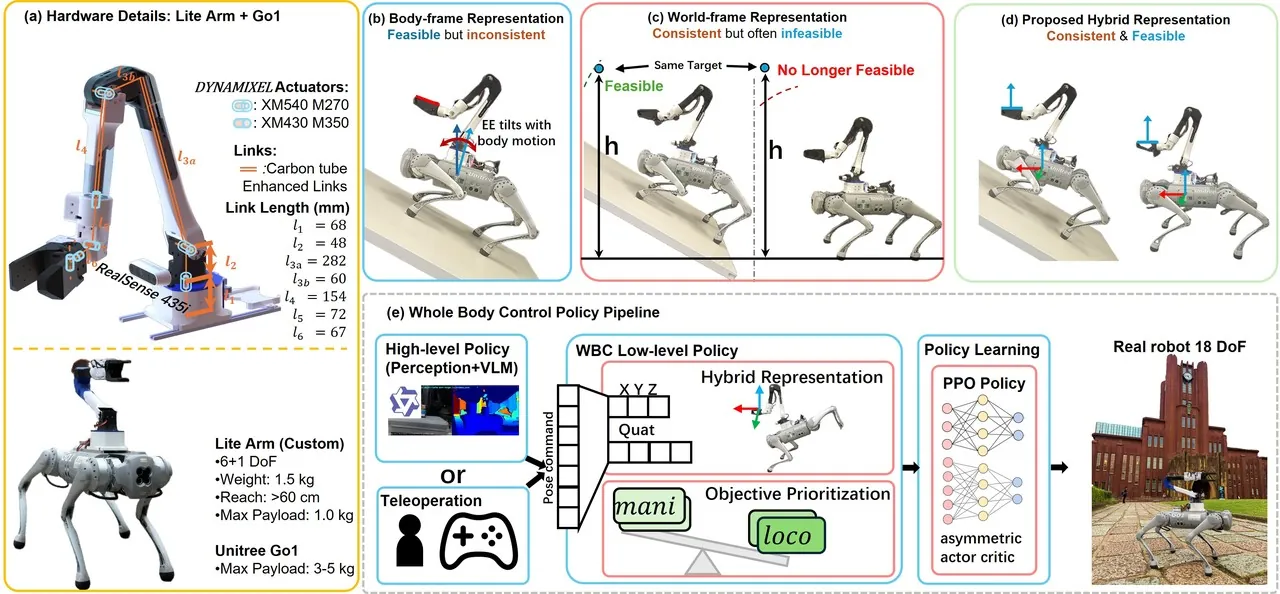
The paper separates two properties of a manipulation command. End-effector position benefits from a local body frame because the arm has finite reach and no redundant kinematics in this platform. A world-frame position may preserve an absolute target, but large body excursions can push that target outside the reachable workspace or require accurate global localization. End-effector orientation has the opposite priority in many tasks: carrying a container or tool often requires the gripper to remain aligned with gravity even as the body tilts. A purely body-frame orientation would rotate with the robot and violate that task requirement.
The work therefore addresses two coupled decisions. At the task-definition level, which frame should represent position and which should represent orientation? At the learning level, how should the policy trade body stability, locomotion, and manipulation when they compete during a rollout? The proposed answer is a hybrid task representation plus a state-dependent soft priority hierarchy.
The controller is formulated as a command-conditioned Markov decision process. A shared policy receives a whole-body command and produces target positions for 18 actuated joints. Training occurs offline in randomized simulation, while deployment uses a fixed-cost neural policy. The method does not solve a nonlinear whole-body optimization at every control cycle, so its embedded runtime is predictable.
2. Platform and Required Concepts
The platform pairs a Unitree Go1 with a custom Lite Arm. The arm has six degrees of freedom, weighs about 1.5 kg, and reaches more than 60 cm. Its links use carbon-fiber-reinforced polylactic acid together with embedded carbon-fiber tubes to obtain stiffness without a large mass penalty. The full robot weighs approximately 13.5 kg. The policy controls 12 leg joints and 6 arm joints; the gripper is part of the downstream grasping system rather than the 18-dimensional continuous action vector.
The actor receives 70 observations: 18 joint positions, 18 joint velocities, the previous 18-dimensional action, a 10-dimensional whole-body command, 3 body angular velocities, and the 3-dimensional projected gravity vector. It outputs 18 normalized target joint positions. A low-level controller converts these targets into joint commands at a higher rate.
The training system uses an asymmetric actor-critic. The critic receives privileged quantities such as body linear velocity, end-effector linear and angular acceleration, orientation deviation, target error, and a local height map. These signals improve value estimation during simulation but are not required by the deployed actor.
Let $ {}^{B}\mathbf{p}_{t} $ denote the commanded end-effector position expressed in the body frame. Let $\mathbf{q}_{t}$ denote the desired end-effector unit quaternion. The position command moves with the robot base, while the orientation command is tied to gravity. This hybrid command is the central interface between perception, planning, and whole-body control.
The priority mechanism is described as soft because it does not impose a strict non-interference constraint. Each lower-level reward is continuously gated by current performance at higher levels. A brief disturbance can still be handled by coordinated action across all objectives, but prolonged loss of body or locomotion quality reduces the influence of manipulation until the higher-priority condition recovers.
3. Method
3.1 A single policy maximizes prioritized return
The shared policy $\pi_{\theta}$ is trained with proximal policy optimization to maximize
$$ \max_{\theta}\mathcal{J}(\theta) =\mathbb{E}_{\pi_{\theta}} \left[\sum_{t=0}^{T-1}r_{t}^{\mathrm{pri}}\right]. $$
Here, $T$ is the number of policy steps in an episode and $r_{t}^{\mathrm{pri}}$ is the synthesized priority reward defined below. The same network therefore controls both locomotion and manipulation. This removes the handoff between separate optimizers that would otherwise need to negotiate every change in body posture and arm configuration.
3.2 The hybrid command splits position and orientation reference frames
The complete command is
$$ \mathbf{c}_{t}^{\mathrm{WBC}} =\left(\mathbf{c}_{t}^{\mathrm{loco}},\mathbf{c}_{t}^{\mathrm{EE}}\right), \qquad \mathbf{c}_{t}^{\mathrm{EE}} =\left({}^{B}\mathbf{p}_{t},\mathbf{q}_{t}\right). $$
The locomotion part $\mathbf{c}_{t}^{\mathrm{loco}}$ contains desired forward and lateral velocity plus yaw rate. The end-effector part contains the body-frame position ${}^{B}\mathbf{p}_{t}$ and the desired orientation $\mathbf{q}_{t}$. The orientation is constructed so that the end-effector vertical axis aligns with the world vertical direction obtained from gravity.
This representation does not claim that one frame is universally superior. It assigns each variable to the frame that matches its role. Body-frame position preserves local reachability and avoids making the arm responsible for global translation. Gravity-referenced orientation preserves task consistency and prevents a 30 degree slope from automatically producing a 30 degree tool tilt.
The distinction matters most for a six-degree-of-freedom arm without kinematic redundancy. If the target is defined globally, body motions consume reach before the arm can respond. If orientation is defined locally, terrain adaptation consumes task orientation. The hybrid command turns these two failure modes into separate interface choices rather than asking a single frame to solve both.
3.3 Body, locomotion, and manipulation form a dependency hierarchy
The objective groups follow the ordering
$$ \mathrm{Body\ Regulation}\succ\mathrm{Locomotion} \succ\mathrm{Manipulation}. $$
This is a dependency statement. A robot with poor body regulation cannot reliably maintain footholds or carry a tool. A robot that cannot move cannot complete a traversal-and-grasp task even if its arm tracks beautifully. Manipulation remains essential, but it is activated as the higher-level conditions become adequate.
3.4 Uprightness gates locomotion and manipulation
The body-regulation factor is
$$ \lambda_{\mathrm{upright}} =\min\left( \frac{\max\left(-\mathbf{g}^{\top}\mathbf{e}_{z},0\right)}{c_{0}}, 1 \right). $$
The vector $\mathbf{g}$ is projected gravity in the body frame, $\mathbf{e}_{z}$ is the body vertical axis, and $c_{0}$ is the threshold at which full activation is reached. When body roll or pitch becomes large, the nonnegative upright score drops and the factor approaches zero. The term does not replace the body reward; it modulates how strongly locomotion and manipulation contribute while the body is outside its desired operating region.
3.5 Locomotion quality gates manipulation
The second activation factor is
$$ \lambda_{\mathrm{loco}} =\min\left(R_{\mathrm{loco}}/c_{1},1\right), $$
where $R_{\mathrm{loco}}$ is the current nonnegative locomotion performance and $c_{1}$ is the saturation threshold. Poor velocity tracking therefore reduces the influence of the arm objective. Once locomotion reaches the required level, the arm receives its full contribution. This schedule lets the policy avoid spending actuator authority on a precise end-effector trajectory while the base is failing to execute the movement needed to reach the task.
3.6 Fine position tracking concentrates reward near the target
The manipulation objective combines coarse position, fine position, and orientation. The fine position reward is
$$ R_{\mathrm{pos}}^{\mathrm{fine}} =1-\tanh\left(\frac{e_{\mathrm{pos}}}{\sigma}\right), \qquad \left|\frac{\partial R_{\mathrm{pos}}^{\mathrm{fine}}} {\partial e_{\mathrm{pos}}}\right| =\frac{1}{\sigma}\operatorname{sech}^{2} \left(\frac{e_{\mathrm{pos}}}{\sigma}\right). $$
Here, $e_{\mathrm{pos}}$ is the Euclidean end-effector position error and $\sigma$ sets the useful range of the fine term. The derivative shrinks rapidly for large errors, preventing extreme arm corrections far from the goal, and becomes more informative near the target. The coarse term supplies a broad reaching signal; the fine term improves local precision.
3.7 The priority vector combines all reward groups
The state-dependent priority vector is
$$ \boldsymbol{\Lambda} =[1,\lambda_{\mathrm{upright}}, \lambda_{\mathrm{upright}}\lambda_{\mathrm{loco}}]^{\top}, $$
and the step reward is
$$ r_{t}^{\mathrm{pri}} =\boldsymbol{\Lambda}^{\top}\mathbf{R}, \qquad \mathbf{R} =[R_{\mathrm{body}},R_{\mathrm{loco}}, R_{\mathrm{mani}}]^{\top}. $$
The body term keeps unit weight. Locomotion is gated by uprightness. Manipulation is gated by both uprightness and locomotion. The multiplicative form is important: if either higher-level condition is poor, the manipulation contribution is attenuated. The resulting reward sequence enters the usual return and advantage calculations for PPO, so the gate affects the learned shared behavior rather than merely rescaling a diagnostic value.
3.8 Orientation control is split into yaw and vertical alignment
The yaw term is
$$ r_{\mathrm{EE\text{-}yaw}} =\exp\left(-ke_{\mathrm{yaw}}^{2}\right), $$
and the upright term is
$$ r_{\mathrm{EE-z-align}} =\exp(-k\bar{\theta}^{2}), \qquad \bar{\theta} =\arccos\left(\mathbf{z}^{\top}\mathbf{e}_{z}^{W}\right). $$
$\mathbf{z}$ is the end-effector local vertical axis expressed in the world frame and $\mathbf{e}_{z}^{W}$ is world vertical. The first term aligns the gripper's heading, while the second keeps its tool axis upright. Grasping often requires both: a gripper can be perfectly vertical yet rotated around the vertical axis and therefore approach an object from the wrong direction.
3.9 Training distribution and domain randomization
The simulation trains 4096 environments for 1000 policy steps per episode at 50 Hz, giving 20 second episodes. The physics timestep is 0.005 seconds and the policy decimation is four. Terrains include flat ground, slopes, stairs, boxes, and random obstacles. A curriculum increases terrain difficulty from 0.0 to 1.0.
Base and end-effector commands remain fixed for the first half of an episode and are resampled once at the midpoint. This creates a controlled change in task intent. When the base command is stationary, arm targets are sampled from the full reachable workspace. During locomotion, targets are biased toward a locomotion-compatible part of the workspace. The policy therefore sees both broad arm capability and a denser sample of trajectories that can coexist with sustained body motion.
Randomization covers PD stiffness and damping, arm-link mass, end-effector payload, action delay, trunk wrench, and velocity perturbations. Stiffness is scaled from 0.8 to 1.3, damping from 0.5 to 1.5, each arm-link mass from 1.0 to 1.8, and the payload from 0 to 0.5 kg. The action delay spans 0 to 3 steps, or 0 to 60 ms. Each trunk force and torque component is sampled from $[-2,2]$, while horizontal velocity perturbations in $[-0.5,0.5]$ m/s are applied every 10 to 15 seconds.
flowchart LR
    subgraph TASK["Hybrid task interface"]
        V["Velocity and yaw command"] --> C["Whole body command"]
        P["Body frame position
preserve local reach"] --> C
        G["Gravity referenced pose
preserve task orientation"] --> C
    end
    C --> O["70D actor observation"]
    O --> PI["Shared PPO policy"]
    PI --> A["18D joint target action"]
    A --> L["12 leg joints"]
    A --> R["6 arm joints"]
    L --> T["Slopes stairs boxes deformable ground"]
    R --> E["End effector tracking"]
    T --> B["Body tilt slip and contact change"]
    B --> H["Upright and locomotion gates"]
    E --> W["Manipulation reward"]
    H --> W
    H --> PI
    W --> PI
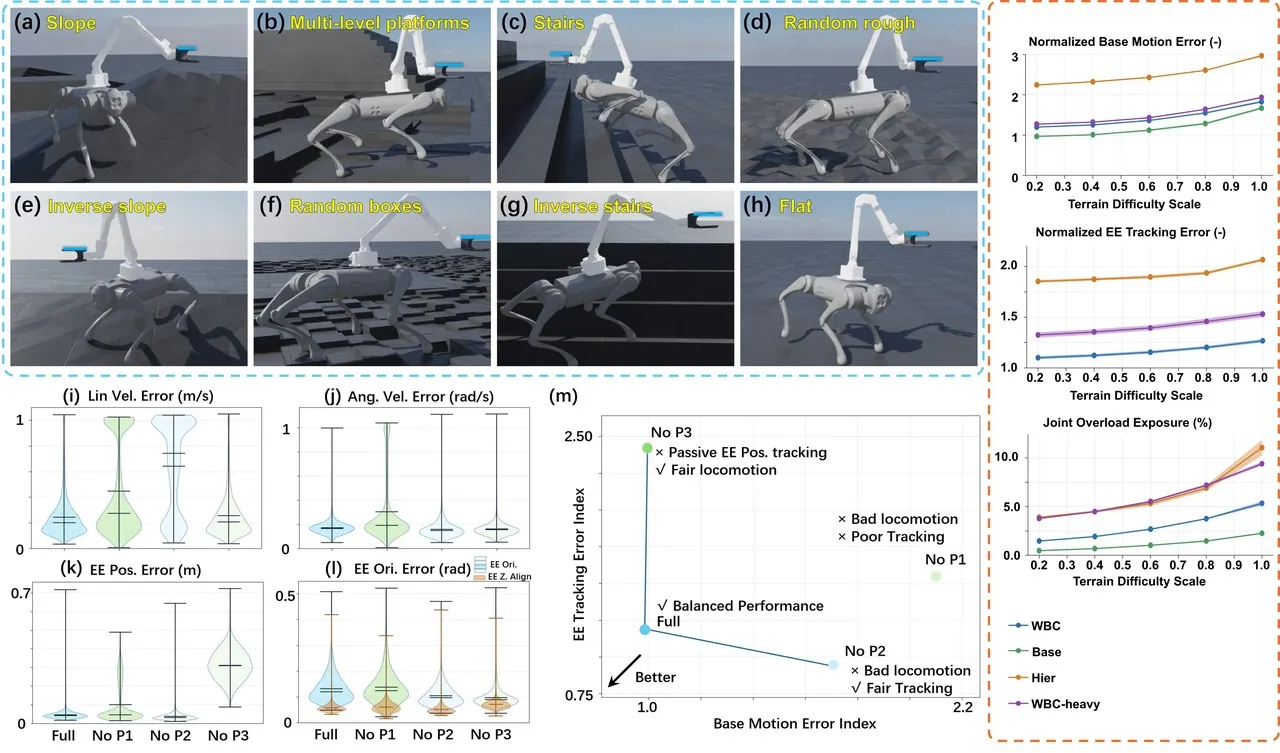
The ablation in Figure 3 tests whether the hierarchy is doing useful work. Removing locomotion priority can improve end-effector error because the robot sacrifices mobility to stabilize the arm. Removing manipulation priority keeps locomotion healthier but lets the arm stay near comfortable local configurations rather than reach the target. Removing body priority degrades both. The full policy lies closest to the low-error corner in the combined locomotion-manipulation trade-off.
4. Experimental Analysis
The ablation uses 1024 parallel rollouts on the most difficult terrain and reports linear and angular body-velocity errors, end-effector position error, and orientation error. The broader simulation study compares four configurations: the full whole-body controller with the Lite Arm, a locomotion-only base, a hierarchical controller that combines locomotion with inverse-kinematics arm tracking, and a whole-body policy trained with a 3 kg arm. Terrain difficulty ranges from 0.2 to 1.0, with 1024 parallel environments per condition.
| Element | Paper configuration | Why it matters |
|---|---|---|
| Robot | Unitree Go1 plus a 1.5 kg six-DoF Lite Arm | Approximately 13.5 kg total with more than 60 cm reach |
| Controlled joints | 12 legs and 6 arm joints | One shared 18-dimensional continuous policy |
| Actor observation | 70 dimensions | Deployable state only; the critic has additional training data |
| Training | 4096 environments, 1000 steps, 50 Hz | 20 second episodes with four physics steps per policy step |
| Terrain curriculum | Flat, slopes, stairs, boxes, obstacles | Difficulty increases from 0.0 to 1.0 |
The most compact reliability comparison comes from repeated lateral end-effector motion at two speeds and payloads. The hierarchical method fails on 8.50 percent of rollouts in the slow and light condition, then on 13.77 percent in the fast and heavy condition. Its successful-rollout position RMSE grows from 0.070 m to 0.108 m. The whole-body controller produces only two failures across all 4096 rollouts and keeps position RMSE between 0.057 and 0.069 m.
| Condition | Hierarchical controller | Whole-body controller |
|---|---|---|
| 0.4 m/s, 0.2 kg | 8.50% failures; 0.070 m RMSE | Two failures over the complete 4096-rollout set |
| 0.8 m/s, 0.5 kg | 13.77% failures; 0.108 m RMSE | RMSE remains within 0.057 to 0.069 m |
The results are more interesting as a robustness statement than as a single average. The hierarchical method remains usable in the easy condition, but both failure rate and error grow when speed and payload increase together. The whole-body method's low failure count indicates that coupling the base and arm in one feedback policy reduces the chance of entering a state where the arm and locomotion controllers demand incompatible corrections.
Terrain difficulty also raises both tracking errors and the fraction of time joints operate near their torque limits. Manipulation-enabled systems carry more load than the locomotion-only base, which is expected. Among those systems, however, the full controller has lower body-motion error, lower end-effector error, and lower overload exposure than the hierarchical baseline. The 3 kg arm version shows higher overload exposure, especially on difficult terrain. This is direct evidence that the lightweight hardware design changes the feasible control problem rather than merely making the robot easier to carry.
Real-world demonstrations use a 30 degree slope and a series of 10 cm stairs. The robot carries a container holding two 36 mm elastic balls, whose visible motion amplifies body and end-effector disturbance. The policy runs onboard a Jetson Xavier NX at 49.9 Hz. Mean inference time is 1.53 ms, average sensor-to-command latency is 2.76 ms, and low-level joint control runs at 500 Hz. Those values leave substantial time between policy decisions for sensing and low-level control.
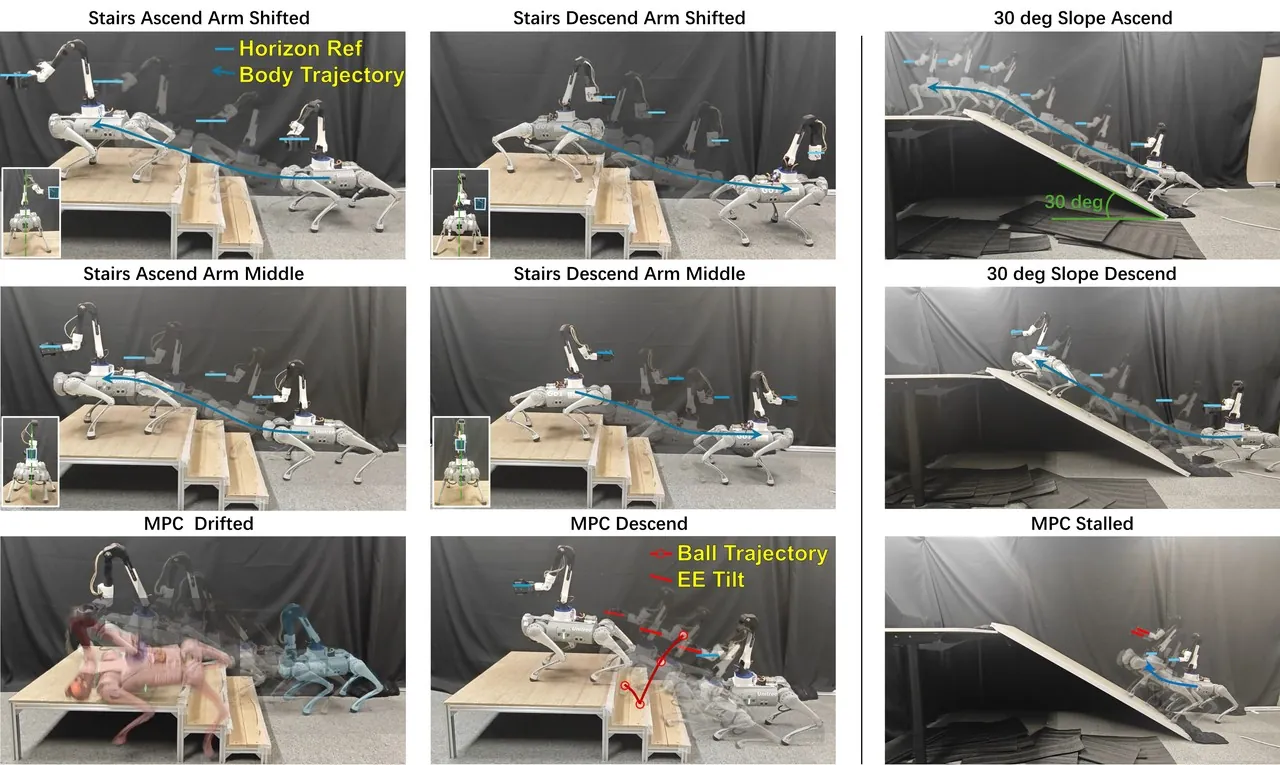
Figure 5 quantifies stair tracking and repeated manual pitching disturbances. During stair tracking with a mean foot-plane tilt of 0.421 rad, end-effector position error is 0.016 plus or minus 0.004 m and orientation error is 0.045 plus or minus 0.017 rad. During five manual disturbances, the average peak foot-plane tilt reaches 0.752 plus or minus 0.031 rad. Leg compensation limits peak body tilt to 0.499 plus or minus 0.037 rad. The arm absorbs most of the residual motion in the vertical direction: mean absolute horizontal errors remain below 0.009 m, vertical error is 0.034 plus or minus 0.029 m, and orientation error is 0.039 plus or minus 0.024 rad.
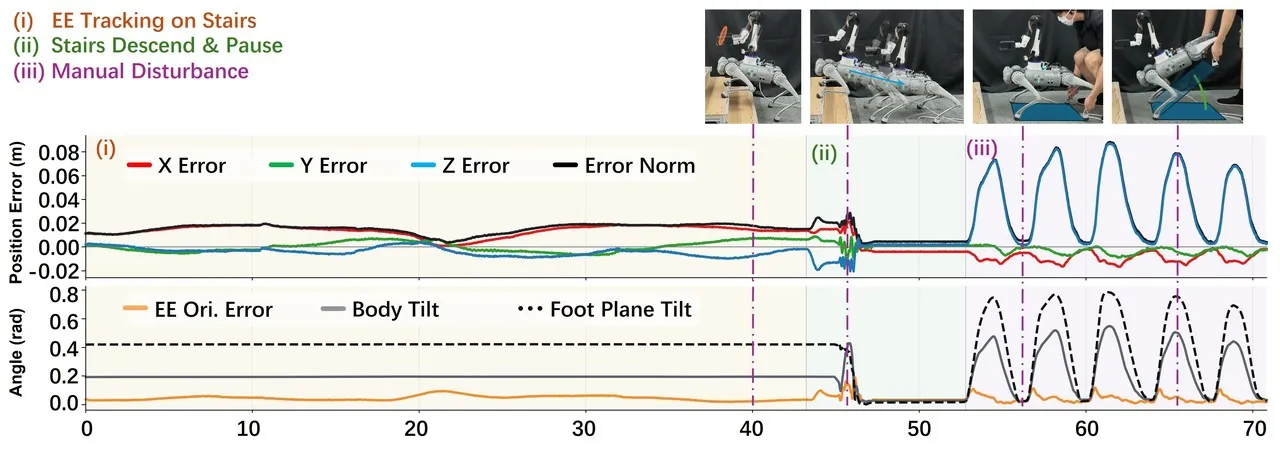
| Real-world quantity | Reported value | Interpretation |
|---|---|---|
| Mean foot-plane tilt on stairs | 0.421 rad | The support surface is far from level |
| Stair end-effector position error | 0.016 plus or minus 0.004 m | Legs and arm jointly compensate terrain motion |
| Stair orientation error | 0.045 plus or minus 0.017 rad | Gravity-referenced pose remains effective |
| Disturbance peak foot/body tilt | 0.752 plus or minus 0.031 / 0.499 plus or minus 0.037 rad | Leg compensation reduces motion reaching the trunk |
| Disturbance horizontal error | Below 0.009 m in both x and y | Most residual correction is vertical |
| Disturbance vertical/orientation error | 0.034 plus or minus 0.029 m / 0.039 plus or minus 0.024 rad | Task pose is retained under large body motion |
The practical grasping experiment adds a semantic pipeline around the learned controller. A language instruction and the initial RGB image are sent once to a vision-language model, which returns a short scene-specific target description. GroundingDINO uses that phrase to localize the target at 10 Hz. Depth gives a three-dimensional point, which is transformed into the body frame and passed to a reachability-aware planner. While unreachable, the planner commands the robot to approach and holds the arm. Once reachability is confirmed over consecutive observations, it changes the command to the grasp pose:
$$ \mathbf{c}^{\mathrm{WBC}}_{t}= \begin{cases} \left[\mathbf{0},\mathbf{x}_{\mathrm{grasp}}\right], & \mathbf{s}_{\mathrm{reach}}({}^{B}\mathbf{p}_{o})=1,\\[4pt] \left[\mathbf{v}_{\mathrm{approach}},\mathbf{x}_{\mathrm{hold}}\right], & \mathbf{s}_{\mathrm{reach}}({}^{B}\mathbf{p}_{o})=0. \end{cases} $$
The controller itself receives no image. Perception affects it only through a body-frame target. During training, that target is sampled independently of any perception stack. The paper argues that an upstream perception module can be replaced without retraining the policy if it produces a compatible body-frame target at a comparable update rate. This is a modularity claim about the interface, not a claim that every perception system will yield identical end-to-end success.
Forty autonomous trials cover four objects on two terrain types: a paper cup, a transparent glass container, a transparent tube, and a 600 g electric screwdriver. Each terrain receives twenty trials. The deformable terrain is built from sandbags and sponges, introducing compliant contact and uncertainty not explicitly represented in simulation; 17 of 20 grasps succeed. During lateral stair descent, the four feet occupy footholds at different heights and create large support-polygon changes; 15 of 20 succeed. Overall success is 32 of 40, or 80 percent.
The eight failures reveal where the system is still limited. Two occur during traversal when balance is lost on the steepest footholds. Four come from inaccurate localization of the transparent tube or container. One occurs when the base fails to stop in time and touches the table edge. One occurs when the gripper closes but cannot retain the object during lift. Grouped by cause, three are motion-control failures and five arise from localization or grasp execution. This distribution is valuable because it shows that improving the learned controller alone would not eliminate the majority of failures.
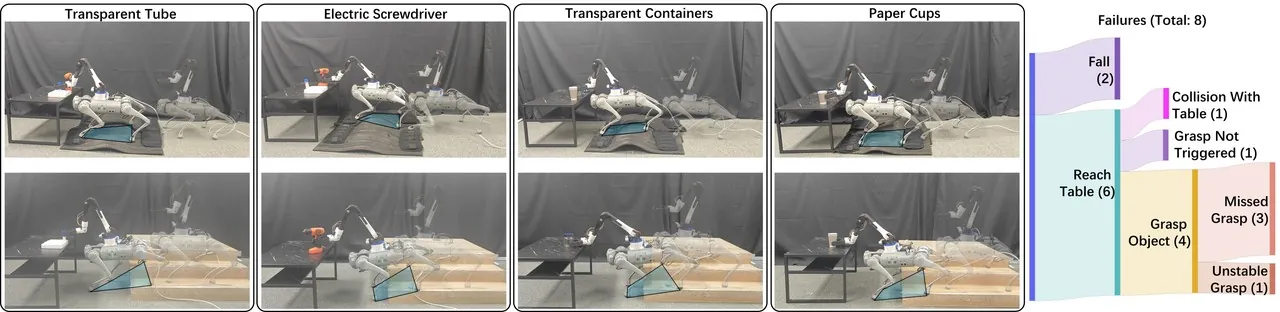
| Autonomous condition | Successes/trials | Rate | Main observation |
|---|---|---|---|
| Sandbag and sponge terrain | 17/20 | 85% | Compliant contact adds uncertainty beyond explicit simulation training |
| Lateral stair descent | 15/20 | 75% | Unequal foothold heights produce large body pitch and roll |
| Combined | 32/40 | 80% | Failures include two falls, four transparent-object localization errors, one table collision, and one lift slip |
5. Discussion
The strongest technical idea is the deliberate separation of position and orientation frames. A fully world-frame command would make the task pose globally consistent but would ask a small arm to compensate for the entire body trajectory. A fully body-frame command would preserve reach but transmit every terrain-induced body tilt to the tool. The hybrid command keeps the task inside the arm's local workspace while reserving the gravity direction as an external reference for the part of the pose that most directly affects manipulation.
The priority hierarchy addresses a different failure of fixed multi-objective rewards. A fixed weight assumes that the relative importance of body, locomotion, and manipulation remains constant throughout an episode. In rough-terrain control, that assumption is weak: a large body tilt temporarily makes locomotion and manipulation commands unsafe, while recovery from a transient disturbance may require simultaneous action. The soft gate changes the effective weight from step to step and links it to measured performance rather than a hand-set schedule.
The hardware and learning results reinforce each other. A lighter arm lowers inertial and torque costs, but it does not remove the kinematic coupling or the need to coordinate the arm with the legs. The 3 kg comparison demonstrates this point: reducing arm mass improves overload exposure, yet the lightweight robot still relies on a whole-body policy to coordinate its remaining configuration-dependent dynamics.
The embedded measurements support deployability at the control-computation level. A 1.53 ms mean inference and 2.76 ms sensor-to-command latency fit comfortably within a 49.9 Hz policy loop. The remaining risk is therefore not raw network execution but the harder problem of contact diversity, perception error, and grasp execution.
6. Limitations
The authors explicitly state that the uneven-terrain test area lacked external motion-capture coverage. Quantitative real-robot evaluation therefore uses onboard inertial and joint measurements with forward kinematics. Body tilt can be estimated from projected gravity and the foot plane from forward-kinematic foot positions, but the end-effector pose has no independent external ground truth. The experiments establish closed-loop operation and repeatable onboard tracking, not absolute world-frame accuracy.
The authors also state that validation is limited to one robot platform and a representative but limited set of terrain and manipulation conditions. The arm mass, joint hardware, object set, and terrain construction remain within a relatively narrow range. The tests do not establish behavior on unknown deformable media, broken stairs, slippery ice, moving targets, sustained towing, or long-duration hardware wear.
The paper does not provide a systematic sensitivity study for the thresholds $c_{0}$ and $c_{1}$. Those constants determine when the higher-priority condition counts as good enough and therefore how aggressively manipulation is gated. A conservative threshold could suppress the arm for too long, while an aggressive threshold could release it before the body is ready. The ablation validates the overall hierarchy but does not fully characterize the continuous scheduler against a broad family of fixed-weight or alternate gate designs.
The grasping pipeline remains largely sequential. The vision-language model is queried once at task onset, and GroundingDINO supplies the target while the planner handles reachability. Four failures on transparent objects show that the perception stage is still a dominant error source. Better uncertainty propagation, online re-identification, or language-guided retry could matter more than further tuning the whole-body reward.
Another boundary is that simulation episodes last 20 seconds without early termination. This design can teach recovery from undesirable states and avoids ending rollouts at the first bad contact, but it also means that training return should not be conflated with real-world safety. Separate hardware safeguards, fall protection, actuator thermal limits, and long-run reliability are not evaluated in the paper.
7. Conclusion
The paper's contribution is an integrated system rather than an isolated reward term. A lightweight six-degree-of-freedom arm reduces the physical burden on a small quadruped. A hybrid command preserves both local reach and task orientation. A soft body-locomotion-manipulation hierarchy makes lower-priority objectives depend on the current state of higher-priority ones. In simulation, the learned controller has only two failures across 4096 speed and payload rollouts. In the real world, it traverses 30 degree slopes and 10 cm stairs, tracks the end effector under significant body tilt, and completes 32 of 40 autonomous grasping trials across deformable terrain and lateral stairs.
The next meaningful advances are likely to be data and perception as much as policy architecture. Larger real-world loco-manipulation datasets, robust sensing of transparent and reflective objects, broader hardware randomization, and dynamic interaction with moving obstacles or targets would test whether the interface generalizes beyond the representative conditions in this study. The authors identify large-scale data collection, hardware improvement, and more complex manipulation and transportation in dynamic environments as future work.
Key takeaway: On rough terrain, the arm does not win by overriding the body; the body, locomotion, and manipulation must share one decision in the right order.
SOURCE LINKS