Skip to content
← Tags

#Mobile Manipulation (62)

ASENA: Self-evolving Agents for Embodied Navigation

ASENA: Self-evolving Agents for Embodied Navigation

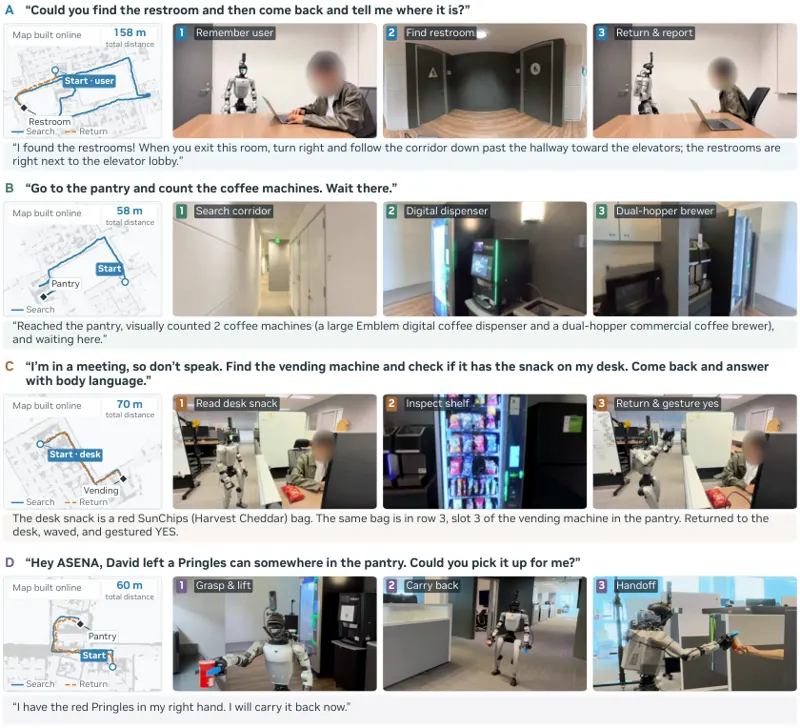
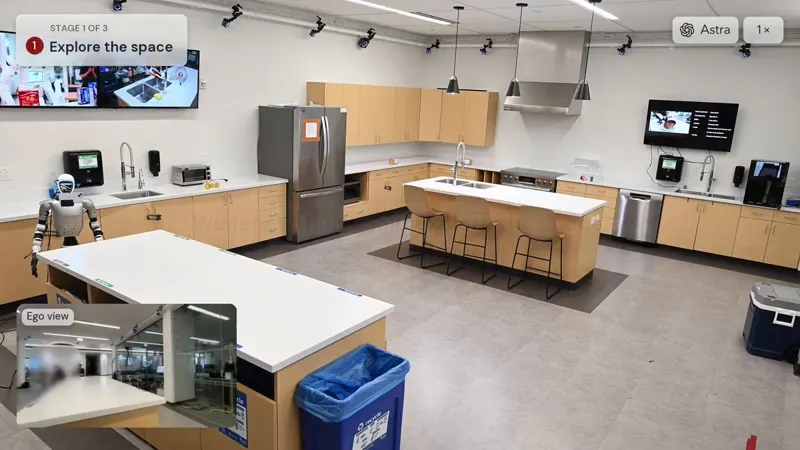
We present ASENA, an embodied agent system that enables general-purpose coding agents to program humanoid navigation, manipulation, and interaction. Through a unified robot harness, agents read sensor data, write and execute programs, inspect recorded outcomes, repair failures, and reuse notes and executable skills while keeping their model weights fixed. We also introduce ASENA-VLN, a 4B monocular navigation policy that serves as an optional tool within this programmable system. ASENA-VLN predicts body-frame trajectories for both extended routes and short-horizon behaviors. Its shared vision-language decoder is trained on route instructions, visual question answering, and a newly curated dataset of geometry-derived atomic navigation tasks. As a standalone policy, ASENA-VLN achieves state-of-the-art success rates of 68.7% on R2R and 70.2% on RxR. When integrated with a coding agent, learned navigation improves ASENA's success rate by 11 percentage points on both agentic benchmarks and reduces execution time. Persistent workspace evolution uses simulator feedback to improve success over ten passes through recurring 100-task subsets. Success increases from 72% to 98% on R2R and from 65% to 89% on RxR. On embodied question answering, ASENA achieves state-of-the-art accuracy with fewer interaction steps. On a Unitree G1, we demonstrate search, visual inspection, spatial reasoning, synthesized gestures, and mobile manipulation combining object pickup, carrying, and handoff without a pre-built map. These demonstrations illustrate how online programming extends robot behavior beyond route following and predefined skills.

An-Chieh Cheng, Isabella Liu, Edmund Bu · 62 views · Sep 30, 2026
Vision-language navigationEmbodied AIHumanoid robotsSep 30, 2026
PanTact: Teaching Whole-Body Dexterity with a Wearable Contact Interface

PanTact: Teaching Whole-Body Dexterity with a Wearable Contact Interface

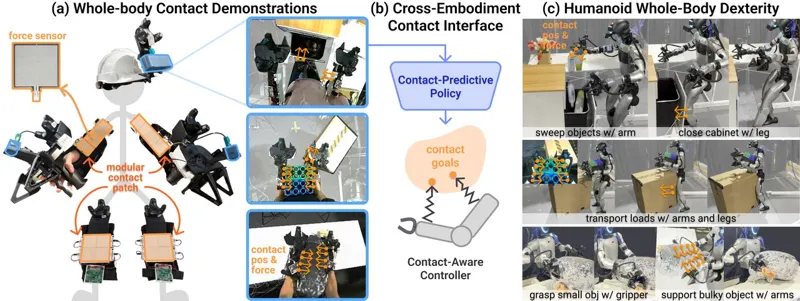
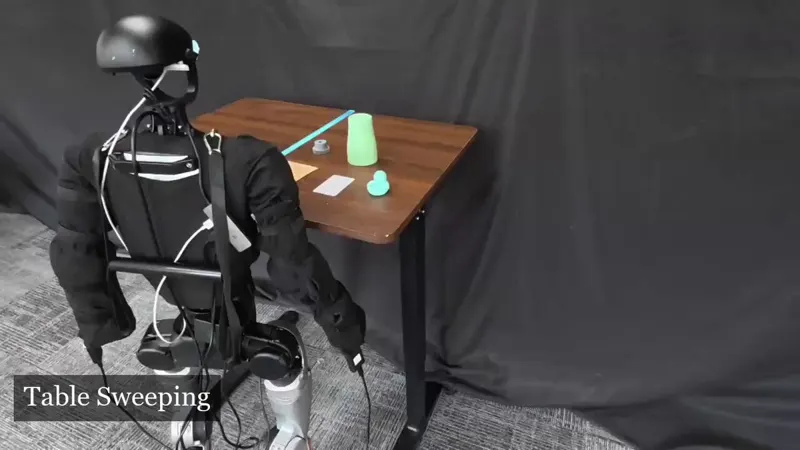
PanTact treats contact, not joint trajectories, as the transfer currency from people to humanoids. Wearable patches are assembled magnetically from 44x44 mm FSR modules; a custom 50x50 mm PCB streams 16 channels at 1 kHz over a CRC-checked RS-485 daisy chain, one Vive tracker per patch maps sensor centers into the world frame, and contact states are binarized against a per-channel adaptive baseline with threshold max(0.35 beta, r_min). The policy observes body-masked 3D egocentric point clouds, both wrist images and proprioception, and at 10 Hz predicts an action chunk of H=16 steps containing a look-at point, EEF poses with gripper widths, and per-sensor contact goals (binary state plus 3D position). A soft-minimum proximity d(p,q) with T = 0.02 m hands each active contact to whichever robot surface is currently nearest, and active goals are offset by delta along the pressing direction to form virtual goals that generate pressing force, so the G1 holds objects without any tactile sensor on its body. Three control formulations trade off differently: training-free upper-body IK, WBIK whose dense reference is executed by SONIC, and a sparse contact tracker trained with PPO over 4096 simulation environments for 30k iterations (50 Hz, 29 joints, S=8 upper-body / S=16 whole-body contact slots). On a 29-DoF Unitree G1: Grasp-and-Embrace reaches 85% with upper-body IK and 80% with the sparse tracker against 0% for Humanoid UMI; Sweep-and-Stow reaches 90.63% end to end while Humanoid UMI++ scores 18.75% on each stage and 0% end to end; Carry-and-Push is 90% versus 40%. In simulation replay, adding contact goals lowers contact distance for all three controllers at almost no cost in EEF accuracy.

Xu, Xiaomeng, Zhang, Han, Ruan, Zhian · 129 views · Oct 8, 2026
Whole-Body ManipulationTactile SensingContact-Rich ManipulationOct 8, 2026
MobileVISTA: Generative Data Augmentation for Pose Generalization in Mobile Manipulation

MobileVISTA: Generative Data Augmentation for Pose Generalization in Mobile Manipulation

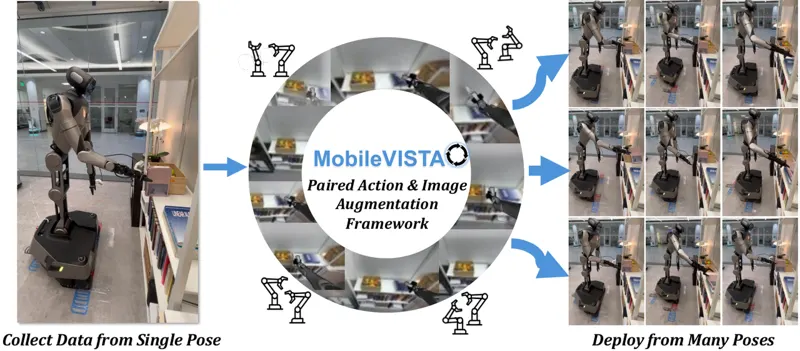
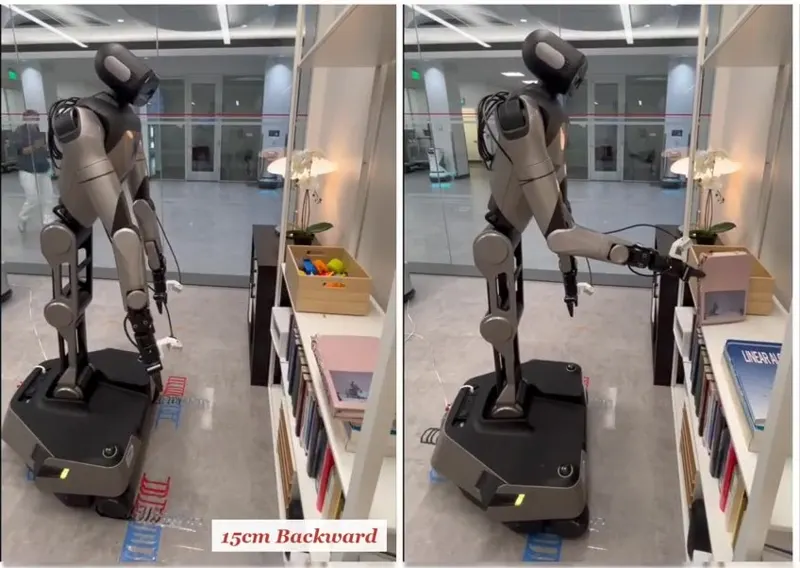
Mobile manipulators such as humanoid robots are increasingly deployed in dynamic, unstructured environments to perform dexterous manipulation tasks. However, end-to-end manipulation policies trained to imitate demonstration data collected from a single robot pose are brittle: even centimeter-scale deviations in robot pose at deployment can drive ego-centric observations and end-effector trajectories out of the training distribution, leading to sharp drops in performance. We introduce MobileVISTA, a data generation framework that transforms demonstrations captured at canonical poses into diverse, pose-perturbed training data by jointly (1) augmenting egocentric visual observations and (2) retargeting actions to compensate for base pose changes. Unlike prior methods, which assume a camera rigidly mounted off the actuated chain or non-trivial articulated robot geometry largely out of frame, MobileVISTA targets compatibility with egocentric platforms (e.g., humanoids) where the camera is both influenced by and must observe the robot's kinematic chain as it moves. We study MobileVISTA in simulated tasks spanning humanoid and bimanual embodiments, and on a real Galaxea R1 Pro. We find policies trained on MobileVISTA-augmented data demonstrate improved robustness to previously out-of-distribution poses encountered at test time, without additional demonstration collection or a trained generative model. Additionally, we find MobileVISTA's benefit is largest on tested humanoids, where the camera rides the actuated chain and the robot fills much of the frame. Additional videos and appendix can be found on our website: https://mobilevista.github.io

Wistreich, Suzannah, Tian, Stephen, Huang, Isabella · 139 views · Oct 5, 2026
Mobile ManipulationData AugmentationImitation LearningOct 5, 2026
UniLM-Nav: A Unified Framework for Zero-Shot Last-Mile Navigation

UniLM-Nav: A Unified Framework for Zero-Shot Last-Mile Navigation

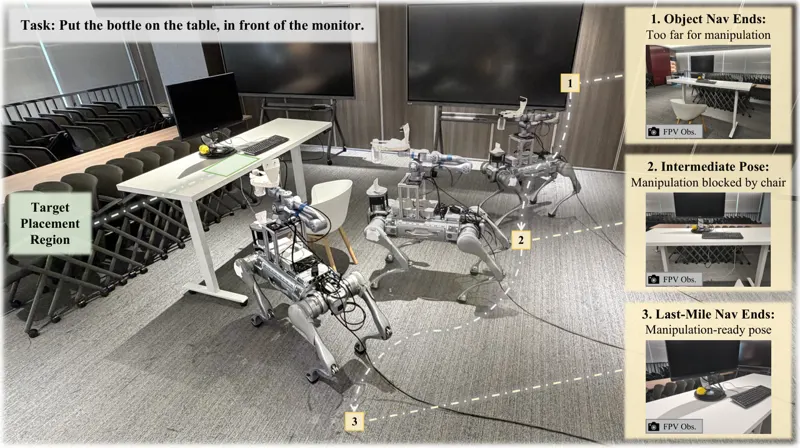
Mobile manipulation requires a robot to navigate to a target object or receptacle and then perform intended manipulation. However, reaching the vicinity of the target does not guarantee a manipulation-ready base pose, a problem known as last-mile navigation. Prior methods for last-mile navigation either rely on manual pose annotation or task-specific training, limiting their scalability to open-vocabulary settings with fine-grained spatial constraints. We propose UniLM-Nav, a unified framework for zero-shot open-vocabulary last-mile navigation. UniLM-Nav decomposes last-mile navigation into view selection, task-conditioned affordance grounding, and geometry-aware base-pose reasoning, all resolved with a shared multimodal large language model (MLLM) backend. Specifically, UniLM-Nav first selects a reference view that best captures the target object or receptacle from recently collected observations. It then grounds task-relevant affordance point in the selected view and lifts the result into the robot-centric coordinate frame. Finally, conditioned on the grounded affordance, task context, and robot geometry, it infers a manipulation-ready base pose for the robot. We evaluate UniLM-Nav on the OVMM benchmark, where it outperforms the previous state-of-the-art method, MoTo, by 3.13 percentage points. Analyses show that the components of our method are crucial to final performance, and that the choice of MLLM also has a substantial effect. We further deploy UniLM-Nav on a Unitree B2 quadruped robot with a 6-DoF Unitree Z1 manipulator, validating its applicability to real-world mobile manipulation tasks.

Zhuofan Zhang, Tianxu Wang, Guoxi Zhang · 229 views · Jul 7, 2026
Mobile ManipulationLast-Mile NavigationAffordance GroundingJul 7, 2026
Robot Planning and Situation Handling with Active Perception (VAP-TAMP)

Robot Planning and Situation Handling with Active Perception (VAP-TAMP)

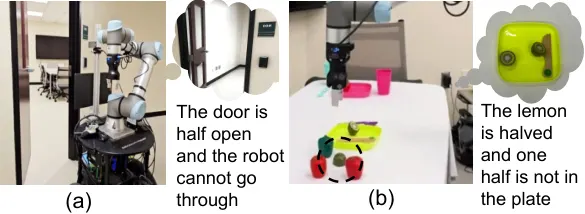
SUNY Binghamton + CMU + Ford Research + Agility Robotics. A TAMP (task and motion planning) framework with VLM-based active perception. Core problem: TAMP assumes a fully observable world, but execution constantly surfaces unforeseen situations — a door only half open, one lemon half fallen out of the plate. Prior open-world planning implicitly assumed situations are fully observable, while real robots rely on unreliable onboard sensors. VAP-TAMP’s key novelty is the bidirectional interaction between VLMs and action knowledge: predicates from the current action’s PDDL preconditions/effects construct VQA prompts for the VLM, and VLM outputs update the action knowledge. Three modules: (1) scene graph generator (RGB-D point cloud + instance segmentation + CLIP embeddings; geometric rules for on/inside/near; updated via both action-driven and observation-driven channels); (2) active perception (N semantically equivalent paraphrases per predicate with majority voting; inconsistent responses → the VLM suggests a viewing direction (left/right/closer/above) → navigate and re-observe, looping within budget K until the view is sufficient); (3) situation handling (verify-execute-verify loop: preconditions checked before, effects after; any failure → correct the scene graph → PDDL replanning; diagnoses whether discrepancies stem from perception error, world state change, or execution failure). Real-world: Segway RMP + UR5e + Robotiq gripper, 4 household tasks × 25 trials (100 total), 88% success (OK-Robot 76%, COWP 69%, Closed-World 33%); 72/100 trials contained at least one unforeseen situation; VLM-guided viewpoint selection averages 1.61 views vs 4.35 for greedy exploration (63% fewer); failure-mode analysis shows VAP-TAMP failures concentrate in manipulation hardware (42%) — the perceptual bottleneck has been shifted away. Simulation (OmniGibson, 5 tasks with injected failure probabilities) shows predicate-based verification beats SuccessVQA/AffordanceVQA and their combination, with effect verification contributing more than precondition verification (grasp/cut carry 50% combined failure rates detectable only post-execution).

Austine Oloo, Zainab Altaweel, Yohei Hayamizu · 468 views · Apr 28, 2026
TAMPActive PerceptionVLMApr 28, 2026
From reactive to cognitive: brain-inspired spatial intelligence for embodied agents

From reactive to cognitive: brain-inspired spatial intelligence for embodied agents

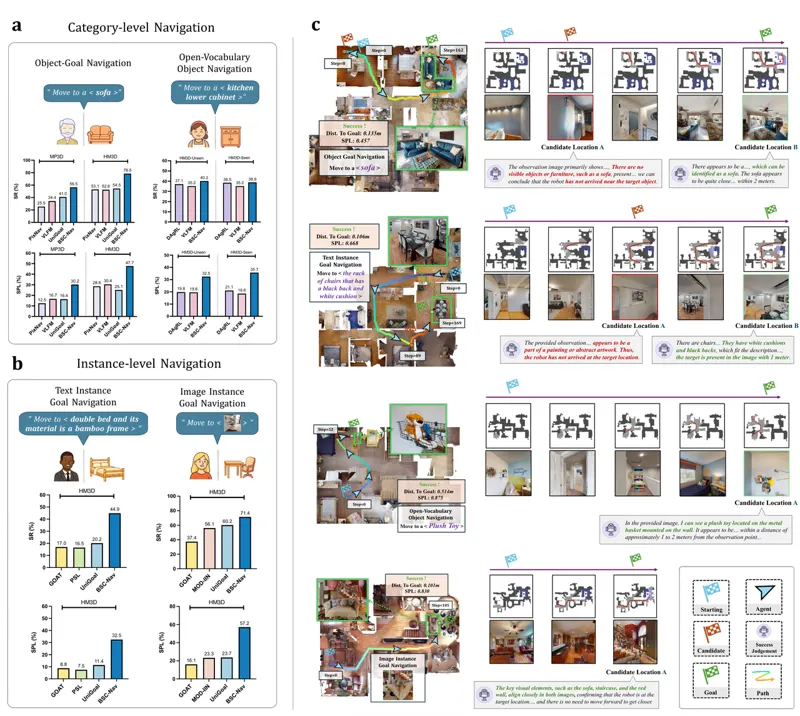
Tsinghua University and Beihang University present BSC-Nav (Brain-inspired Spatial Cognition for Navigation). The paper argues that existing embodied agents — whether end-to-end RL or "MLLM plus modular pipeline" — are fundamentally reactive and stateless: they process an observation and discard it, lacking any durable internal model of space, which yields fragmented knowledge, short-sighted planning and poor generalization. The authors borrow the answer from neuroscience, where spatial knowledge consolidates into three interconnected forms: landmarks, route knowledge, and survey knowledge. BSC-Nav instantiates these computationally in three modules. Landmark memory stores 4-tuples (world coordinates, open-vocabulary category, detection confidence, GPT-4o contextual description) with a spatial-overlap set plus confidence-weighted fusion for deduplication. The cognitive map extracts DINO-v2 patch features, projects them through inverse perspective projection and cascaded coordinate transforms into a voxel grid, and adopts a free-energy-principle-inspired surprise-driven update: a new feature is written when its mean distance to features in the n-hop neighborhood exceeds a threshold, replacing the lowest-surprise entry when the buffer is full, preserving cross-viewpoint diversity while bounding storage. Working memory retrieves hierarchically by instruction complexity — simple targets use text-only GPT-4 reasoning over landmark memory (even inferring unrecorded targets from co-located landmarks), while complex targets first have descriptions refined by GPT-4o, then "imagine" the appearance via Stable Diffusion 3.5, encoded by DINO-v2 and center-distance weighted pooled to query the cognitive map (imagine-then-localize), with similarity-weighted DBSCAN yielding candidate coordinates. Rather than greedily taking the highest confidence, candidates are ordered by H_i = lambda*p_i + (1-lambda)(1 - d_i/d_max). Across 62 MP3D/HM3D scenes and 8,195 episodes: OGN reaches 78.5% SR on HM3D (24.0 points above SOTA UniGoal), OVON zero-shot beats supervised DAgRL, IIN reaches 71.4%; SPL gains are even more consistent (IIN 57.2% vs 23.7%). On A-EQA it achieves the highest LLM-Match of 54.6, still trailing humans by 27.5. Real-world deployment on a custom platform (AgileX Ranger-mini-3.0 chassis, Franka Research 3 arm, RealSense D435i) ran 75 episodes in a ~200 m² two-floor space, with IIN reaching 100% SR on 4 of 5 targets and reliable localization to semantically plausible regions even on failure, plus long-horizon navigation-plus-manipulation demos such as "make breakfast" over three open-vocabulary objects. The paper proposes an embodied Turing test for spatial cognition probing three dimensions: real-time construction of reusable spatial representations, abstraction from sparse partial observations, and translation of high-level goals into actionable spatial plans.

Ruan, Shouwei, Wang, Liyuan, Kang, Caixin · 879 views · Aug 24, 2025
BSC-NavEmbodied AIVisual navigationAug 24, 2025
As an Amazon Associate, we earn from qualifying purchases.