Skip to content
Spatial and Semantic Reasoning for LLM-Driven Robot Navigation via MCP

Spatial and Semantic Reasoning for LLM-Driven Robot Navigation via MCP

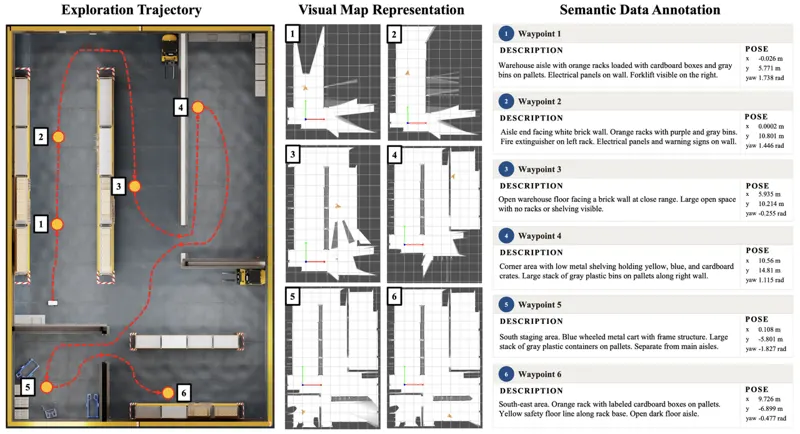
Large language models (LLMs) are increasingly used as natural-language interfaces for robotic systems, yet their integration with Robot Operating System (ROS)-based navigation remains limited by two gaps. First, navigation data such as occupancy grids are represented as raw geometric messages that are difficult for LLMs to use directly as spatial or semantic context. Second, adding LLM-driven capabilities often requires custom wrappers or robot-specific interfaces, limiting reuse across systems. To address these challenges, we propose a non-invasive framework that connects LLM reasoning with ROS-based navigation through a navigation-oriented representation layer, exposed through the Model Context Protocol (MCP) as standardized, reusable tools so that any MCP-compatible LLM can access them without robot-specific wrappers. The visual map modules transform occupancy grids into metric, pose-aware images for goal reasoning, while the semantic annotation modules record waypoint-level observations with robot poses. We evaluate the framework on three tasks: autonomous mapping, spatial reasoning-based navigation, and semantic reasoning-based navigation. The results show that the evaluated LLM backends use these representations to achieve over 97% map coverage and select spatial or semantic navigation targets from natural-language instructions in a simulated indoor environment. This demonstrates representation-mediated LLM navigation without modifying the existing ROS navigation stack.

LLMRobot navigation
Jungsoo Lee, Jaegyun Park, Wansoo Kim · 73 views · Sep 23, 2026
StereoVLM: Binocular Vision-Language Models for Metric 3D Spatial Reasoning

StereoVLM: Binocular Vision-Language Models for Metric 3D Spatial Reasoning

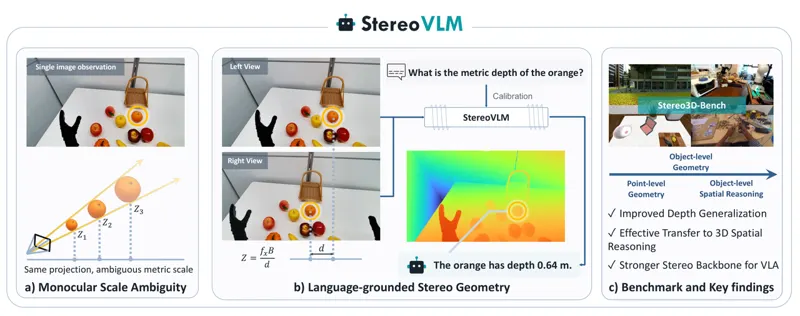
Vision-language models (VLMs) exhibit strong semantic understanding but remain limited in their ability to reason about metric 3D space in the physical world. Existing VLMs typically infer 3D scene structure from one or more images without known camera calibration or cross-view geometric constraints. This makes metric 3D inference inherently ambiguous and leaves it unclear whether their spatial predictions are grounded in visual evidence or driven primarily by semantic priors. In contrast, calibrated stereo provides explicit cross-view geometry that resolves this ambiguity and offers a more reliable foundation for metric 3D perception and geometric generalization. We investigate how VLMs can learn transferable 3D representations directly from calibrated binocular observations. To this end, we introduce StereoVLM, the first geometry-aware binocular VLM for metric 3D spatial reasoning. StereoVLM follows a hierarchical learning paradigm spanning from cross-view correspondence and disparity estimation to calibration-conditioned metric depth perception and semantic spatial reasoning. We further find that disparity supervision generalizes substantially better than direct binocular depth supervision on unseen environments. To evaluate these capabilities, we introduce Stereo3D-Bench, a comprehensive benchmark across three levels, from point-level geometry to object-level spatial reasoning. StereoVLM-8B achieves 95.17% depth accuracy (δ₁) and a 66.98 average object-level score on Stereo3D-Bench. Intervention results further indicate that the model's performance on Stereo3D-Bench benefits from valid cross-view geometry and cannot be explained solely by additional visual tokens or semantic priors. Hierarchical geometric supervision also yields average gains of 3.54 points across five spatial benchmarks and 4.3 percentage points in RoboCasa manipulation success.

Stereo visionVision-language models
Chi Yan, Guoyang Zhao, Wentao Yuan · 173 views · Nov 20, 2026
LIN-SLAM: Lightweight LiDAR–Inertial Neural SLAM for Real-Time Onboard Navigation

LIN-SLAM: Lightweight LiDAR–Inertial Neural SLAM for Real-Time Onboard Navigation

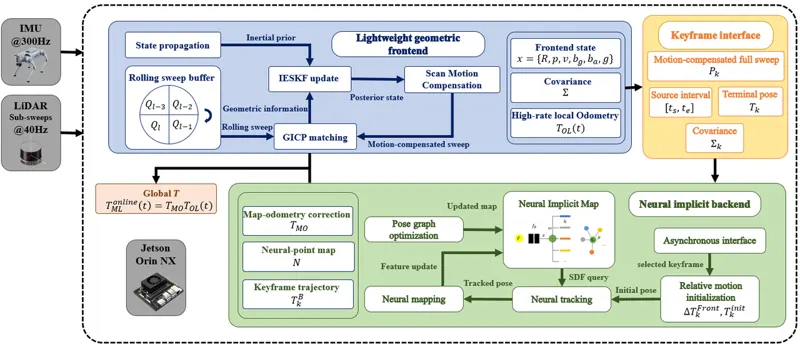
Geometric light detection and ranging (LiDAR)–inertial simultaneous localization and mapping (SLAM) provides efficient state estimation but lacks the continuous map representation and global refinement capabilities of neural implicit SLAM, while neural implicit methods remain computationally expensive. We propose Lightweight LiDAR–Inertial Neural SLAM (LIN-SLAM), a hybrid method that couples high-rate geometric LiDAR–inertial estimation with neural implicit tracking, continual mapping, and global refinement for accurate real-time onboard SLAM. Experiments on twelve representative sequences from three datasets spanning 32-, 64-, and 128-channel LiDAR configurations show that LIN-SLAM achieves the lowest overall mean absolute trajectory error (ATE) among the evaluated state-of-the-art geometric and neural implicit methods, while substantially reducing runtime compared with existing neural implicit SLAM methods. On a Unitree Go2 equipped with an NVIDIA Jetson Orin NX and a 16-channel LiDAR, LIN-SLAM sustains real-time localization and neural mapping over a 1.47-km indoor trajectory through challenging repetitive corridor environments, with an endpoint closure error of only 0.141 m. To the best of our knowledge, LIN-SLAM is the first LiDAR–inertial SLAM system with a neural implicit backend to achieve real-time online operation on a mobile robotic platform while maintaining state-of-the-art localization accuracy. The code will be released upon acceptance.

LiDAR-Inertial SLAMNeural Implicit Mapping
Shiqi Che, Yijie Liu, Shuo Wang · 127 views · Oct 15, 2026
CPNav: Calibrated Vision-Language Navigation for Object-Goal Search in Unseen Environments

CPNav: Calibrated Vision-Language Navigation for Object-Goal Search in Unseen Environments

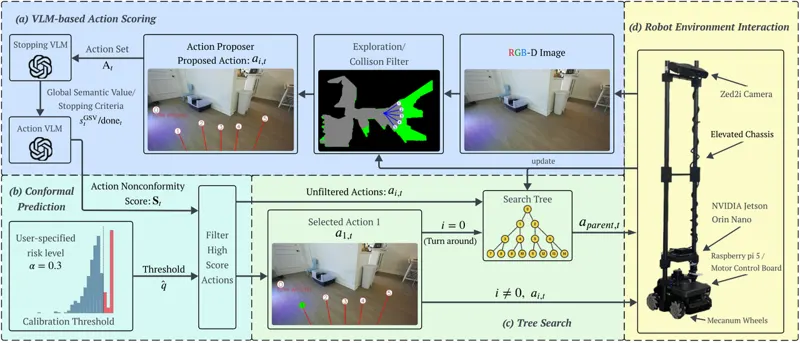
Directing a robot to locate a target object in unseen environments remains a central challenge in embodied AI. Vision-Language Model (VLM)-based methods provide rich semantic reasoning but often produce uncalibrated and overconfident action decisions. We introduce CPNav, a navigation framework that combines collision-aware planning with statistically calibrated VLM action scoring for map-free object-goal navigation. From RGB-D input, CPNav constructs a navigability map, generates collision-free motion primitives, and queries two VLMs for goal detection and action scoring. The resulting scores are calibrated offline via conformal prediction (CP) using oracle actions obtained through a tree-structured exploration procedure with backtracking, providing finite-sample guarantees at a user-specified risk level. The CP layer is model-agnostic and can wrap any VLM policy. Online, calibrated VLM scores guide action selection, while a tree-structured exploration history records alternative actions and allows backtracking. We evaluate CPNav in both simulation and real-world hardware settings. In AI Habitat simulation, compared with the uncalibrated baseline method, CPNav achieves relative SR and SPL improvements of 6.2% and 11.4% on HM3D v0.2, and 12.4% and 8.8% on MP3D, respectively. In real-world deployment on a modified Hiwonder MentorPi robot, the corresponding improvements in SR and SPL are 24.9% and 15.2%, respectively. Code is available at https://github.com/practice-lab-ucla/CPnav.
Vision-language navigationObject-Goal Navigation
Qizhao Chen, Yuanhong Zeng, Shoh Nishino · 124 views · Nov 7, 2026
HALO: A Unified Vision-Language-Action Model for Embodied Multimodal Chain-of-Thought Reasoning

HALO: A Unified Vision-Language-Action Model for Embodied Multimodal Chain-of-Thought Reasoning

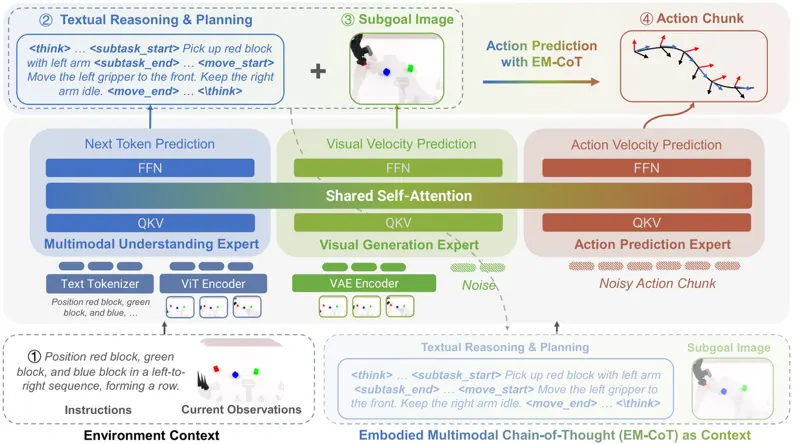
Vision-Language-Action (VLA) models have shown strong performance in robotic manipulation, but often struggle in long-horizon or out-of-distribution scenarios due to the lack of explicit mechanisms for multimodal reasoning and anticipating how the world will evolve under action. Recent works introduce textual chain-of-thought or visual subgoal prediction within VLA models to reason, but still fail to offer a unified human-like reasoning framework for joint textual reasoning, visual foresight, and action prediction. To this end, we propose HALO, a unified VLA model that enables embodied multimodal chain-of-thought (EM-CoT) reasoning through a sequential process of textual task reasoning, visual subgoal prediction for fine-grained guidance, and EM-CoT-augmented action prediction. We instantiate HALO with a Mixture-of-Transformers (MoT) architecture that decouples semantic reasoning, visual foresight, and action prediction into specialized experts while allowing seamless cross-expert collaboration. To enable HALO learning at scale, we introduce an automated pipeline to synthesize EM-CoT training data along with a carefully crafted training recipe. Extensive experiments demonstrate that: (1) HALO achieves superior performance in both simulated and real-world environments, surpassing baseline policy pi_0 by 34.1% on RoboTwin benchmark; (2) all proposed components of the training recipe and EM-CoT design help improve task success rate; and (3) HALO exhibits strong generalization capabilities under aggressive unseen environmental randomization with our proposed EM-CoT reasoning.

VLARobot Manipulation
Quanxin Shou, Fangqi Zhu, Shawn Chen · 182 views · Feb 24, 2026

As an Amazon Associate, we earn from qualifying purchases.