Skip to content
Juno: Taming Predictive Latents for Vision-Language-Action Models

Juno: Taming Predictive Latents for Vision-Language-Action Models

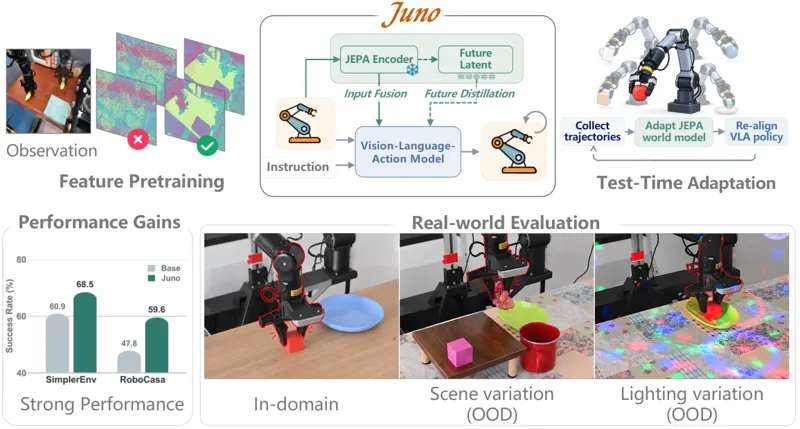
Joint-embedding predictive architectures (JEPAs) predict masked or future observations in representation space, offering a natural source of predictive latents for vision-language-action (VLA) models. Yet making these latents useful across pretraining, policy learning, and deployment requires addressing three failures: mismatch with embodiment-specific control, interference with action learning, and teacher miscalibration under distribution shifts. We introduce Juno, a unified framework built around one action-conditioned JEPA that serves as a control-aligned representation backbone, a predictive teacher, and an adaptable dynamics model. During pretraining, we train it on embodiment-matched trajectories and use a dynamic CLS loss to transfer motion-weighted patch dynamics to a compact global state. During policy learning, we fuse current-frame JEPA patches into VLA perception and use a decoupled reasoning branch with separate transformation parameters to distill future latent states for action generation. During deployment, we adapt the world model on all observed transitions, including failed rollouts, freeze the adapted teacher, and re-align the policy on verified executions using LoRA adapters and a trainable action head, without expert corrections or task rewards. On SimplerEnv, Juno raises average success from 60.9% to 68.5% over Qwen3GR00T, the strongest baseline, and test-time adaptation further reaches 72.7%; on a real robot, it retains 70%–75% success under background, height, and object shifts where the base policy collapses to 0%.

Vision-language-action (VLA)World Models
Yuchen Zhu, Chenyi Xu, Yulin Zhang · 347 views · Oct 7, 2026
Into the LidarVerse: A Real-Time Unified LiDAR World Model Across Tasks and Sensors

Into the LidarVerse: A Real-Time Unified LiDAR World Model Across Tasks and Sensors

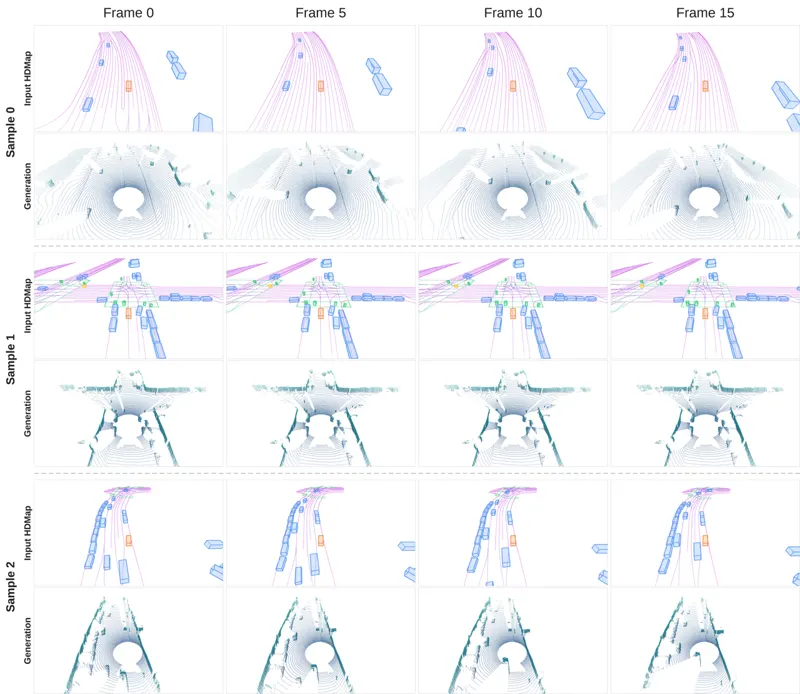
We present LidarVerse, a real-time unified LiDAR world model for sensor simulation across tasks and sensors. Existing LiDAR simulators largely follow one of two complementary paradigms: reconstruction-based methods preserve the geometry of a captured scene but require lengthy per-scene optimization, whereas generative methods amortize learning across data but lack the consistency needed for long-horizon rollouts. LidarVerse brings both paradigms into a single, unified conditional generative framework. A universal tokenizer maps LiDAR range sequences into a shared latent space, where a bidirectional teacher learns a common interface for conditioning on a LiDAR prefix, an HD-Map, a persistent spatial cache, and optionally, text. Varying the available scene evidence turns the same model into a generator of new worlds, a point-cloud forecaster, or a generalizable resimulator of observed scenes without per-scene optimization. We distill the teacher into a four-step autoregressive causal student and maintain both a rolling temporal K/V cache and a world-aligned spatial cache, enabling persistent long-horizon rollouts with real-time inference at 11 FPS on a single H100 GPU. LidarVerse achieves state-of-the-art performance on most reported metrics across all three evaluation protocols, while its tokenizer supports 32-, 64-, and 128-beam LiDAR and generalizes to an unseen scanning pattern. These results demonstrate that generative and reconstruction-grounded LiDAR simulation can be realized within one model, providing the core capabilities for future closed-loop sensor simulation.

LiDARWorld Models
Che, Henry, Ren, Xuanchi, Fidler, Sanja · 553 views · Oct 13, 2026
PaperBanana-Interact: Scientific Diagram Refinement with Multi-Turn Human Feedback

PaperBanana-Interact: Scientific Diagram Refinement with Multi-Turn Human Feedback

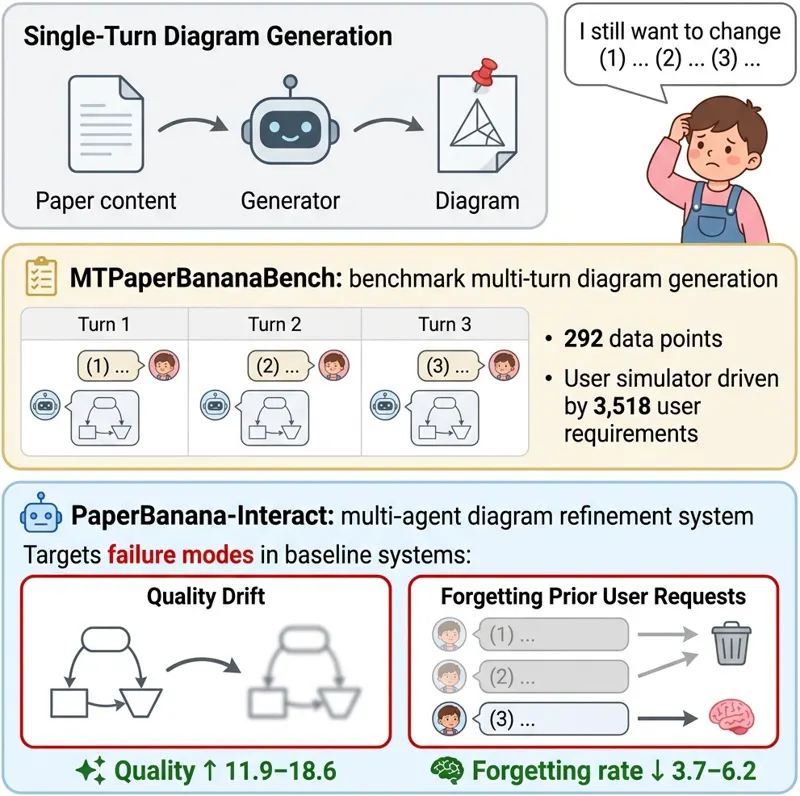
Recent efforts have aimed to automate scientific diagram generation from paper content (Lin et al., 2026; Zhu et al., 2026a). However, fully satisfying an author's visual and communicative preferences in a single turn is challenging: in our formative user study (N = 14), all participants requested further revisions after viewing an initial draft, and 86% of them rated the refined diagrams as more satisfactory. Despite the clear demand, the multi-turn workflow remains largely underexplored. To bridge this gap, we present MTPaperBananaBench, a benchmark for multi-turn diagram generation containing 292 images annotated with 3,518 user requirements. To reduce expensive human studies and enable scalable benchmarking, we construct a user simulator that, at each turn, identifies unsatisfied requirements and converts k of them into natural language feedback. Evaluating both requirement satisfaction and overall diagram quality reveals two key failure modes shared across baseline multiturn systems: (1) quality drift, where diagram quality progressively declines over turns, and (2) forgetting, where previously implemented features are lost in subsequent turns. To address these issues, we introduce PaperBanana-Interact, a multi-agent system that refines diagrams via an internal critique-and-refine loop. PaperBanana-Interact consistently improves rather than degrades diagram quality across turns, outperforming baselines by 11.9-18.6 points in quality score and reducing forgetting by 3.7-6.2 points.

Multi-agentDiagram Generation
Xueqing Wu, Ashwin Balasubramanian, Bingxuan Li · 337 views · Aug 31, 2026
Generative Agents: Interactive Simulacra of Human Behavior

Generative Agents: Interactive Simulacra of Human Behavior

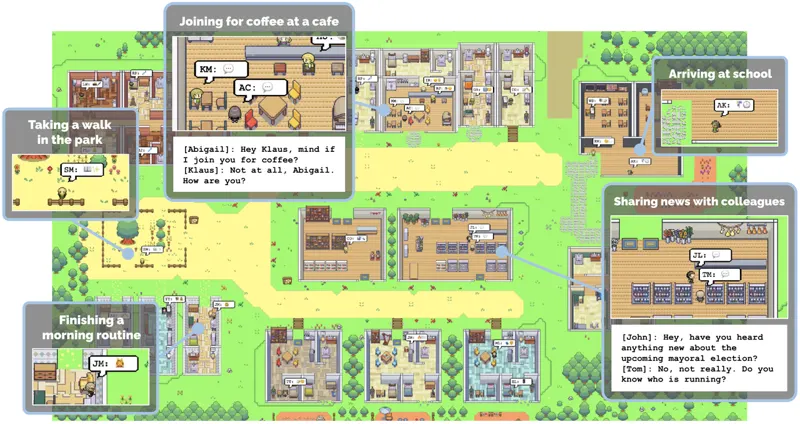
Believable proxies of human behavior can empower interactive applications ranging from immersive environments to rehearsal spaces for interpersonal communication to prototyping tools. In this paper, we introduce generative agents–computational software agents that simulate believable human behavior. Generative agents wake up, cook breakfast, and head to work; artists paint, while authors write; they form opinions, notice each other, and initiate conversations; they remember and reflect on days past as they plan the next day. To enable generative agents, we describe an architecture that extends a large language model to store a complete record of the agent's experiences using natural language, synthesize those memories over time into higher-level reflections, and retrieve them dynamically to plan behavior. We instantiate generative agents to populate an interactive sandbox environment inspired by The Sims, where end users can interact with a small town of twenty five agents using natural language. In an evaluation, these generative agents produce believable individual and emergent social behaviors: for example, starting with only a single user-specified notion that one agent wants to throw a Valentine's Day party, the agents autonomously spread invitations to the party over the next two days, make new acquaintances, ask each other out on dates to the party, and coordinate to show up for the party together at the right time. We demonstrate through ablation that the components of our agent architecture–observation, planning, and reflection–each contribute critically to the believability of agent behavior. By fusing large language models with computational, interactive agents, this work introduces architectural and interaction patterns for enabling believable simulations of human behavior.

LLM AgentAgent Architecture
Joon Sung Park, Joseph C. O'Brien, Carrie J. Cai · 578 views · Apr 7, 2023
Blind Precise Assembly: Proprioceptive Sim-to-Real Peg-in-Hole for Diverse Parts

Blind Precise Assembly: Proprioceptive Sim-to-Real Peg-in-Hole for Diverse Parts

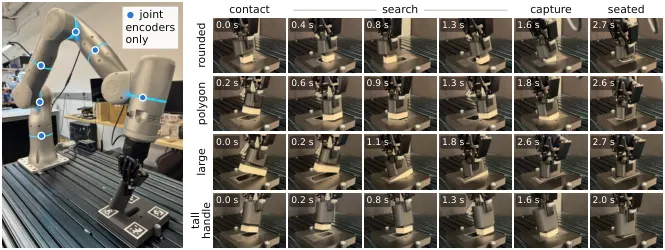
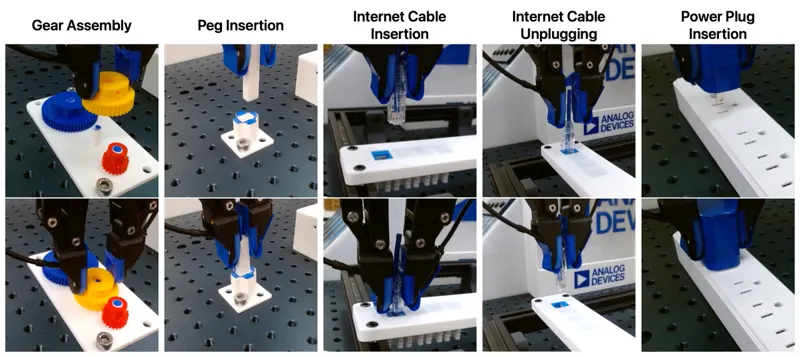
Every robot already carries high-resolution contact sensors: its own joints. Legged robots and humanoids exploit them to walk, run, and track whole-body motions without vision, but there the contacts are large and forceful. Is joint sensing also enough for precise, contact-rich assembly, where the robot must find a millimeter-scale opening, mesh gear teeth, or catch a thread through light contact? We study this question by training blind assembly policies that observe only a short history of joint positions, velocities, and their own actions, without visual, force, torque, or tactile sensing. The poses of both the fixture and the part are unknown to the policy, and the grasp is randomized substantially. The policy must therefore assemble the parts through contact, sensed exclusively through its own proprioception. Trained with reinforcement learning entirely in simulation over randomized parts, grasps, and contacts, such policies learn peg insertion, gear meshing, and nut threading. The peg insertion policy transfers zero-shot to the real world and inserts pegs of different shapes and sizes in 73% of trials. Controlled comparisons with matched visual policies in simulation show that blind policies generalize far better to unseen part shapes and sizes, though they can be slower. Training such policies needs thousands of different assemblies, each simulated with its clearance intact, so we also release an open-source generator that builds them procedurally from exact convex pieces for MuJoCo; it is more accurate and faster than convex decomposition or MuJoCo's signed-distance collision. Videos and interactive simulations are at https://younghyopark.me/blind-proprioceptive-assembly/.
Peg-in-HoleSim-to-Real
Antonia Bronars, Younghyo Park, Kushal Kedia · 542 views · Oct 16, 2026
LoopWAM: Closed-Loop Generalist Policy Improvement from Deployment Rollouts

LoopWAM: Closed-Loop Generalist Policy Improvement from Deployment Rollouts

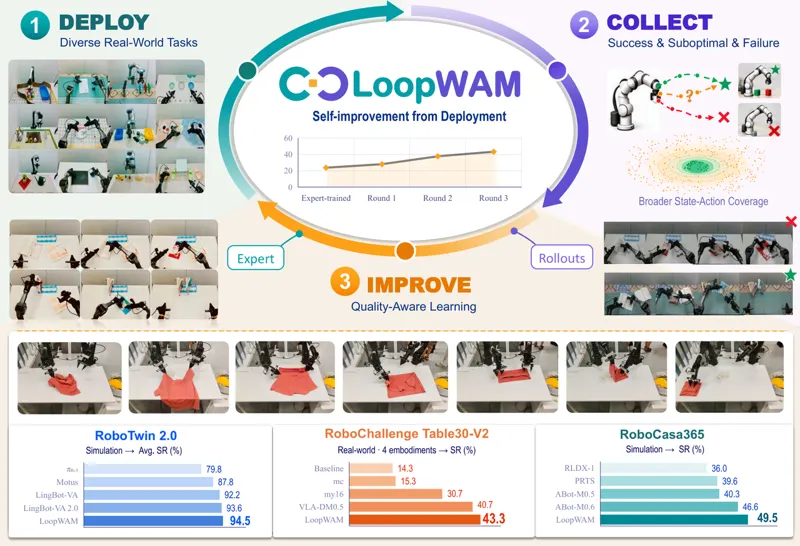
Scaling expert demonstrations alone does not enable generalist robot policies to improve from deployment. Real-world rollouts contain successes, suboptimal behavior, and failures: imitating every recorded action can reinforce poor behavior, while filtering out failures discards evidence of physical interactions and their consequences. We introduce LoopWAM, a closed-loop world-action model that learns directly from this full quality spectrum, using rollouts from both itself and other deployed policies. Source-dependent noise sampling unifies behavior learning and action-conditioned world modeling, while quality steering and quality-weighted supervision retain full video supervision across qualities and regulate action imitation. Video and action tokens interact throughout parallel denoising, allowing learned consequences to inform action generation directly. On RoboChallenge Table30-V2, three deployment-and-training rounds raise success from 23.67% to 43.33%, a 19.7-percentage-point gain, with a final score of 56.80. LoopWAM also achieves 94.5% average success on RoboTwin 2.0 and 49.5% overall success on RoboCasa365 without additional embodied pretraining, obtaining the best overall results among the compared methods across all three benchmarks. On challenging shirt folding task, two rounds of deployment-driven improvement after single-task post-training raise success from 13.20% to 55.56%. These results demonstrate closed-loop improvement from mixed-quality experience under both multi-task learning and single-task post-training. Project page: https://loop-wam.github.io/

World-action modelsSelf-Improvement
Wenxuan Guo, Yingping Liang, Zhaoguo Wang · 556 views · Oct 13, 2026
Agile-WAM: An Agile Tactile World Action Model for Contact-Rich Robot Control

Agile-WAM: An Agile Tactile World Action Model for Contact-Rich Robot Control

World Action Models (WAMs) advance beyond conventional visuomotor policies by jointly predicting future world states and robot actions, enabling the policy to learn phys- ical dynamics that support effective control. However, recent tactile WAMs often rely on large-scale pretrained generative backbones to capture contact-rich physical dynamics, which limit their inference efficiency and flexible deployment. In this paper, we present Agile-WAM, an agile tactile World Action Model for contact-rich robot control. Agile-WAM encodes visual and tactile observations into a shared latent that serves as the source of a direct vision-tactile-to-action flow-matching process, which can jointly generate latent representations of action chunks and future visual/tactile latents. A key observation is that vision and tactile signals evolve at inherently different timescales: adjacent visual frames are often highly similar, whereas tactile signals can change abruptly upon contact. We therefore introduce multi-horizon multimodal prediction in Agile-WAM, which provides supervision for visual latent at a larger temporal offset while predicting the tactile latent in the next frame to capture fine-grained contact dynamics. Across nine simulated and five real-world contact-rich ma- nipulation tasks, Agile-WAM demonstrates strong and robust performance, outperforming the strongest baseline in success rate while maintaining low inference latency. In particular, in five real-world experiments, Agile-WAM yields a relative gain of 29.4% in overall success rates while achieving inference latency of 11.9 ms. These results demonstrate that multimodal WAM can be achieved with an agile architecture suitable for precise and high-frequency robot control. More details are available on our project page.

World-action modelsFlow Matching
Hanchu Zhou, Brendan Lynch, Raman Goyal · 383 views · Sep 17, 2026
Terminal-RSI: Recursive Self-Improving Terminal Agents via Recursive Self-Rewrite and Policy-Refine

Terminal-RSI: Recursive Self-Improving Terminal Agents via Recursive Self-Rewrite and Policy-Refine

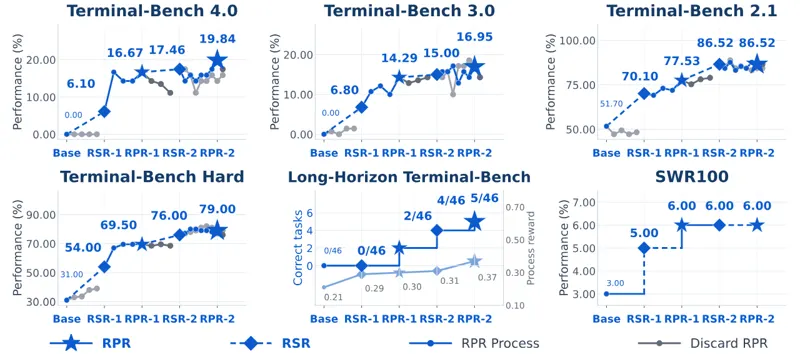
Converting verifier outcomes into useful policy updates and partial progress into complete task resolution is crucial for terminal agents. We present Terminal-RSI, which alternates Recursive Self-Rewrite (RSR) of verified trajectories with critic-inheriting Recursive Policy-Refine (RPR). We formulate Turn-Boundary Skip-Observation GAE (TB-GAE) to retain token-specific baselines while applying decay across interaction turns. Family Dense Reward (FDR) calibrates semantic progress across task families; Success-Prioritized Reward (SPR) separates strict success from bounded partial credit. A Warm-up Critic Model, recursive critic handoff, and stage-specific learning rates coordinate the two refinement phases. The five-stage sequence from Qwen3.8-27B base model through RSR-1, RPR-1, RSR-2, and RPR-2 yields Terminal-RSI-27B: 19.84% on Terminal-Bench 4.0, 86.52% on Terminal-Bench 2.1, 16.95% on Terminal-Bench 3.0, and 79.00% on Terminal-Bench Hard. On LHTB, process reward rises from 0.21 to 0.37 and strict completion from 0/46 to 5/46; SWR100 success doubles from 3.00% to 6.00%. By recursively coupling verified trajectory rewriting with critic-inheriting policy refinement, each retained stage consolidates discovered behaviors and progressively advances the agent from partial local repairs to strict terminal verification.

Terminal AgentReinforcement Learning
Junyao Yang, Zongxia Li, Yucheng Shi · 629 views · Oct 15, 2026
P-BFM: Perceptive Behavioral Foundation Models for Humanoid Control via Unsupervised Reinforcement Learning

P-BFM: Perceptive Behavioral Foundation Models for Humanoid Control via Unsupervised Reinforcement Learning

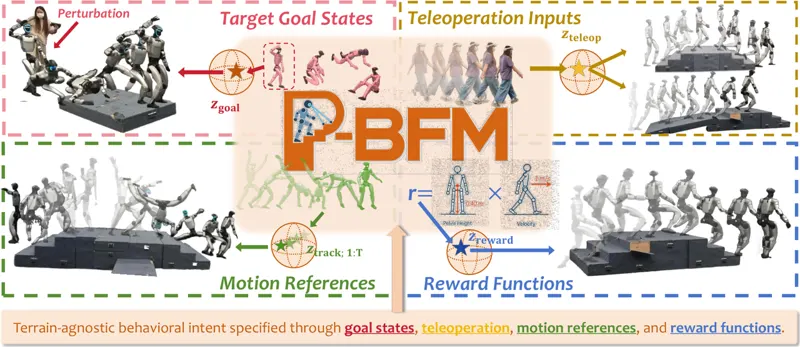
Behavioral foundation models (BFMs) provide humanoids with reusable repertoires of whole-body behaviors; in real-world humanoid control, the same behavioral intent may require fundamentally different motions under different terrain constraints. Covering such variation with terrain-matched demonstrations requires enumerating a combinatorial space of behaviors and terrain geometries. We introduce P-BFM, a perceptive behavioral foundation model that factorizes humanoid control into terrain-invariant intent and terrain-conditioned realization. A forward-backward representation maps motion references, target states, and reward functions into a shared intent space without terrain information, while a perceptive policy learns how to realize each intent under the surrounding terrain geometry. We further identify a complementary limitation of purely latent control: behavioral latents can preserve local motion patterns while losing precise global progress. We therefore introduce Explicit Root Instructions (ERI), which separates global transport (e.g., heading and planar velocity) from behavioral intent, while leaving local whole-body adaptation to the perceptive policy. This decomposition leads to a characteristic capability absent from conventional BFMs: one fixed intent induces different, terrain-appropriate behaviors, including changes in step height, stride, posture, foothold placement, and contacts, without terrain-specific demonstrations. Across challenging terrains, P-BFM improves motion fidelity, root-control precision, and perturbation recovery over strong baselines. A single frozen policy further supports motion tracking, goal reaching, reward inference, teleoperation, and terrain-aware recovery, and transfers zero-shot to a Unitree G1 using onboard depth sensing.

HumanoidUnsupervised Reinforcement Learning
Xue Wang, Yitang Li, Yiming Zhang · 735 views · Oct 11, 2026
Interactive Navigation Beyond Reachability: Benchmark and Agentic Framework

Interactive Navigation Beyond Reachability: Benchmark and Agentic Framework

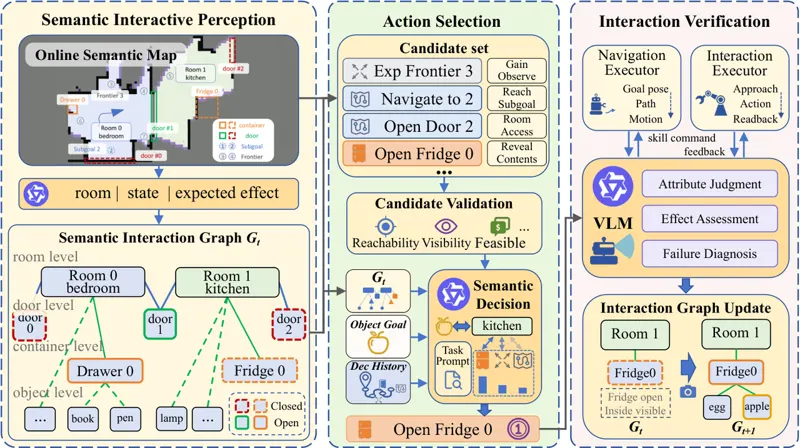
Existing embodied navigation tasks commonly assume that traversability and object states remain fixed during an episode. Yet reaching a goal may require opening a door to access a room and then opening a container to reveal a hidden target. We formulate interactive navigation beyond reachability, unifying channel-induced changes in spatial connectivity, container-induced changes in target visibility, and their sequential dependencies. We introduce MultINav-Bench, a 3K-episode ObjectGoal benchmark in MolmoSpaces spanning channel, container, and mixed tasks, with interaction-necessity annotations covering required and unnecessary episodes. Its data generation pipeline automates task construction across multiple task types. The evaluation protocol separately measures navigation success, interaction effectiveness, and cost. We further propose MultINav-Agent, a three-stage agentic framework built on a persistent, state-conditioned interaction graph. Semantic interactive perception grounds entities and interaction states; a vision-language model selects task-relevant actions based on expected changes in connectivity and target observability; and post-interaction verification updates the graph to guide subsequent navigation, exploration, or interaction. Experiments on MultINav-Bench show that MultINav-Agent consistently outperforms adapted baselines across channel, container, and mixed tasks.

Embodied NavigationInteractive Navigation
Delun Li, Xueyao Wei, Rui Chen · 410 views · Oct 12, 2026
EWAM: Emergent Depth-Wise Specialization in a Unified Embodied Model – From Semantic Understanding through Visual Foresight to Action

EWAM: Emergent Depth-Wise Specialization in a Unified Embodied Model – From Semantic Understanding through Visual Foresight to Action

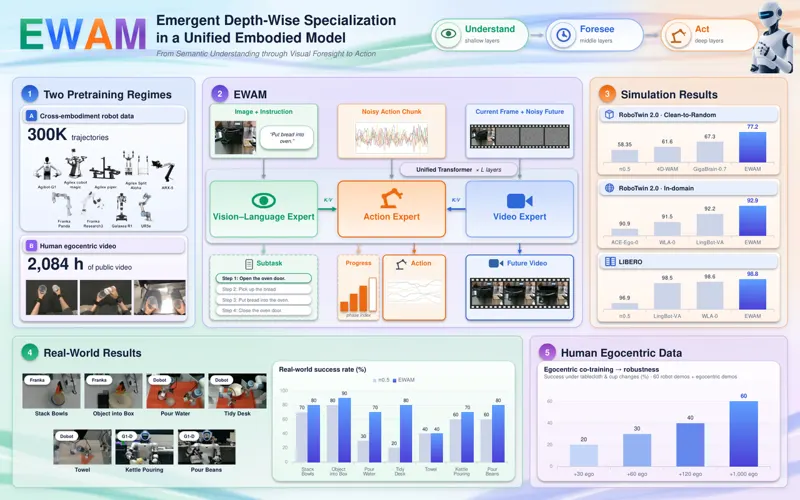
Vision-language-action (VLA) policies emphasize semantic understanding, whereas world-action models (WAMs) learn predictive representations of environment dynamics. Systems that expose a policy to both sources often still concentrate action computation on a single expert. We present EWAM, an action-centric unified embodied model whose asymmetric joint attention lets action tokens read semantic, current-visual, predicted-future, and action information at every layer while the perceptual experts retain their distinct roles. Without layer-wise supervision, EWAM develops an emergent depth-wise specialization: action queries attend mainly to vision-language features in shallow layers, to predicted future frames in intermediate layers, and to action tokens themselves in deep layers. This handoff replicates across tasks and is stable across denoising steps. Checkpoint tracking and causal interventions show that it is learned and that action generation depends on it. EWAM is pretrained in two separate regimes, one on cross-embodiment robot trajectories and one on human egocentric video. In simulation and real-robot experiments, it surpasses existing VLA, WAM, and hybrid baselines. Human egocentric data improve both cross-embodiment transfer and real-robot robustness, and subtask-phase supervision improves long-horizon completion. Together, these results suggest that unified embodied learning can induce an ordered internal progression from semantic understanding, through visual foresight, to action formation.

VLAWorld-action models
Hao Wang, Jiajun Wen, Jingzhi Liu · 333 views · Sep 30, 2026

As an Amazon Associate, we earn from qualifying purchases.