Skip to content
RoboColosseum: Evaluating Physical Intelligence at Scale In-The-Wild

RoboColosseum: Evaluating Physical Intelligence at Scale In-The-Wild

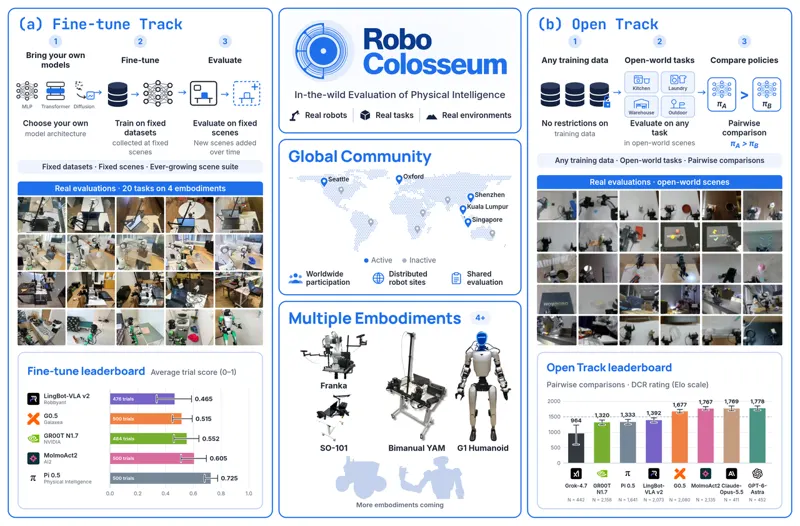
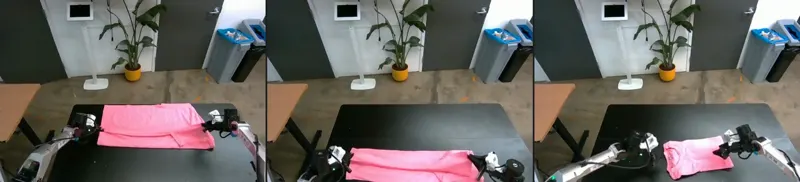
General-purpose robot policies must work across robots, tasks, and environments, yet the variation that makes physical trials informative also makes them difficult to reproduce. We introduce RoboColosseum, a distributed evaluation framework that combines unified policy serving and standardized protocols across a network of locally operated robots in diverse environments. Our initial study evaluates five vision-language-action (VLA) policies and three frontier AI agents across four embodiments (SO-101, Franka, Bimanual-YAM, and G1 Humanoid). The Open Track compares models without task-specific adaptation in blinded, pairwise trials under matched local conditions. The Fine-tune Track measures how well VLA policies adapt to 20 tasks across all four embodiments when each policy receives the same 100 demonstrations per task. Across 5,699 pairwise Open Track comparisons at 124 sites, frontier agents rival specialized VLA policies, while all systems struggle to complete open-world tasks reliably. After fine-tuning, GR00T N1.7 leads on SO-101 and pi0.5 leads on Franka and Bimanual-YAM. Policy rankings show weak agreement across embodiment-specific task suites (Kendall W = 0.24). Open Track rankings poorly predict relative performance after fine-tuning, with substantial rank reversals on all three embodiments shared between tracks. Measuring partial progress reveals differences that task success alone misses. On the G1 Humanoid, no policy completes any of the five tasks, yet average progress ranges from 13.3% to 23.2% across policies. Open Track rankings stabilize as trials accumulate, and active matchmaking achieves comparable ranking agreement with substantially fewer physical trials than uniform sampling. These results show how distributed physical evaluation can reveal where robot policies generalize, how well they adapt to new tasks, and how far they progress on tasks they fail to complete.
Physical AIVLA
Tan Sang Nguyen, Yi Ru Wang, Shailesh Shailesh · 422 views · Nov 2, 2026
D&A: Decoupling Description and Assessment Enables VLMs as Zero-Shot Robotic Reward Models

D&A: Decoupling Description and Assessment Enables VLMs as Zero-Shot Robotic Reward Models

Vision-Language Models (VLMs) hold promise for zero-shot video task-progress estimation in robot learning, yet existing frameworks frequently suffer from confirmation bias, hallucinating progress in failed executions due to implicit success assumptions or relative temporal ranking designs. Naive prompting of frontier models collapses into a binary success detector that fails to capture nuanced, non-linear progress and failures. While post-training approaches can mitigate this through explicit training, they demand expensive real-world robotics data and require computationally intensive post-training for every individual base model. To resolve these limitations, we introduce D&A (Describe & Assess): our approach decouples progress estimation into an objective, task-grounded textual description of scene dynamics followed by an assessment phase using explicit rubrics. By compelling the VLM to synthesize an explicit, text-based definition of absolute success before scoring, the framework anchors evaluations to an external, global criterion rather than the video's internal timeline. Empirical results demonstrate that our method calibrates zero-shot estimates and mitigates confirmation bias, providing fine-grained, partial progress metrics that accurately penalize failed executions while correctly interpolating successful runs. Being purely prompt-based, D&A generalizes across tasks, embodiments, and benchmarks—matching or surpassing post-trained reward models—and its reward estimates enable efficient downstream reinforcement learning.

VLMRobot Reward Modeling
Marius Memmel, Shawn Yin, Urvi Rutia · 341 views · Nov 2, 2026
T2-z: Test-Time Optimization of Environment Latents for Robotic World Models

T2-z: Test-Time Optimization of Environment Latents for Robotic World Models

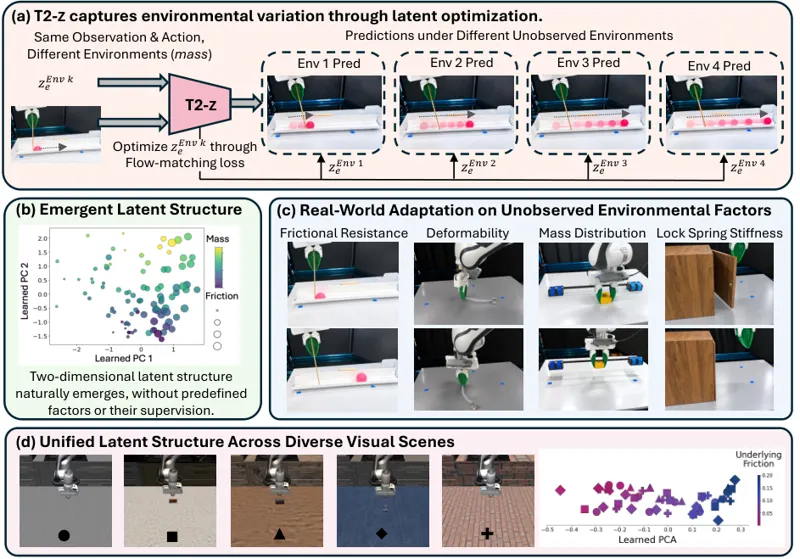
Predicting how the world responds to an action requires more than what can be seen: robots must account for environmental factors that are neither directly observable nor explicitly specified, from physical properties such as friction and mass to human-defined environmental rules. We introduce T2-Z for test-time optimization of environment latents, which augments a robotic world model with a learnable environment latent to condition world predictions. This compact latent captures underlying environmental variation without supervision of what environmental factors exist or what values they take. During training, T2-Z alternates between two stages: a world-model optimization stage that fixes the latents and learns general action-conditioned dynamics across environments; and an environment-latent optimization stage that freezes the world model and optimizes the conditioning latents, allowing latent structure to emerge purely through world prediction. At test time, the world model remains frozen and a newly initialized environment latent is optimized from one or more test-time interactions, adapting the model to previously unseen environmental configurations. Across 7 simulated settings and 4 real-world robotic tasks, T2-Z reduces object prediction error metric from 15.20 to 7.00 and raises action success from 33.73% to 72.96%. Its emergent latents capture structured representations of individual and compounded factors across diverse visual scenes. Ablations further show that T2-Z can efficiently infer environment latents from as little as a single test-time interaction trajectory.

Robotic World ModelsTest-Time Optimization
Chenyuan Zhou, Yining Hong, Huang Huang · 287 views · Oct 15, 2026
NavJev: Efficient Vision-Language Navigation via Action-Centric Visual Compression and Discriminative Action-Semantic Memory

NavJev: Efficient Vision-Language Navigation via Action-Centric Visual Compression and Discriminative Action-Semantic Memory

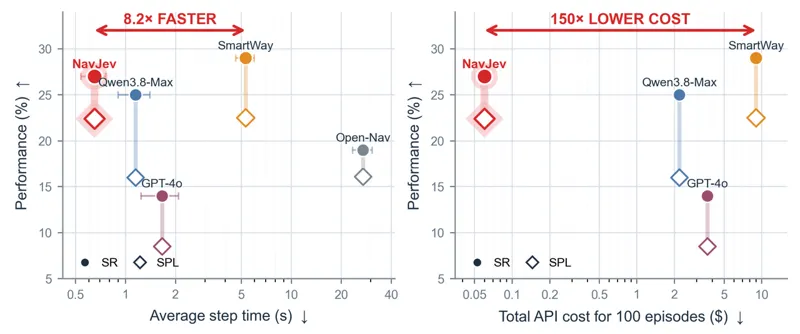
Recent zero-shot Vision-and-Language Navigation (VLN) methods increasingly rely on multimodal large language models (MLLMs) to reason over visual observations, navigation instructions, and candidate actions. Although effective, repeatedly invoking autoregressive multimodal reasoning at every navigation step introduces substantial inference latency, limiting the responsiveness of embodied agents. We propose NavJev, an efficient VLN framework that reformulates online navigation from repeated multimodal generation into compact visual compression followed by lightweight typed action selection. Specifically, Action-Centric Visual Compression (ACVC) integrates waypoint geometry, BLIP captions, and RAM semantic tags into compact representations of candidate actions, while Discriminative Action-Semantic Memory (DASM) filters shared semantics and maintains discriminative action-specific evidence across navigation steps. Based on these representations, Jev directly performs structured probabilistic decisions over the available action set. Experiments on R2R-CE show that NavJev achieves 27.0% SR and 22.4% SPL with only 0.65 s per navigation step, while substantially reducing inference latency and cost compared with MLLM-based VLN methods. The project page is available at https://kai-sheng-caesar.github.io/NavJev/.

Vision-language navigationZero-Shot
Kai Sheng, Liuyi Wang, Jinlong Li · 393 views · Sep 28, 2026
OpenBelief-Nav: Evidence-Preserving Object Memory for Open-Vocabulary Language-Guided Navigation

OpenBelief-Nav: Evidence-Preserving Object Memory for Open-Vocabulary Language-Guided Navigation

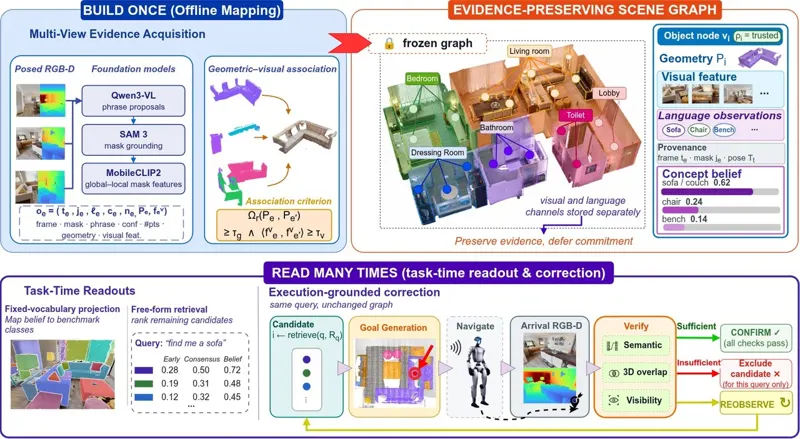
Open-vocabulary 3D scene graphs provide compact semantic memory for language-guided navigation, but mapped objects are often exposed through a single fused feature or committed semantic label. Such commitment can remove minority yet task-relevant hypotheses from the task-time interface. We present OpenBelief-Nav, an evidence-preserving object memory that retains observation-level phrases, reliability cues, and frame-mask provenance while maintaining separate aggregate geometric and visual representations. Semantically related phrases are consolidated into a vocabulary-independent object belief from which task-specific readouts perform fixed-vocabulary projection or free-form retrieval. On five ScanNet200 and eight Replica scenes, full-belief projection achieves mIoU scores of 0.2742 and 0.2912, compared with 0.2393 and 0.2701 for a matched early-commit readout. Across 78 HM3D-YCB navigation trials, consensus and early-commit retrieval each achieve 60/78 successes, compared with 58/78 for belief-weighted retrieval and 55/78 for DualMap. Across 20 Unitree G1 runs organized as 10 matched evaluation cases, a correction policy permitting at most two verified candidate attempts improves target-confirmation success from 6/10 to 8/10 relative to top-1-only execution. Code will be released upon acceptance at https://openbelief-nav.github.io/.

Open-Vocabulary Navigation3D scene graphs
Dinh Tuan Nguyen, Anh Dao, Phuong Nam Dang · 288 views · Aug 14, 2026

As an Amazon Associate, we earn from qualifying purchases.