Skip to content
Post-Training Large Language Models via Reinforcement Learning from Self-Feedback

Post-Training Large Language Models via Reinforcement Learning from Self-Feedback

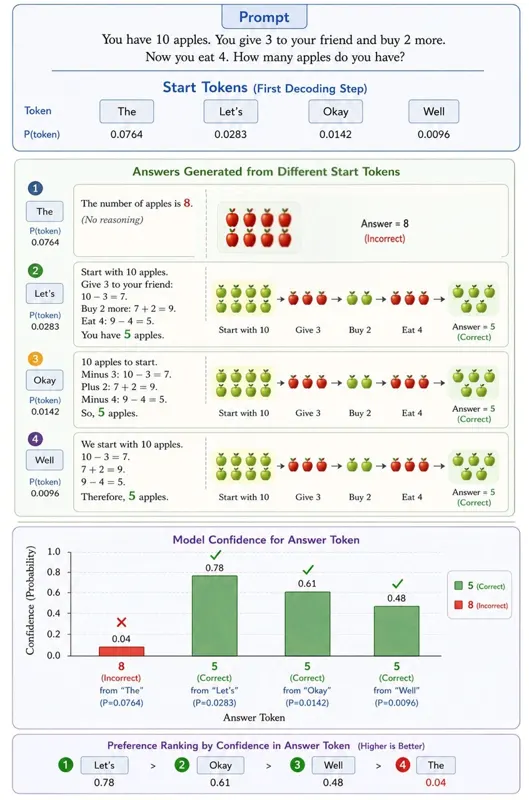
Large Language Models (LLMs) often produce plausible but poorly-calibrated answers, limiting their reliability on reasoning-intensive tasks. Recent research suggests that Chain-of-Thought (CoT) reasoning paths are inherent in pre-trained LLMs and can be elicited by simply altering the decoding process, where the presence of a CoT path correlates with higher answer confidence. Building on these insights, we present Reinforcement Learning from Self-Feedback (RLSF), a post-training stage that utilises the model's intrinsic confidence as a self-generated reward. By generating multiple CoT decoding beams from a frozen LLM, we compute the confidence of each final answer span and rank the resulting traces accordingly to create synthetic preferences. These preferences are subsequently utilised to fine-tune the policy through standard preference optimisation, requiring no human labels, gold answers, or externally curated rewards. RLSF simultaneously (i) refines the model's probability estimates–restoring well-behaved calibration–and (ii) strengthens step-by-step reasoning, yielding improved performance on arithmetic reasoning and multiple-choice question answering. By converting a model's own uncertainty into structured self-feedback, RLSF affirms reinforcement learning on intrinsic model behaviour as a principled and data-efficient component of the LLM post-training pipeline. Our results demonstrate that leveraging these inherent reasoning capabilities provides a robust path for enhancing model reliability without manual prompt engineering or external supervision.

Large Language ModelsReinforcement Learning
Carel van Niekerk, Renato Vukovic, Benjamin Ruppik · 549 views · Jul 29, 2025
Learning Multi-Phase Robot Loco-Manipulation via Phase-Conditioned Policy Optimization

Learning Multi-Phase Robot Loco-Manipulation via Phase-Conditioned Policy Optimization

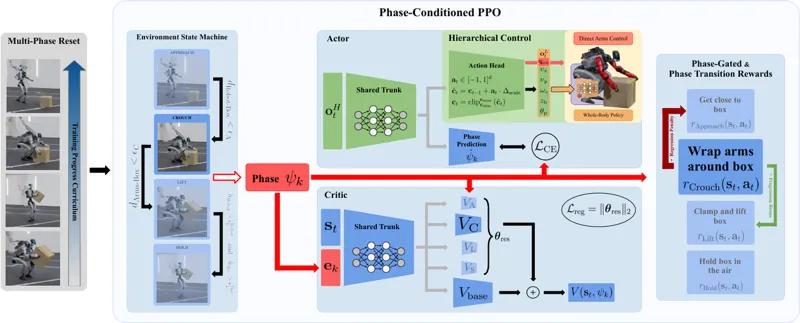
Complex whole-body loco-manipulation requires executing diverse maneuvers, such as crouching, grasping, and locomotion, within a single long-horizon task. While performing simple pick-and-place behaviors is well-established, scaling to complex, long-horizon tasks remains difficult. Currently, this challenge is addressed by relying on human motion data and correspondingly humanoid platforms, which limits platform independence and introduces substantial data processing overhead. Instead, we extend proximal policy optimization (PPO) to train a single policy for multi-phase tasks across diverse robotic hardware, leveraging prior task structure to shape behavior. Our method adapts PPO using a phase-conditioned critic, phase-gated reward functions, and a multi-phase reset curriculum to guide exploration. To support varied hardware, we employ a decoupled hierarchical control architecture that separates lower-level balancing dynamics from high-level phase execution. We demonstrate multi-stage loco-manipulation skills on hardware on both the Unitree G1 and a Boston Dynamics Spot equipped with a manipulator arm, and validate our design choices through ablations. Our approach enables the acquisition of complex loco-manipulation behaviors purely through environment interaction while directly incorporating high-level task structure into policy learning.
Whole-Body Loco-ManipulationPhase-Conditioned PPO
Simone Manni, Annika Wollschläger, Dario Bellicoso · 443 views · Oct 26, 2026
Compliant GMT: Making General Motion Tracking Compliant via Residual Reference Adaptation

Compliant GMT: Making General Motion Tracking Compliant via Residual Reference Adaptation

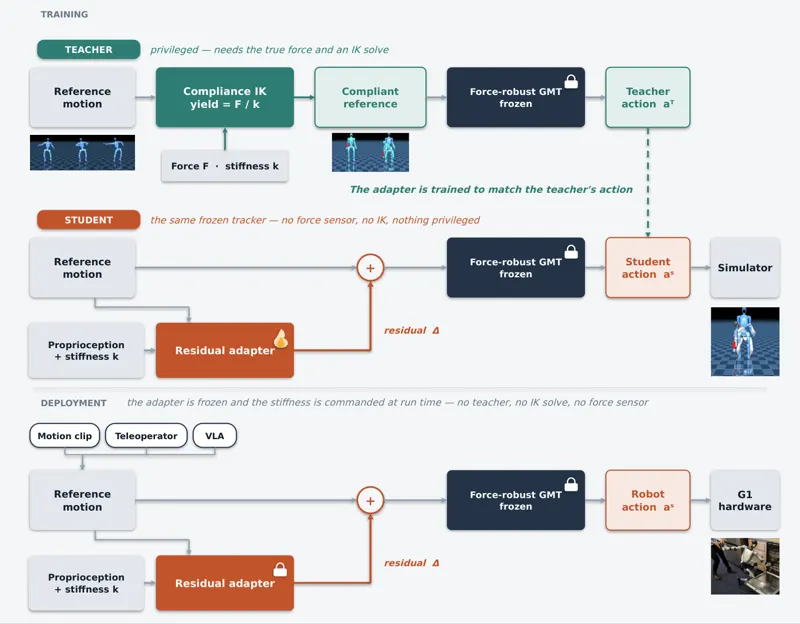
We propose Compliant GMT (C-GMT), a modular framework for full-body compliant responses in general motion tracking. As humanoid robots move into real world deployment, they not only need to perform any motion but also respond safely and robustly to interaction forces. Existing general motion tracking policies can imitate diverse motions but are trained to be stiff, leading to unexpected and unsafe behaviors under disturbance. Prior work in compliant humanoid control trades off compliance and generality. There exist examples of full-body compliant responses, but these are heavily curated to single-reference policies. On the other hand, general motion trackers (GMT) are trained to rigidly imitate massive motion capture datasets. Our key insight is to leverage the generality of pretrained GMTs for motion tracking while introducing compliance from a residual adapter that conditions on a history of proprioception. This enables our approach, C-GMT, to achieve both general motion tracking and whole-body compliant responses. Compared to state-of-the-art general motion trackers and single-motion compliant policies, C-GMT demonstrates competitive performance in both motion tracking accuracy and compliance adherence. We further demonstrate improved safety, robustness, and error tolerance in simulation and real-world G1 experiments.

HumanoidMotion Tracking
Venki Parsuram, Michelle Wang, Jin-Hyuk Hong · 395 views · Oct 15, 2026
Humanoid Mobility via Attention-based Contacts

Humanoid Mobility via Attention-based Contacts

Humanoid mobility over complex terrain requires accurate foot placement and coordinated whole-body motion capable of robust adaptation. Reinforcement learning (RL) policies trained without motion references generalize well across terrains, yet eliciting effective whole-body coordination through reward design and exploration alone remains challenging. In contrast, reference-based methods yield natural motions but struggle to adapt beyond the predefined trajectories in their training data. We introduce a learning framework that bridges these two approaches by using motion data strictly as a training prior. An explicit, self-supervised, attention-based contact planner predicts future body-environment contacts, while a contact-conditioned tracker translates these plans into coordinated whole-body motion. Together, they establish contact as an interface between sensory observations and control actions. This abstraction allows the policy to internalize the contact-aware structure of locomotion rather than directly replicating kinematics. Consequently, a single policy can exploit data-driven motion priors for natural whole-body coordination while retaining the flexibility to discover environment-dependent behaviors through reinforcement learning. Building on the learned contact planner and tracker, a subsequent fine-tuning stage bootstraps their acquired capabilities to explore environment variations beyond those covered by the original motion data. Operating entirely from onboard observations without any reference inputs at deployment, this framework enables versatile humanoid mobility in challenging environments.

HumanoidLocomotion
Junzhe He, Kehan Wen, Chong Zhang · 754 views · Oct 22, 2026
DONIC: Generalist Dexterous Bimanual Tracking Control from Human Demonstrations

DONIC: Generalist Dexterous Bimanual Tracking Control from Human Demonstrations

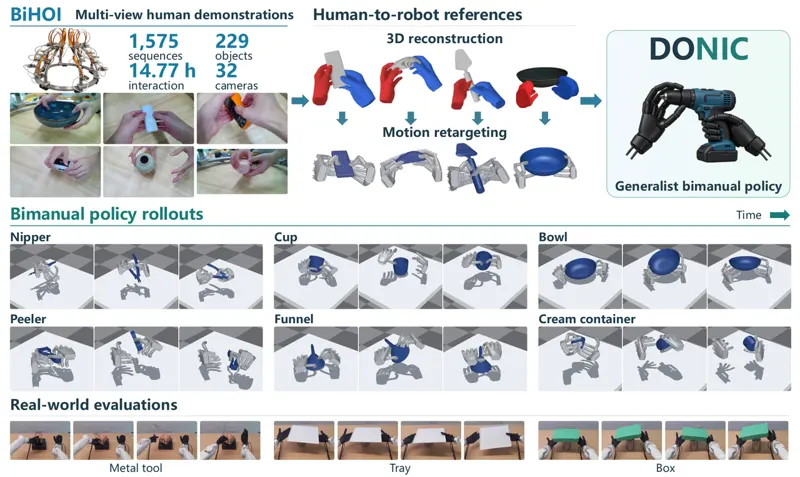
Despite recent progress in dexterous reference tracking, existing models focus primarily on single-hand manipulation and a limited range of interactions, leaving the bimanual dexterous behaviors common in real life unaddressed. The scarcity of contact-rich bimanual manipulation data and the increased complexity of coordinating contacts make developing a generalist bimanual tracker particularly challenging. Therefore, we present 1) DONIC, the first generalist bimanual tracker jointly trained across operation categories and human-motion sources, together with 2) BiHOI, a multi-view dataset of 1,575 sequences spanning 229 objects and emphasizing sustained bimanual interaction, where reconstructed interactions are retargeted into robot references. DONIC combines proximal policy optimization with behavioral cloning in a feedback loop that recycles verified successful executions into training demonstrations. An object-centered per-hand reward maintains object-motion feedback while supervising each hand according to its reference contact role. Clip-Centered Advantages remove reference-dependent advantage offsets while preserving within-trajectory differences. Together, these designs enable one single policy to learn coordinated manipulation across heterogeneous references. Without finetuning, a single checkpoint achieves 86.79% success on unseen trajectories of training objects and 57.32% on held-out objects, surpassing the state-of-the-art bimanual tracking baselines by 77.36 and 45.73 percentage points.

Dexterous ManipulationBimanual Manipulation
Mingze Sun, Ziang Cao, Yuan Fei · 377 views · Oct 21, 2026

As an Amazon Associate, we earn from qualifying purchases.