Skip to content
Per-Group Error, Not Total MSE: Fine-Tuning Vision-Language-Action Models for 11-DoF Mobile Manipulation

Per-Group Error, Not Total MSE: Fine-Tuning Vision-Language-Action Models for 11-DoF Mobile Manipulation

Fine-tuning Vision-Language-Action (VLA) models for mobile manipulators with heterogeneous joint spaces can produce a counterintuitive result: the checkpoint with the lowest aggregate MSE is not the one that performs best on the real robot. We argue this is a predictable consequence of collapsing heterogeneous joint groups (arm, gripper, head, wheeled base) into a single metric, where easy-to-predict joints can mask joints that still fail. We fine-tune SmolVLA (450M, action-expert only) on the 11-DoF Toyota HSR and compare it against π_0.5 (3.3B), a stronger pretrained baseline. Per-group analysis exposes two patterns: in SmolVLA, the mobile base converges slowest and limits overall performance. In expert-only fine-tuning of π_0.5 (training only the action head, backbone frozen), total MSE drops below the baseline but arm accuracy degrades. On 60 real-robot trials (20 per model), π_0.5 80k (4.0/4) significantly outperforms both fine-tuned variants (expert-only 3k: 3.75/4; HSR-SmolVLA: 3.5/4; Mann-Whitney p ≤ 0.010), despite expert-only 3k having the lowest total MSE. This separation is most consistent with the offline arm-group error, not total MSE or base-group error. We conclude that per-group error is a more reliable signal than total MSE for checkpoint selection on robots with heterogeneous action spaces. Code: https://github.com/paumontagut/per-group-mse-vla

VLA ModelMobile Manipulation
Pau Montagut Bofi, Mario García Blasco, Tessa Pulli · 525 views · May 29, 2026
Whole-body Motion Control of an Omnidirectional Wheel-Legged Mobile Manipulator via Contact-Aware Dynamic Optimization

Whole-body Motion Control of an Omnidirectional Wheel-Legged Mobile Manipulator via Contact-Aware Dynamic Optimization

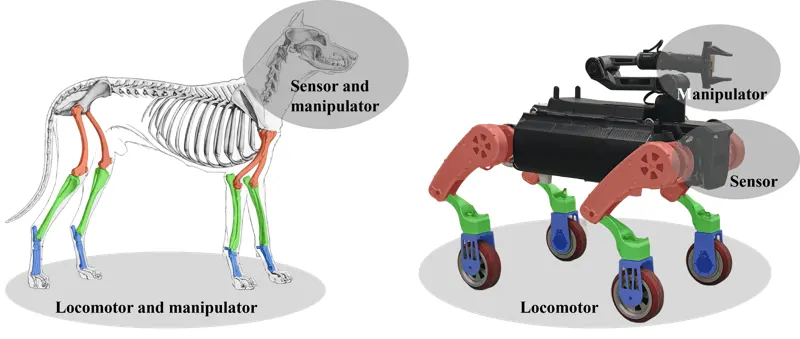
Wheel-legged robots with integrated manipulators hold great promise for mobile manipulation in logistics, industrial automation, and human-robot collaboration. However, unified control of such systems remains challenging due to the redundancy in degrees of freedom, complex wheel-ground contact dynamics, and the need for seamless coordination between locomotion and manipulation. In this work, we present the design and whole-body motion control of an omnidirectional wheel-legged quadrupedal robot equipped with a dexterous manipulator. The proposed platform incorporates independently actuated steering modules and hub-driven wheels, enabling agile omnidirectional locomotion with high maneuverability in structured environments. To address the challenges of contact-rich interaction, we develop a contact-aware whole-body dynamic optimization framework that integrates point-contact modeling for manipulation with line-contact modeling for wheel-ground interactions. A warm-start strategy is introduced to accelerate online optimization, ensuring real-time feasibility for high-dimensional control. Furthermore, a unified kinematic model tailored for the robot's 4WIS-4WID actuation scheme eliminates the need for mode switching across different locomotion strategies, improving control consistency and robustness. Simulation and experimental results validate the effectiveness of the proposed framework, demonstrating agile terrain traversal, high-speed omnidirectional mobility, and precise manipulation under diverse scenarios, underscoring the system's potential for factory automation, urban logistics, and service robotics in semi-structured environments.
Wheel-legged robotsWhole-Body Control
Zong Chen, Shaoyang Li, Ben Liu · 540 views · Sep 17, 2025
Optimizing Grasping in Legged Robots: A Deep Learning Approach to Loco-Manipulation

Optimizing Grasping in Legged Robots: A Deep Learning Approach to Loco-Manipulation

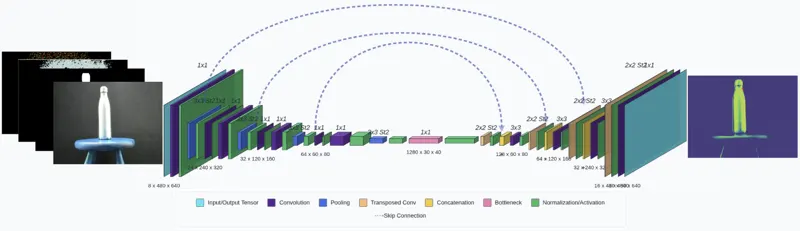
This paper presents a deep learning framework designed to enhance the grasping capabilities of quadrupeds equipped with arms, with a focus on improving precision and adaptability. Our approach centers on a sim-to-real methodology that minimizes reliance on physical data collection. We developed a pipeline within the Genesis simulation environment to generate a synthetic dataset of grasp attempts on common objects. By simulating thousands of interactions from various perspectives, we created pixel-wise annotated grasp-quality maps to serve as the ground truth for our model. This dataset was used to train a custom CNN with a U-Net-like architecture that processes multi-modal input from an onboard RGB and depth cameras, including RGB images, depth maps, segmentation masks, and surface normal maps. The trained model outputs a grasp-quality heatmap to identify the optimal grasp point. We validated the complete framework on a four-legged robot. The system successfully executed a full loco-manipulation task: autonomously navigating to a target object, perceiving it with its sensors, predicting the optimal grasp pose using our model, and performing a precise grasp. This work proves that leveraging simulated training with advanced sensing offers a scalable and effective solution for object handling.

Legged robotsDeep Learning
Dilermando Almeida, Guilherme Lazzarini, Juliano Negri · 554 views · Aug 24, 2025
A Nonlinear MPC Framework for Loco-Manipulation of Quadrupedal Robots with Non-Negligible Manipulator Dynamics

A Nonlinear MPC Framework for Loco-Manipulation of Quadrupedal Robots with Non-Negligible Manipulator Dynamics

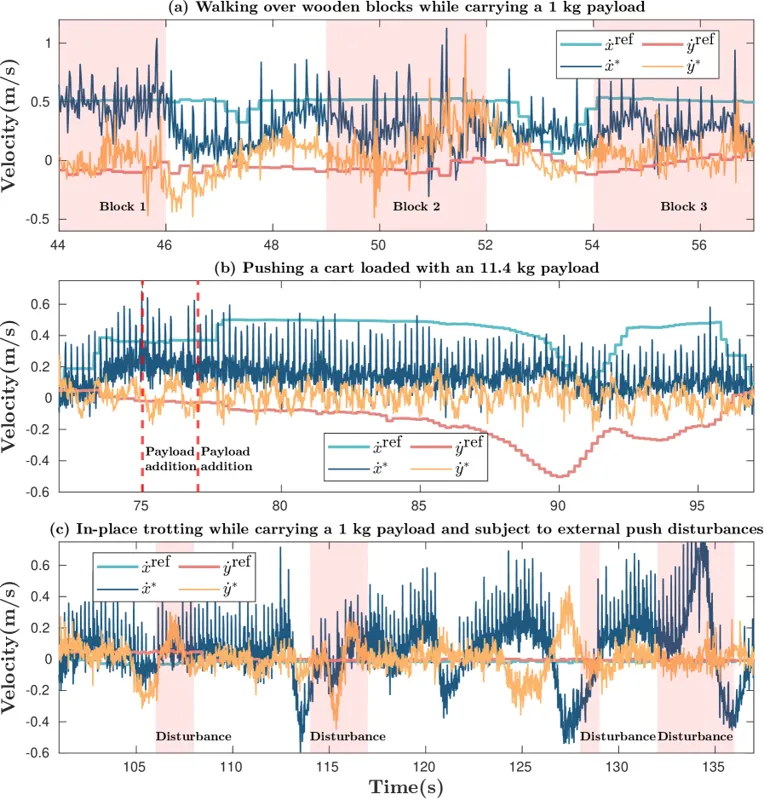
Model predictive control (MPC) combined with reduced-order template models has emerged as a powerful tool for trajectory optimization in dynamic legged locomotion. However, loco-manipulation tasks performed by legged robots introduce additional complexity, necessitating computationally efficient MPC algorithms capable of handling high-degree-of-freedom (DoF) models. This letter presents a computationally efficient nonlinear MPC (NMPC) framework tailored for loco-manipulation tasks of quadrupedal robots equipped with robotic manipulators whose dynamics are non-negligible relative to those of the quadruped. The proposed framework adopts a decomposition strategy that couples locomotion template models – such as the single rigid body (SRB) model – with a full-order dynamic model of the robotic manipulator for torque-level control. This decomposition enables efficient real-time solution of the NMPC problem in a receding horizon fashion at 60 Hz. The optimal state and input trajectories generated by the NMPC for locomotion are tracked by a low-level nonlinear whole-body controller (WBC) running at 500 Hz, while the optimal torque commands for the manipulator are directly applied. The layered control architecture is validated through extensive numerical simulations and hardware experiments on a 15-kg Unitree Go2 quadrupedal robot augmented with a 4.4-kg 4-DoF Kinova arm. Given that the Kinova arm dynamics are non-negligible relative to the Go2 base, the proposed NMPC framework demonstrates robust stability in performing diverse loco-manipulation tasks, effectively handling external disturbances, payload variations, and uneven terrain.

MPCMobile Manipulation
Ruturaj Sambhus, Kapi Ketan Mehta, Ali MirMohammad Sadeghi · 600 views · Jul 29, 2025
MLM: Learning Multi-task Loco-Manipulation Whole-Body Control for Quadruped Robot with Arm

MLM: Learning Multi-task Loco-Manipulation Whole-Body Control for Quadruped Robot with Arm

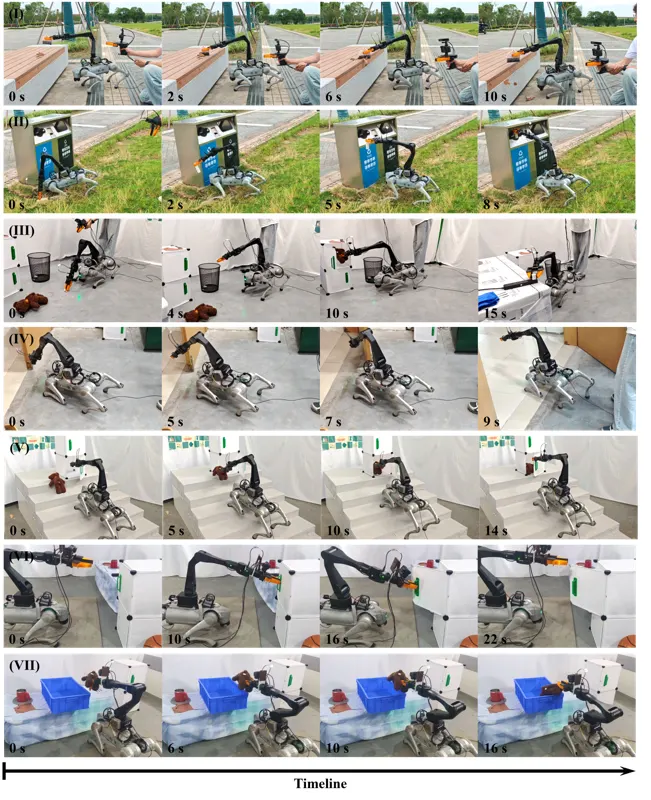
Whole-body loco-manipulation for quadruped robots with arms remains a challenging problem, particularly in achieving multi-task control. To address this, we propose MLM, a reinforcement learning framework driven by both real-world and simulation data. It enables a six-DoF robotic arm-equipped quadruped robot to perform whole-body loco-manipulation for multiple tasks autonomously or under human teleoperation. To address the problem of balancing multiple tasks during the learning of loco-manipulation, we introduce a trajectory library with an adaptive, curriculum-based sampling mechanism. This approach allows the policy to efficiently leverage real-world collected trajectories for learning multi-task loco-manipulation. To address deployment scenarios with only historical observations and to enhance the performance of policy execution across tasks with different spatial ranges, we propose a Trajectory-Velocity Prediction policy network. It predicts unobservable future trajectories and velocities. By leveraging extensive simulation data and curriculum-based rewards, our controller achieves whole-body behaviors in simulation and zero-shot transfer to real-world deployment. Ablation studies in simulation verify the necessity and effectiveness of our approach, while real-world experiments on a Go2 robot with an Airbot robotic arm demonstrate the policy's good performance in multi-task execution.

Reinforcement LearningMobile Manipulation
Xin Liu, Bida Ma, Chenkun Qi · 473 views · Aug 14, 2025
Language-Guided Grasping under Partial Observation for Mobile Manipulation in Field Inspection and Maintenance

Language-Guided Grasping under Partial Observation for Mobile Manipulation in Field Inspection and Maintenance

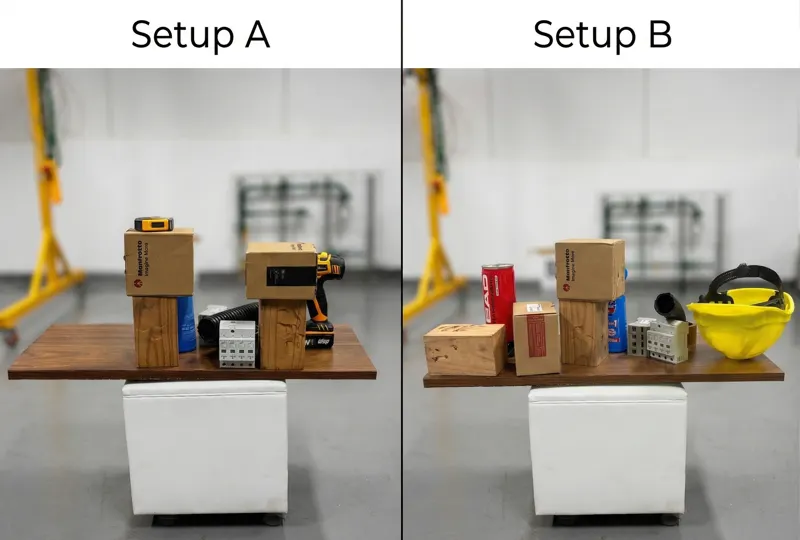
Offshore inspection and maintenance have increasingly been using legged robots for routine sensing, yet many useful interventions still require physical interaction with tools, containers, and task-relevant objects. Employing robots for these tasks can reduce operators' exposure in confined, elevated, or potentially explosive areas. This paper presents a language-guided grasping pipeline for a legged mobile manipulator operating under partial observation. An operator defines the target, the system grounds it in RGB with open-vocabulary detection and promptable segmentation, extracts an object-centric RGB-D point cloud, improves sparse geometry through depth compensation and point-cloud completion, and selects a 6-DoF grasp using collision, clearance, reachability, and approach constraints. The system is implemented on a quadruped robot with an arm and evaluated in two cluttered tabletop scenes motivated by small-object retrieval during inspection and maintenance. Across paired trials, the proposed pipeline achieved 9/10 successful grasps, compared with 3/10 for a view-dependent deployment baseline. In this controlled setting, object-centric completion and execution-aware selection reduced approach collisions and improved the reliability of language-guided grasping for supervised field manipulation.

Inspection RobotLanguage-Guided Grasping
Dilermando Almeida, Juliano Negri, Guilherme Lazzarini · 503 views · Mar 9, 2026

As an Amazon Associate, we earn from qualifying purchases.