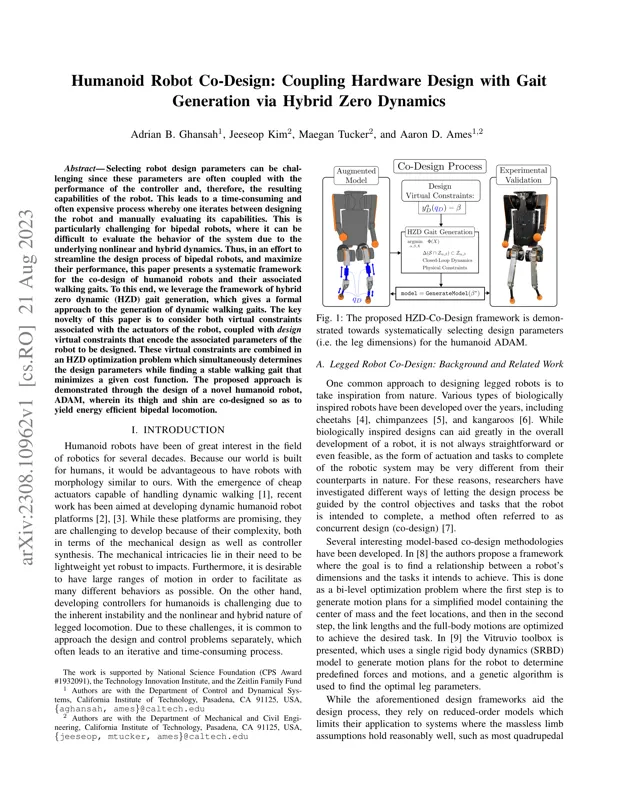
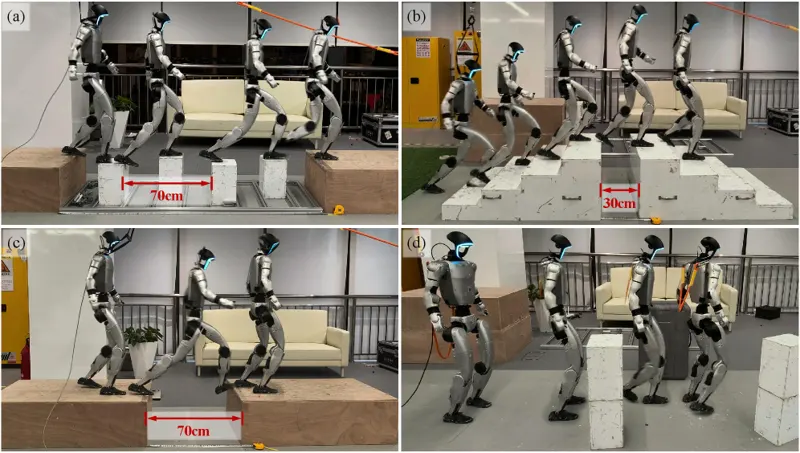
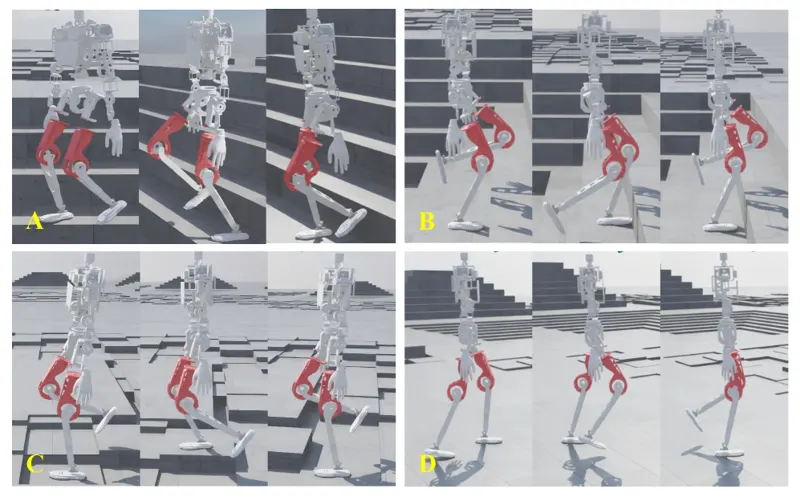
Presents a systematic co-design framework for humanoid robots using hybrid zero dynamics (HZD) gait generation, coupling actuator virtual constraints with design virtual constraints to jointly optimize robot design parameters and walking gaits. Demonstrated on the ADAM humanoid robot with co-designed thigh and shin for energy-efficient bipedal locomotion.
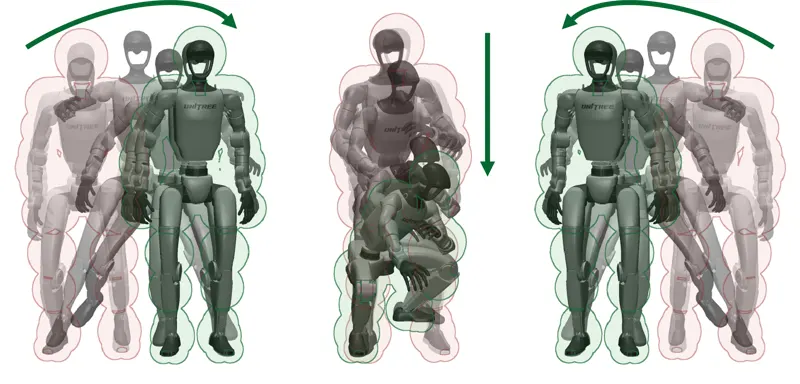
A perception-aware CBF-RL framework that couples control-barrier safety with onboard sensing for whole-body humanoid dodgeball. The deployed policy sees the ball only as segmentation-masked depth from a head-mounted camera, with CBF guidance representing clearance to every body link. Deployed zero-shot on Unitree G1, achieving 95% success rate on real-world throws.
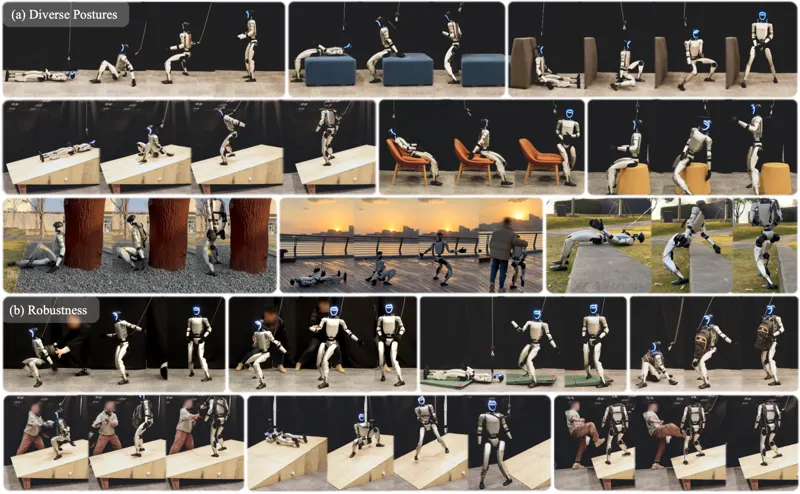
Standing-up control is crucial for humanoid robots, with the potential for integration into current locomotion and loco-manipulation systems, such as fall recovery. Existing approaches are either limited to simulations that overlook hardware constraints or rely on predefined ground-specific motion trajectories, failing to enable standing up across postures in real-world scenes. To bridge this gap, we present HoST (Humanoid Standing-up Control), a reinforcement learning framework that learns standing-up control from scratch, enabling robust sim-to-real transfer across diverse postures. HoST effectively learns posture-adaptive motions by leveraging a multi-critic architecture and curriculum-based training on diverse simulated terrains. To ensure successful real-world deployment, we constrain the motion with smoothness regularization and implicit motion speed bound to alleviate oscillatory and violent motions on physical hardware, respectively. After simulation-based training, the learned control policies are directly deployed on the Unitree G1 humanoid robot. Our experimental results demonstrate that the controllers achieve smooth, stable, and robust standing-up motions across a wide range of laboratory and outdoor environments. Videos and code are available at https://taohuang13.github.io/humanoid-standingup.github.io/.
Robust humanoid locomotion in unstructured environments requires architectures that balance fast low-level stabilization with slower perceptual decision-making. We show that a simple layered control architecture (LCA), a proprioceptive stabilizer running at high rate, coupled with a compact low-rate perceptual policy, enables substantially more robust performance than monolithic end-to-end designs, even when using minimal perception encoders. Through a two-stage training curriculum (blind stabilizer pretraining followed by perceptual fine-tuning), we demonstrate that layered policies consistently outperform one-stage alternatives in both simulation and hardware. On a Unitree G1 humanoid, our approach succeeds across stair and ledge tasks where one-stage perceptual policies fail. These results highlight that architectural separation of timescales, rather than network scale or complexity, is the key enabler for robust perception-conditioned locomotion.
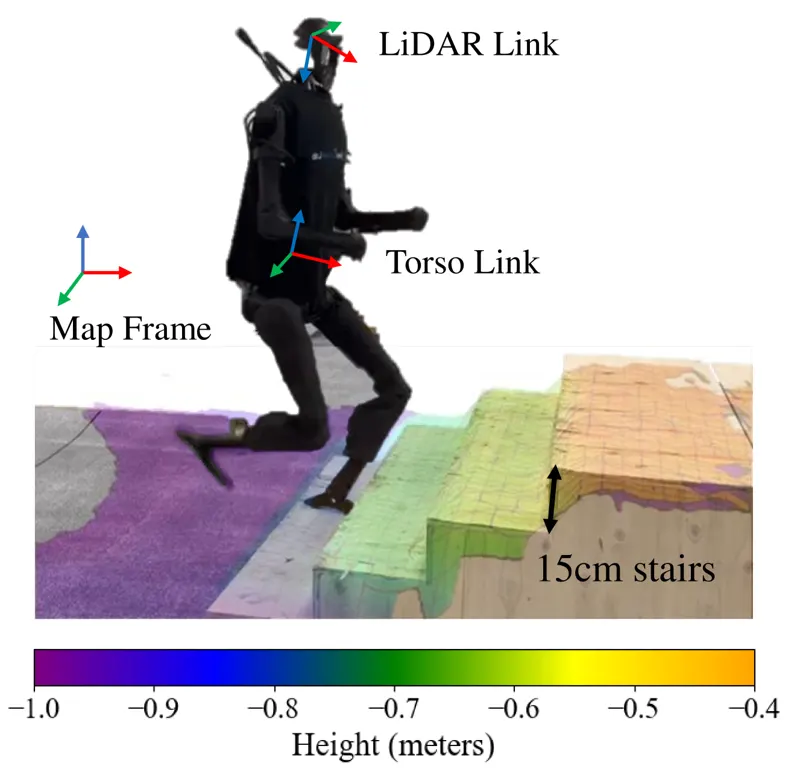
Although reinforcement learning has significantly advanced humanoid locomotion, perceptive policies still struggle on sparse-foothold terrain and constrained environments. Success in these scenarios requires both broad terrain awareness and precise foothold selection, two perceptual roles that conventional encoders often entangle. To address this challenge, we propose Global-Local Attention Decomposition (GLAD) for terrain encoding in humanoid locomotion. Realized by a coarse-to-fine encoder over a robot-centric elevation map, GLAD explicitly separates these objectives: a global attention branch utilizes attention pooling to summarize the surrounding terrain context, while a state-conditioned local attention branch sparsifies and encodes precise foothold-relevant geometry. This explicit attention decomposition prevents the dilution of fine-grained spatial cues while reducing training overhead. Experiments demonstrate that GLAD enables reliable locomotion over challenging gaps, stepping stones, and stairs. Furthermore, the learned policy exhibits emergent terrain-responsive behaviors, autonomously following narrow paths and avoiding obstacles under simple velocity commands without explicit navigation planners. In real-world deployment on a Unitree G1 humanoid robot using onboard LiDAR, the proposed method achieves robust zero-shot sim-to-real transfer across diverse sparse-foothold and obstacle-rich domains.
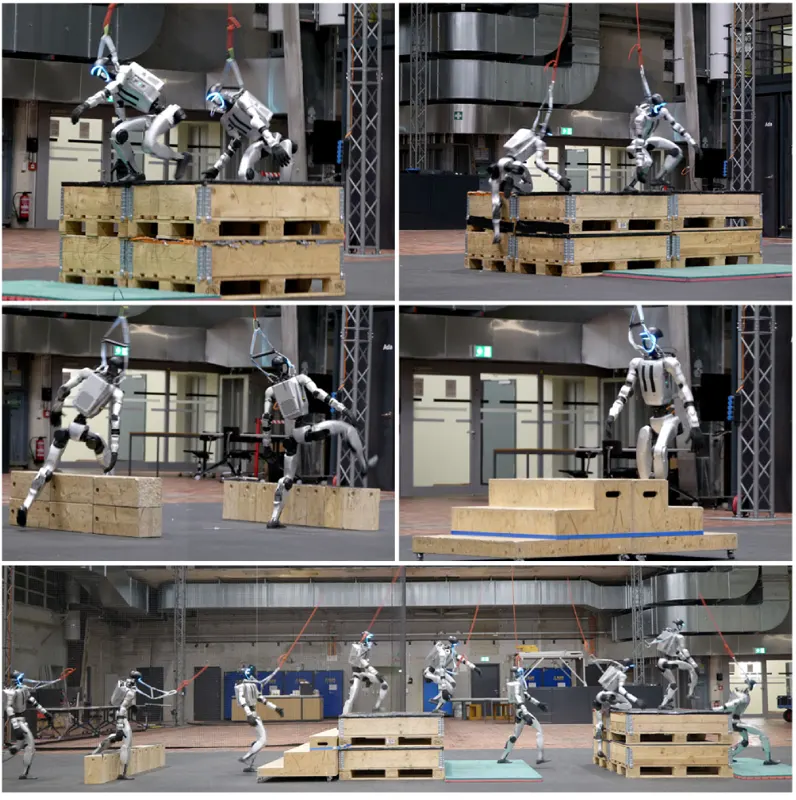
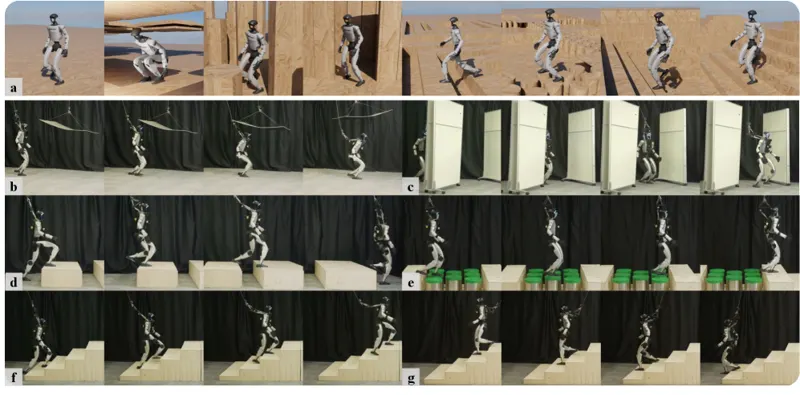
Whole-body humanoid locomotion is challenging due to high-dimensional control, morphological instability, and the need for real-time adaptation to various terrains using onboard perception. Directly applying reinforcement learning (RL) with reward shaping to humanoid locomotion often leads to lower-body-dominated behaviors, whereas imitation-based RL can learn more coordinated whole-body skills but is typically limited to replaying reference motions without a mechanism to adapt them online from perception for terrain-aware locomotion. To address this gap, we propose a whole-body humanoid locomotion framework that combines skills learned from reference motions with terrain-aware adaptation. We first train a diffusion model on retargeted human motions for real-time prediction of terrain-aware reference motions. Concurrently, we train a whole-body reference tracker with RL using this motion data. To improve robustness under imperfectly generated references, we further fine-tune the tracker with a frozen motion generator in a closed-loop setting. The resulting system supports directional goal-reaching control with terrain-aware whole-body adaptation, and can be deployed on a Unitree G1 humanoid robot with onboard perception and computation. The hardware experiments demonstrate successful traversal over boxes, hurdles, stairs, and mixed terrain combinations. Quantitative results further show the benefits of incorporating online motion generation and fine-tuning the motion tracker for improved generalization and robustness.
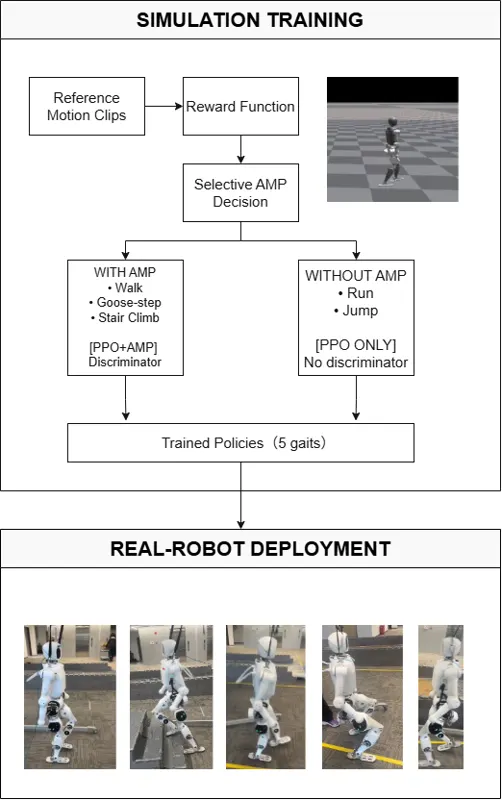
Learning diverse locomotion skills for humanoid robots in a unified reinforcement learning framework remains challenging due to the conflicting requirements of stability and dynamic expressiveness across different gaits. We present a multi-gait learning approach that enables a humanoid robot to master five distinct gaits – walking, goose-stepping, running, stair climbing, and jumping – using a consistent policy structure, action space, and reward formulation. The key contribution is a selective Adversarial Motion Prior (AMP) strategy: AMP is applied to periodic, stability-critical gaits (walking, goose-stepping, stair climbing) where it accelerates convergence and suppresses erratic behavior, while being deliberately omitted for highly dynamic gaits (running, jumping) where its regularization would over-constrain the motion. Policies are trained via PPO with domain randomization in simulation and deployed on a physical 12-DOF humanoid robot through zero-shot sim-to-real transfer. Quantitative comparisons demonstrate that selective AMP outperforms a uniform AMP policy across all five gaits, achieving faster convergence, lower tracking error, and higher success rates on stability-focused gaits without sacrificing the agility required for dynamic ones.
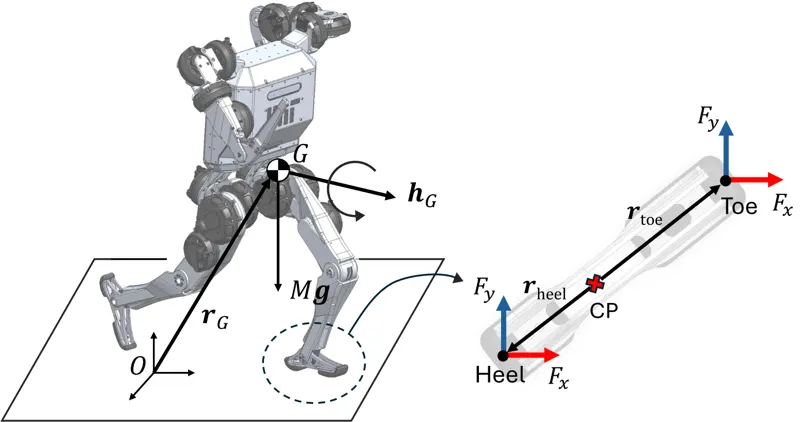
Humans naturally swing their arms during locomotion to regulate whole-body dynamics, reduce angular momentum, and help maintain balance. Inspired by this principle, we present a limb-level multi-agent reinforcement learning (RL) framework that enables coordinated whole-body control of humanoid robots through emergent arm motion. Our approach employs separate actor-critic structures for the arms and legs, trained with centralized critics but decentralized actors that share only base states and centroidal angular momentum (CAM) observations, allowing each agent to specialize in task-relevant behaviors through modular reward design. The arm agent guided by CAM tracking and damping rewards promotes arm motions that reduce overall angular momentum and vertical ground reaction moments, contributing to improved balance during locomotion or under external perturbations. Comparative studies with single-agent and alternative multi-agent baselines further validate the effectiveness of our approach. Finally, we deploy the learned policy on a humanoid platform, achieving robust performance across diverse locomotion tasks, including flat-ground walking, rough terrain traversal, and stair climbing.
Robust humanoid locomotion requires accurate and globally consistent perception of the surrounding 3D environment. However, existing perception modules, mainly based on depth images or elevation maps, offer only partial and locally flattened views of the environment, failing to capture the full 3D structure. This paper presents Gallant, a voxel-grid-based framework for humanoid locomotion and local navigation in 3D constrained terrains. It leverages voxelized LiDAR data as a lightweight and structured perceptual representation, and employs a z-grouped 2D CNN to map this representation to the control policy, enabling fully end-to-end optimization. A high-fidelity LiDAR simulation that dynamically generates realistic observations is developed to support scalable, LiDAR-based training and ensure sim-to-real consistency. Experimental results show that Gallant's broader perceptual coverage facilitates the use of a single policy that goes beyond the limitations of previous methods confined to ground-level obstacles, extending to lateral clutter, overhead constraints, multi-level structures, and narrow passages. Gallant also firstly achieves near 100% success rates in challenging scenarios such as stair climbing and stepping onto elevated platforms through improved end-to-end optimization.
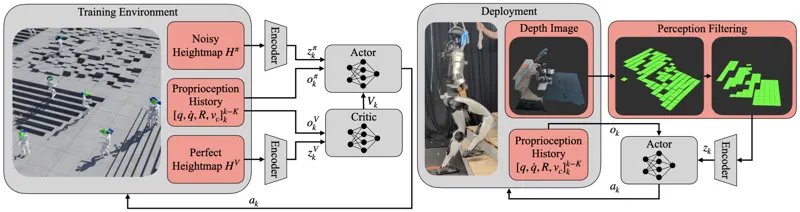
In contrast to quadruped robots that can navigate diverse terrains using a "blind" policy, humanoid robots require accurate perception for stable locomotion due to their high degrees of freedom and inherently unstable morphology. However, incorporating perceptual signals often introduces additional disturbances to the system, potentially reducing its robustness, generalizability, and efficiency. This paper presents the Perceptive Internal Model (PIM), which relies on onboard, continuously updated elevation maps centered around the robot to perceive its surroundings. We train the policy using ground-truth obstacle heights surrounding the robot in simulation, optimizing it based on the Hybrid Internal Model (HIM), and perform inference with heights sampled from the constructed elevation map. Unlike previous methods that directly encode depth maps or raw point clouds, our approach allows the robot to perceive the terrain beneath its feet clearly and is less affected by camera movement or noise. Furthermore, since depth map rendering is not required in simulation, our method introduces minimal additional computational costs and can train the policy in 3 hours on an RTX 4090 GPU. We verify the effectiveness of our method across various humanoid robots, various indoor and outdoor terrains, stairs, and various sensor configurations. Our method can enable a humanoid robot to continuously climb stairs and has the potential to serve as a foundational algorithm for the development of future humanoid control methods.
Training perceptive humanoid locomotion policies that traverse complex terrains with natural gaits remains an open challenge, typically demanding multi-stage training pipelines, adversarial objectives, or extensive real-world calibration. We present PRIOR, an efficient and reproducible framework built on Isaac Lab that achieves robust terrain traversal with human-like gaits through a simple yet effective design: (i) a parametric gait generator that supplies stable reference trajectories derived from motion capture without adversarial training, (ii) a GRU-based state estimator that infers terrain geometry directly from egocentric depth images via self-supervised heightmap reconstruction, and (iii) terrain-adaptive footstep rewards that guide foot placement toward traversable regions. Through systematic analysis of depth image resolution trade-offs, we identify configurations that maximize terrain fidelity under real-time constraints, substantially reducing perceptual overhead without degrading traversal performance. Comprehensive experiments across terrains of varying difficulty-including stairs, boxes, and gaps-demonstrate that each component yields complementary and essential performance gains, with the full framework achieving a 100% traversal success rate. We will open-source the complete PRIOR framework, including the training pipeline, parametric gait generator, and evaluation benchmarks, to serve as a reproducible foundation for humanoid locomotion research on Isaac Lab.
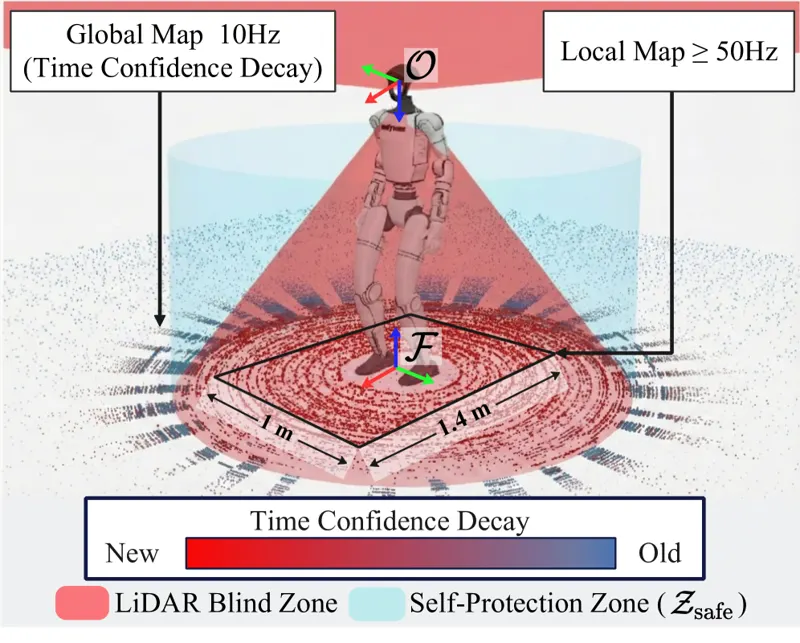
Humanoid robots, characterized by numerous degrees of freedom and a high center of gravity, are inherently unstable. Safe omnidirectional locomotion on stairs requires both omnidirectional terrain perception and reliable foothold selection. Existing methods often rely on forward-facing depth cameras, which create blind zones that restrict omnidirectional mobility. Furthermore, sparse post-contact unsafe stepping penalties lead to low learning efficiency and suboptimal strategies. To realize safe stair-traversal gaits, this paper introduces a single-stage training framework incorporating a dense unsafe stepping penalty that provides continuous feedback as the foot approaches a hazardous placement. To obtain stable and reliable elevation maps, we build a rolling point-cloud mapping system with spatiotemporal confidence decay and a self-protection zone mechanism, producing temporally consistent local maps. These maps are further refined by an Edge-Guided Asymmetric U-Net (EGAU), which mitigates reconstruction distortion caused by sparse LiDAR returns on stair risers. Simulation and real-robot experiments show that the proposed method achieves a near-100% safe stepping rate on stair terrains in simulation, while maintaining a remarkably high safe stepping rate in real-world deployments. Furthermore, it completes a continuous long-distance walking test on complex outdoor terrains, demonstrating reliable sim-to-real transfer and long-term stability.