PAPER DEEP DIVE
SSR: Scaling Surefooted and Symmetric Humanoid Traversal to the Open World
Extending humanoid traversal to the open world is key to practical deployment in human environments, but remains challenging. The robot must use vision to ensure safe and reliable foot placement on heterogeneous terrain under highly dynamic motion, while producing coordinated, natural whole-body behaviors. We propose SSR, an efficient end-to-end framework for egocentric vision-based humanoid traversal that jointly learns these capabilities. SSR introduces imagined foothold guidance, which learns to model forthcoming swing-foot contacts and evaluates their support to guide pre-touchdown swings toward stable regions, reducing edge slips. It further employs equivariant latent-space symmetry augmentation to efficiently induce bilateral coordination under high-dimensional visual observations, and uses terrain-specific multi-discriminator motion priors to encourage human-like behavior across scenes. Extensive experiments show that SSR achieves safe, stable, and high-quality locomotion on diverse real-world terrains, including stairs with varied structures and extreme challenges such as wide gaps and high platforms, while enabling reliable long-horizon traversal in open outdoor environments.
Authors: Ruiqi Yu*, Yiwen Wang*, Yuan Hao, Jun Wu, Qiuguo Zhu (corresponding) (* equal contribution)
Affiliation: Zhejiang University
Links: arXiv:2605.30770 ·
project page
Code status: no public code repository at ingestion time; the project page ships paper, videos and BibTeX only
One-Sentence Summary
SSR packs three training-time mechanisms into one single-stage egocentric-vision policy: imagined foothold guidance corrects the swing foot before touchdown, equivariant latent-space mirroring buys bilateral symmetry at 48 dimensions instead of 36x36 pixels, and per-terrain discriminators keep the gait human-like on every surface.
Background and Motivation
For a humanoid to enter human environments, the first hurdle is not walking at all but walking on whatever the ground happens to be. Stairs vary in tread and rise; curbs become gaps; parks offer grassy slopes and rubble. A foot that lands half a centimeter off on flat concrete is a non-event, while three centimeters off on a 22 cm tread is a slip. Open-world traversal therefore demands that perception, foothold decision and whole-body coordination live in one closed loop, and that this loop runs on the robot's own sensors and compute.
Learning-based humanoid locomotion has increasingly added exteroception on top of proprioception. Policies conditioned on egocentric depth are especially attractive for dynamic real scenes because they skip explicit mapping, and with it the drift, latency and occlusion errors that mapping accumulates. But seeing is not stepping: the policy must infer local terrain structure from coarse depth cues and translate that inference into reliable foothold decisions. For flat-footed humanoids this is acute, because stepping near a terrain edge sharply shrinks the available support area and raises the risk of slips and falls.
Safety alone is not enough. Traversal among humans also asks for coordinated, controllable, natural whole-body motion. Prior work typically adds symmetry priors or human-motion imitation as separate ingredients: symmetry keeps left and right leg behavior balanced, imitation keeps the gait from looking mechanical. Injecting both into an egocentric vision policy is where budgets collide. High-dimensional visual observations make symmetry learning expensive in compute and memory, while terrain-dependent dynamics destabilize a single shared human-like style prior. Safe footholds, bilateral symmetry and human-like style have long been three budgets fighting over the same policy.
The authors' observation is that these budgets collide because the three jobs sit at the wrong levels. Foothold safety used to be assessed only at or after contact, so swing-phase actions received delayed feedback. Symmetry augmentation used to act on high-resolution depth images and recurrent hidden states, paying for a mirrored encoding per augmented sample. Style priors used to be a single discriminator forced to compromise between stairs, gaps and platforms. SSR moves each job to a cheaper, timelier level: imagined contacts push safety assessment into the swing phase, an equivariant encoder pushes mirroring down to a 48-dimensional latent, and multiple terrain discriminators split the style prior apart.
The result is a unified single-stage end-to-end reinforcement learning framework that learns directly from egocentric depth and proprioception, jointly acquiring reliable foot placement and high-quality whole-body motion with gait symmetry coupled to human-like behavior. In simulation it holds near-100% success across all training difficulties and extrapolates beyond the curriculum to a 90 cm gap and a 45 cm platform; on the real robot it traverses these terrains zero-shot and completes a continuous 1.3 km, 40-minute outdoor route with no reset and no misstep.
Preliminaries
SSR formulates humanoid locomotion as a partially observable Markov decision process and optimizes the policy with PPO under an asymmetric actor-critic. The actor sees only proprioceptive history and the depth image; the critic additionally sees ground-truth base velocity, foot velocities, contact states, limb positions and height maps around the feet and body. This is privileged-information training in its standard form: a stronger teacher estimates value during training, and only the student deploys.
At timestep $t$ the proprioception $\mathbf{o}_{t}^{p}\in\mathbb{R}^{72}$ contains base angular velocity, projected gravity, velocity commands, joint positions, joint velocities and the previous action, with a short history $\mathbf{o}_{t-h+1:t}^{p}$ stacked to reduce partial observability. Together with the depth image $\mathbf{I}_{t}\in\mathbb{R}^{36\times 36}$ this forms the observation, and the policy outputs position targets for 21 actuated joints. The 36x36 resolution looks crude but is an onboard constraint: a Jetson AGX Orin runs inference at 50 Hz while the waist-mounted depth camera streams at 60 Hz.
The policy has three parts: a recurrent cross-modal encoder, a motion-state estimator and a mixture-of-experts actor. The encoder reads depth with a CNN and temporal proprioception with an MLP, fuses them with a GRU into a three-headed latent $\hat{\mathbf{z}}_{t}=[\hat{\mathbf{z}}_{t}^{f},\hat{\mathbf{z}}_{t}^{b},\hat{\mathbf{z}}_{t}^{p}]^{\top}$: the first two heads decode foot- and base-centric terrain geometry, the third is a variational head predicting the next proprioception and thereby modeling system dynamics implicitly. A separate MLP estimator predicts base velocity $\hat{\mathbf{v}}_{t}$ from temporal proprioception. The actor consumes current proprioception, $\hat{\mathbf{v}}_{t}$ and $\hat{\mathbf{z}}_{t}$ through five experts, which lets one policy represent terrain-dependent motion modes.
Method
Imagined foothold guidance: safety assessment before touchdown. During training a foothold imagination model maps privileged state $\mathbf{s}_{t}$ and action $\mathbf{a}_{t}$ to a prospective contact distribution $\hat{\mathbf{F}}_{t}=\{\hat{F}_{i,t}\}_{i=1}^{2}$. For foot $i$, $\hat{F}_{i,t}=(\hat{\bm{\mu}}_{i,t},\hat{\sigma}_{i,t})$ parameterizes a Gaussian imagined-contact distribution in the current base frame, $q_{i,t}(\mathbf{p})=\mathcal{N}(\mathbf{p};\hat{\bm{\mu}}_{i,t},(\hat{\sigma}_{i,t})^{2}\mathbf{I})$, where $\hat{\bm{\mu}}_{i,t}\in\mathbb{R}^{2}$ is the anticipated contact location and $\hat{\sigma}_{i,t}$ captures uncertainty. The supervision target $\mathbf{p}_{i,t}^{*}$ is foot $i$'s first valid future contact in base frame, and the model is trained with Gaussian negative log-likelihood:
$$\mathcal{L}_{\text{pred}}=-\sum_{i=1}^{2}\log q_{i,t}(\mathbf{p}_{i,t}^{*})\propto\sum_{i=1}^{2}\left(\frac{\|\mathbf{p}_{i,t}^{*}-\hat{\bm{\mu}}_{i,t}\|_{2}^{2}}{2(\hat{\sigma}_{i,t})^{2}}+2\log\hat{\sigma}_{i,t}\right)$$
Early in training unstable gaits make future-contact targets noisy, so the authors use terrain level as a reliability proxy and enable pre-contact guidance only beyond a preset curriculum level, keeping unreliable imagined signals out of early learning.
Support deficiency: a scalar for "how well supported is this step". Let $\mathbf{H}^{f}(\mathbf{p})=\{h_{k}(\mathbf{p})\}_{k=1}^{n}$ be the height map of a sole-sized patch, 22.5 cm by 10 cm, centered at $\mathbf{p}\in\mathbb{R}^{2}$ and sampled every 2.5 cm, with $h_{k}(\mathbf{p})$ the terrain height at $\mathbf{p}+\delta_{k}$. Support deficiency at $\mathbf{p}$ is
$$\rho(\mathbf{p})=1-\frac{1}{n}\sum_{k=1}^{n}\mathbb{1}\{h^{f}(\mathbf{p})-h_{k}(\mathbf{p})<\epsilon_{h}\}$$
where $h^{f}(\mathbf{p})$ is the sole height, taken as $h^{f}(\mathbf{p})=\max_{k}h_{k}(\mathbf{p})$ for imagined pre-contact locations. Larger $\rho(\mathbf{p})$ means less support overlap, typically near terrain edges or suspended regions. This turns "stepping on the edge" from a qualitative worry into a scalar the reward can consume directly.
From sparse to dense: expected deficiency during swing. Each foot alternates stance and swing, and SSR writes the guidance into the RL objective accordingly:
$$r^{f}_{t}=\exp\!\left(-\left(\sum_{i=1}^{2}\tilde{\rho}_{i,t}\right)^{2}/\sigma_{f}\right),\quad \tilde{\rho}_{i,t}=c_{i,t}\,\rho(\mathbf{p}_{i,t})+(1-c_{i,t})\,\mathbb{E}_{\mathbf{p}\sim q_{i,t}}[\rho(\mathbf{p})]$$
with $c_{i,t}$ indicating whether foot $i$ is in stance: stance feet are evaluated at their current contact, swing feet under the imagined distribution $q_{i,t}$ approximated by discrete Gaussian-weighted samples. This is the paper's central conversion: a safety signal that existed only at touchdown becomes dense guidance present at every swing-phase step, letting the policy steer the foot toward flat, well-supported regions before it lands. On slopes the authors zero $\tilde{\rho}_{i,t}$ for both feet so that $r^{f}_{t}=1$, avoiding unintended suppression of inclined contacts.
Equivariant latent-space augmentation: mirroring at 48 dimensions. Input-level symmetry augmentation is expensive for visual recurrent policies, because every mirrored sample re-encodes the depth image and rolls out a mirrored memory state. SSR encodes the original observation once and augments the compact actor input instead. The requirement is a mirror-equivariant encoder: the latent of a mirrored observation must equal the mirror of the latent.
To make that valid, each latent head $\hat{\mathbf{z}}^{(k)}_{t}$, $k\in\{f,b,p\}$, is organized as paired left-right channel groups, and the mirror operator $\mathcal{M}_{c}$ simply swaps the two groups:
$$\mathbf{X}=[\mathbf{X}^{(L)},\mathbf{X}^{(R)}]^{\top},\qquad \mathcal{M}_{c}(\mathbf{X})=[\mathbf{X}^{(R)},\mathbf{X}^{(L)}]^{\top}$$
The encoder inputs are then put into symmetry-structured form: a fixed operator $\mathcal{T}$ reorganizes temporal proprioception as $\bar{\mathbf{o}}^{p}_{t}=\mathcal{T}(\mathbf{o}^{p}_{t-h+1:t})$, and the first CNN layer lifts the image into paired channels. The MLP, CNN and GRU are built from equivariant linear and convolutional layers following Cesa et al. For each head $E_{\phi}^{(k)}$ the equivariance condition reads
$$E_{\phi}^{(k)}(\mathcal{M}_{c}\bar{\mathbf{o}}^{p}_{t},\mathcal{M}_{\mathrm{2D}}\mathbf{I}_{t})=\mathcal{M}_{c}\,E_{\phi}^{(k)}(\bar{\mathbf{o}}^{p}_{t},\mathbf{I}_{t})$$
with $\mathcal{M}_{\mathrm{2D}}$ the horizontal reflection. Joint-space mirroring is spelled out as well: for $\mathbf{x}=[\mathbf{x}_{R}^{\mathrm{leg}},\mathbf{x}_{L}^{\mathrm{leg}},x^{\mathrm{waist}},\mathbf{x}_{R}^{\mathrm{arm}},\mathbf{x}_{L}^{\mathrm{arm}}]^{\top}\in\mathbb{R}^{21}$, sign vectors $\mathbf{s}_{\mathrm{leg}}=[1,-1,-1,1,1,-1]^{\top}$ and $\mathbf{s}_{\mathrm{arm}}=[1,-1,-1,1]^{\top}$ flip the coordinates whose physical axis changes sign while the left and right chains exchange:
$$\mathcal{F}(\mathbf{x})=[\mathbf{x}_{L}^{\mathrm{leg}}\odot\mathbf{s}_{\mathrm{leg}},\ \mathbf{x}_{R}^{\mathrm{leg}}\odot\mathbf{s}_{\mathrm{leg}},\ -x^{\mathrm{waist}},\ \mathbf{x}_{L}^{\mathrm{arm}}\odot\mathbf{s}_{\mathrm{arm}},\ \mathbf{x}_{R}^{\mathrm{arm}}\odot\mathbf{s}_{\mathrm{arm}}]^{\top}$$
During training the encoder runs only on the original observation; the compact actor observation, privileged state and action are then mirrored, $\mathbf{o}^{a,g}_{t}=\mathcal{M}_{o}\mathbf{o}^{a}_{t}$, $\mathbf{s}^{g}_{t}=\mathcal{M}_{s}\mathbf{s}_{t}$, $\mathbf{a}^{g}_{t}=\mathcal{M}_{a}\mathbf{a}_{t}$, producing a mirrored trajectory $\tau^{g}$ appended to the original rollout for PPO updates. Compared with input-level augmentation this avoids mirrored image encoding and hidden-state rollout; compared with strictly equivariant architectures it keeps the freedom to break symmetry near neutral states for gait exploration.
Cross-terrain motion priors: one discriminator per terrain. To encourage terrain-appropriate style, SSR uses multiple discriminators, one $D_{i}$ per terrain type. Each reads a five-frame history $\bm{\psi}_{t}$ whose frames $\mathbf{s}_{t}^{\mathrm{amp}}\in\mathbb{R}^{63}$ contain projected gravity, base linear and angular velocities, joint positions and velocities, and limb positions. Following adversarial motion priors, $D_{i}$ distinguishes reference from policy motion and yields the style reward
$$r^{s}_{t}=\max[\,0,\ 1-0.25\,(D_{i}(\bm{\psi}_{t})-1)^{2}\,]$$
Reference motions per terrain come from in-house motion capture plus a retargeted AMASS subset (slope 261.3 s, stairs 295.8 s, discrete 136.0 s, gap 174.5 s, platform 181.6 s). The three reward groups $r^{l}$ (task), $r^{f}$ (foothold) and $r^{s}$ (style) each get their own critic, with advantage weights $w_{l}=1.0$, $w_{f}=0.25$ and $w_{s}=0.2$ in a multi-critic formulation.
Deployment-consistent depth rendering. Simulated depth must match the real sensor's distribution, or sim-to-real cracks at the perception layer before control ever gets a vote. The authors implement depth rendering with self-occlusion in NVIDIA Warp: rays are cast against both the static terrain mesh and the robot's dynamic link meshes, but instead of refitting bounding volume hierarchies every step, each camera ray is transformed from the world frame into each mesh's local frame before intersection, since rigid transforms keep hit distances comparable. This keeps self-occluded depth cheap across 4096 parallel environments.
The overall flow is shown below: encoder, estimator and MoE actor are the only policy at deployment; imagined foothold guidance, equivariant latent augmentation and multi-discriminator AMP are training-time mechanisms that cost nothing onboard.
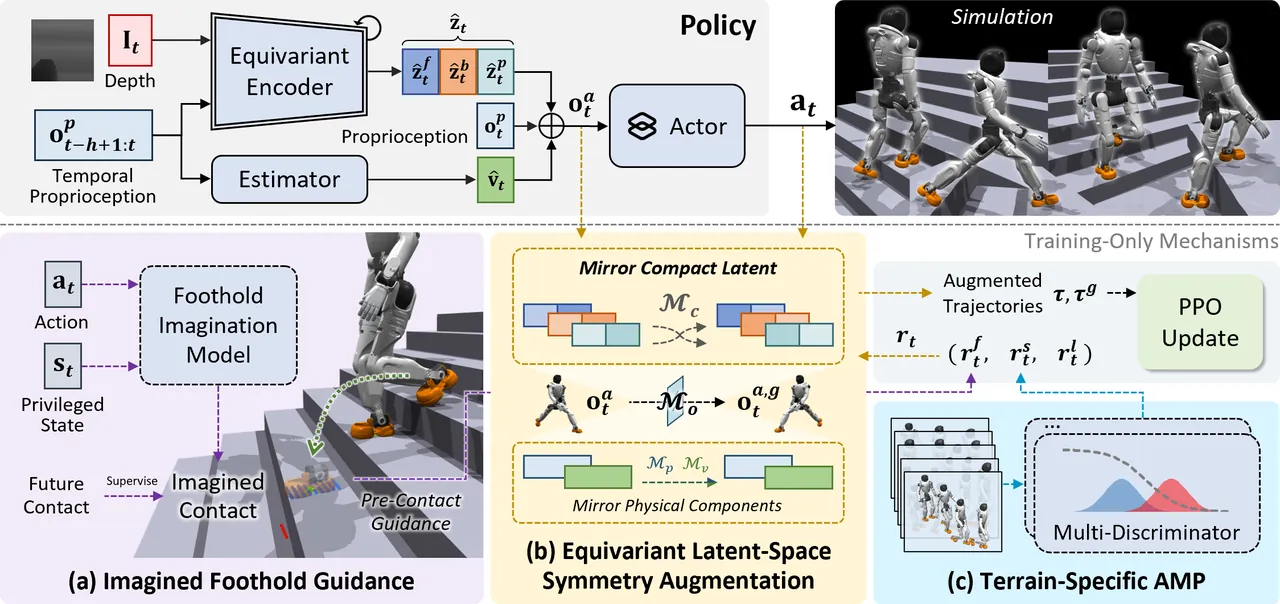
Figure 1: SSR framework overview. The policy combines a recurrent equivariant encoder, an estimator and a MoE actor; the three training-only mechanisms are imagined foothold guidance, equivariant latent-space symmetry augmentation and terrain-specific multi-discriminator AMP.
flowchart TD
  D[Egocentric depth 36x36] --> CNN[Equivariant CNN]
  P[Temporal proprioception] --> MLP[Equivariant MLP]
  CNN --> GRU[Equivariant GRU fusion]
  MLP --> GRU
  GRU --> ZF[latent zf: foot terrain]
  GRU --> ZB[latent zb: base terrain]
  GRU --> ZP[latent zp: VAE dynamics]
  P --> EST[Velocity estimator]
  EST --> V[base velocity estimate]
  ZF --> ACT[MoE actor, 5 experts]
  ZB --> ACT
  ZP --> ACT
  V --> ACT
  P --> ACT
  ACT --> A[21 joint position targets]
  S[Privileged state + action] --> FIM[Foothold imagination model]
  FIM --> Q[imagined contact Gaussian q]
  Q --> RHO[expected support deficiency]
  RHO --> RF[dense swing reward rf]
  ZF --> MIR[mirror latent Mc]
  MIR --> AUG[mirrored trajectory for PPO]
  M[5 terrain discriminators] --> RS[style reward rs]
Figure 2: Data flow drawn from the paper's actual method. The deployment path is encoder-estimator-actor only; imagination, mirroring and style discriminators exist solely during training.
Experiments
Simulation training runs in Isaac Gym with 4096 parallel AgiBot X2 humanoids on a single RTX 4090 for about 20k iterations. Success is the fraction of trials completing a 20 s traversal without termination under a 1.0 m/s forward command, with 1000 randomized trials per terrain. SSR holds near-100% success across all training difficulties, including the hardest stairs where a 22 cm foot has only a 3 cm support margin, and extrapolates beyond the curriculum to a 90 cm gap and a 45 cm platform, roughly 1.6x shank length. The perceptive baselines HPL (multi-stage egocentric parkour) and PIM (single-stage height-map traversal) degrade rapidly as difficulty rises, indicating that sparse or indirect foothold guidance cannot support precise foothold learning here. Among ablations the largest drops belong to NoFoothold (foothold reward removed) and NoImgn (contact-time assessment only), which pins dense pre-contact signaling as the main source of traversal capability.
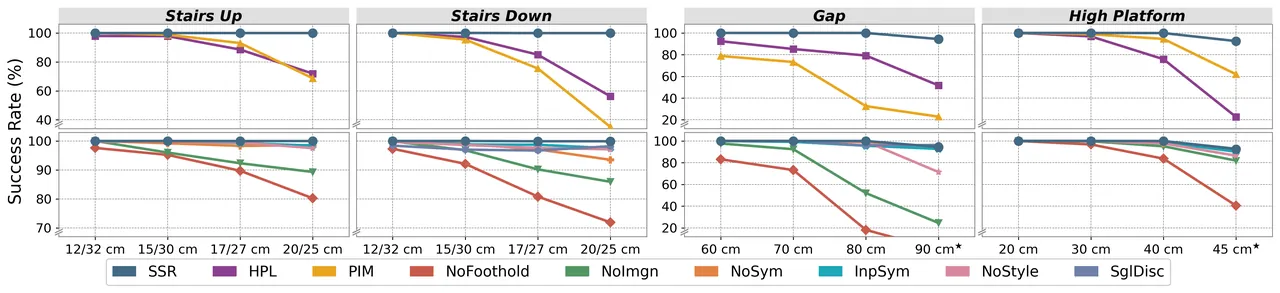
Figure 3: Traversal success across terrains and difficulty levels in simulation. Top row compares against prior methods, bottom row reports ablations; stars mark difficulties beyond the training curriculum.
Foothold safety is measured by safe foothold rate (SFR, fraction of footholds with support ratio above 75%) and mean support ratio (MSR). SSR attains the highest SFR on every terrain; on stairs-down and gap, terrains that demand precise landing, its kernel-density-smoothed foothold distributions still concentrate inside valid support regions. Checkpoint-wise MSR curves, saved every 100 iterations, show SSR reaching the 75% line earliest, so imagined guidance makes learning to be safe faster, not just safer. NoImgn assesses only at contact, so swing corrections arrive late and contacts stay edge-biased; NoFoothold produces more aggressive gaits and the lowest safety.
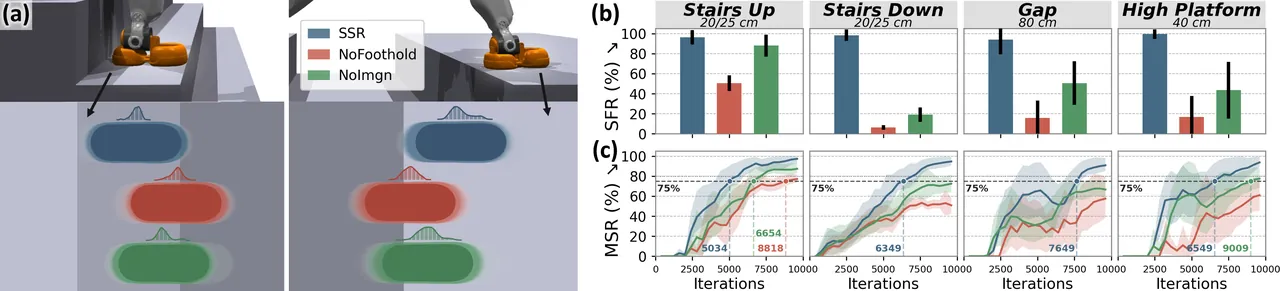
Figure 4: Safe foot placement ablation. (a) Foothold distributions on stairs-down and gap, KDE-smoothed; (b) safe foothold rate; (c) MSR versus training iterations, dashed line marking the first point at 75%.
The symmetry ablation looks at three angles: trajectory tracking under eight linear-velocity commands, centering under in-place yaw commands, and training efficiency. SSR tracks more accurately and stays localized while turning, with nearly mirror-symmetric trajectories; NoSym accumulates drift, left-right imbalance and a fixed lead leg. Crucially, SSR traverses gaps and platforms led by either leg, evidence of bilateral skill acquisition rather than a one-sided habit. On efficiency, against input-level mirroring (InpSym) SSR reaches higher returns in the same wall-clock time, hits maximum difficulty earlier, and cuts peak GPU memory from 28.8 GB to 23.7 GB, an 18% reduction. InpSym exceeds 24 GB and had to be trained on a 48 GB card; SSR fits a single 24 GB RTX 4090. That is the practical meaning of mirroring the latent: symmetry learning moves from unaffordable to affordable.
Human-likeness is proxied by average power (AP) and peak foot contact force (PFCF), since natural legged locomotion spends less mechanical energy and lands softer. The table below, excerpted from the paper's Table 1, shows SSR beating both NoStyle (style reward removed) and SglDisc (one shared discriminator) on all four terrains, indicating that per-terrain discriminators supply motion priors aligned with each terrain's dynamics instead of one compromised average style.
| Method | Stairs Up AP (W) | Stairs Up PFCF (N) | Gap AP (W) | Gap PFCF (N) | Platform AP (W) | Platform PFCF (N) |
|---|---|---|---|---|---|---|
| SSR | 381.3 ± 5.4 | 507.7 ± 12.6 | 214.4 ± 5.7 | 463.4 ± 15.3 | 253.0 ± 6.3 | 480.4 ± 14.9 |
| NoStyle | 451.6 ± 10.1 | 538.5 ± 13.5 | 317.0 ± 6.5 | 518.1 ± 16.6 | 292.3 ± 6.3 | 508.7 ± 16.4 |
| SglDisc | 391.8 ± 5.9 | 544.7 ± 9.7 | 241.1 ± 7.4 | 481.8 ± 14.7 | 258.2 ± 5.9 | 505.8 ± 16.4 |
Table 1: Human-like motion ablation (mean ± std). AP is average power and PFCF peak foot contact force; lower is closer to natural gait.
Zero-shot real-robot deployment runs on the AgiBot X2 (29 joints, 1.31 m, about 39 kg): a waist-mounted RealSense D435i streams 640x360 depth at 60 Hz, cropped and downsampled to 36x36, while a Jetson AGX Orin runs ONNX Runtime inference at 50 Hz over a 1 kHz ROS 2 link to the RK3588 motion controller. Lab results are tabulated below: all four standard terrains succeed at high rates, and the beyond-curriculum 90 cm gap and 45 cm platform reach 85% and 95%, close to simulation. The authors note these are among the most challenging real-world terrain levels reported for a single traversal policy.
| Terrain | Setting | Success (AgiBot X2) | Success (DR02, 1.8 m / 70 kg) |
|---|---|---|---|
| Stairs up | 15 / 30 cm (X2), 15 / 40 cm (DR02) | 100.0% (20/20) | 100.0% (20/20) |
| Stairs down | 15 / 30 cm (X2), 15 / 40 cm (DR02) | 100.0% (20/20) | 100.0% (20/20) |
| Gap | 80 cm | 95.0% (19/20) | 100.0% (20/20) |
| Platform | 40 cm (X2), 45 cm (DR02) | 100.0% (20/20) | 95.0% (19/20) |
| Gap-hard | 90 cm (beyond curriculum) | 85.0% (17/20) | - |
| Platform-hard | 45 cm (beyond curriculum) | 95.0% (19/20) | - |
Table 2: Real-world lab traversal success over 20 trials per terrain; right column is the same pipeline transferred to the full-size DEEP Robotics DR02.
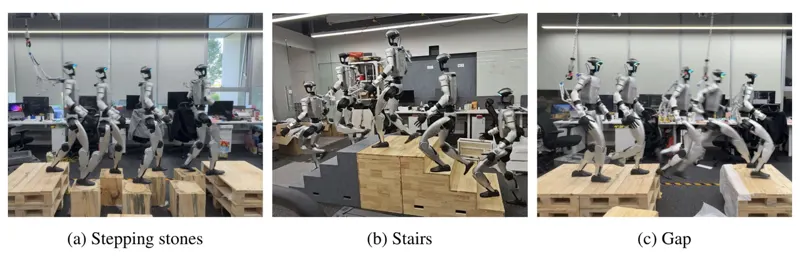
The outdoor deployment is the most persuasive evidence in the paper: on a route through an industrial heritage park the robot traverses 1.3 km continuously over 40 minutes, crossing stairs of varying size, high platforms, rough ground and grassy slopes without a reset or a misstep. Three stress tests sharpen the picture. Under wheeled-trolley shaking and pushes from behind during stair descent it still lands on flat treads, showing timely foothold decisions under tight response windows. Under grass-induced occlusion the gait does not visibly degrade and the robot steers away from poorly observed regions. On out-of-distribution terrains never seen in training, including perforated grid flooring, a slippery trolley, movable forklift pallets, narrow 1.3 m open-riser stairs and spiral stairs, the policy traverses stably. Cross-platform validation moves the identical training and deployment pipeline to the 1.8 m, 70 kg DEEP Robotics DR02 with no platform-specific algorithmic changes and still reports the high success rates in the right column above, so SSR is not tied to one embodiment.
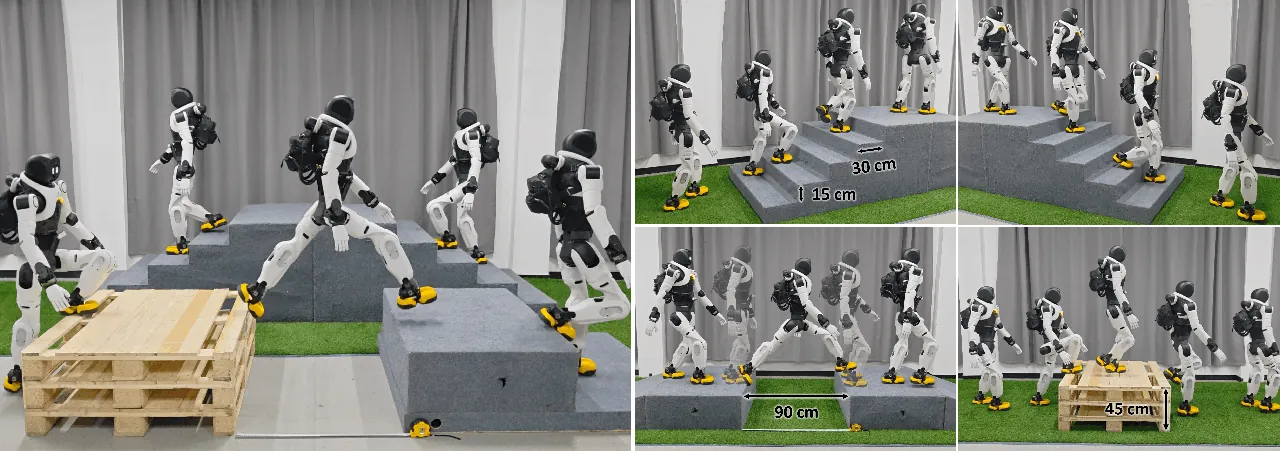
Figure 5: Zero-shot lab deployment key frames: stair traversal, 90 cm gap crossing and 45 cm platform climbing with safe foot placement and natural whole-body motion.
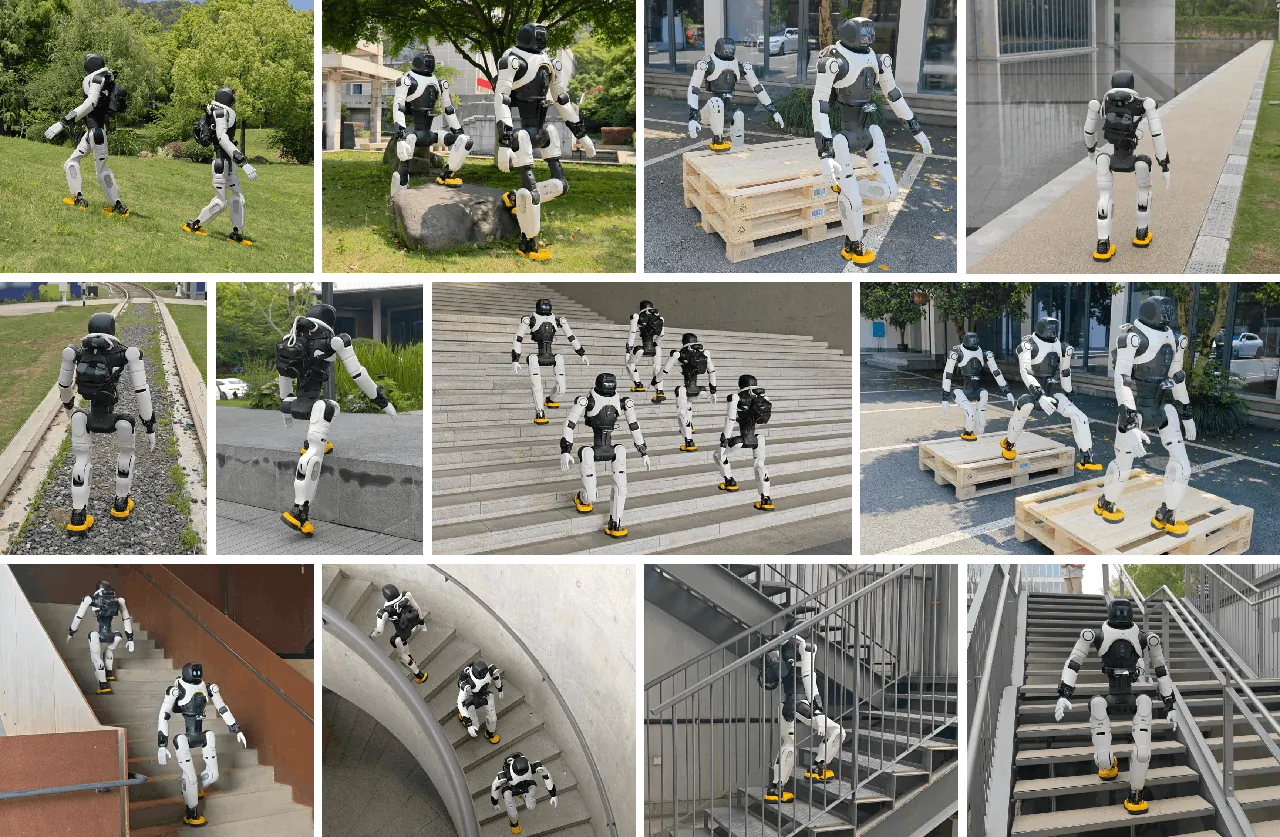
Figure 6: SSR traversing open-world human environments: grassy slopes, stairs of varying structure, high platforms and wide gaps, keeping safe foot placement and coordinated natural motion over long horizons.
Limitations
The authors state three. First, the fixed forward-facing depth camera limits perceptual coverage, making omnidirectional traversal difficult; multi-view sensing or active viewpoint adjustment is future work. Second, although the policy is robust to visual occlusion and several outdoor OOD terrains, severe depth failures such as specular reflections under strong sunlight still distort local geometry, calling for more robust perceptual embeddings. Third, SSR focuses on foot-ground interaction and leaves upper-body contacts unexplored; multi-contact skills and richer human demonstrations are the natural extension.
Two further caveats deserve attention. The long-horizon outdoor traversal is qualitative: the 1.3 km route was run once, with no repeated trials or success statistics, so the lab tables should not be read as coverage of that route, and the perturbation and occlusion tests remain demonstrations. And the human-likeness metrics (AP, PFCF) are computed only in simulation; on hardware the "more human" claim rests largely on video, while the 36x36 depth resolution that buys onboard feasibility also means the policy is essentially blind to fine surface texture such as wet versus dry ground, so its safety margin comes from conservative foothold geometry rather than material understanding.
Conclusion and Outlook
SSR's contribution is not a single trick but a reassignment of three long-competing jobs to the levels where they are cheap: safety assessment moves into the swing phase, symmetry augmentation moves into latent space, and the style prior splits per terrain. All three share one single-stage PPO loop, and deployment keeps only an encoder-estimator-MoE-actor policy running at 50 Hz onboard. This "complex in training, minimal at deployment" structure is a pattern worth remembering as vision-based humanoid control moves into the open world.
The paper's own outlook, multi-view perception, robust depth embeddings and multi-contact skills, maps exactly onto the three remaining gaps of open-world traversal: see everything, see it reliably, use the whole body. If imagined foothold guidance were combined with surface-material estimation, and equivariant latent augmentation extended to asymmetric loading tasks such as carrying or railing support, the framework would move another step toward walking among humans the way humans do. For engineering teams the most reusable asset here may be the deployment-consistent self-occluded depth renderer: keeping simulated perception in distribution with the real sensor is what stops sim-to-real from cracking at the perception layer.
Golden Line
A safe foothold is not discovered at touchdown; it is imagined, evaluated and corrected while the foot is still in the air.