Humanoid locomotion across complex terrain demands forward-looking exteroception to anticipate obstacles, yet this signal is unreliable in real-world deployment, failing partially and intermittently. Existing perceptive policies often assume that depth observations remain clean and in-distribution, while recent attempts to unify perceptive and blind control typically route or switch between separate sub-policies, leaving recoverable information in partially corrupted depth unexploited. We instead propose CAP, a single-stage humanoid locomotion policy that recovers this signal with a perceptive world-model encoder trained as a learned denoiser to reconstruct clean depth from a corrupted input, together with a co-active proprioceptive variational encoder that supplies depth-free body-state information. A coupled training recipe pairs a depth-noise curriculum on the world-model input with world-model feature dropout on the policy-facing latent, exposing the policy to failures across the entire perception-quality spectrum. In simulation, CAP matches or improves upon perceptive baselines when depth remains informative, and degrades more smoothly than a binary-switching baseline as perception worsens. On the Unitree G1, controlled trials and indoor-outdoor deployments demonstrate perception-robust locomotion under intermittent occlusion, real-sensor corruption, and outdoor depth artifacts.
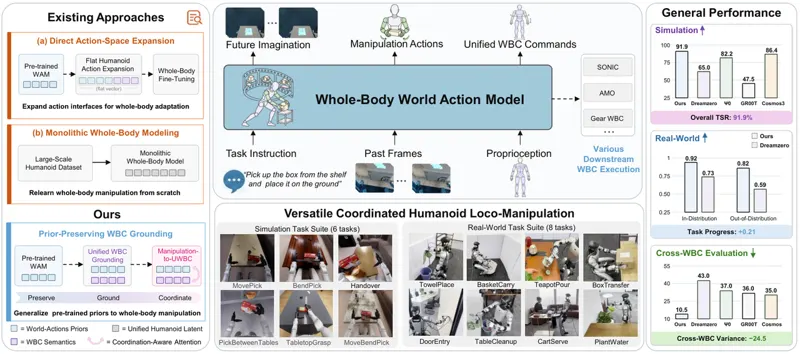
World Action Models (WAMs) offer a promising approach to general-purpose robot manipulation by jointly modeling visual dynamics and actions. However, most WAM studies focus on tabletop or arm-centric manipulation, while humanoid loco-manipulation remains less explored. To address this gap, we introduce WholeBodyWAM, which jointly predicts future visual dynamics, manipulation actions, and whole-body control intents for generalizable humanoid loco-manipulation. It preserves pre-trained world-action priors while grounding heterogeneous whole-body controller (WBC) semantics and coordinating whole-body behavior. Extensive experiments show that WholeBodyWAM achieves an overall simulation task success rate of 91.9%, with a 0.23 improvement in real-world out-of-distribution task progress and a 70% reduction in success-rate variance across WBCs relative to the respective baselines. These results suggest a path toward scalable humanoid whole-body intelligence by extending pre-trained world-action priors through structured WBC grounding and coordination, rather than relearning whole-body behavior from scratch. Project page: https://wholebodywam.github.io/.
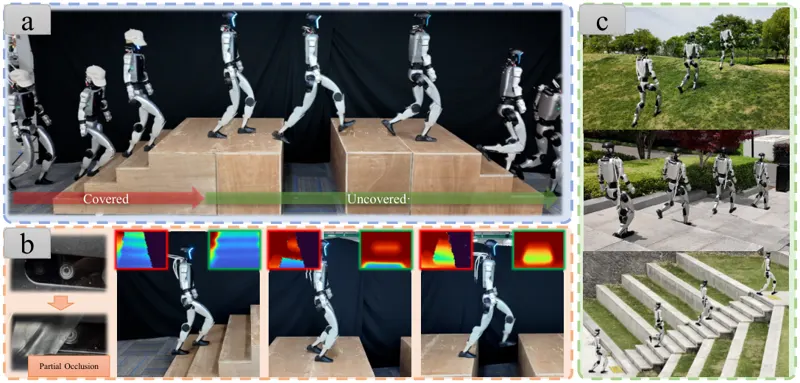
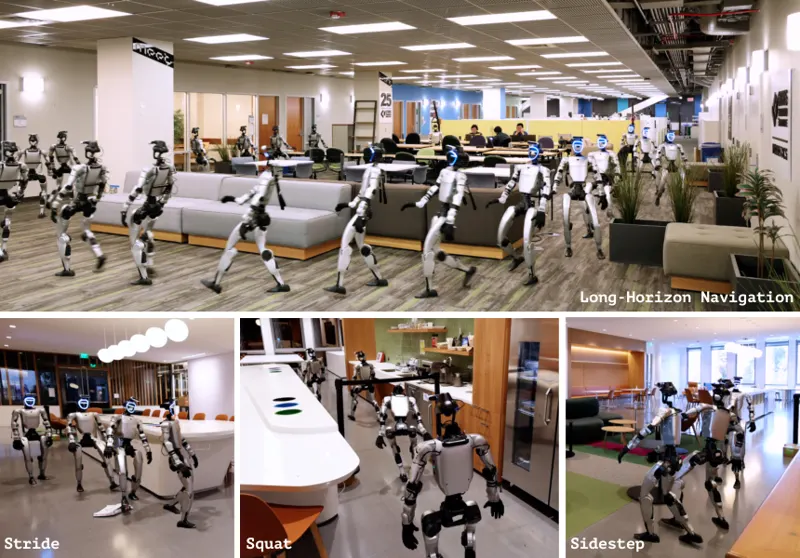
Extending humanoid traversal to the open world is key to practical deployment in human environments, but remains challenging. The robot must use vision to ensure safe and reliable foot placement on heterogeneous terrain under highly dynamic motion, while producing coordinated, natural whole-body behaviors. We propose SSR, an efficient end-to-end framework for egocentric vision-based humanoid traversal that jointly learns these capabilities. SSR introduces imagined foothold guidance, which learns to model forthcoming swing-foot contacts and evaluates their support to guide pre-touchdown swings toward stable regions, reducing edge slips. It further employs equivariant latent-space symmetry augmentation to efficiently induce bilateral coordination under high-dimensional visual observations, and uses terrain-specific multi-discriminator motion priors to encourage human-like behavior across scenes. Extensive experiments show that SSR achieves safe, stable, and high-quality locomotion on diverse real-world terrains, including stairs with varied structures and extreme challenges such as wide gaps and high platforms, while enabling reliable long-horizon traversal in open outdoor environments.
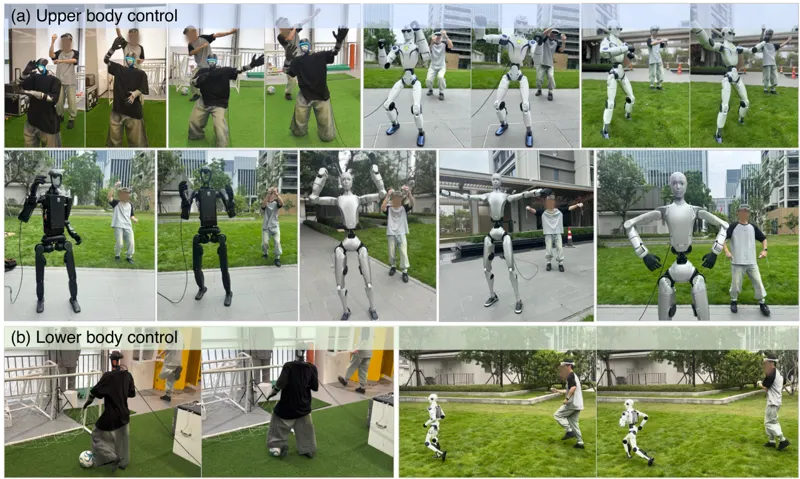
Scaling humanoid whole-body control toward general-purpose deployment requires large human motion corpora and training experience shared across robot bodies. Existing methods usually train one policy per robot, leaving motion experience isolated across embodiments. We introduce X-WBC, a cross-embodiment foundation framework that separates relatively shared human motion semantics from embodiment-specific physical execution. Human-centered command tokens align full human motion, robot reference motion, and sparse VR observations. A causal Transformer learns reusable temporal structure from mixed multi-robot rollouts, while lightweight robot-specific modules map the shared representation to each robot's proprioception and action space. Across nine simulated embodiments, external motions, and four real robots, experiments show that joint training improves tracking, the aligned representation supports consistent control across command sources, and the learned policy remains competitive beyond the training corpus. These results support heterogeneous humanoids as joint data sources and establish cross-embodiment joint training as a practical route toward whole-body control foundation models.
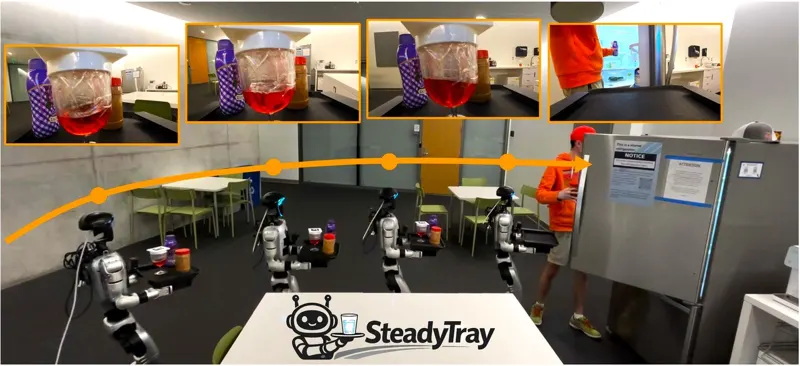
Stabilizing unsecured payloads against the inherent oscillations of dynamic bipedal locomotion remains a critical engineering bottleneck for humanoids in unstructured environments. To solve this, we introduce ReST-RL, a hierarchical reinforcement learning architecture that explicitly decouples locomotion from payload stabilization, evaluated via the SteadyTray benchmark. Rather than relying on monolithic end-to-end learning, our framework integrates a robust base locomotion policy with a dynamic residual module engineered to actively cancel gait-induced perturbations at the end-effector. This architectural separation ensures steady tray transport without degrading the underlying bipedal stability. In simulation, the residual design significantly outperforms end-to-end baselines in gait smoothness and orientation accuracy, achieving a 96.9% success rate in variable velocity tracking and 74.5% robustness against external force disturbances. Successfully deployed on the Unitree G1 humanoid hardware, this modular approach demonstrates highly reliable zero-shot sim-to-real generalization across various objects and external force disturbances.
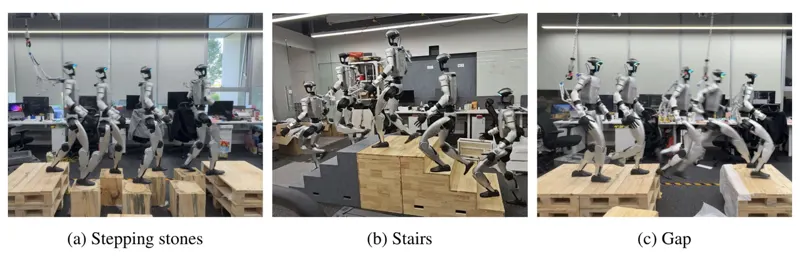
Foothold-constrained terrain is characterized by sparse, discontinuous, or geometrically restricted feasible foot contacts, as encountered on stepping stones, across gaps, and on narrow stair treads. On such terrain, a single misstep often leaves little room to recover, so policies that base foot-placement decisions primarily on the immediately visible terrain are prone to failure. We ask whether a learned predictive summary of near-future observations and rewards can provide the anticipatory information required in such settings. We present World-Model-Augmented Visual Locomotion (WM-LOCO), which jointly trains a recurrent world model and a PPO policy. Conditioned on proprioception and a single onboard depth image, the world model produces a predictive recurrent feature that guides the policy, without explicit foothold labels. In simulation, WM-LOCO succeeds on gaps and stepping stones where a matched baseline fails completely, and matches the baseline's success rate on stairs while improving stride efficiency and reducing pelvis acceleration. We deploy the same policy onboard a physical Unitree G1 humanoid using onboard proprioception and a single depth stream; it traverses all three terrain classes with an average success rate of 93.3%.
Training vision-language-action (VLA) policies for humanoid loco-manipulation is constrained by the high cost and complexity of collecting human teleoperation demonstrations. VLA policies fine-tuned in simulators have, until now, failed to transfer effectively in humanoid loco-manipulation tasks. We present LEGS (Loco-manipulation via Embodied Gaussian Splatting), a hybrid simulator that composites a mesh foreground (robot, objects, props) over a photorealistic 3D Gaussian Splatting (3DGS) background reconstructed from a handheld scene capture. LEGS uses a procedural motion-primitive generator to synthesize labeled demonstrations at scale without human teleoperation, and a deterministic two-stage color calibration to align the rendered 3DGS image to the robot's deployment camera. On a Unitree G1 humanoid robot, across three pick-and-place tasks of increasing whole-body difficulty and three VLA backbones (psi_0, pi_0.5, GR00T N1.6), a policy trained purely on LEGS data matches or exceeds one trained on human teleoperation demos on every experiment. It also outperforms a mesh-only simulation baseline that ablates the effect of the 3DGS background, showing that photorealistic rendering is a key enabler for synthetic data transfer. Humanoid motion is recorded independently of scene appearance in LEGS, allowing the same auto-generated demonstrations to be re-rendered under new backgrounds and object meshes–covering a new scene at more than 15x lower cost than teleoperation–to augment training data for robustness to scene variations. Under combined object-and-scene appearance shift, the policy trained on re-rendered LEGS-AUG data maintains task success while the baseline trained on teleoperation data fails entirely. Our project page is located at https://legsvla.github.io/.
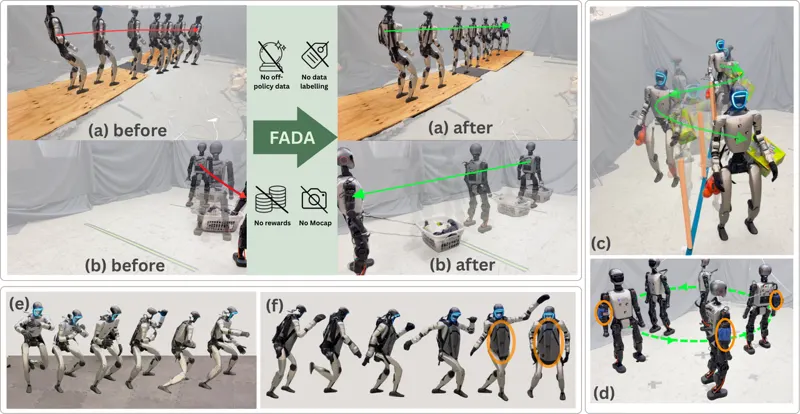
High-precision humanoid control is limited by target-domain dynamics mismatch, where the same control objective can induce different realized motions under changes in terrain, payload, or actuator response. Existing methods either pursue zero-shot transfer through domain randomization or in-context adaptation without target-domain specialization, or require heavy adaptation pipelines that leverage target-domain data, such as model calibration, residual learning, or policy retraining. In this paper, we present FADA (Few-Shot Domain Adaptation via Dynamics Alignment), a three-stage Planner-Inverse Dynamics Model (Planner-IDM) framework for few-shot adaptation in humanoid control. FADA first trains an oracle policy with privileged information and then distills the oracle behavior into a deployable Planner-IDM student through DAgger. At deployment, FADA freezes the planner and finetunes only the IDM using approximately 2 minutes of target-domain rollouts with standard supervised learning. Rather than requiring optimal demonstrations or rewards, FADA uses the paired actions and observations that are observed during these rollouts as supervision, aligning the IDM's action generation with target-domain dynamics. Experiments show that FADA outperforms both in-context and end-to-end adaptation baselines, improving task performance under dynamics shifts and enabling real humanoid robots to execute diverse high-precision whole-body tasks. Implementation details and qualitative hardware rollout videos are available at https://lecar-lab.github.io/FADA-humanoid/.
We study the problem of navigating cluttered indoor environments with a humanoid robot. Unlike conventional methods that model navigation as a 2D path planning problem, humanoid traversal in cluttered environments requires continuous geometry-aware whole-body adaptation, including coordinated arm placement, torso adjustment, and gait modulation for collision-free movement through complex 3D spaces. We introduce TANGO, the first whole-body vision-language navigation framework for language-conditioned humanoid traversal in cluttered environments. Given a natural-language instruction and egocentric RGB observations, TANGO directly predicts 29-DoF joint-space actions for downstream whole-body control. We train TANGO entirely in simulation by synthesizing diverse collision-free traversal behaviors via global path planning, kinematic whole-body motion generation, obstacle-aware motion editing, and RL-based tracking. This pipeline provides dynamically feasible action supervision for learning language-conditioned whole-body policies. In extensive simulation experiments, TANGO demonstrates state-of-the-art performance in vision-language navigation, while outperforming strong modular baselines in navigating challenging scenes requiring obstacle negotiation. Lastly, we deploy TANGO zero-shot on a Unitree G1 humanoid robot, and observe robust language-guided traversal in cluttered real-world scenes without training on any real-world navigation data.
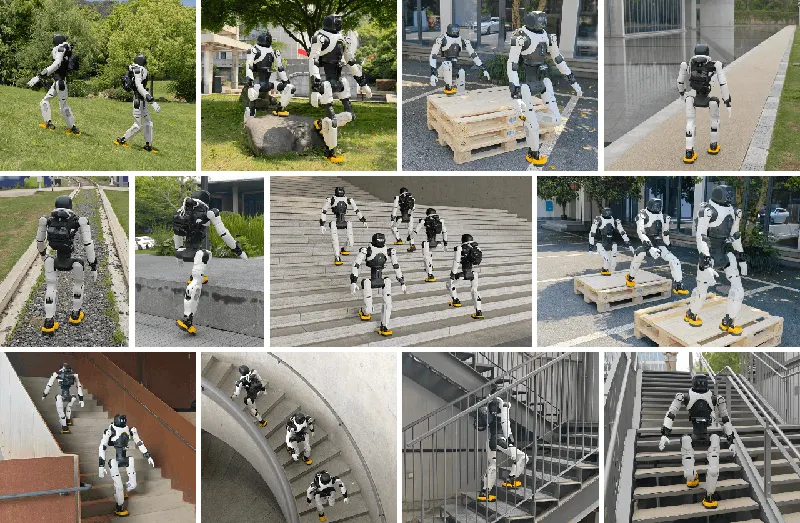
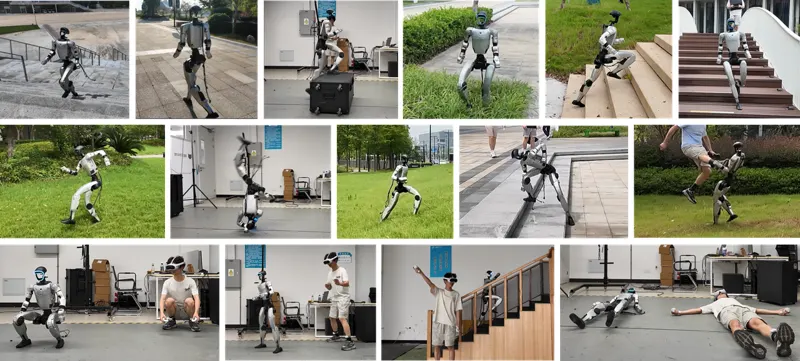
Humanoid motion trackers can reproduce diverse whole-body motions, but their performance degrades on complex terrain where terrain-agnostic references become physically infeasible. We present PGMT, a Perceptive General Motion Tracking pipeline for humanoid robots that learns terrain adaptation from independently selected motion references and terrains. PGMT first learns a general tracking and recovery prior, then incorporates terrain perception through motion-conditioned terrain glimpses that selectively encode regions relevant to the current motion. Terrain-aware tracking relaxation allows necessary deviations from the reference while preserving its motion intent. Zero-shot deployment on a Unitree G1 demonstrates robust terrain-adaptive locomotion and whole-body motion execution over real-world terrain with obstacles up to 37 cm high, while supporting teleoperation, dynamic motion tracking, and fall recovery. PGMT extends general humanoid motion tracking beyond flat ground, providing a unified policy for terrain-adaptive locomotion, diverse whole-body behaviors, and teleoperation in complex environments.
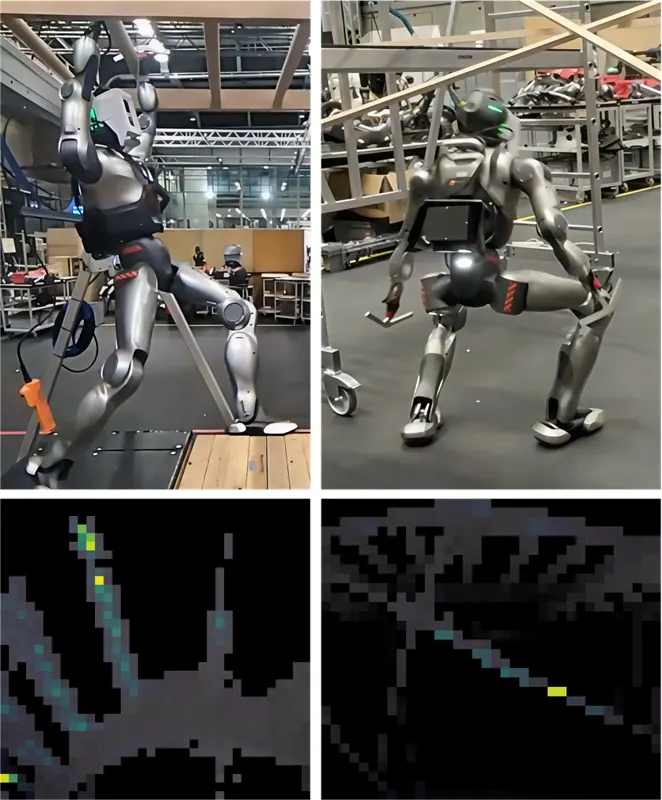
Traversing sparse 3D structures requires humanoid robots to perceive thin, overhanging geometry while executing agile, accurate whole-body motions. We study this problem through monkey-bar traversal, where the robot must jump to the structure, traverse it through sparse bar interactions, and land safely. For this task, we present a reinforcement-learning-based perceptive control system that operates directly on observations from a head-mounted solid-state lidar. To extract task-relevant geometry from the sparse returns, the policy consumes the raw lidar scan through an attention-based encoder with recurrent memory. This policy is obtained by a phase-scheduled teacher- student pipeline that combines privileged experts for jumping up, brachiating, and jumping down. For transfer to hardware, we model lidar noise, battery-voltage sag, and actuator thermal limits, and equip the humanoid with passive hook end-effectors for robust bar interaction. On hardware, the resulting policy completes the full jump-up->brachiation->jump-down sequence in 14 of 15 trials across three bar configurations and reaches brachiation speeds up to 0.5 m/s. Beyond brachiation, the same perception backbone supports a separately trained policy that ducks beneath thin overhead obstacles with 2 cm cross-sections.
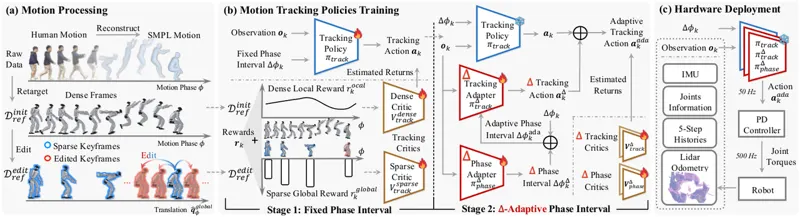
Humanoid robots are envisioned to adapt demonstrated motions to diverse real-world conditions while accurately preserving motion patterns. Existing motion prior approaches enable well adaptability with a few motions but often sacrifice imitation accuracy, whereas motion-tracking methods achieve accurate imitation yet require many training motions and a test-time target motion to adapt. To combine their strengths, we introduce AdaMimic, a novel motion tracking algorithm that enables adaptable humanoid control from a single reference motion. To reduce data dependence while ensuring adaptability, our method first creates an augmented dataset by sparsifying the single reference motion into keyframes and applying light editing with minimal physical assumptions. A policy is then initialized by tracking these sparse keyframes to generate dense intermediate motions, and adapters are subsequently trained to adjust tracking speed and refine low-level actions based on the adjustment, enabling flexible time warping that further improves imitation accuracy and adaptability. We validate these significant improvements in our approach in both simulation and the real-world Unitree G1 humanoid robot in multiple tasks across a wide range of adaptation conditions. Videos and code are available at https://taohuang13.github.io/adamimic.github.io/.