Skip to content
PhyAI: Real-Time Physical AI at the Edge, Scalable Rollouts in the Cloud

PhyAI: Real-Time Physical AI at the Edge, Scalable Rollouts in the Cloud

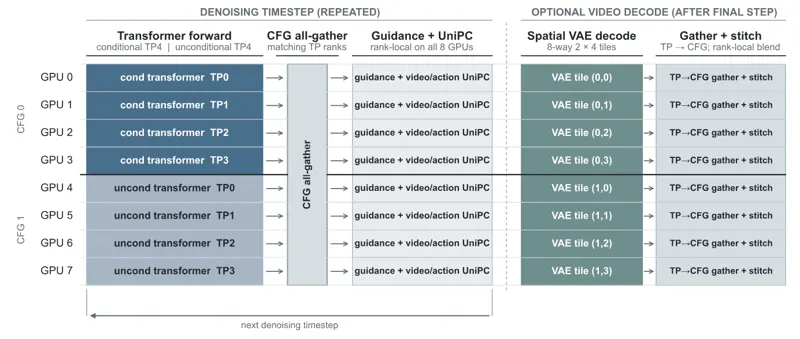
Physical AI policies require inference throughout their lifecycle, including model evaluation, cloud reinforcement learning rollout, edge GPU serving, and onboard deployment. Although these settings share the same checkpoint and action semantics, they often rely on separate inference programs. To unify them, we build PhyAI, a Physical AI inference engine with a single runtime that keeps architecture-specific conditioning, solver, cache, and output logic in model adapters while sharing graph execution, kernels, memory management, and parallel services. The same codebase runs vision-language-action (VLA) models and world-action models (WAMs) on single or multiple GPUs across onboard, edge, and cloud deployments. We used the adapter interface to add MiniCPM-Robot on the day of its release. PhyAI achieves 1.40x-4.65x speedups over the official implementations of pi0, pi0.5, GR00T N1.7, and MiniCPM-Robot. On Cosmos3-Nano-Policy-DROID it reduces latency from 2.46 to 1.18 s on eight H20 GPUs (CFG=2, TP=4), a 2.08x speedup. Specialized runtimes remain faster in several configurations, so our goal is one runtime with competitive latency rather than the fastest result in every case. Detailed profiles reveal why different models need different execution policies: on a Hopper-series GPU at batch size one, the pi0.5 action expert accounts for 8.8% of FLOPs but 57.2% of latency; at batch size 32 its share drops to 13.5% and throughput reaches about 100 samples/s. Cosmos3 remains generation-dominated and gains only 14.3% throughput as batch size increases from 1 to 16. We further introduce the control-time Roofline, which distinguishes inference-bound from environment-bound control; the measured pi0.5 points on four LIBERO suites are environment-bound while Cosmos3 stays inference-bound. Code and benchmarks: https://github.com/mingti-org/phyai.

Physical AIVLA
Chenghua Wang, Daliang Xu, Dongqi Cai · 868 views · Aug 4, 2026
RL²-VLA: Adaptive RL Latent Compositional Steering with Test-Time Scaling for Vision-Language-Action Models

RL²-VLA: Adaptive RL Latent Compositional Steering with Test-Time Scaling for Vision-Language-Action Models

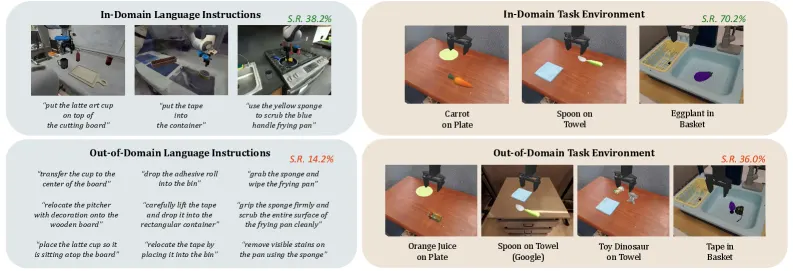
Despite the impressive visuomotor capabilities enabled by Vision-Language-Action (VLA) models, their performance often degrades on challenging and out-of-domain tasks. Recent test-time steering and scaling methods improve performance without extensive data collection and retraining, but action samples often remain concentrated around similar behaviors and therefore inherit correlated failure modes. Moreover, existing methods apply the same intervention strategy at every timestep, regardless of whether the base policy is already likely to succeed. To address these limitations, we introduce RL², an adaptive inference-time steering framework that leverages Reinforcement Learning on VLA Latents. First, we train a lightweight offline RL policy conditioned on expressive latents extracted from the VLA action expert and compose its flow velocity with that of the frozen VLA during inference. This compositional steering strategy combines the behavioral priors of large-scale imitation learning with the action diversity induced by offline RL beyond dominant demonstration modes. We further discover that inference-time steering follows fundamentally different scaling laws under success and failure states, revealing that action diversity is most beneficial when the base VLA is likely to fail, but can unnecessarily perturb already-accurate actions when success is likely. Building on this insight, RL² activates compositional steering only when failure is predicted. Across the SIMPLER and PolaRiS benchmarks, RL² improves success rates by up to +17.3% in out-of-domain settings, while ablations and scaling studies demonstrate the importance of latent representations and RL training. Finally, real-world experiments demonstrate that these gains transfer beyond simulation, establishing RL² as a practical and modular steering framework for VLA deployment.

VLARL2-VLA
Derek Ming Siang Tan, Shailesh Shailesh, Srikrishna Iyer · 795 views · Jul 29, 2026
πR²: Reactive Real-time Flow Policies

πR²: Reactive Real-time Flow Policies

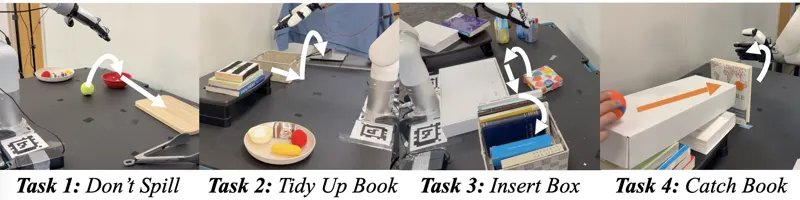
Generalist manipulation policies increasingly take the form of action-chunking flow policies built on large pretrained backbones. Such chunks run open-loop, so the policy cannot react to sensory input arriving mid-execution, sacrificing reactivity. Replanning more often would restore it, but the perception-to-action pipeline (a large backbone plus multiple denoising steps) is too slow: this latency forbids frequent replanning and leaves committed actions stale, making such policies ill-suited for dynamic, closed-loop control. We present πR², which makes these policies reactive and real-time while retaining large backbones, expressive multi-modal policies, and multi-action prediction. Built on the per-position noise schedule of diffusion forcing, πR² contributes two ideas. First, it splits conditioning into a fast channel (proprioception, fresh every tick) and an asynchronously updated slow channel (vision-language features), so the policy reacts to proprioception within a chunk while tolerating stale vision. Second, a latency-adaptive flow schedule treats in-flight actions as inpainting conditioning and emits actions in one denoising step per call, letting one trained model adapt to varying hardware latency. Requiring minimal modification to existing architectures, πR² can be finetuned from a pretrained policy: applied to GR00T-N1.7 on a real xArm6+XHand platform, it replans closed-loop roughly 4× faster than the base policy (~$25$Hz on an A5000 GPU), acting on a fresh observation every $40$ms. Across simulation and real-world manipulation tasks, πR² improves the success rate by up to 23% in simulation and 30% in the real world over the strongest baseline. Project page: https://pi-r2-flow.github.io/

VLAreactive
Sungjae Park, Shubham Tulsiani · 891 views · Jul 28, 2026
FA-RDP: A Frequency-Adaptive Reactive Diffusion Policy for Contact-Rich Manipulation

FA-RDP: A Frequency-Adaptive Reactive Diffusion Policy for Contact-Rich Manipulation

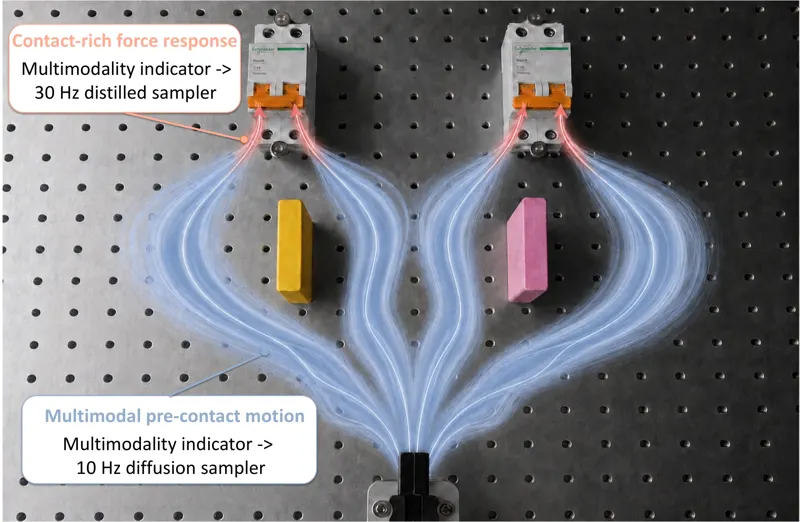
In contact-rich manipulation, action multimodality and reactivity dominate different stages of a single episode. Before contact, multiple trajectories might be equally valid, making it important to preserve diverse action modes. After contact, geometric constraints and force limits narrow the solution space, while successful execution demands rapid responses to force feedback. However, standard diffusion policies use a fixed inference frequency and sampling steps throughout the episode, forcing a fundamental compromise: low-frequency, multi-step sampling better preserves pre-contact multimodality but responds slowly to force feedback, whereas high-frequency sampling improves reactivity but tends to collapse distinct pre-contact modes. To resolve this tradeoff, we present FA-RDP, a frequency-adaptive reactive diffusion policy. A shared multi-frequency visual-force Transformer predicts action chunks at both low and high frequencies, while a learned multimodality indicator dynamically selects multi-step low-frequency sampling before contact and one-step high-frequency sampling as action ambiguity decreases. We further introduce Manifold Consistency Distillation (MCD), which reparameterizes the diffusion network to predict actions on the robot action manifold while retaining DDPM-based residual supervision. Experiments on three contact-rich manipulation tasks show that FA-RDP achieves the highest success rate while preserving diverse pre-contact trajectory modes. Code and videos are available at https://fa-rdp.github.io.

VLADiffusion policies
Lifeng Zhuo, Wendi Chen, Han Xue · 567 views · Jul 30, 2026
HiFi-UMI: Learning Deployable Manipulation Policies from High-Fidelity UMI Data Alone

HiFi-UMI: Learning Deployable Manipulation Policies from High-Fidelity UMI Data Alone

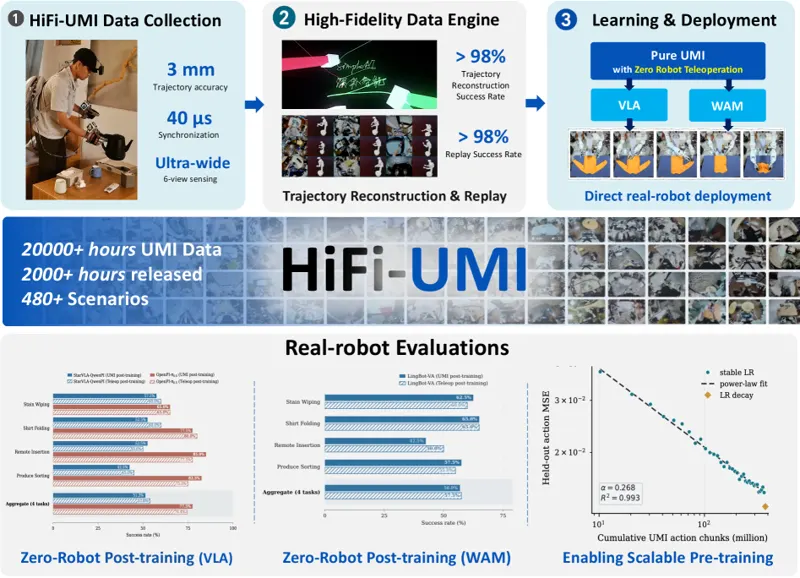
Learning deployable manipulation policies is bottlenecked by the scarcity of data that is both high-fidelity and scalable. Real-robot teleoperation is accurate but costly to scale; robot-free UMI capture scales readily, and current practice uses the resulting data mainly for pre-training, adding a small real-robot "anchor" at post-training. We ask whether raising the fidelity of robot-free UMI data, rather than shrinking the real-robot fraction, can remove that anchor. We present HiFi-UMI, a portable UMI data-production system co-designed for trajectory accuracy, inter-gripper relative pose, synchronization, and field of view: head-mounted offline stereo-inertial SLAM, native rather than reconstructed relative pose, a shared microsecond GPIO trigger, and two wide-angle cameras per hand covering ~200 degrees. It reaches 3 mm workspace-local end-effector accuracy without external tracking infrastructure. Using this corpus, we demonstrate zero-robot post-training: a policy post-trained solely on HiFi-UMI demonstrations deploys directly on a real robot and matches in-domain teleoperation across three backbones spanning the vision-language-action and world-action-model families, with success-rate differences of -2.5, +3.1, and -0.6 percentage points on StarVLA-QwenPI, OpenPI-pi_0.5, and LingBot-VA; the strongest policy reaches 85% on a precision insertion task, even though the teleoperation baseline is collected in the evaluation scene and no HiFi-UMI trajectory is. Pre-training on 4,000 hours from the same corpus lowers action error on ten unseen tasks by 41% and, on StarVLA-QwenPI, raises real-robot success by a further 18.1 percentage points. We open-source HiFi-UMI-2K, 2,000 hours of microsecond-synchronized, ultra-wide-FoV demonstrations, each automatically reconstructed and validated through simulation replay, as a large-scale, high-fidelity resource for the robot-learning community.
UMIVLA
Simple AI, :, Yuteng Wei · 622 views · Jul 28, 2026

As an Amazon Associate, we earn from qualifying purchases.