Skip to content
Harness-Zero: Harness Distillation via Agent-as-Harness

Harness-Zero: Harness Distillation via Agent-as-Harness

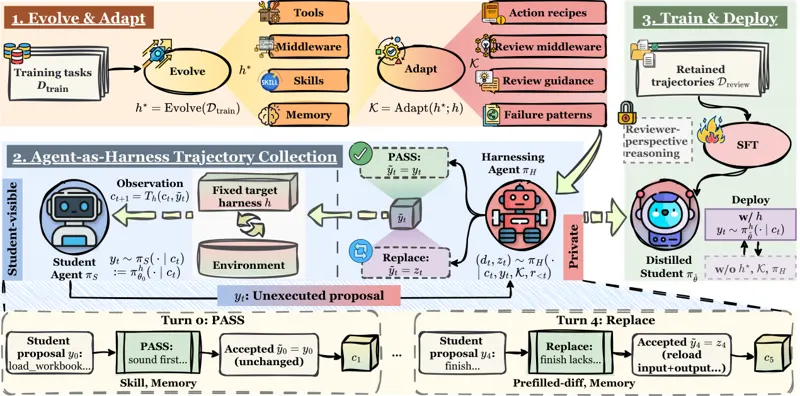
Agent harnesses, the external systems that mediate model-environment interaction, can substantially improve agent performance, but their gains remain tied to the harness at deployment. Because the best harness varies across domains, instances, and models, a general-purpose agent must either settle for a suboptimal shared harness or route among an ever-growing set of specialized ones. We therefore study agent harness distillation: using a domain- or instance-optimized harness as training-time guidance and transferring the behaviors it induces into model weights, so that its gains survive under a single fixed target harness. The challenge is that the two harnesses differ in action space and available information, so guidance from the optimized harness cannot serve directly as supervision for the target one. We introduce Harness-Zero, which enables harness distillation through agent-as-harness. Guided by the optimized harness, a harnessing agent corrects student responses before execution in the target harness's action space, turning harness guidance into training demonstrations. Fine-tuning on the resulting trajectories internalizes harness-induced behavior into the model, so the specialized harness can be removed at deployment. Our experiments spanning knowledge work, tool use, and science domains show that: (1) For frontier LLMs using the same evolved harness, agent-as-harness outperforms code-as-harness. (2) With the specialized harness removed at deployment, Harness-Zero improves the base model's macro-average task success from 23.3% to 44.3%, even exceeding the 41.7% it reaches with that harness still attached. (3) Harness-Zero recovers harness-induced behaviors absent from the base model, with 82.3% average recovery across 28 patterns in the three domains.
Agent HarnessHarness Distillation
Ye, Haoran, Lu, Yuxing, Dong, Haonan · 439 views · Sep 21, 2026
RLSR: Reinforcement Learning from Self Reward

RLSR: Reinforcement Learning from Self Reward

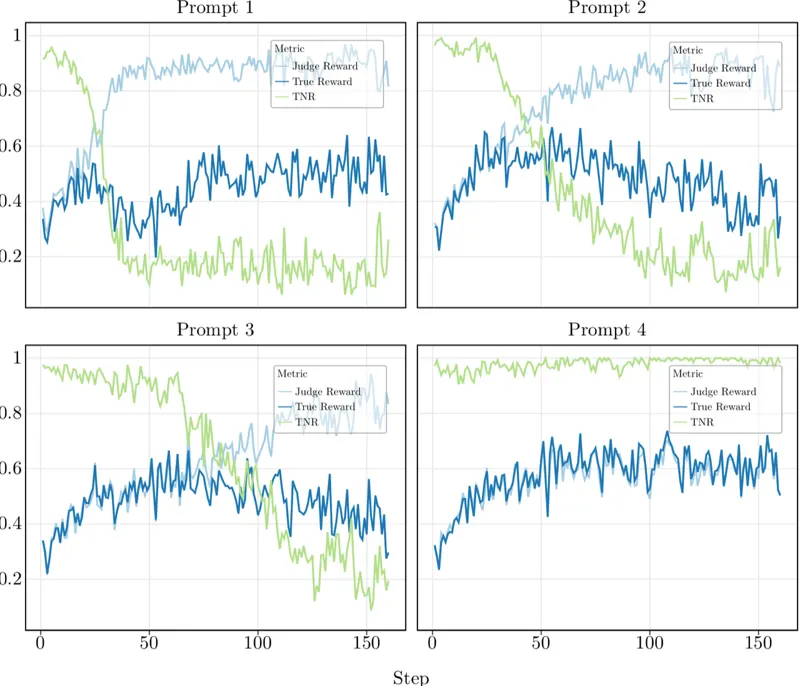
Large language models can generate solutions to complex problems, but training them with reinforcement learning typically requires verifiable rewards that are expensive to create and not possible for all domains. We demonstrate that LLMs can effectively self-improve through self-judging without reference solutions, leveraging the inherent asymmetry between generating and verifying solutions. Our experiments show that models can provide reliable reward signals without ground truth answers, enabling reinforcement learning in domains where verifiable rewards are impractical. By implementing self-judging across Countdown puzzles and integration problems, we achieve performance comparable to formal verification without ground truth solutions. Most notably, Qwen 2.5 7B DeepSeek Distilled trained with self-rewards qualifies for the prestigious MIT Integration Bee competition, performance through self-supervised improvement. When combined with synthetic question generation, we establish a complete self-improvement loop where models generate practice problems, solve them, and evaluate their own performance without any external validation. Our findings demonstrate that LLM judges can provide effective reward signals for training, unlocking reinforcement learning in countless domains previously limited by reward engineering challenges. This work represents a significant step toward autonomous AI systems that continuously improve through self-directed learning rather than human-guided training, potentially accelerating progress across domains where training data is scarce or evaluation is complex.

Reinforcement LearningLarge Language Models
Toby Simonds, Kevin Lopez, Akira Yoshiyama · 348 views · May 12, 2025
Post-Training Large Language Models via Reinforcement Learning from Self-Feedback

Post-Training Large Language Models via Reinforcement Learning from Self-Feedback

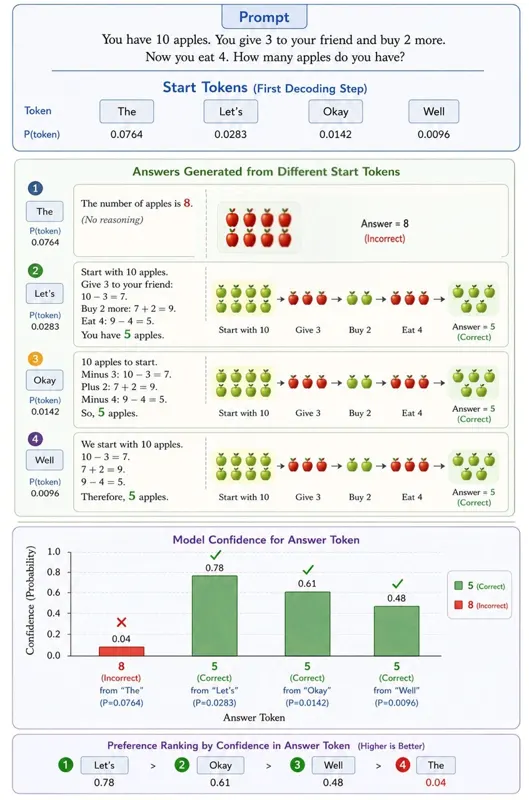
Large Language Models (LLMs) often produce plausible but poorly-calibrated answers, limiting their reliability on reasoning-intensive tasks. Recent research suggests that Chain-of-Thought (CoT) reasoning paths are inherent in pre-trained LLMs and can be elicited by simply altering the decoding process, where the presence of a CoT path correlates with higher answer confidence. Building on these insights, we present Reinforcement Learning from Self-Feedback (RLSF), a post-training stage that utilises the model's intrinsic confidence as a self-generated reward. By generating multiple CoT decoding beams from a frozen LLM, we compute the confidence of each final answer span and rank the resulting traces accordingly to create synthetic preferences. These preferences are subsequently utilised to fine-tune the policy through standard preference optimisation, requiring no human labels, gold answers, or externally curated rewards. RLSF simultaneously (i) refines the model's probability estimates–restoring well-behaved calibration–and (ii) strengthens step-by-step reasoning, yielding improved performance on arithmetic reasoning and multiple-choice question answering. By converting a model's own uncertainty into structured self-feedback, RLSF affirms reinforcement learning on intrinsic model behaviour as a principled and data-efficient component of the LLM post-training pipeline. Our results demonstrate that leveraging these inherent reasoning capabilities provides a robust path for enhancing model reliability without manual prompt engineering or external supervision.

Large Language ModelsReinforcement Learning
Carel van Niekerk, Renato Vukovic, Benjamin Ruppik · 549 views · Jul 29, 2025
DeFM: Learning Foundation Representations from Depth for Robotics

DeFM: Learning Foundation Representations from Depth for Robotics

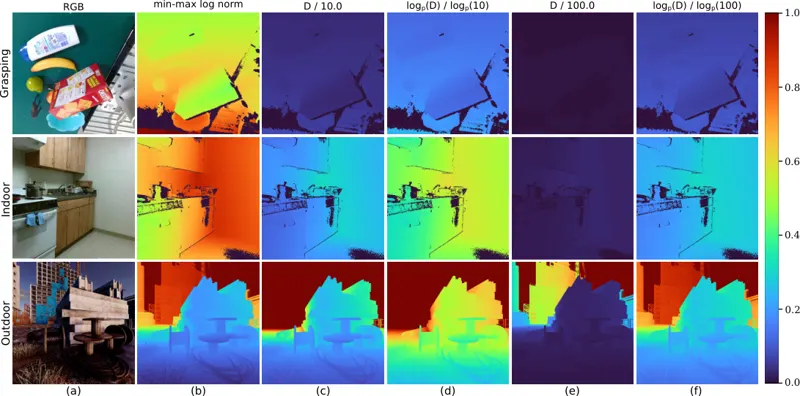
Depth sensors are widely deployed across robotic platforms, and advances in fast, high-fidelity depth simulation have enabled robotic policies trained on depth observations to achieve robust sim-to-real transfer for a wide range of tasks. Despite this, representation learning for depth modality remains underexplored compared to RGB, where large-scale foundation models now define the state of the art. To address this gap, we present DeFM, a self-supervised foundation model trained entirely on depth images for robotic applications. Using a DINO-style self-distillation objective on a curated dataset of 60M depth images, DeFM learns geometric and semantic representations that generalize to diverse environments, tasks, and sensors. To retain metric awareness across multiple scales, we introduce a novel input normalization strategy. We further distill DeFM into compact models suitable for resource-constrained robotic systems. When evaluated on depth-based classification, segmentation, navigation, locomotion, and manipulation benchmarks, DeFM achieves state-of-the-art performance and demonstrates strong generalization from simulation to real-world environments. We release all our pretrained models, which can be adopted off-the-shelf for depth-based robotic learning without task-specific fine-tuning. Webpage: https://de-fm.github.io/

DepthSelf-Supervised Learning
Manthan Patel, Jonas Frey, Mayank Mittal · 329 views · Jan 26, 2026
Learning Multi-Phase Robot Loco-Manipulation via Phase-Conditioned Policy Optimization

Learning Multi-Phase Robot Loco-Manipulation via Phase-Conditioned Policy Optimization

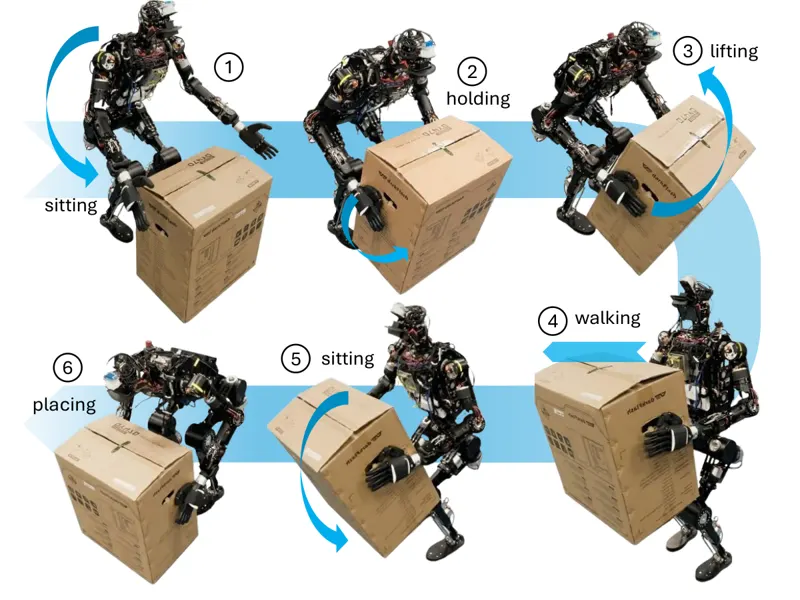
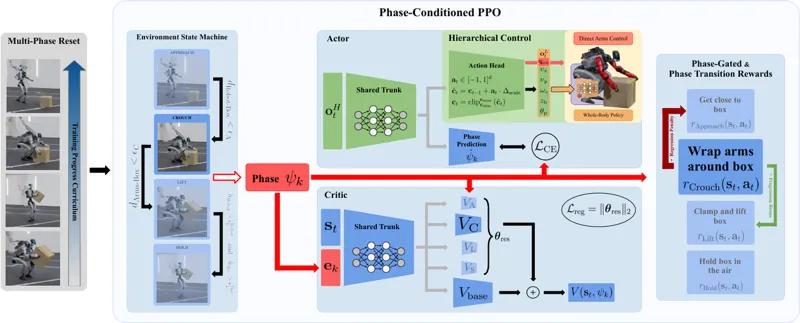
Complex whole-body loco-manipulation requires executing diverse maneuvers, such as crouching, grasping, and locomotion, within a single long-horizon task. While performing simple pick-and-place behaviors is well-established, scaling to complex, long-horizon tasks remains difficult. Currently, this challenge is addressed by relying on human motion data and correspondingly humanoid platforms, which limits platform independence and introduces substantial data processing overhead. Instead, we extend proximal policy optimization (PPO) to train a single policy for multi-phase tasks across diverse robotic hardware, leveraging prior task structure to shape behavior. Our method adapts PPO using a phase-conditioned critic, phase-gated reward functions, and a multi-phase reset curriculum to guide exploration. To support varied hardware, we employ a decoupled hierarchical control architecture that separates lower-level balancing dynamics from high-level phase execution. We demonstrate multi-stage loco-manipulation skills on hardware on both the Unitree G1 and a Boston Dynamics Spot equipped with a manipulator arm, and validate our design choices through ablations. Our approach enables the acquisition of complex loco-manipulation behaviors purely through environment interaction while directly incorporating high-level task structure into policy learning.

Whole-Body Loco-ManipulationPhase-Conditioned PPO
Simone Manni, Annika Wollschläger, Dario Bellicoso · 444 views · Oct 26, 2026

As an Amazon Associate, we earn from qualifying purchases.