Skip to content
InteractiveWorld: A Verifiable Human-Centric Environment for Building Better Interactive MLLM Assistants

InteractiveWorld: A Verifiable Human-Centric Environment for Building Better Interactive MLLM Assistants

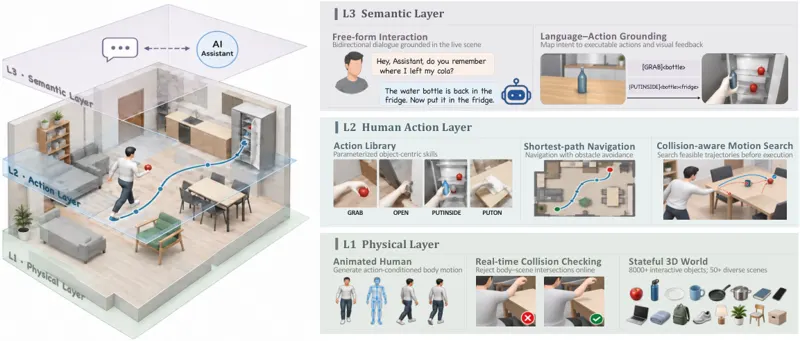
People have long dreamed of an assistant that is always there to guide them and remind what they forget, from new dishes to lost keys. Powered by multimodal large language models (MLLMs), egocentric AI assistants on wearable devices are bringing this dream within reach: they see what the user sees and give instructions for user's physical work when necessary. However, testing such assistance is challenging and usually requires real people. The expensive and rare real interaction data leaves a key question unanswered: Can today's MLLMs truly help people in physical world? To answer this question, we propose InteractiveWorld, the first verifiable environment for closed-loop interaction between human and AI assistant. Unlike existing robot-centric simulators, InteractiveWorld lets the assistant guide a human agent who observes the scene, understands instructions, and acts independently. It thus realistically simulates how AI assistant collaborates with human: the assistant instructs, the human acts, and the environment executes actions and updates what they see next. Building on it, we introduce InteractiveBench, the first dynamic benchmark for egocentric AI assistants, with 120 multi-turn tasks across six categories. In each task, the assistant guides the human in real time, and every instruction shapes the outcome, which is scored by verifiable, state-based rewards. Experiments with 12 frontier MLLMs show they are still far from reliable assistants. Even the strongest model, Claude Fable 5.1, achieves at most 20% and 25% on long-horizon Guidance and Planning tasks, respectively. Overall, our work offers a verifiable platform and a rigorous evaluation set, laying a solid foundation for research on interactive MLLM assistants that truly help people in the physical world.
MLLMEgocentric AI Assistant
Qinsi Wang, Wei Wen, Chong Zhou · 356 views · Oct 25, 2026
NavJev: Efficient Vision-Language Navigation via Action-Centric Visual Compression and Discriminative Action-Semantic Memory

NavJev: Efficient Vision-Language Navigation via Action-Centric Visual Compression and Discriminative Action-Semantic Memory

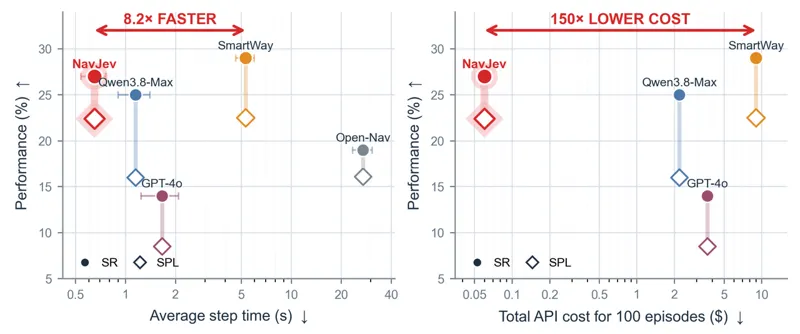
Recent zero-shot Vision-and-Language Navigation (VLN) methods increasingly rely on multimodal large language models (MLLMs) to reason over visual observations, navigation instructions, and candidate actions. Although effective, repeatedly invoking autoregressive multimodal reasoning at every navigation step introduces substantial inference latency, limiting the responsiveness of embodied agents. We propose NavJev, an efficient VLN framework that reformulates online navigation from repeated multimodal generation into compact visual compression followed by lightweight typed action selection. Specifically, Action-Centric Visual Compression (ACVC) integrates waypoint geometry, BLIP captions, and RAM semantic tags into compact representations of candidate actions, while Discriminative Action-Semantic Memory (DASM) filters shared semantics and maintains discriminative action-specific evidence across navigation steps. Based on these representations, Jev directly performs structured probabilistic decisions over the available action set. Experiments on R2R-CE show that NavJev achieves 27.0% SR and 22.4% SPL with only 0.65 s per navigation step, while substantially reducing inference latency and cost compared with MLLM-based VLN methods. The project page is available at https://kai-sheng-caesar.github.io/NavJev/.

Vision-language navigationZero-Shot
Kai Sheng, Liuyi Wang, Jinlong Li · 393 views · Sep 28, 2026
OpenBelief-Nav: Evidence-Preserving Object Memory for Open-Vocabulary Language-Guided Navigation

OpenBelief-Nav: Evidence-Preserving Object Memory for Open-Vocabulary Language-Guided Navigation

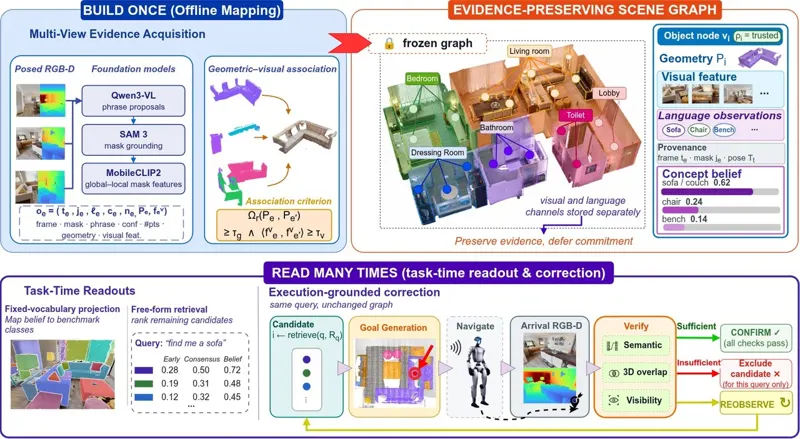
Open-vocabulary 3D scene graphs provide compact semantic memory for language-guided navigation, but mapped objects are often exposed through a single fused feature or committed semantic label. Such commitment can remove minority yet task-relevant hypotheses from the task-time interface. We present OpenBelief-Nav, an evidence-preserving object memory that retains observation-level phrases, reliability cues, and frame-mask provenance while maintaining separate aggregate geometric and visual representations. Semantically related phrases are consolidated into a vocabulary-independent object belief from which task-specific readouts perform fixed-vocabulary projection or free-form retrieval. On five ScanNet200 and eight Replica scenes, full-belief projection achieves mIoU scores of 0.2742 and 0.2912, compared with 0.2393 and 0.2701 for a matched early-commit readout. Across 78 HM3D-YCB navigation trials, consensus and early-commit retrieval each achieve 60/78 successes, compared with 58/78 for belief-weighted retrieval and 55/78 for DualMap. Across 20 Unitree G1 runs organized as 10 matched evaluation cases, a correction policy permitting at most two verified candidate attempts improves target-confirmation success from 6/10 to 8/10 relative to top-1-only execution. Code will be released upon acceptance at https://openbelief-nav.github.io/.

Open-Vocabulary Navigation3D scene graphs
Dinh Tuan Nguyen, Anh Dao, Phuong Nam Dang · 288 views · Aug 14, 2026

As an Amazon Associate, we earn from qualifying purchases.