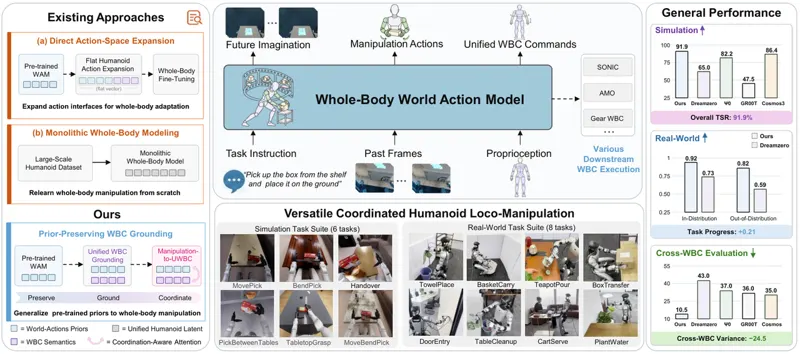
World Action Models (WAMs) offer a promising approach to general-purpose robot manipulation by jointly modeling visual dynamics and actions. However, most WAM studies focus on tabletop or arm-centric manipulation, while humanoid loco-manipulation remains less explored. To address this gap, we introduce WholeBodyWAM, which jointly predicts future visual dynamics, manipulation actions, and whole-body control intents for generalizable humanoid loco-manipulation. It preserves pre-trained world-action priors while grounding heterogeneous whole-body controller (WBC) semantics and coordinating whole-body behavior. Extensive experiments show that WholeBodyWAM achieves an overall simulation task success rate of 91.9%, with a 0.23 improvement in real-world out-of-distribution task progress and a 70% reduction in success-rate variance across WBCs relative to the respective baselines. These results suggest a path toward scalable humanoid whole-body intelligence by extending pre-trained world-action priors through structured WBC grounding and coordination, rather than relearning whole-body behavior from scratch. Project page: https://wholebodywam.github.io/.
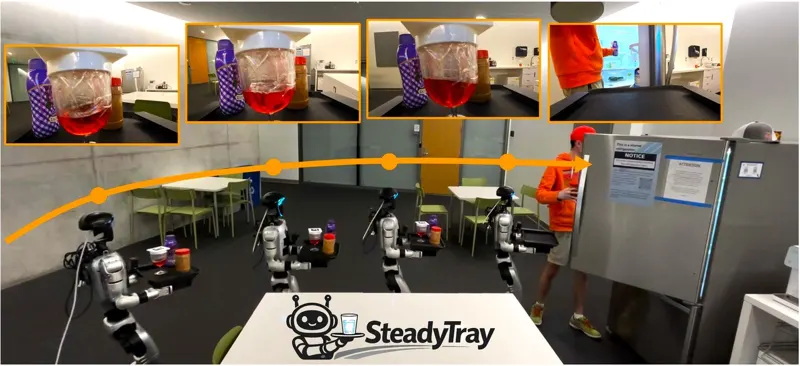
Stabilizing unsecured payloads against the inherent oscillations of dynamic bipedal locomotion remains a critical engineering bottleneck for humanoids in unstructured environments. To solve this, we introduce ReST-RL, a hierarchical reinforcement learning architecture that explicitly decouples locomotion from payload stabilization, evaluated via the SteadyTray benchmark. Rather than relying on monolithic end-to-end learning, our framework integrates a robust base locomotion policy with a dynamic residual module engineered to actively cancel gait-induced perturbations at the end-effector. This architectural separation ensures steady tray transport without degrading the underlying bipedal stability. In simulation, the residual design significantly outperforms end-to-end baselines in gait smoothness and orientation accuracy, achieving a 96.9% success rate in variable velocity tracking and 74.5% robustness against external force disturbances. Successfully deployed on the Unitree G1 humanoid hardware, this modular approach demonstrates highly reliable zero-shot sim-to-real generalization across various objects and external force disturbances.
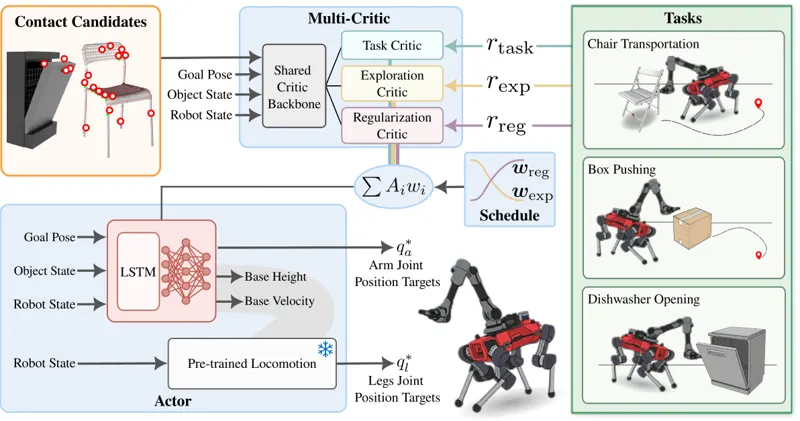
The paper turns 25 grasp-algorithm candidates into a retractable exploration objective, separates task, exploration, and regularization signals with three value heads, and schedules their advantages during training. The full method reaches 94.1% simulation success with 4.4% tipover and transports unseen IKEA objects in 40/58 zero-shot hardware trials.
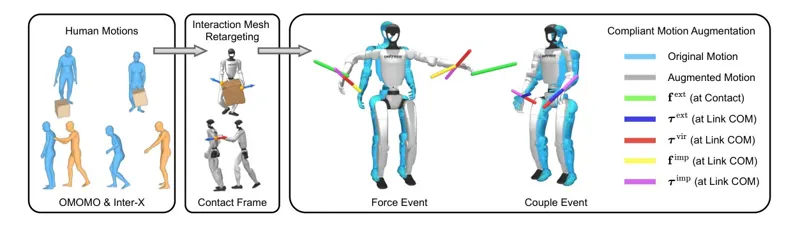
LAC is a general humanoid whole-body controller that simultaneously realizes commanded linear and angular compliance for wrenches applied to the upper body. Sampled force and couple events imposed on contact frames from human interaction data synthesize a large-scale compliant-response dataset; teacher-student RL then trains a single policy to track compliant motions under external wrenches, with sim and real experiments showing monotonic stiffness modulation and teleoperated loco-manipulation.
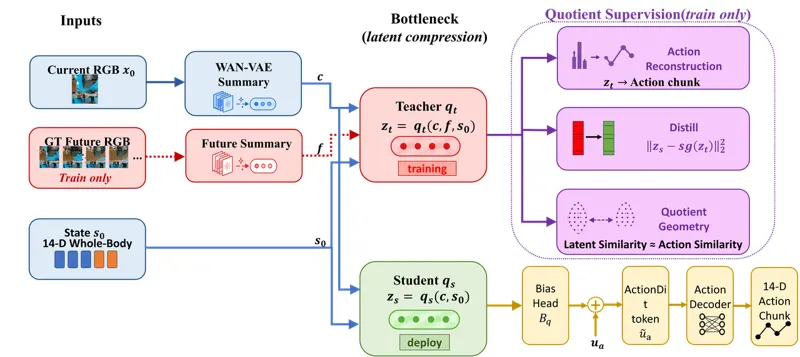
DECOWAM adapts a frozen FastWAM video-action backbone to legged mobile manipulation via decoupled interfaces — an action-equivalent future bottleneck, adversarial base/arm factorization, and ego-motion-aware video conditioning — cutting Stage-2 trainable parameters 232x while leading real-robot deployment at 58.2% success.
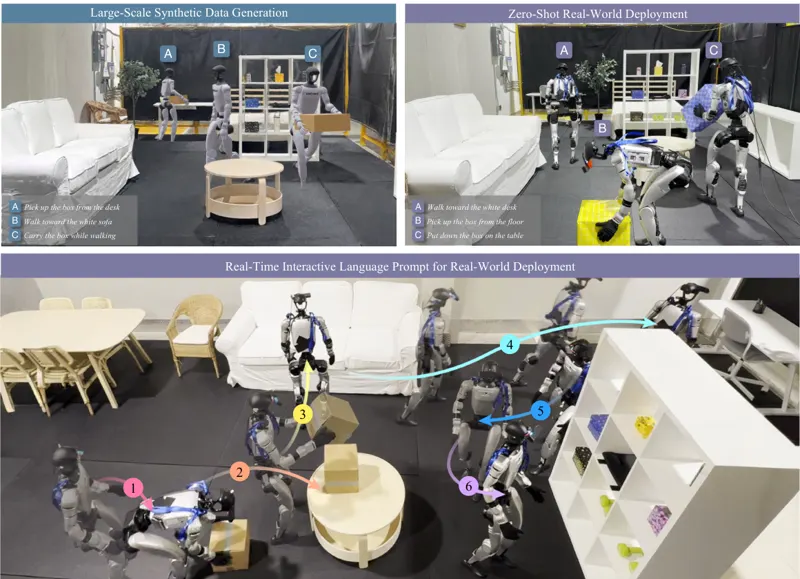
VLK synthesizes paired vision-language-kinematics supervision inside 3DGS-reconstructed real scenes: it generates navigation and object-interaction trajectories with privileged scene info, renders egocentric views after the fact, and produces 48,000 paired trajectories to train a policy predicting Unitree G1 whole-body motion, enabling sim-to-real perception-based humanoid loco-manipulation.
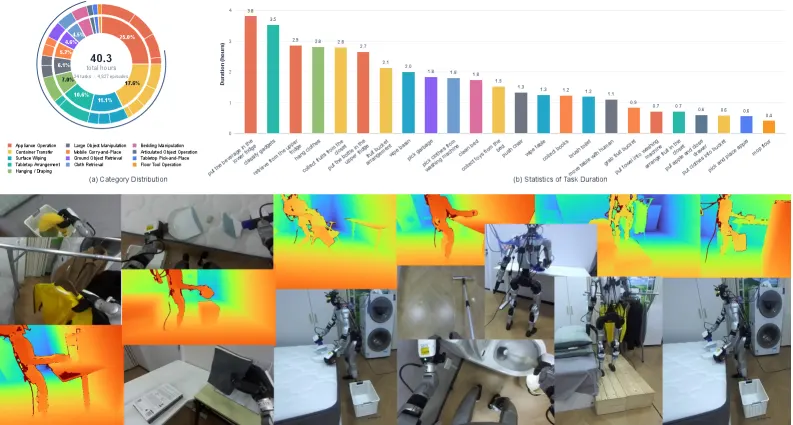
ω-0 is a latent predictive whole-body world-action model for real-world humanoid concurrent loco-manipulation: given a language instruction, visual observation, and proprioceptive state, it directly predicts controller-compatible whole-body action latents, coupling compact future-observation embedding prediction with diffusion-based action generation. A 40+ hour real-world dataset ω-HOME is collected; a single model outperforms IL, VLA, humanoid, and WAM baselines on 11 household tasks.
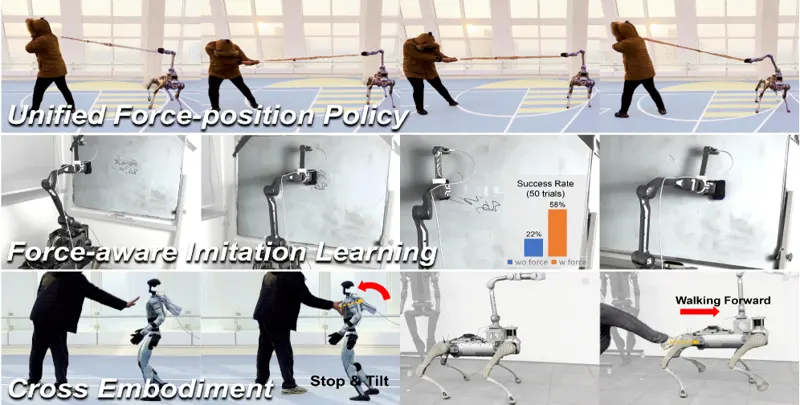
Robotic loco-manipulation tasks often involve contact-rich interactions, requiring joint modeling of contact force and robot position. We propose a unified policy for legged robots that jointly models force and position control without relying on force sensors, and improves contact-rich imitation learning by approximately 39.5%.
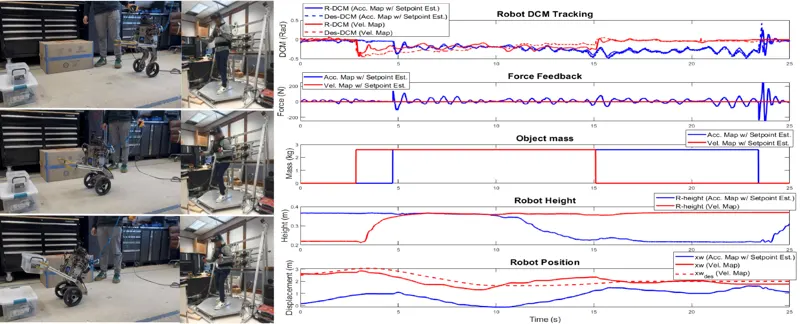
Humanoid robots can support human workers in physically demanding environments by performing tasks that require whole-body coordination, such as lifting and transporting heavy objects.These tasks, which we refer to as Dynamic Mobile Manipulation (DMM), require the simultaneous control of locomotion, manipulation, and posture under dynamic interaction forces. This paper presents a teleoperation framework for DMM on a height-adjustable wheeled humanoid robot for carrying heavy payloads. A Human-Machine Interface (HMI) enables whole-body motion retargeting from the human pilot to the robot by capturing the motion of the human and applying haptic feedback. The pilot uses body motion to regulate robot posture and locomotion, while arm movements guide manipulation.Real time haptic feedback delivers end effector wrenches and balance related cues, closing the loop between human perception and robot environment interaction. We evaluate the different telelocomotion mappings that offer varying levels of balance assistance, allowing the pilot to either manually or automatically regulate the robot's lean in response to payload-induced disturbances. The system is validated in experiments involving dynamic lifting of barbells and boxes up to 2.5 kg (21% of robot mass), demonstrating coordinated whole-body control, height variation, and disturbance handling under pilot guidance. Video demo can be found at: https://youtu.be/jF270_bG1h8?feature=shared
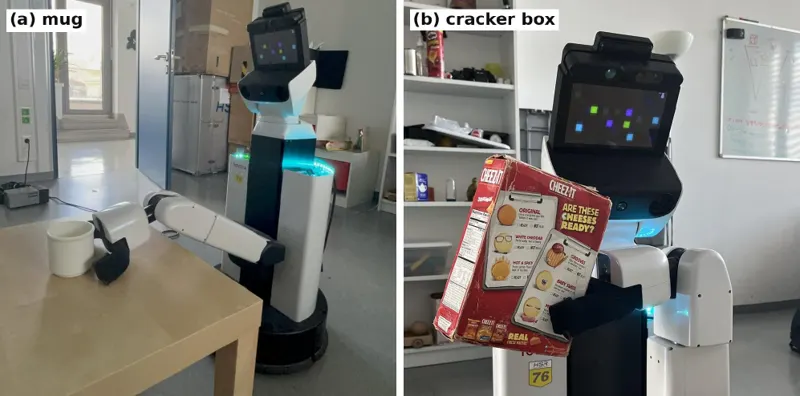
Fine-tuning Vision-Language-Action (VLA) models for mobile manipulators with heterogeneous joint spaces can produce a counterintuitive result: the checkpoint with the lowest aggregate MSE is not the one that performs best on the real robot. We argue this is a predictable consequence of collapsing heterogeneous joint groups (arm, gripper, head, wheeled base) into a single metric, where easy-to-predict joints can mask joints that still fail. We fine-tune SmolVLA (450M, action-expert only) on the 11-DoF Toyota HSR and compare it against π_0.5 (3.3B), a stronger pretrained baseline. Per-group analysis exposes two patterns: in SmolVLA, the mobile base converges slowest and limits overall performance. In expert-only fine-tuning of π_0.5 (training only the action head, backbone frozen), total MSE drops below the baseline but arm accuracy degrades. On 60 real-robot trials (20 per model), π_0.5 80k (4.0/4) significantly outperforms both fine-tuned variants (expert-only 3k: 3.75/4; HSR-SmolVLA: 3.5/4; Mann-Whitney p ≤ 0.010), despite expert-only 3k having the lowest total MSE. This separation is most consistent with the offline arm-group error, not total MSE or base-group error. We conclude that per-group error is a more reliable signal than total MSE for checkpoint selection on robots with heterogeneous action spaces. Code: https://github.com/paumontagut/per-group-mse-vla
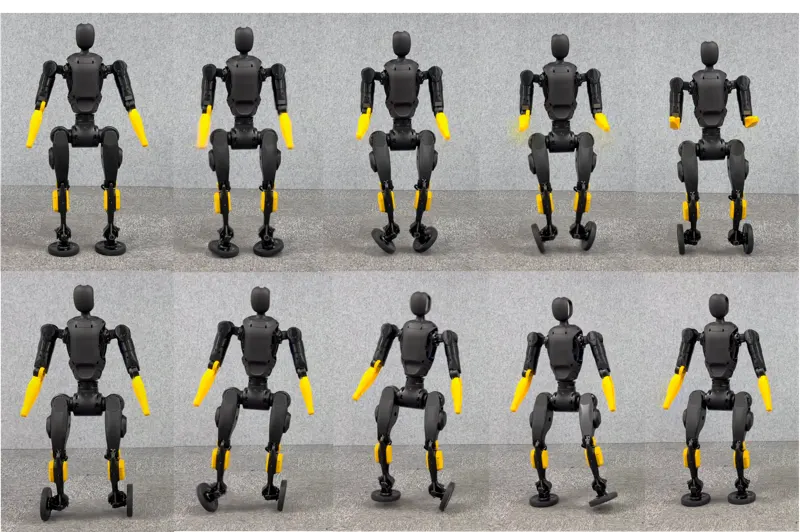
Wheel-legged robots combine the efficiency of wheeled locomotion with the versatility of legged systems, enabling rapid traversal over both continuous and discrete terrains. However, conventional designs typically employ fixed wheels as feet and limited degrees of freedom (DoFs) at the hips, resulting in reduced stability and mobility during legged locomotion compared to humanoids with flat feet. In addition, most existing platforms lack a full upper body with arms, which limits their ability to perform dexterous manipulation tasks. In this letter, we present X2-N, a high-DoF transformable robot with dual-mode locomotion and manipulation. X2-N can operate in both humanoid and wheel-legged forms and transform seamlessly between them through joint reconfiguration. We further propose a reinforcement learning (RL)-based whole-body control framework tailored to this morphology, enabling unified control across hybrid locomotion, transformation, and manipulation. We validate X2-N in a range of challenging locomotion and manipulation tasks, including dynamic skating-like motion, stair climbing and package delivery. Results demonstrate high locomotion efficiency, strong terrain adaptability, and stable loco-manipulation performance of X2-N, highlighting its potential for real-world deployment.
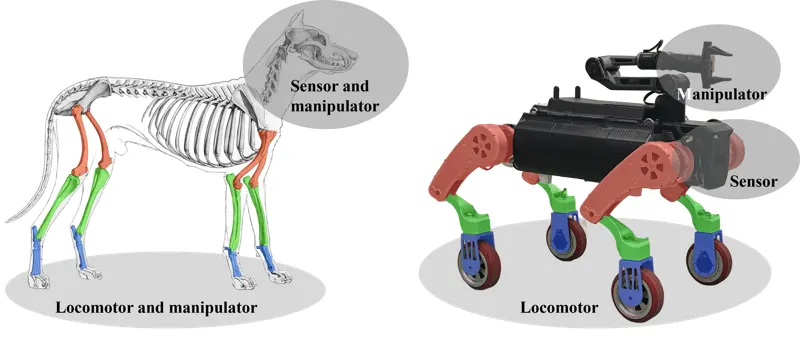
Wheel-legged robots with integrated manipulators hold great promise for mobile manipulation in logistics, industrial automation, and human-robot collaboration. However, unified control of such systems remains challenging due to the redundancy in degrees of freedom, complex wheel-ground contact dynamics, and the need for seamless coordination between locomotion and manipulation. In this work, we present the design and whole-body motion control of an omnidirectional wheel-legged quadrupedal robot equipped with a dexterous manipulator. The proposed platform incorporates independently actuated steering modules and hub-driven wheels, enabling agile omnidirectional locomotion with high maneuverability in structured environments. To address the challenges of contact-rich interaction, we develop a contact-aware whole-body dynamic optimization framework that integrates point-contact modeling for manipulation with line-contact modeling for wheel-ground interactions. A warm-start strategy is introduced to accelerate online optimization, ensuring real-time feasibility for high-dimensional control. Furthermore, a unified kinematic model tailored for the robot's 4WIS-4WID actuation scheme eliminates the need for mode switching across different locomotion strategies, improving control consistency and robustness. Simulation and experimental results validate the effectiveness of the proposed framework, demonstrating agile terrain traversal, high-speed omnidirectional mobility, and precise manipulation under diverse scenarios, underscoring the system's potential for factory automation, urban logistics, and service robotics in semi-structured environments.