Skip to content
PAPERJul 22, 2026

FELT: Generating Tactile Signals from Vision for Visuo-Tactile Manipulation

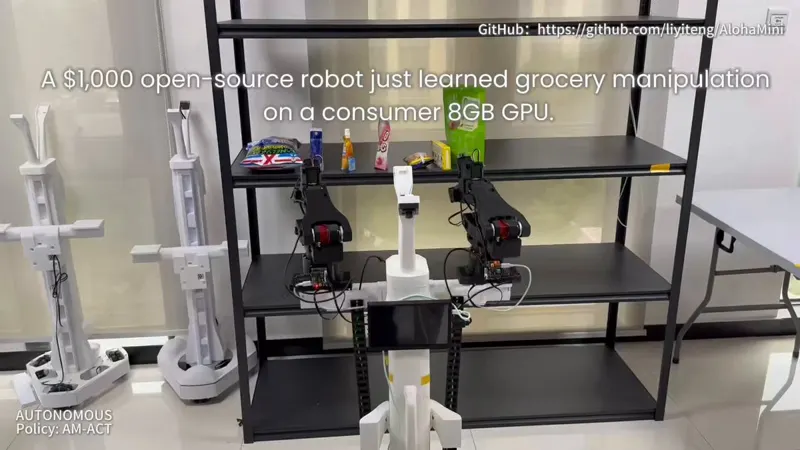
The sense of touch is central to manipulation, especially when vision is occluded or ambiguous. Although combining vision and touch improves manipulation, learning robust visuo-tactile policies requires substantial tactile data. Such data remains scarcer than visual data, because tactile sensors are fragile, specialized, and hard to standardize. To address this, we present Feature-Extracted Latent Tactile (FELT), a learning-based framework that synthesizes per-finger pressure tactile images from RGB observations, reducing the need for tactile-equipped data collection. FELT uses a large frozen visual encoder and a lightweight query decoder to predict tactile signals in a single feed-forward pass. To respect the physical topology of dual-finger tactile sensors, FELT decodes the left and right tactile sensor panels through separate branches, capturing the asymmetric contact patterns during interactions such as wiping, insertion, and in-hand rotation. At inference time, FELT only requires RGB data, allowing us to augment existing vision-only data with tactile observations, either as generated tactile images or as latent tactile features. Experiments on four contact-rich manipulation tasks demonstrate that both generated tactile images and latent tactile features improve policy success over vision-only baselines, with latent feature requiring no real tactile sensor during policy training or deployment. Supplementary material is available on our anonymous website: https://felt-tactile.github.io/.

Zinan Li, Yiyang Ling, Yuming Gu

Tactile GenerationVisual-tactileCross-ModalityManipulation
PAPERJul 22, 2026

RealVDeblur: One-Step Diffusion for Generalizable Real-World Video Deblurring

Real-world video deblurring remains challenging due to diverse motion patterns, complex degradations, and the scarcity of realistic training data, yet robust restoration is critical for downstream pipelines such as mobile imaging and 3D reconstruction. This work presents RealVDeblur, an efficient generative framework designed to improve in-the-wild robustness under diverse real capture conditions. First, a large-scale, physically grounded blur synthesis pipeline is constructed from scene-level 3D Gaussian Splatting (3DGS) assets and high-frame-rate videos, providing realistic training data covering both camera-induced and object-motion blur. Second, a video diffusion prior is leveraged for restoration; to better accommodate frame-dependent blur variations, temporal compression in the VAE is disabled and a frame-wise encoding scheme is adopted. For practical deployment on long videos, multi-step diffusion sampling is distilled into an efficient one-step generator, and a training-free Temporal Window Mask stabilizes inference beyond the training horizon with constant memory usage. Extensive experiments on diverse real-world benchmarks demonstrate strong perceptual quality, semantic fidelity, and temporal consistency on unseen videos, as well as improved robustness in downstream 3D reconstruction under severe motion blur. Project page: https://rbjin.github.io/RealVDeblur

Renbiao Jin, Mingxin Yang, Yutian Chen

3D Gaussian Splatting
PAPERJul 22, 2026

ATSplat: Compact Feed-forward 3D Gaussian Splatting with Adaptive Token Expansion

3D Gaussian Splatting (3DGS) achieves high-quality novel-view synthesis by optimizing freely placed primitives in 3D and adaptively densifying them in under-reconstructed regions. However, this scene-adaptive capacity allocation is largely lost in existing feed-forward 3DGS methods, which commonly regress Gaussians at input pixels and lift them along camera rays. Such pixel-aligned formulations make the number and placement of primitives depend on image resolution and input viewpoints rather than scene complexity, resulting in dense and often redundant Gaussian sets. We present ATSplat, a feed-forward 3DGS framework that restores the adaptive allocation capability of 3DGS optimization through Adaptive 3D Tokens. ATSplat first lifts coarse patch-level depth and camera cues into sparse 3D anchor tokens, forming a compact scaffold of the scene. Each token is then regressed into local Gaussians with learnable 3D offsets, decoupling primitive placement from input image grids. An Adaptive Token Expansion module predicts a token-level uncertainty score, supervised by rendering error maps, and selectively expands high-uncertainty tokens through learnable expansion layers. This sparse-to-adaptive formulation enables ATSplat to concentrate primitives in challenging regions while maintaining a compact representation. Experiments on two representative datasets, RealEstate10K and DL3DV, show that ATSplat achieves state-of-the-art rendering quality while reducing the number of Gaussians by more than 5.7× compared with dense feed-forward 3DGS methods. From 12 input images at 512 × 960 resolution, ATSplat completes reconstruction in less than a second using a single commercial GPU, and renders high-quality novel views at 1136 FPS (512 × 960) with only 311K Gaussians.

Cho In, Jeonghwan Cho, Mijin Yoo

3D Gaussian SplattingtokenFeedforwardAdaptive
PAPERJul 22, 2026

Odin: Primitive-Level Synchronization for Distributed Point-Based Neural Rendering

Point-based neural rendering (PBNR) represents 3D scenes as explicit, trainable primitives and underpins high-quality reconstruction and emerging embodied AI and world-model pipelines. Unlike layer-structured neural networks, PBNR has primitive-indexed dependencies: each view reads and updates only a sparse, view-dependent subset of mutable scene state. As large scenes require distributed training and optimized renderers reduce per-view computation, global task- or iteration-level barriers increasingly place synchronization, rather than rendering, on the critical path. We present Odin, a distributed PBNR training system that replaces global barriers with primitive-level synchronization. Its ahead-of-time scheduler uses stable locality and phase order to identify low-conflict overlap windows, while the runtime validates primitive publication before later work observes mutable state. Odin provides a quality-first path that preserves synchronized-training visibility and a throughput-first path that uses overlap and gradient evidence to admit only small, low-impact delayed reads; structural changes and high-impact cases remain synchronized. Across four existing PBNR pipelines and 13 non-city scenes on 8 GPUs, Odin improves throughput by 1.22 times on average and hides 82% of critical-path wait while preserving reconstruction quality. In a MatrixCity mixed-parallel case study scaling to 64 GPUs, Odin improves throughput over Grendel by up to 1.89 times without changing renderer kernels, optimizers, training budgets, or model capacity.

Zhenxiang Ma, Zeyu He, Yuanzhen Zhou

3D Gaussian SplattingNeural renderingPoint cloudsDistributed
PAPERJul 22, 2026

Look Before You Edit: Attention-Guided Camera Placement and Multi-View Alignment for 3D Gaussian Splatting Editing

Text-driven 3D scene editing with 3D Gaussian Splatting (3DGS) typically applies a 2D diffusion editor to views rendered from fixed training cameras, limiting both the spatial coverage of edits and the user's freedom to target specific objects in complex scenes. We present LB-Edit, a framework that addresses two coupled problems: where to place editing cameras for localized edits, and how to make per-view edits agree with one another so that the 3D scene remains consistent after fine-tuning. First, Attention-Guided Editing Camera Placement (ACP) probes the diffusion model's self- and cross-attention at multiple candidate camera distances to find where attention is well-contained in the region of interest, then places a compact, geometrically diverse editing camera set at that attention-optimal distance. Second, Multi-view Attention Alignment (MAA) steers the editor toward the same edit across views along two axes: it aligns appearance by sharing self-attention features via token-level correspondence, and aligns spatial location by lifting cross-attention maps onto the 3D Gaussians as a shared 3D attention field, suppressing both appearance and spatial drift. Experiments on multi-object and single-object scenes show that our method achieves the highest user preference in instruction fidelity, multi-view consistency, and editing locality, using as few as 5 editing views and reducing latency by up to 7x over existing methods.

Jaeyeon Park, Taeho Kang, Youngki Lee

3D Gaussian SplattingScene EditingCamera PlacementMulti-View

As an Amazon Associate, we earn from qualifying purchases.