PAPER DEEP DIVE
SubSplat: High-Resolution Pixel-aligned 3DGS via Sub-pixel Gaussian Reparameterization
Pixel-aligned Gaussian splatting enables efficient and generalizable novel-view synthesis. However, high-resolution rendering faces a critical trade-off where increasing input resolution improves detail at the expense of quadratically rising network computational cost. Conversely, maintaining low-resolution inputs stabilizes this cost but results in insufficient Gaussian density and artifacts. To address this, we propose SubSplat, which introduces Sub-pixel Gaussian Reparameterizer(SPGR) to subdivide primary Gaussians into fine-grained primitives, restoring structural density directly from low-resolution features. We further enhance the reparameterization quality through feature aggregation, which effectively captures high-frequency details across multiple views. Experiments on RealEstate10K and ACID demonstrate that SubSplat achieves high-fidelity rendering with superior efficiency. Our results validate that the proposed framework successfully resolves the trade-off between reparameterization fidelity and network computational cost inherent in pixel-aligned Gaussian Splatting.
SubSplat: High-Resolution Pixel-aligned 3DGS via Sub-pixel Gaussian Reparameterization
Paper: SubSplat: High-Resolution Pixel-aligned 3DGS via Sub-pixel Gaussian Reparameterization
Link: arXiv:2607.20813 | Benchmarks: RealEstate10K / ACID | Basis: MVSplat + Deformable Attention
One-line summary: Introduces a Sub-pixel Gaussian Reparameterizer (SPGR) that subdivides primary Gaussians from low-resolution features into fine-grained primitives, restoring structural density while maintaining stable backbone latency, achieving real-time high-fidelity rendering at 42ms/frame.
Background and Motivation
Pixel-aligned Gaussian splatting enables efficient and generalizable novel-view synthesis — feed-forward networks train across diverse scenes predicting Gaussian primitives on a fixed image grid without per-scene optimization. But high-resolution rendering faces a critical trade-off: increasing input resolution improves detail at quadratic network computational cost; maintaining low-resolution inputs stabilizes cost but yields insufficient Gaussian density and artifacts.
The core contradiction is the grid-anchored design — total primitive count is tied to input resolution. Directly increasing input resolution makes the backbone process a denser grid, and since total latency is dominated by the backbone forward pass, doubling resolution requires 4× computation. Using low-resolution inputs to render sparse Gaussians on high-resolution screens leads to under-parameterization — blur and halo artifacts. Existing methods are trapped between (i) quadratic backbone cost or (ii) quality degradation from coarse input grids.
SubSplat's core idea: instead of increasing backbone input resolution (avoiding quadratic cost), introduce SPGR to subdivide primary Gaussians into $K$ sub-pixel primitives, restoring structural density directly from low-resolution features. $K$ is the squared ratio of target to input resolution ($K=4$ for $2\times$, $K=16$ for $4\times$).
Method Details
1. Feature Aggregation
SubSplat is an end-to-end pipeline: a pixel-aligned backbone (MVSplat) initializes primary Gaussians, a deformable-attention module aggregates multi-view features to enrich primitive descriptions, and SPGR subdivides primary Gaussians into sub-pixel primitives. Feature aggregation has geometry and appearance paths.
Geometry feature aggregation maps primary Gaussian attributes (position, scale, rotation, opacity) through small MLPs to a geometry query, projected onto reference views to aggregate cross-view geometric context via deformable attention. Three stacked deformable-attention layers progressively aggregate local-to-global cross-view features, yielding the geometry descriptor $\mathbf{f}^g_p$. Appearance feature aggregation maps spherical harmonic coefficients to an appearance query, conditioned on the geometry descriptor via deformable attention — geometry determines "where to look," appearance determines "what to amplify."
2. Geometry Reparameterization
SPGR's geometry head $g_\theta$ predicts spatial properties for each sub-pixel primitive: sub-pixel offsets $(\Delta u_k, \Delta v_k)$, depth residual $\Delta z_k$, log-scale residuals, and axis-angle rotation. Position is back-projected through camera intrinsics and adjusted along the viewing ray:
$$\mathbf{\mu}_{p,k}=\mathbf{\mu}_{p}+R_{c2w}\begin{bmatrix}z_{\text{sel}}\Delta u_{k}/f_{x}\\z_{\text{sel}}\Delta v_{k}/f_{y}\\0\end{bmatrix}+\Delta\hat{z}_{k}\,R_{c2w}\begin{bmatrix}0\\0\\1\end{bmatrix}$$
Depth residual is bounded via $\tanh$: $\Delta\hat{z}_k=\tanh(\Delta z_k)$. Anisotropic scale inherits and locally refines: $\mathbf{s}_{p,k}=\mathbf{s}_p\odot\exp(\Delta\log\mathbf{s}_k)$. Rotation residual converts to quaternion, composes with primary quaternion, and normalizes. Covariance: $\Sigma_{p,k}=R(q_{p,k})\text{diag}(\mathbf{s}_{p,k}^2)R(q_{p,k})^\top$.
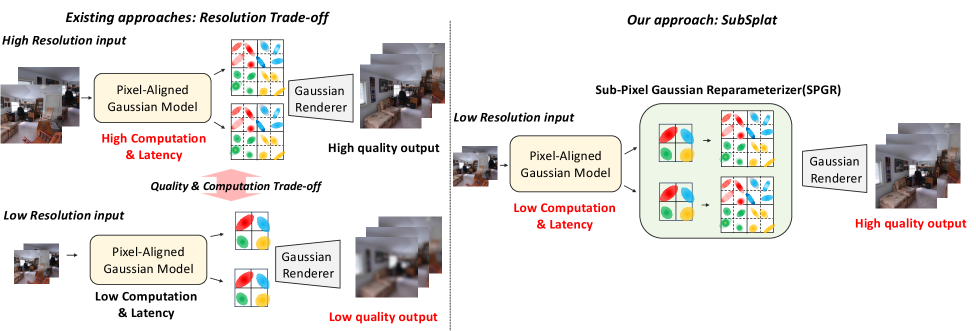
Figure 1: SubSplat generates sub-pixel reparameterized Gaussians from low-resolution features, avoiding quadratic cost of high-resolution inputs.
3. Opacity Redistribution and Color Modulation
The appearance head predicts per-primitive opacity weights and color gains. Opacity is softmax-normalized and adjusted by projected area; final opacity is distributed from the primary Gaussian:
$$\alpha_{k}=\alpha_{p}\cdot\frac{\tilde{w}_{k}}{\sum_{j}\tilde{w}_{j}}$$
This enforces distributional integrity from primary to sub-pixel primitives, prioritizing density on intricate scene details. Color is modulated by a bounded gain: $\mathbf{h}_{p,k}=\gamma_k\mathbf{h}_p$. Anti-aliasing enforces a minimum projected area $A_{\min}$ to mitigate flickering.
4. Training Objective
The network is trained with ground-truth RGB images using weighted $\ell_2$ and LPIPS losses:
$$\mathcal{L}=\mathcal{L}_{\ell_2}+\lambda\,\mathcal{L}_{\text{LPIPS}}$$
with $\lambda=0.05$, trained for 300K iterations on a single NVIDIA A100, batch size 12, Adam optimizer with learning rate $2\times 10^{-4}$.
graph TD
  A[Low-res input 256x256] --> B[MVSplat backbone: primary Gaussians]
  B --> C[Deformable Attention: geometry+appearance aggregation]
  C --> D[SPGR: sub-pixel reparameterization]
  D --> E[Geometry head: position/depth/scale/rotation]
  D --> F[Appearance head: opacity/color]
  E --> G[K sub-pixel Gaussians]
  F --> G
  G --> H[High-res rendering 512x512 / 1024x1024]
  style D fill:#f5a623,stroke:#b97316,color:#fff
  style C fill:#4a90d9,stroke:#2c5f8a,color:#fff
  style H fill:#7ed321,stroke:#4a8a14,color:#fff
Experimental Results
Resolution Scalability
Reconstructing from $256\times 256$ inputs and evaluating at $512\times 512$ ($\times 2$) and $1024\times 1024$ ($\times 4$), SubSplat achieves SOTA across all metrics on RealEstate10K and ACID, with minimal degradation as target resolution scales. Baselines couldn't be evaluated at $1024\times 1024$ inputs due to OOM.
| Method | Input Res | Output Res | Latency(ms) | Peak Mem(GB) | PSNR |
|---|---|---|---|---|---|
| PixelSplat | 512 | 512 | 86 | 15.2 | 24.35 |
| MVSplat | 512 | 512 | 58 | 12.1 | 25.21 |
| HiSplat | 512 | 512 | 1960 | 28.5 | 25.40 |
| SubSplat | 256 | 512 | 42 | 6.8 | 25.52 |
Efficiency and Cost-Performance
At a fixed $512\times 512$ target, SubSplat achieves 25.52 PSNR and 0.850 SSIM at only 42ms/frame (24 FPS) — the only real-time method among evaluated baselines. HiSplat achieves competitive quality but 1960ms latency from its three-stage feed-forward design. SubSplat's low-resolution feature recovery significantly reduces compute and memory budgets.
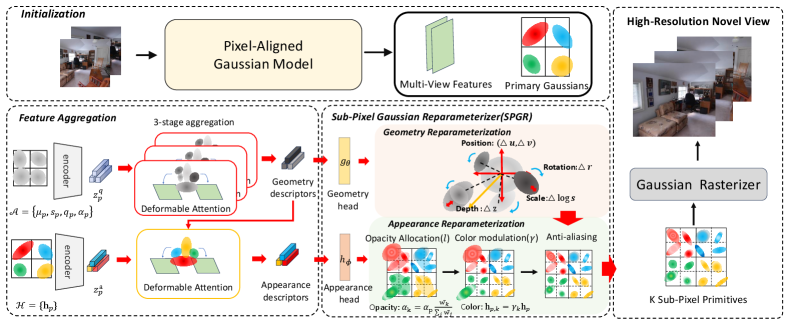
Figure 2: Comparison with image-space upsamplers. SubSplat densifies geometry in 3D space, recovering structural details that image-space methods cannot.
Comparison with Image-Space Upsamplers
| Method | PSNR | SSIM | LPIPS | Latency(s) |
|---|---|---|---|---|
| MVSplat + Bilinear | 24.01 | 0.801 | 0.237 | 0.042 |
| MVSplat + HiT-SR | 23.88 | 0.807 | 0.203 | 0.215 |
| SubSplat | 25.52 | 0.850 | 0.167 | 0.042 |
Bilinear interpolation remains blurry; SR head introduces ringing and cross-view inconsistencies. SubSplat optimizes Gaussian distributions via sub-pixel reparameterization, capturing geometry-aware details that 2D upsamplers cannot recover — they cannot resolve grid-anchored primitive limitations.
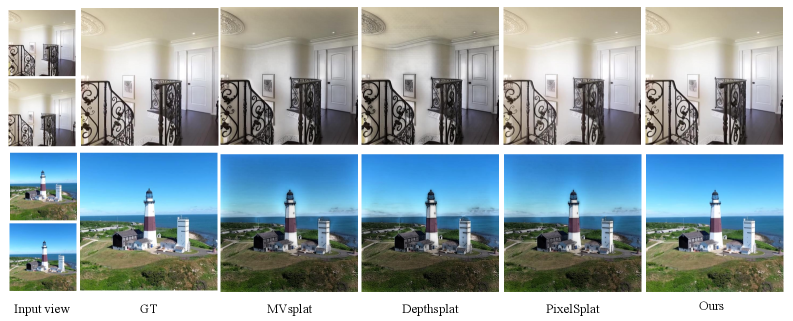
Figure 3: Ablation. SPGR provides the primary performance gain; feature aggregation ensures structural consistency at larger scales.
Ablation Study
| Module | K=4 PSNR | K=16 PSNR | Contribution |
|---|---|---|---|
| Baseline (MVSplat) | 19.46 | 16.98 | — |
| + Sub-pixel Reparam. | 25.15 | 19.49 | +5.69 / +2.51 dB |
| + Feature Aggregation (Full) | 25.52 | 22.65 | +0.37 / +3.16 dB |
SPGR provides +5.69 dB at $K=4$ as the primary recovery mechanism. Feature aggregation's contribution grows with task difficulty — +3.16 dB at $K=16$, as larger scale ratios need richer cross-view context. Three-stage deformable attention yields 1.58 dB over one-stage, as iterative feature sampling better captures spatial details.
高斯属性向量
$$ \mathbf{a}_{p}=[\,\boldsymbol{\mu}_{p},\mathbf{s}_{p},q_{p},\alpha_{p}\,]\in\mathbb{R}^{11} $$
几何特征编码
$$ \mathbf{z}^{g}_{p}=W_{g}\!\big(\phi_{x}(\boldsymbol{\mu}_{p})+\phi_{s}(\mathbf{s}_{p})+\phi_{q}(q_{p})+\phi_{\alpha}(\alpha_{p})\big) $$
LimitationsAuthor-stated: Rendering overhead increases with primitive count. Future work will explore content-aware primitive density control to further optimize the rendering throughput vs. structural fidelity trade-off.
Analysis: While backbone latency is stable, the 16× primitive count at $K=16$ significantly increases differentiable rasterization rendering overhead. Bounded sub-pixel offsets and depth residuals ($\tanh$) stabilize but may limit extreme geometric detail expression. Feature aggregation relies on deformable attention cross-view projections that may degrade with sparse input views or wide baselines. The training objective uses only $\ell_2$ + LPIPS without explicit geometry consistency or depth optimization. The $\times 4$ model trained at $128\to 512$ on 720p is directly applied to $256\to 1024$, relying on scale-ratio invariance — absolute scale differences may introduce unverified generalization risks. SPGR's $K$ is fixed rather than content-adaptive, potentially producing redundant primitives in texture-sparse regions.
Conclusion and Outlook
SubSplat achieves high-fidelity rendering by generating fine-grained sub-pixel primitives directly from low-resolution features, mitigating quadratic backbone cost while maintaining stable network latency across extended output scales. The core innovation is shifting detail enhancement from backbone computation to the subdivision stage — SPGR reparameterizes primary Gaussians into sub-pixel primitives, with deformable attention feature aggregation capturing cross-view high-frequency details. The 42ms/frame real-time performance and 6.8GB peak memory represent a significant quality-efficiency advantage over full-resolution baselines. Ablations reveal SPGR provides the primary gain while feature aggregation becomes increasingly important at larger scale ratios — this synergy provides insight into modular design for multi-scale rendering. SubSplat demonstrates that 3D-space geometry densification outperforms image-space upsampling, which cannot resolve the fundamental grid-anchored primitive limitation.
The secret of high resolution lies not in larger inputs but in smarter subdivision — transforming one coarse Gaussian into multiple fine sub-pixel primitives, recovering detail in 3D space rather than image space. This is the core of SubSplat's real-time high-fidelity from low-resolution inputs.
SOURCE LINKS