Skip to content
← Tags

#Bimanual Manipulation (10)

DONIC: Generalist Dexterous Bimanual Tracking Control from Human Demonstrations

DONIC: Generalist Dexterous Bimanual Tracking Control from Human Demonstrations

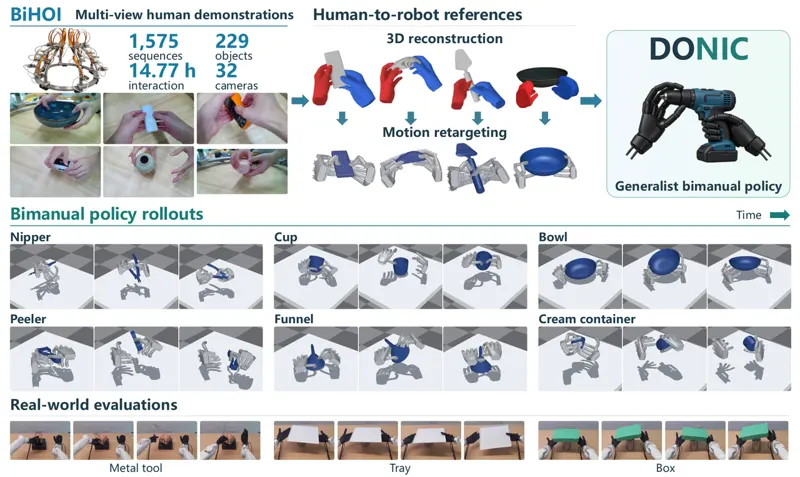
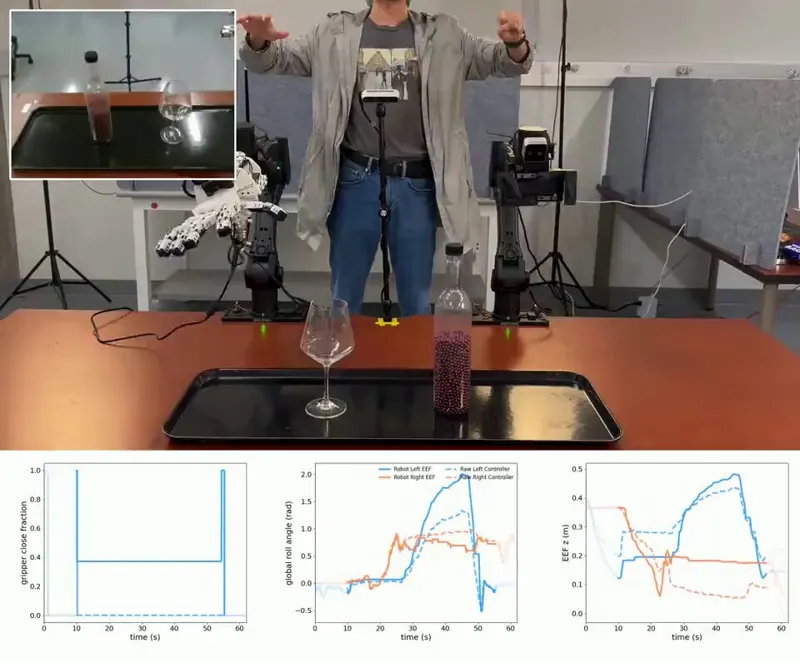
Despite recent progress in dexterous reference tracking, existing models focus primarily on single-hand manipulation and a limited range of interactions, leaving the bimanual dexterous behaviors common in real life unaddressed. The scarcity of contact-rich bimanual manipulation data and the increased complexity of coordinating contacts make developing a generalist bimanual tracker particularly challenging. Therefore, we present 1) DONIC, the first generalist bimanual tracker jointly trained across operation categories and human-motion sources, together with 2) BiHOI, a multi-view dataset of 1,575 sequences spanning 229 objects and emphasizing sustained bimanual interaction, where reconstructed interactions are retargeted into robot references. DONIC combines proximal policy optimization with behavioral cloning in a feedback loop that recycles verified successful executions into training demonstrations. An object-centered per-hand reward maintains object-motion feedback while supervising each hand according to its reference contact role. Clip-Centered Advantages remove reference-dependent advantage offsets while preserving within-trajectory differences. Together, these designs enable one single policy to learn coordinated manipulation across heterogeneous references. Without finetuning, a single checkpoint achieves 86.79% success on unseen trajectories of training objects and 57.32% on held-out objects, surpassing the state-of-the-art bimanual tracking baselines by 77.36 and 45.73 percentage points.
Mingze Sun, Ziang Cao, Yuan Fei · 129 views · Oct 21, 2026
Dexterous ManipulationBimanual Manipulation
Oct 21, 2026
Show-Harness: Just a VLM Agent Can Play Robots

Show-Harness: Just a VLM Agent Can Play Robots

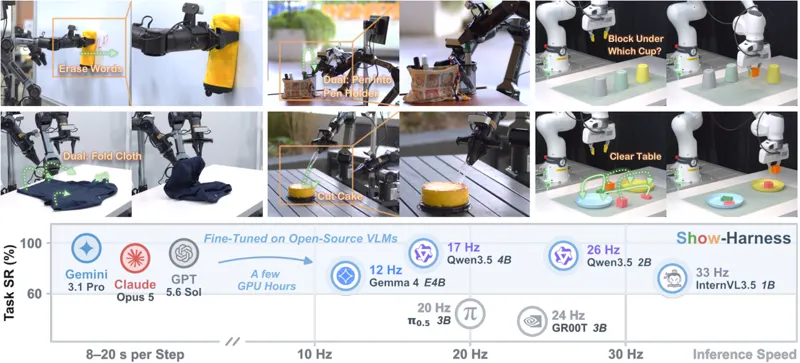
Foundation vision-language models (VLMs) exhibit broad intelligence about the world, yet translating this intelligence into robot control remains challenging. We present Show-Harness, an Embodied Harness that enables VLMs to "play" robots through a compact semantic interface linking intent to action. Show-Harness exposes discrete semantic action units that VLMs can naturally reason over, while embodiment-specific interpreters deterministically ground them into local robot actions, keeping the VLM directly responsible for fine-grained physical decisions. Through the same interface, Show-Harness demonstrates the feasibility of (1) directly unlocking closed-source frontier VLMs for zero-shot robot control, and (2) adapting small-scale open-source VLMs for low-cost deployment with just a few GPU-hours of fine-tuning. We further develop GUMI (GUI Manipulation Interface), which extends the same semantic action space to GUI-based demonstration collection, allowing humans and agents to "play" robots across embodiments without specialized teleoperation hardware. Extensive experiments show that Show-Harness-equipped VLM agents generalize robustly across tasks, embodiments, and environments, outperforming representative agentic and VLA paradigms. These results suggest that the right interface can unlock substantial embodied capability from foundation VLMs, without requiring additional model capacity or costly embodiment-specific pretraining.

Yanzhe Chen, Zechen Bai, Zhijun Cao · 1.1k views · Sep 9, 2026
Vision-language modelsAgentic Harness
Sep 9, 2026

As an Amazon Associate, we earn from qualifying purchases.