Skip to content
Tags

#Continual learning (4)

Extreme-RGMT: Continual Learning of Highly Dynamic Skills for Robust Generalist Humanoid Control

Extreme-RGMT: Continual Learning of Highly Dynamic Skills for Robust Generalist Humanoid Control

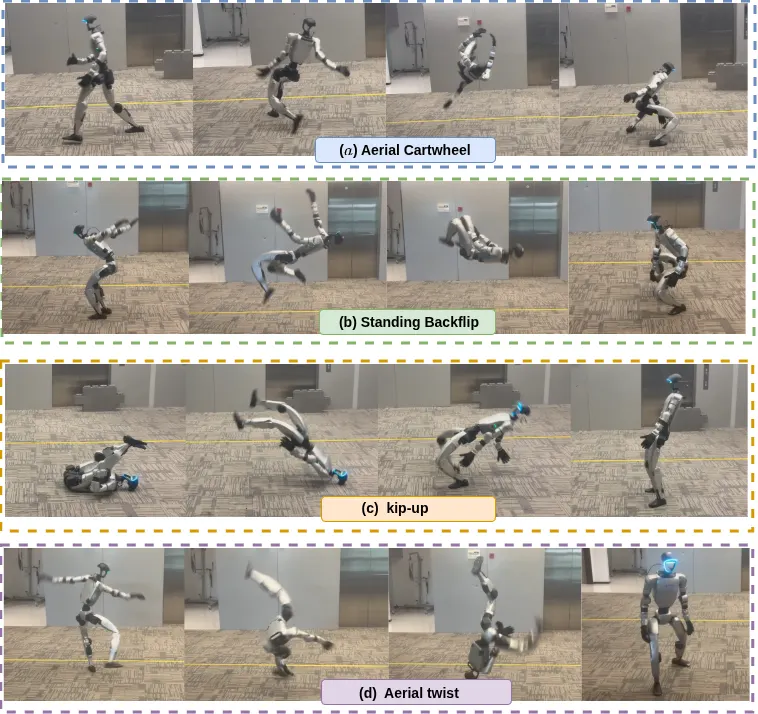
Humans can progressively acquire highly dynamic motor skills while preserving reliable everyday motor abilities. In contrast, existing humanoid controllers face a trade-off between generalist and specialist capabilities: generalist motion tracking policies struggle to reliably execute rare highly dynamic motions, whereas specialist training can degrade previously acquired behaviors. We introduce Extreme-RGMT, a two-stage continual learning framework for robust generalist humanoid control. The method first learns a generalist motion-tracking base policy from diverse multi-source motion data, then employs an asymmetric skill acquisition and capability consolidation mechanism to constrain policy drift on mastered motions while emphasizing difficult dynamic segments. To address the scarcity of highly dynamic motions, their high failure rates, and the resulting shortage of informative samples, Extreme-RGMT combines difficulty-aware sampling with advantage-prioritized trajectory resampling to emphasize critical segments. Experiments show that Extreme-RGMT achieves state-of-the-art generalist whole-body motion-tracking performance, including substantially improved completion of challenging highly dynamic motions. The resulting controller directly executes diverse unseen highly dynamic motions under fixed references and online inertial motion-capture inputs, advancing generalist whole-body motion-tracking controllers toward highly dynamic motor capabilities at the human-expert level.

Yubiao Ma, Han Yu, Kai GuoJul 22, 2026
HumanoidContinual learningMotion ControlJul 22, 2026
The World Model Remembers, the Actor Forgets: Dream Rehearsal for Continual Model-Based RL

The World Model Remembers, the Actor Forgets: Dream Rehearsal for Continual Model-Based RL

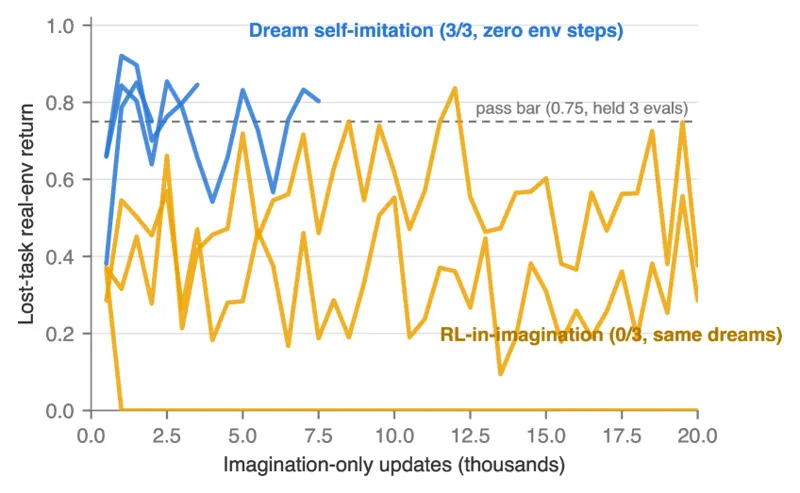
Model-based reinforcement-learning agents of the DreamerV3 family forget catastrophically when trained on task sequences, even when an unbounded replay buffer preserves every earlier experience. We ask a question the continual-RL literature has assumed an answer to but never measured: which component forgets? Under never-clear replay, pre-registered component-level probes (n=3 seeds throughout) show that the world model retains essentially everything measurable about old tasks – reward discrimination (retention ratio ~1.0), value estimates, and termination structure – while the actor's behavior collapses. Forgetting in this regime is a channel problem, not a memory problem. We demonstrate this by intervention: with the world model frozen and identical imagined rollouts, reinforcement learning in imagination fails to recover a lost skill (0/3 seeds), while supervised self-imitation on the world model's own graded dreams recovers it on 3/3 seeds with zero environment interaction. Interleaved during training, this graded dream rehearsal yields a task-label-free, parameter-constant continual learner: 3/3 four-task chains retained where plain replay passes 0/3, 3/3 eight-task chains, and consistent gains over matched real-episode cloning (paired difference +0.13, bootstrap 95% CI [0.07, 0.24], complete seed separation). The dream-grading step is load-bearing: we characterize two scoring failure modes, provide an offline selection gauge that caught both before they contaminated results, and give a realized-first grading rule that closes them. All experiments were pre-registered with committed protocols; every refuted hypothesis is reported.

Gurp NijjerJul 22, 2026
DreamerWorld ModelsContinual learningJul 22, 2026