Skip to content
← Tags

#Embodied Navigation (6)

WayTrace: A Map-to-Language-to-Trace Hierarchy for Embodied Urban Navigation

WayTrace: A Map-to-Language-to-Trace Hierarchy for Embodied Urban Navigation

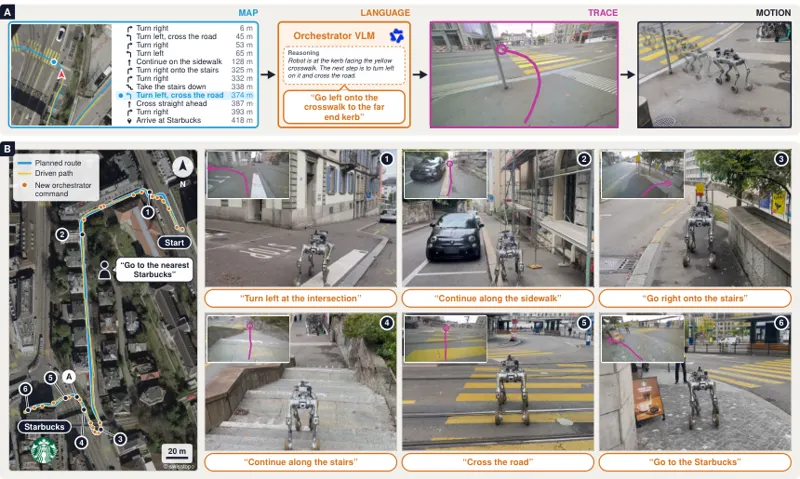
Web services provide walking directions for nearly every city, but following them reliably over long routes remains challenging for autonomous robots. Point-goal navigation policies rely heavily on accurate GNSS, while most vision-language navigation models struggle to execute even short instructions outdoors. We present WayTrace, a hierarchical system that connects web-map directions to robot motion through language. An off-the-shelf orchestrator vision-language model reads the turn-by-turn directions, a satellite map and recent camera images, and issues one atomic language command at a time, such as "cross the road to the left". An onboard trace predictor, trained on over one million automatically labelled samples from street-level images, draws the path for this command in the image, and a reinforcement learning policy tracks it. In long-range simulated missions, WayTrace remains robust to GNSS noise and rarely leaves crosswalks or sidewalks, while point-goal baselines degrade sharply with about ten times more violations. Deployed on a wheeled-legged robot, WayTrace completes real-world missions of up to 1.37 km at about 1.1 m/s through a busy city centre, rural trails and a university campus, handling crosswalks, staircases and construction sites. Project page: https://way-trace.github.io
Manthan Patel, Jonas Frey, Pascal Roth · 264 views · Nov 3, 2026
Embodied NavigationVision-language navigation
Nov 3, 2026
Interactive Navigation Beyond Reachability: Benchmark and Agentic Framework

Interactive Navigation Beyond Reachability: Benchmark and Agentic Framework

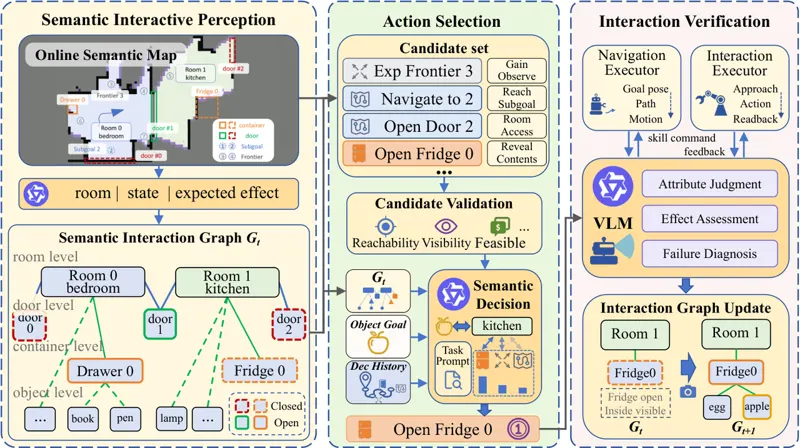
Existing embodied navigation tasks commonly assume that traversability and object states remain fixed during an episode. Yet reaching a goal may require opening a door to access a room and then opening a container to reveal a hidden target. We formulate interactive navigation beyond reachability, unifying channel-induced changes in spatial connectivity, container-induced changes in target visibility, and their sequential dependencies. We introduce MultINav-Bench, a 3K-episode ObjectGoal benchmark in MolmoSpaces spanning channel, container, and mixed tasks, with interaction-necessity annotations covering required and unnecessary episodes. Its data generation pipeline automates task construction across multiple task types. The evaluation protocol separately measures navigation success, interaction effectiveness, and cost. We further propose MultINav-Agent, a three-stage agentic framework built on a persistent, state-conditioned interaction graph. Semantic interactive perception grounds entities and interaction states; a vision-language model selects task-relevant actions based on expected changes in connectivity and target observability; and post-interaction verification updates the graph to guide subsequent navigation, exploration, or interaction. Experiments on MultINav-Bench show that MultINav-Agent consistently outperforms adapted baselines across channel, container, and mixed tasks.

Delun Li, Xueyao Wei, Rui Chen · 364 views · Oct 12, 2026
Embodied NavigationInteractive Navigation
Oct 12, 2026

As an Amazon Associate, we earn from qualifying purchases.