Skip to content
← Tags

#Google DeepMind (15)

Video GenerationMediaTopA

Gemini Omni: moving the unit of video delivery from one attempt to a conversational editing process

Google DeepMind's video and multimodal generation model, officially create anything from any input, starting with video: it edits video through step-by-step conversation, each edit building on the last and keeping the scene coherent, raising the unit of delivery from one shot to footage you can keep revising; the other two surfaces are real-world knowledge and arbitrary reference composition. Read the level with its votes: on the Artificial Analysis arena (2026-09-22) gemini-omni-1.1-flash is #1 for text-to-video at Elo 1516 with only 1,784 votes and a ±15 CI, while #2 is the sibling at 1513 with 26,576 votes and ±9, a 3-point gap far smaller than either CI, so statistically indistinguishable: the honest statement is that the Omni family ties for the top. For image-to-video minimax-h3 leads (1495, 57,112 votes) with Omni #2 at 1488 on 3,734 votes. Pricing: $1.50 per million input tokens, $9.00 text and $17.50 video output, 720p about $0.10 per second and a 30-second clip roughly $3. GA to paid-tier developers, none on the free tier. Closed, not self-hostable, not fine-tunable. Graded A (confirmed), the first A-grade video asset; A means the reading is credible and checkable, not undisputed first place.

1516Arena T2V Elo (1,784 votes)Confirmed · 2026-09
ProductGoogle DeepMindSite
Gemini Omni: moving the unit of video delivery from one attempt to a conversational editing process
MathResearchTopB

AlphaEvolve: pointing a model at problems that come with an objective scoring function

Google DeepMind's coding-agent-driven evolutionary search: Gemini Flash proposes candidates in volume and Gemini Pro in quality, automatic evaluators score them, and high scorers stay in the population as next-round context, i.e. evolutionary search with an LLM as the mutation operator; it applies only where an automatic evaluator exists, hence the math and agents filing. An evolved scheduling heuristic has run in production in Google data centres (Borg) for over a year, recovering 0.7% of Google's global compute (Google's compute, not all compute on earth), the card reading and the only result validated by long-running production. An evolved matmul kernel is 23% faster at specific sizes, and about 20% of 50+ open maths problems improved, including 4x4 complex matrix multiplication in 48 multiplications against Strassen's 1969 record of 49. Verification differs from the prover line: a Lean check is mathematical correctness, "23% faster" is an empirical reading on specific hardware. No public weights, Early Access is a waitlist, and the precondition is an evaluator you write yourself. Graded B (contested): a year of production behind the Borg result, nothing reproduced.

0.7%Google global compute recovered (production-verified)Contested · 2025-05
ProductionGoogle DeepMindSite
AlphaEvolve: pointing a model at problems that come with an objective scoring function
Dream-RSI: Recursive Self-Improvement through Evolving Worlds

Dream-RSI: Recursive Self-Improvement through Evolving Worlds

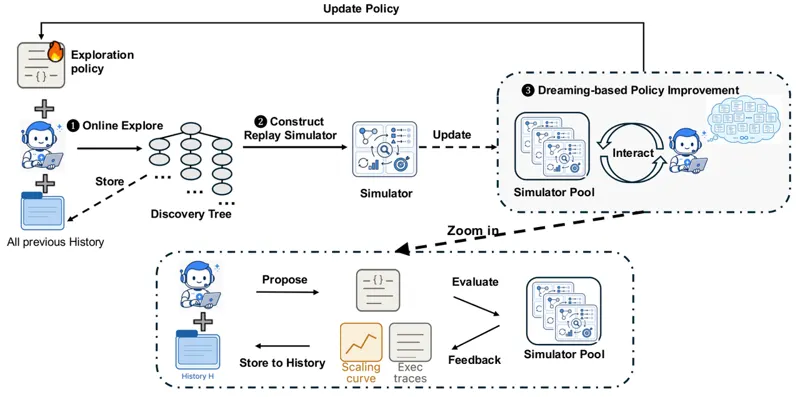
Recursive self-improvement is becoming increasingly vital for autonomous AI agents, where progress hinges on discovering high-value solutions across complex domains. The driver of this process is effective exploration, however, managing and improving exploration strategies remains a major bottleneck. Current systems face a fundamental dilemma: fixed strategies fail to adapt as search spaces scale, while online policy optimization requires navigating vast meta-search spaces under delayed and expensive feedback over long-horizon rollouts. We introduce {Dream-RSI}, a framework for scalable and recursively self-improving exploration. A lightweight orchestration layer makes exploration explicit and programmable while leaving the underlying coding agent unchanged. Our key insight is that accumulated discovery history can serve as a replay simulator over the realized search space. By performing dreaming in the replay simulator constructed from historical discovery trees, {Dream-RSI} secures immediate, low-cost off-policy feedback to evaluate and refine exploration policies without invoking repetitive, expensive online evaluations. The improved policy is subsequently redeployed online to drive further discovery, continuously expanding the simulator pool in a self-improving loop. Across algorithm engineering, mathematical optimization, and GPU kernel engineering, {Dream-RSI} achieves competitive or improved discovery quality while substantially reducing discovery cost in several settings.

Tong Zheng, Xidong Wu, Zheng Zhang · 976 views · Sep 14, 2026
Recursive self-improvementWorld ModelsLLM AgentSep 14, 2026

As an Amazon Associate, we earn from qualifying purchases.