Skip to content
← Tags

#Multimodal (23)

Video GenerationMediaTopA

Gemini Omni: moving the unit of video delivery from one attempt to a conversational editing process

Google DeepMind's video and multimodal generation model, officially create anything from any input, starting with video: it edits video through step-by-step conversation, each edit building on the last and keeping the scene coherent, raising the unit of delivery from one shot to footage you can keep revising; the other two surfaces are real-world knowledge and arbitrary reference composition. Read the level with its votes: on the Artificial Analysis arena (2026-09-22) gemini-omni-1.1-flash is #1 for text-to-video at Elo 1516 with only 1,784 votes and a ±15 CI, while #2 is the sibling at 1513 with 26,576 votes and ±9, a 3-point gap far smaller than either CI, so statistically indistinguishable: the honest statement is that the Omni family ties for the top. For image-to-video minimax-h3 leads (1495, 57,112 votes) with Omni #2 at 1488 on 3,734 votes. Pricing: $1.50 per million input tokens, $9.00 text and $17.50 video output, 720p about $0.10 per second and a 30-second clip roughly $3. GA to paid-tier developers, none on the free tier. Closed, not self-hostable, not fine-tunable. Graded A (confirmed), the first A-grade video asset; A means the reading is credible and checkable, not undisputed first place.
1516Arena T2V Elo (1,784 votes)Confirmed · 2026-09
ProductGoogle DeepMindSite
Gemini Omni: moving the unit of video delivery from one attempt to a conversational editing process
Image GenerationDesign & FrontendTopD

Nano Banana Pro: the image editing model that turned "edit it by talking to it" into a product

Gemini's native image generation and editing tier, known in the community as Nano Banana. Its point is not peak image quality but the interaction shape: keep editing one image across a multi-turn conversation, read the text inside an image and change it, and fuse several references into one output. That made image generation feel like talking to a designer instead of pulling a slot-machine lever. Most of its ranking comes from preference arenas, which are votes rather than measurements, so graded as needing reproduction.

ProductGoogle DeepMind (Gemini image)Site
Nano Banana Pro: the image editing model that turned "edit it by talking to it" into a product
Geo3R: Mitigating Spatial Reasoning Hallucination in Multimodal Large Language Models

Geo3R: Mitigating Spatial Reasoning Hallucination in Multimodal Large Language Models

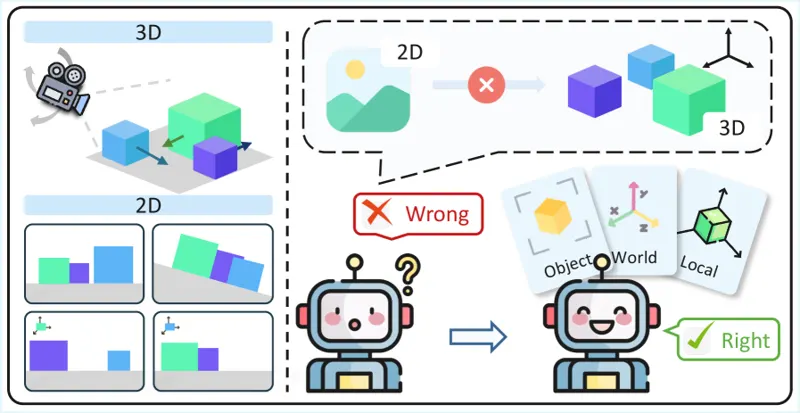
Despite remarkable progress in visual understanding, Multimodal Large Language Models (MLLMs) remain prone to hallucinations when reasoning about spatial relationships, often producing judgments that contradict the true 3D structure of the scene. Though several existing works have proposed to mitigate hallucinations, our analysis indicates that they show limited effectiveness in spatial reasoning, as they fail to bridge the fundamental gap between 2D visual representations and 3D spatial reality. Based on this finding, we define hallucinations arising from insufficient spatial structure modeling as spatial reasoning hallucination, a subcategory of relation hallucination that existing mitigation methods fail to address. We further identify three typical scenarios where such hallucinations frequently occur: perspective effects, object orientation, and viewpoint changes. To this end, we propose Geo3R, a training-free, plug-and-play framework that incorporates geometric evidence and structured 3D reasoning to mitigate spatial reasoning hallucination. Experiments on three benchmarks, covering 18 tasks across all three scenarios, show that Geo3R substantially reduces spatial reasoning hallucination across diverse MLLMs without additional training, outperforming existing models and methods.

Mingyu Wang, Weilin Jin, Wenbo Li · 342 views · Jul 23, 2026
Spatial reasoningMultimodalHallucinationJul 23, 2026
Scaling Native Multimodal Pre-Training From Scratch

Scaling Native Multimodal Pre-Training From Scratch

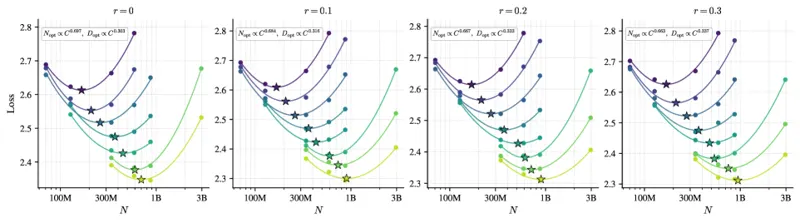
Although large language models (LLMs) exhibit remarkable reasoning capabilities, their reliance on text-only pre-training restricts the perception of the multimodal physical world. Native multimodal pre-training avoids this limitation by training models from scratch on multimodal inputs, thereby achieving deep cross-modal integration and mitigating optimization asymmetries inherent to traditional late-fusion architectures. Despite these advantages, the scaling properties of this paradigm remain systematically uncharacterized. To address this gap, we investigate the optimal model size and token count for training a transformer-based vision-language model under a fixed computational budget. We demonstrate that minimal objective loss adheres to a predictable compute law, whereas compute-optimal model sizes and token counts scale as power laws. Notably, language and multimodal objectives manifest distinct scaling behaviors. The language allocation law is largely invariant to the composition of the data, indicating stable language learning regardless of the multimodal data ratio. Conversely, the multimodal allocation law is highly sensitive to this composition. Specifically, text-heavy mixtures become compute-efficient only at larger model scales, shifting the optimal resource allocation toward greater model capacity. Additionally, by modeling the influence of data composition on compute laws and allocation exponents, we derive an efficiency frontier specifying precise configurations of model size, token count, and data mixture. Downstream evaluations further reveal that native multimodal pre-training induces positive cross-modal transfer, thereby enhancing pure-text spatial reasoning and enabling robust multimodal in-context learning. In summary, this empirical research establishes the essential groundwork for predictably scaling multimodal foundation models.

Haoyuan Wu, Aoqi Wu, Hai Wang · 368 views · Jul 24, 2026
MultimodalPre-TrainingNativeJul 24, 2026
Asynchronous Multimodal Diffusion Policy Composition via Latency-Aware Guidance Fusion

Asynchronous Multimodal Diffusion Policy Composition via Latency-Aware Guidance Fusion

Diffusion policies have shown strong potential for robotic imitation learning, and recent extensions incorporate additional modalities to improve manipulation performance. However, these modalities often differ not only in information content but also in sensing rates and inference latencies. Existing multimodal diffusion policies typically rely on synchronous fusion or manually designed multi-frequency architectures, which either slow down high-frequency feedback or limit extensibility to new modality combinations. We propose LAG-Fusion, a latency-aware guidance fusion framework for asynchronous multimodal diffusion policy composition. LAG-Fusion allows modality-specific policies to operate at their native inference rates and contribute denoising guidance whenever available. To make asynchronous composition consistent, we derive a reference-frame rebasing rule for diffusion variables under relative action representations, enabling delayed guidance to be aligned before fusion. We instantiate LAG-Fusion in contact-rich manipulation by composing a low-frequency vision policy with a high-frequency force policy. Experiments under heterogeneous modality latencies show that LAG-Fusion improves policy responsiveness and task performance over synchronous fusion and specially designed force-aware baselines.

Zihao He, Hongjie Fang, Shirun Tang · 317 views · Jul 19, 2026
Diffusion policiesMultimodalLatencyJul 19, 2026

As an Amazon Associate, we earn from qualifying purchases.