Skip to content
Tags

#Neural rendering (3)

WilLaGS: Latent-Conditional 3D Appearance Fields for Robust Gaussian Splatting In-the-Wild

WilLaGS: Latent-Conditional 3D Appearance Fields for Robust Gaussian Splatting In-the-Wild

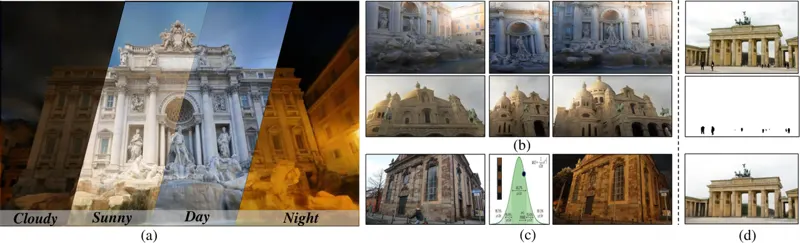
3D Gaussian Splatting (3DGS) delivers real-time and high-fidelity rendering but remains challenged by unconstrained in-the-wild scenes, where drastic appearance variations and transient objects violate multi-view consistency. Existing methods are fundamentally limited by independent and discrete embeddings that struggle to capture continuous environmental changes or model spatially-varying local illumination. To address these limitations, we propose WilLaGS, a unified framework for robust 3D scene reconstruction and generative appearance synthesis under unconstrained settings. Specifically, we introduce a generative appearance model where a β-VAE learns a structured and continuous manifold of global appearance. Conditioned on the latent code, we construct a 3D neural appearance field that generates dynamic Tri-Plane features to encode spatially-varying local illumination effects. Furthermore, to suppress transient artifacts, we present a self-supervised perceptual masking mechanism that leverages a Teacher-Student (EMA) architecture to derive a stable scene consensus, robustly identifying inconsistent regions via perceptual discrepancies. Extensive experiments on multiple datasets demonstrate that WilLaGS achieves state-of-the-art performance in reconstruction quality and novel view appearance synthesis, while maintaining real-time rendering efficiency.

Yuhao Bai, Qianqiu Tan, Lilong ChenAug 28, 2026
3D Gaussian SplattingGaussian Splattingβ-VAEAug 28, 2026
Odin: Primitive-Level Synchronization for Distributed Point-Based Neural Rendering

Odin: Primitive-Level Synchronization for Distributed Point-Based Neural Rendering

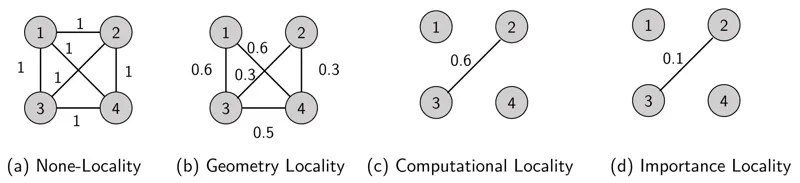
Point-based neural rendering (PBNR) represents 3D scenes as explicit, trainable primitives and underpins high-quality reconstruction and emerging embodied AI and world-model pipelines. Unlike layer-structured neural networks, PBNR has primitive-indexed dependencies: each view reads and updates only a sparse, view-dependent subset of mutable scene state. As large scenes require distributed training and optimized renderers reduce per-view computation, global task- or iteration-level barriers increasingly place synchronization, rather than rendering, on the critical path. We present Odin, a distributed PBNR training system that replaces global barriers with primitive-level synchronization. Its ahead-of-time scheduler uses stable locality and phase order to identify low-conflict overlap windows, while the runtime validates primitive publication before later work observes mutable state. Odin provides a quality-first path that preserves synchronized-training visibility and a throughput-first path that uses overlap and gradient evidence to admit only small, low-impact delayed reads; structural changes and high-impact cases remain synchronized. Across four existing PBNR pipelines and 13 non-city scenes on 8 GPUs, Odin improves throughput by 1.22 times on average and hides 82% of critical-path wait while preserving reconstruction quality. In a MatrixCity mixed-parallel case study scaling to 64 GPUs, Odin improves throughput over Grendel by up to 1.89 times without changing renderer kernels, optimizers, training budgets, or model capacity.

Zhenxiang Ma, Zeyu He, Yuanzhen ZhouJul 22, 2026
3D Gaussian SplattingNeural renderingPoint cloudsJul 22, 2026