Skip to content
Tags

#Open-vocabulary (6)

RelateAnything: Real-Time Open-Vocabulary Relation Prediction From Any Inputs

RelateAnything: Real-Time Open-Vocabulary Relation Prediction From Any Inputs

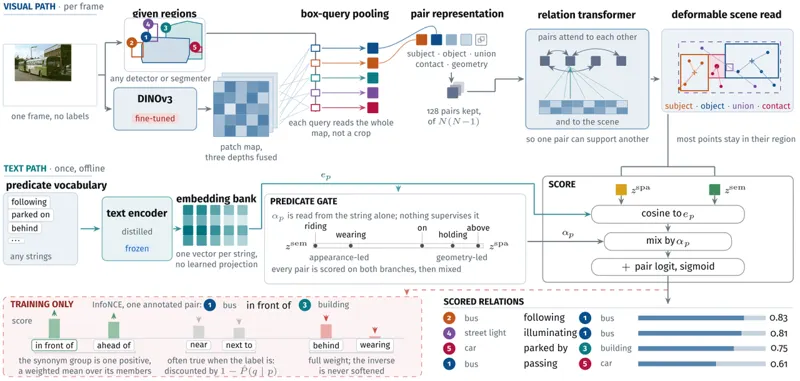
Open-vocabulary detection accepts any class list at inference, and promptable segmentation returns regions without class names: the taxonomy has left the model and become an input. Relation prediction has not. Scene-graph models are still trained and evaluated on the 50 or 56 predicates of one annotation style, their relation head conditioned on object labels and so tied to one detector. Three obstacles explain this, none primarily modelling: no relation corpus is both free-text and verified, a label-conditioned architecture cannot accept a vocabulary it was not trained on, and the standard metric rewards agreement with the training corpus, so a larger vocabulary scores as a regression. We present RelateAnything, a 53M-parameter model taking an image and regions from any source and returning scored relations over a predicate vocabulary supplied at inference as strings. Object labels are never an input, so the region source can change without retraining, and the vocabulary is a bank of text embeddings, not a learned classifier. It runs at 20 ms/frame. Training over 19,103 predicates requires positive-unlabeled supervision and a text encoder that separates antonyms, which contrastive encoders embed at cosine 0.95. To supply the supervision we build RA-4M, 474k images and 4.3M relations over 10,102 free-text predicates, generated against numbered box markers and geometrically verified. To measure it we build OV-SGG-Bench, six axes scored across datasets that the priors standard recall rewards cannot satisfy. On three cross-dataset benchmarks and a fourth zero-shot, RelateAnything has 2.3-3.5x the mean recall of the strongest open-vocabulary method of comparable scale, margins that survive a real detector, and leads a 3B-VLM scene-graph model on both metrics at under 2% of its parameters. In-domain measurement overstates transfer gains ~5x. Model, corpus and benchmark are public.
Neau, MaëlicSep 11, 2026
Scene Graph GenerationOpen-vocabularyRelation PredictionSep 11, 2026
Vision-Language-Motion Maps: An Open-Vocabulary, Uncertainty-Aware, Queryable Motion Attribute for 3D Scene Maps

Vision-Language-Motion Maps: An Open-Vocabulary, Uncertainty-Aware, Queryable Motion Attribute for 3D Scene Maps

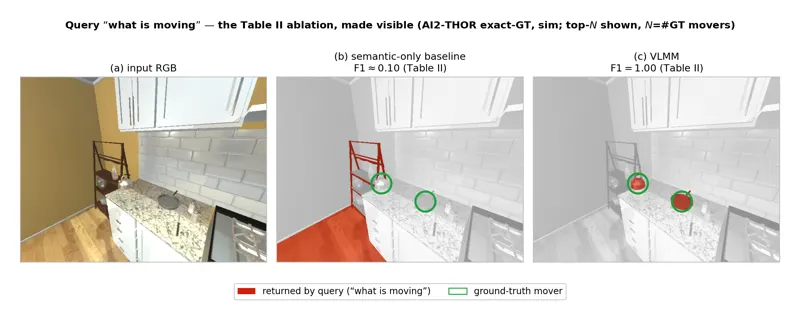
Open-vocabulary 3D maps let robots answer language queries about what and where, but they assume a static world and cannot answer queries about how scene elements behave. We introduce Vision-Language-Motion Maps (VLMM), an open-vocabulary, natural-language-queryable 3D map in which each element carries a fused motion attribute: a VLM/LLM semantic movability prior combined with geometrically observed cross-frame motion, together with a per-element uncertainty. Queries reduce to attribute filters that distinguish what has been seen to move, what could move but has not, and what stays still. On a controlled simulator benchmark with exact ground truth (AI2-THOR, three scene types) we show through ablation that the schema fields are non-substitutable: a semantic-only baseline fails motion queries even with strong features, and neither motion field substitutes for the other (the prior cannot answer "what is moving," observed motion cannot answer "what could move"). On real dynamic RGB-D (TUM and Bonn, six sequences) we show the uncertainty channel-our key difference from prior fused-motion work-consistently improves moving-vs-static average precision and reduces false motion flags, and is robust to estimated (noisy) poses. The raw confidence is not calibrated, but post-hoc isotonic calibration reaches an expected calibration error of 0.10. VLMM is a representation contribution: the closest prior maps each lack at least one of the four properties-open-vocabulary, language-queryable, fused prior-and-observed motion, and per-element uncertainty-that our combination provides.

Dibyendu Ghosh, Ayushi ShakyaJul 17, 2026
VLMMOpen-vocabularyMotionJul 17, 2026