PAPER DEEP DIVE
GaussLite: Online Task-Conditioned 3D Gaussian Splatting for Real-Time Robotic Mapping
MIT presents GaussLite, the first 3DGS mapping system that takes a natural-language task and allocates representation capacity online by task relevance: a one-shot LLM parser extracts target and anchor objects, Grounding DINO + FastSAM ground them per frame into relevance masks that steer seeding density, gradient flow and initial scale. At matched Gaussian budget and real-time 4 Hz mapping, ROI PSNR improves by +2.72 dB on Replica and +2.23 dB on real campus scenes; multi-agent maps fuse via per-voxel voting on active-optimization counts, beating concatenation by +3.42 dB while sharing only 7.08% of the map.
TL;DR
Existing 3D Gaussian Splatting systems distribute representation capacity uniformly across a scene, ignoring that many downstream robotic tasks engage only a fraction of the reconstructed geometry — wasting precious onboard compute on irrelevant parts. GaussLite makes mapping task-driven: given a natural-language task (e.g., "prepare to pick up the object on the desk"), a one-shot LLM parser extracts target and anchor objects, which an open-vocabulary detector and segmentor ground per frame into per-pixel relevance masks that steer seeding density, gradient flow, and initial scale. At matched Gaussian budget and real-time 4 Hz mapping, it beats baselines on ROI PSNR by an average of +2.72 dB on Replica and +2.23 dB on real hardware. Two task-specialized agents' maps also fuse via per-voxel voting on active-optimization counts, outperforming concatenation by +3.42 dB while sharing only 7.08% of the map.
Background: Compute Spent in the Wrong Places
3D Gaussian Splatting (3DGS) has emerged as an expressive scene representation for photorealistic rendering, and a growing line of online Gaussian mapping systems integrate it into robotic SLAM. But on robot hardware, the per-frame mapping loop must run in real time, memory is bounded, and the compute budget is typically too tight to refine the full scene at uniform fidelity. The problem: current online GS-SLAM systems still allocate the representation uniformly over the visible scene, spending onboard compute on regions that could be irrelevant to the task at hand. These constraints compound across robot teams, where the inter-agent link is itself a bounded resource that cannot support an entire reconstruction.
Prior work has addressed 3DGS cost from three directions, but every allocation criterion is geometric: post-hoc compression and pruning (global significance, principled sensitivity, local distinctiveness); level-of-detail methods that select Gaussian subsets by camera distance; and online mapping systems that adapt densification to evolving geometry and tracking uncertainty. None consider what the robot's task requires. As a result, a robot instructed to water plants near a wall may allocate substantial representational capacity to the ceiling instead of concentrating fidelity where the task is actually performed.
Biological vision is non-uniform by design: the fovea encodes a narrow high-acuity region while the periphery provides a coarse scaffold, and the observer's task determines where the eye fixates. GaussLite proposes that this principle transfer to online 3DGS — that representation capacity should follow the task rather than the geometry. The authors note this is the first system to accept natural-language task inputs and spatially allocate the scene representation online, and the first to extend the principle to robot teams.
Method: Three Components
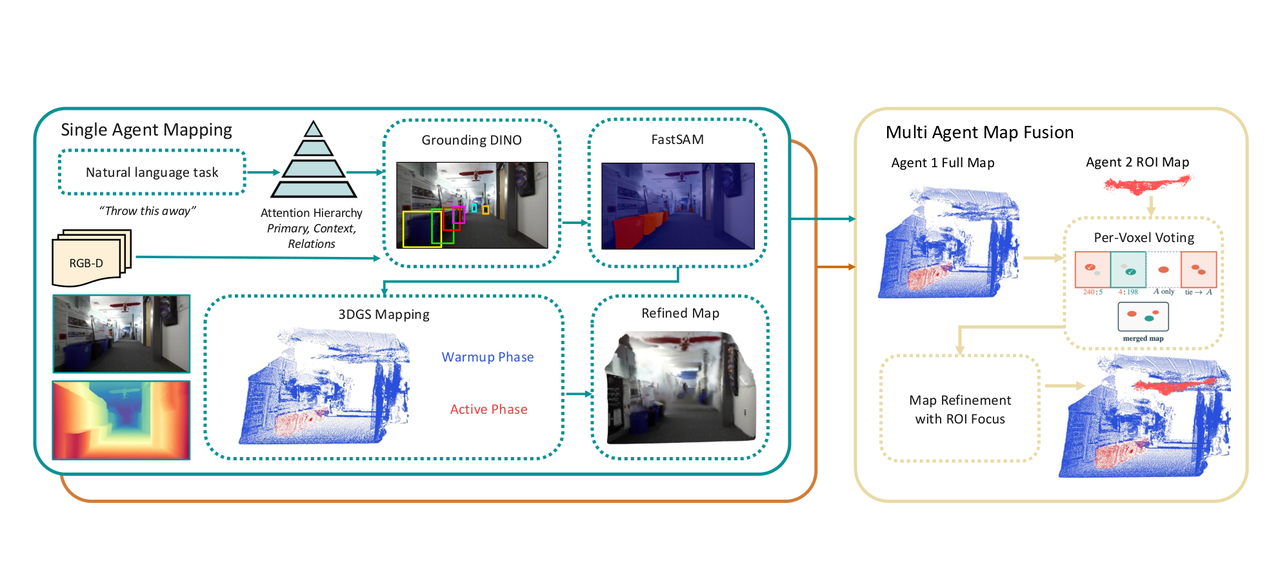
Figure 2: System overview. A task description is parsed once into a structured object–relation graph. Per frame, an open-vocabulary detector and segmentor produce attention masks that modulate Gaussian seeding, initialization, and optimization within the mapping loop.
Representation: Two Extra Task Variables per Gaussian
Following standard 3DGS, the scene is a set of $N$ anisotropic 3D Gaussians $\mathcal{G}=\{G_i\}_{i=1}^N$, each parameterized by a mean $\mu_i\in\mathbb{R}^3$, a covariance $\Sigma_i = R_i S_i S_i^{\top} R_i^{\top}$ factored into rotation $R_i$ and diagonal scale $S_i$, an opacity $\alpha_i\in[0,1]$, and a color $c_i\in[0,1]^3$. A differentiable rasterizer produces a color image $\hat{I}$, depth $\hat{D}$, and an alpha-accumulation map $\hat{\alpha}$.
On top of these standard attributes, each $G_i$ carries two non-differentiable task-related variables:
- An active flag $a_i\in\{0,1\}$, set at seed time from the binary relevance map, controlling whether $G_i$ receives gradient during the active optimization phase;
- An active-optimization counter $\kappa_i\in\mathbb{N}$, incremented each iteration $G_i$ is in the active set, serving as the fusion weight for multi-agent merging.
Component 1: Task-Conditioned Attention Front-End
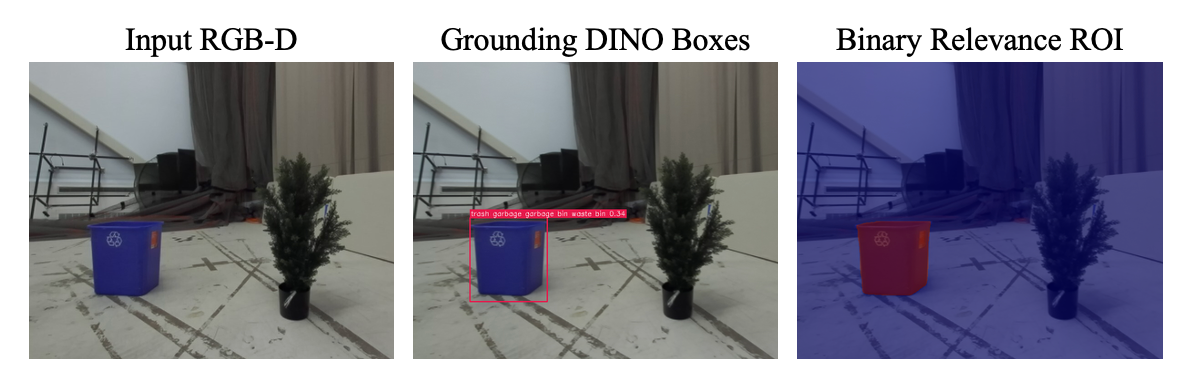
Figure 3: Task-to-attention front-end on Replica. Grounding DINO detects task-relevant objects; FastSAM produces pixel-level masks; spatial filtering prunes detections inconsistent with the 3D map.
1) Structured task parsing. Given a free-form task description $\mathcal{T}$, a lightweight instruction-tuned LLM (Phi-3-mini, 3.8 B) with a few-shot schema extracts a structured task graph:
$$\mathcal{G}_{\text{task}} = \{\mathcal{O}_{\text{target}},\ \mathcal{O}_{\text{anchor}},\ \mathcal{R}\}$$
where $\mathcal{O}_{\text{target}}$ are target noun phrases, $\mathcal{O}_{\text{anchor}}$ are spatial reference objects, and $\mathcal{R}$ holds binary spatial predicates $r(t,a)$. Two predicates are implemented: NEAR (Euclidean distance below a threshold) and ON (target centroid above anchor centroid with overlapping $xy$ projection). The authors restrict $\mathcal{R}$ to centroid-based predicates because they remain well-defined under partial observation; richer predicates (INSIDE, BEHIND) require fuller object geometry and are deferred. Parsing runs once per task (<4 s), producing query set $Q=\mathcal{O}_{\text{target}}\cup\mathcal{O}_{\text{anchor}}$.
2) Open-vocabulary grounding and segmentation. On each motion-triggered keyframe, Grounding DINO runs with query set $Q$ to produce 2D bounding boxes, filtering out detections that span too much of the image. FastSAM refines boxes into pixel-level masks matched by IoU. Between detection frames, prior boxes are re-projected via their 3D frustum corners and re-segmented by FastSAM, avoiding the full Grounding DINO forward pass every frame.
3) 3D spatial filtering. Spatial predicates are relational and need 3D positions for both target and anchor. For each detection $i$, a 3D centroid $c_i$ is obtained by lifting the 2D mask centroid into world coordinates through depth rendered from the current Gaussian map, then predicates are evaluated against anchor centroids:
$$\text{keep}(i) = \bigwedge_{r\in\mathcal{R}} \text{pred}_r\big(c_i,\ \{c_j : j \in \text{anchors}(r)\big\})$$
4) Per-pixel relevance map. Masks merge into a binary per-pixel relevance map $w(u,v)\in\{0,1\}$. Each new Gaussian inherits its active flag $a_i$ from $w$ at its seed pixel: active Gaussians ($a_i=1$) receive concentrated optimization while background Gaussians ($a_i=0$) serve as a coarse scaffold.
Component 2: Relevance-Driven Seeding
Built on the Gaussian-SLAM mapper with camera poses treated as external input (ground-truth poses on Replica, LiDAR-inertial odometry from DLIO on the campus dataset), decoupling mapping quality from tracking error. Each frame contributes $N$ new Gaussians by back-projecting sampled depth pixels. Three components govern the seed budget and layout:
1) ROI Seed Budgeting (SB). The seed budget splits between ROI and background pixels by an ROI allocation $\rho\in[0,1]$:
$$N_{\text{ROI}} = \lfloor \rho N \rfloor,\qquad N_{\text{bg}} = N - N_{\text{ROI}}$$
concentrating Gaussians on task-relevant geometry while retaining a coarse background scaffold for geometric anchoring and free-space coverage.
2) Stratified Initial Scaling (SIS). Two coupled details. First, background pixels are drawn via stratified sampling: the non-ROI area is partitioned into a $\sqrt{N_{\text{bg}}}\times\sqrt{N_{\text{bg}}}$ grid with one jittered sample per cell, eliminating the clumping artifacts of uniform random sampling at fixed budget. Second, each new Gaussian is initialized with identity rotation, color from observed RGB, opacity $\alpha_0=0.5$, and initial scale proportional to local median nearest-neighbor distance $s_0$, modulated by a per-tier multiplier:
$$s_{\text{init}} = \log(s_0 \cdot m_{\tau}), \qquad m_{\tau} = \begin{cases} 0.5 & \text{ROI seed} \\ 0.7 & \text{background seed} \end{cases}$$
The smaller ROI scale allows finer detail; the reduced background scale prevents alpha bleed into neighboring ROI pixels. Under a limited per-frame iteration budget the optimizer cannot shrink oversized Gaussians, so starting small is critical.
3) Gradient-Focused Densification (GFD). Within the SB budget and SIS cells, pixel selection is biased toward high-frequency content: a Sobel filter on the luminance channel gives an edge-magnitude map $E(u,v)=\lVert\nabla I(u,v)\rVert$, turned into a within-cell sampling distribution where the seed pixel is drawn with probability proportional to $E(u,v)+\epsilon$. The effect is to place Gaussians at object silhouettes and textured surfaces, where photometric residual is highest and added density yields the largest fidelity gain.
Component 3: Relevance-Driven Optimization
1) ROI Optimization. Each mapped frame runs a brief warmup over the full image, then restricts both rendering and gradient updates to active Gaussians ($a_i=1$) for remaining iterations. Excluding background Gaussians concentrates the optimization budget on task-relevant geometry and roughly halves per-iteration render cost, since the rasterizer processes only the ROI subset. Each active Gaussian's $\kappa_i$ increments per active-phase iteration. The per-iteration loss combines absolute-error color and depth terms with an SSIM term:
$$\mathcal{L} = \mathcal{L}_{\text{color}} + \lambda_d \mathcal{L}_{\text{depth}} + \lambda_s\big(1 - \text{SSIM}(\hat{I}, I)\big)$$
Color and SSIM terms are evaluated over the full image during warmup and restricted to ROI pixels intersected with the rendering footprint during the active phase.
2) Multi-View Optimization (MVO). At each iteration the training view is sampled uniformly at random from a window of recent keyframes, preventing over-supervision by the current viewpoint and forcing ROI Gaussians to stay consistent across recent observations. Adam with per-parameter-group learning rates is used, with the standard 3DGS clone/split/prune scheme — cloned and split daughters inherit the parent's $a_i$.
Multi-Agent Fusion: Exchange Only What You Invested In
When multiple agents map the same environment with different task specifications, their Gaussian maps fuse without re-optimization. The counter $\kappa_i$ serves as the fusion weight: a per-voxel vote on each Gaussian's active-optimization count selects the better-trained source per region, so agents exchange only the small task-specialized subset of each map that carries meaningful information.
Experiments
Replica (8 scenes, 24 scene–task pairs)
| Method | PSNR ↑ | SSIM ↑ | LPIPS ↓ |
|---|---|---|---|
| MonoGS | 26.10 | 0.815 | 0.287 |
| Gaussian-SLAM | 26.62 | 0.823 | 0.303 |
| SplaTAM | 28.56 | 0.821 | 0.230 |
| GaussLite | 29.81 | 0.835 | 0.230 |
GaussLite surpasses baselines in PSNR on 7/8 scenes, outperforming SplaTAM by +1.25 dB, Gaussian-SLAM by +3.19 dB, and MonoGS by +3.71 dB in mean ROI PSNR. All baselines run from released configurations with per-frame iteration count and frame-step interval adjusted to the same real-time budget, at matched Gaussian count (1M cap on Replica) and real-time mapping on an RTX 4070 Laptop GPU (≤0.5 s/frame) — so gains are entirely attributable to where the budget is spent.
Campus Real Dataset (3 scenes, 9 scene–task pairs)
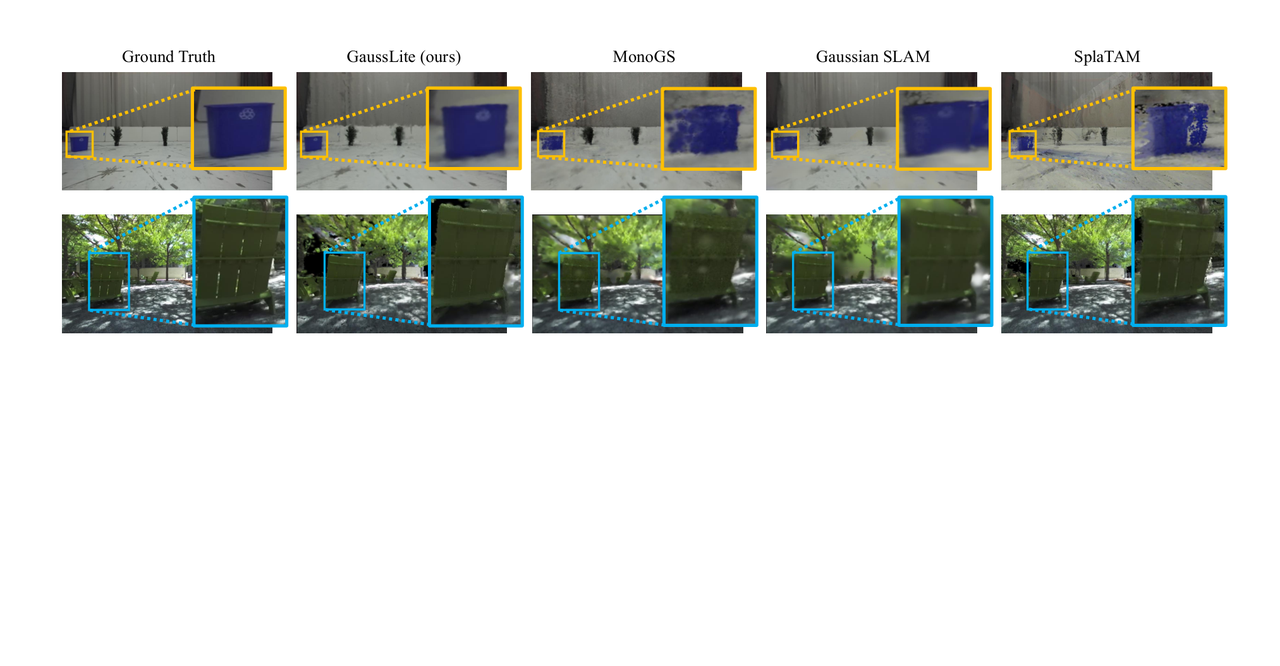
Figure 4: Qualitative comparison on Campus. Insets show crops of task-relevant regions. GaussLite preserves fine detail in task-relevant regions (comparable to ground truth) while baselines lose foreground detail after uniform allocation, or produce sharper edges but lower pixel fidelity in the ROI.
| Method | Single-agent PSNR ↑ | Multi-agent fused PSNR ↑ |
|---|---|---|
| Gaussian-SLAM | 18.06 | 17.41 |
| SplaTAM | 19.35 | 18.19 |
| MonoGS | 19.06 | 18.27 |
| GaussLite | 21.05 | 21.38 |
The campus dataset is captured onboard a Clearpath Husky rover with a ZED 2i stereo camera and processed on an RTX 4070 Laptop GPU, with poses produced online by DLIO — demonstrating performance from real onboard sensing. GaussLite achieves the best ROI PSNR in all settings, beating SplaTAM by +1.70 dB, Gaussian-SLAM by +2.99 dB, and MonoGS by +1.99 dB. For reference: +1 dB ROI PSNR corresponds to approximately a 21% reduction in MSE within task-relevant regions; observed improvements range from that level up to roughly 74% MSE reduction in some settings.
Multi-Agent Fusion
Evaluated on two real sequences (Campus Highbay and Campus Outdoor) where two agents build task-specialized maps, comparing Combine Maps (naive concatenation), Voxel Voting ($\kappa_i$-weighted per-voxel selection), and Refinement (voting plus a short joint optimization pass). On the highbay sequence, voxel voting alone yields near-specialist quality, with the refinement pass pushing further. Overall it outperforms naive concatenation of baselines by an average of +3.42 dB while sharing only 7.08% of the map on average.
Component Ablation
| SB | MVO | ROI | SIS | GFD | Replica | Campus |
|---|---|---|---|---|---|---|
| ✗ | ✗ | ✗ | ✗ | ✗ | 34.57 | 21.50 |
| ✓ | ✗ | ✗ | ✗ | ✗ | 35.95 | 21.61 |
| ✓ | ✓ | ✗ | ✗ | ✗ | 35.96 | 22.55 |
| ✓ | ✓ | ✓ | ✗ | ✗ | 36.87 | 22.15 |
| ✓ | ✓ | ✓ | ✓ | ✗ | 38.05 | 25.14 |
| ✓ | ✓ | ✓ | ✓ | ✓ | 38.23 | 25.25 |
The ablation runs with ground-truth ROI masks to isolate each budget-allocation component from upstream detection error. Every component contributes a positive ROI PSNR gain. The largest single jumps come from ROI Seed Budgeting (+1.38 dB on Replica) and Stratified Initial Scaling (+1.18 dB on Replica, +2.99 dB on Campus) — the Campus result showing that small-init Gaussians become especially important under real-world depth and exposure noise. GFD adds a smaller but consistent improvement on both datasets. The full pipeline lifts ROI PSNR from 34.57 to 38.23 dB on Replica and 21.50 to 25.25 dB on Campus. Meanwhile full-image PSNR drops modestly as budget is reallocated away from the background — the intended tradeoff of task-conditioned mapping.
Significance and Limitations
\"throw this away\""] --> B["① One-shot LLM parsing
Phi-3-mini extracts
targets / anchors / predicates"] B --> C["② Per-frame grounding
Grounding DINO detect
FastSAM segment"] C --> D["③ 3D spatial filtering
NEAR / ON predicate check"] D --> E["④ Per-pixel relevance mask w(u,v)"] E --> F["⑤ Relevance-driven seeding
SB budget split · SIS small scale
GFD edge weighting"] F --> G["⑥ Relevance-driven optimization
warmup full → active-only
MVO multi-view sampling"] G --> H["Task-specialized map
each Gaussian carries a_i and κ_i"] H --> I["⑦ Multi-agent fusion
per-voxel κ_i vote
shares only 7.08% of map"]
The one sentence worth keeping: 3D scene representations should not be passive reconstructions but task-conditioned cognitive maps whose fidelity follows the robot's purpose. This is especially practical on resource-constrained onboard platforms — the same compute and memory, spent where the task actually happens.
Three transferable engineering lessons. First, the "parse once, ground per frame" split amortizes the expensive LLM call across the whole sequence (<4 s per task), while 3D frustum reprojection plus re-segmentation between detection frames avoids running the detector every frame — a classic cost optimization for online systems. Second, initialize small: under a limited per-frame iteration budget the optimizer cannot shrink oversized Gaussians, so starting small beats post-hoc pruning — and this matters far more under real noise (Campus +2.99 dB) than in clean simulation (Replica +1.18 dB). Third, using the active-optimization count as a fusion weight is a remarkably lightweight multi-agent map merge: each Gaussian carries its own counter, voting selects the better-trained source per region, no global re-optimization is needed, and only 7.08% of the map is exchanged.
On limitations, the paper states plainly that the system does not re-allocate budget when the task changes mid-sequence: regions that were under-reconstructed cannot be retroactively refined without re-observing them or conducting further refinement offline. Further boundaries are visible from the design: only NEAR and ON centroid-based predicates are implemented, with INSIDE and BEHIND deferred; the front-end depends on the open-vocabulary capability of Grounding DINO and FastSAM, so detection error propagates directly into the relevance mask (the ablation deliberately uses ground-truth masks to isolate this); and ROI gains come at the cost of modestly reduced full-image PSNR, which must be traded off if downstream also needs global fidelity.
SOURCE LINKS