Skip to content
Tags

#Perception and motion (5)

Light-Loco-Parkour: Versatile Perceptive Whole-Body Locomotion via Multi-Skill Distillation

Light-Loco-Parkour: Versatile Perceptive Whole-Body Locomotion via Multi-Skill Distillation

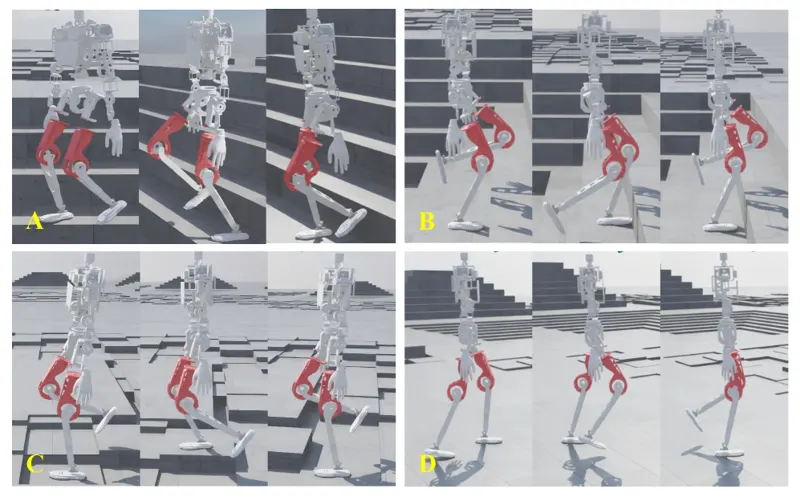
Existing humanoid whole-body control systems still fall short of the way humans move through cluttered terrain: they either track expressive whole-body references without terrain generalization, or react to terrain online while leaving the arms, torso, and knees largely unused. We present Light-Loco-Parkour (LLP), an end-to-end perceptive whole-body locomotion system that closes this gap with a single deployable policy. Conditioned only on onboard depth and a velocity command, the policy decides when to walk, balance, climb, step down, or vault, with no reference input, skill label, hand-coded gate, or runtime motion graph. Compared with prior humanoid systems, LLP makes three contributions. First, it introduces a whole-body perceptive-control pipeline that extends an RL-trained, velocity-tracking locomotion policy with parkour skills learned from object-interacting motions, so the same policy tracks velocity in open terrain, executes whole-body traversal at obstacles, and resumes locomotion afterward. Second, it acquires terrain-conditioned skills from sparse seeds by expanding a single motion into dynamically feasible, terrain-paired references across obstacle geometry, rather than relying on a large motion corpus. Third, it learns autonomous skill transitions from reward, letting the policy decide when and which whole-body skill to invoke from depth and command alone, with no one-hot skill label, hand-coded state machine, or runtime motion generator. Simulation and real-world experiments show high success across both benchmarked terrains and unseen obstacle variations, and the same policy transfers zero-shot to indoor and outdoor hardware experiments. These results demonstrate autonomous perceptive whole-body locomotion on a humanoid in outdoor settings, using only onboard sensing and a single deployable policy.
Hongming Chen, Zhuoran Li, Hongxi WangAug 1, 2026
RLHumanoidWhole-bodyAug 1, 2026
Global-Local Attention Decomposition for Terrain Encoding in Humanoid Perceptive Locomotion

Global-Local Attention Decomposition for Terrain Encoding in Humanoid Perceptive Locomotion

Although reinforcement learning has significantly advanced humanoid locomotion, perceptive policies still struggle on sparse-foothold terrain and constrained environments. Success in these scenarios requires both broad terrain awareness and precise foothold selection, two perceptual roles that conventional encoders often entangle. To address this challenge, we propose Global-Local Attention Decomposition (GLAD) for terrain encoding in humanoid locomotion. Realized by a coarse-to-fine encoder over a robot-centric elevation map, GLAD explicitly separates these objectives: a global attention branch utilizes attention pooling to summarize the surrounding terrain context, while a state-conditioned local attention branch sparsifies and encodes precise foothold-relevant geometry. This explicit attention decomposition prevents the dilution of fine-grained spatial cues while reducing training overhead. Experiments demonstrate that GLAD enables reliable locomotion over challenging gaps, stepping stones, and stairs. Furthermore, the learned policy exhibits emergent terrain-responsive behaviors, autonomously following narrow paths and avoiding obstacles under simple velocity commands without explicit navigation planners. In real-world deployment on a Unitree G1 humanoid robot using onboard LiDAR, the proposed method achieves robust zero-shot sim-to-real transfer across diverse sparse-foothold and obstacle-rich domains.

Shengcheng Fu, Yang Zhang, Zhanxiang CaoMay 30, 2026
HumanoidAttention MechanismTerrain EncodingMay 30, 2026
PRIOR: Perceptive Learning for Humanoid Locomotion with Reference Gait Priors

PRIOR: Perceptive Learning for Humanoid Locomotion with Reference Gait Priors

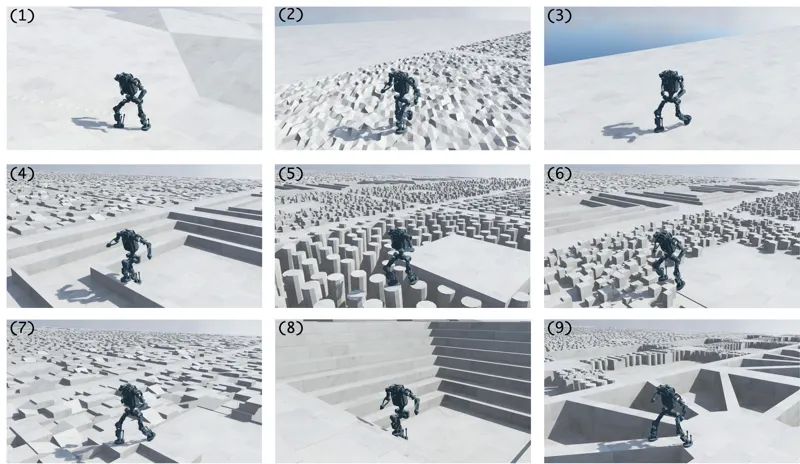
Training perceptive humanoid locomotion policies that traverse complex terrains with natural gaits remains an open challenge, typically demanding multi-stage training pipelines, adversarial objectives, or extensive real-world calibration. We present PRIOR, an efficient and reproducible framework built on Isaac Lab that achieves robust terrain traversal with human-like gaits through a simple yet effective design: (i) a parametric gait generator that supplies stable reference trajectories derived from motion capture without adversarial training, (ii) a GRU-based state estimator that infers terrain geometry directly from egocentric depth images via self-supervised heightmap reconstruction, and (iii) terrain-adaptive footstep rewards that guide foot placement toward traversable regions. Through systematic analysis of depth image resolution trade-offs, we identify configurations that maximize terrain fidelity under real-time constraints, substantially reducing perceptual overhead without degrading traversal performance. Comprehensive experiments across terrains of varying difficulty-including stairs, boxes, and gaps-demonstrate that each component yields complementary and essential performance gains, with the full framework achieving a 100% traversal success rate. We will open-source the complete PRIOR framework, including the training pipeline, parametric gait generator, and evaluation benchmarks, to serve as a reproducible foundation for humanoid locomotion research on Isaac Lab.

Chenxi Han, Shilu He, Yi ChengMar 19, 2026
Isaac LabHumanoidReinforcement LearningMar 19, 2026
Gait-Adaptive Perceptive Humanoid Locomotion with Real-Time Under-Base Terrain Reconstruction

Gait-Adaptive Perceptive Humanoid Locomotion with Real-Time Under-Base Terrain Reconstruction

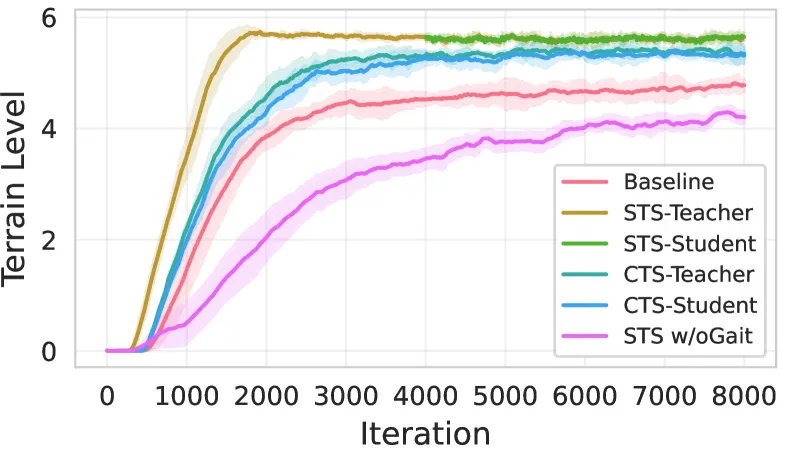
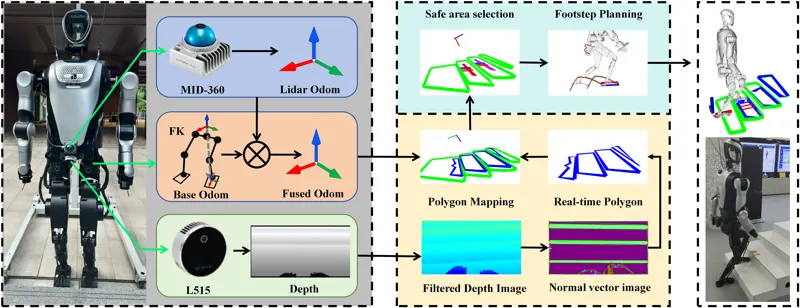
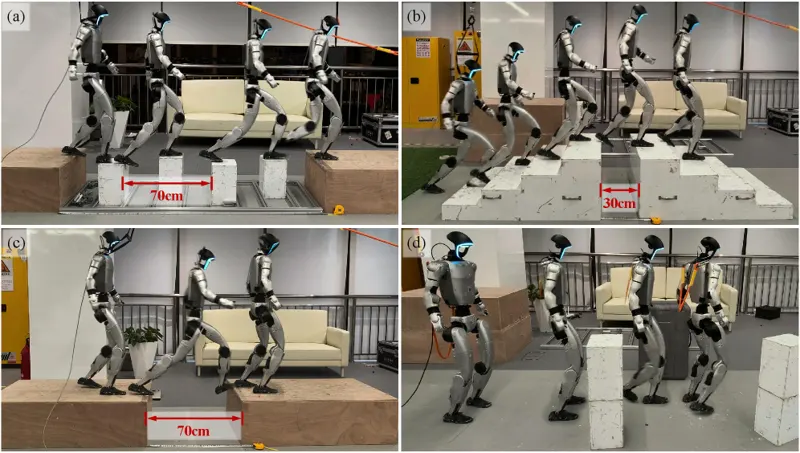
For full-size humanoid robots, even with recent advances in reinforcement learning-based control, achieving reliable locomotion on complex terrains, such as long staircases, remains challenging. In such settings, limited perception, ambiguous terrain cues, and insufficient adaptation of gait timing can cause even a single misplaced or mistimed step to result in rapid loss of balance. We introduce a perceptive locomotion framework that merges terrain sensing, gait regulation, and whole-body control into a single reinforcement learning policy. A downward-facing depth camera mounted under the base observes the support region around the feet, and a compact U-Net reconstructs a dense egocentric height map from each frame in real time, operating at the same frequency as the control loop. The perceptual height map, together with proprioceptive observations, is processed by a unified policy that produces joint commands and a global stepping-phase signal, allowing gait timing and whole-body posture to be adapted jointly to the commanded motion and local terrain geometry. We further adopt a single-stage successive teacher-student training scheme for efficient policy learning and knowledge transfer. Experiments conducted on a 31-DoF, 1.65 m humanoid robot demonstrate robust locomotion in both simulation and real-world settings, including forward and backward stair ascent and descent, as well as crossing a 46 cm gap. Project Page:https://ga-phl.github.io/

Haolin Song, Hongbo Zhu, Tao YuDec 8, 2025
HumanoidGait AdaptationTerrain ReconstructionDec 8, 2025