Skip to content
← Tags

#Proprioception (9)

Blind Precise Assembly: Proprioceptive Sim-to-Real Peg-in-Hole for Diverse Parts

Blind Precise Assembly: Proprioceptive Sim-to-Real Peg-in-Hole for Diverse Parts

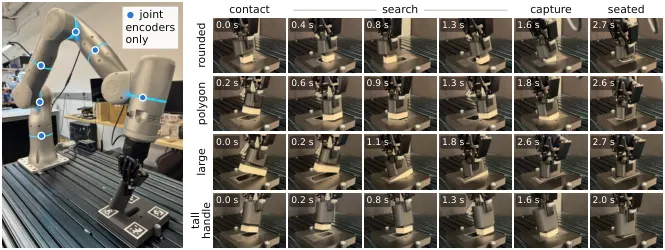
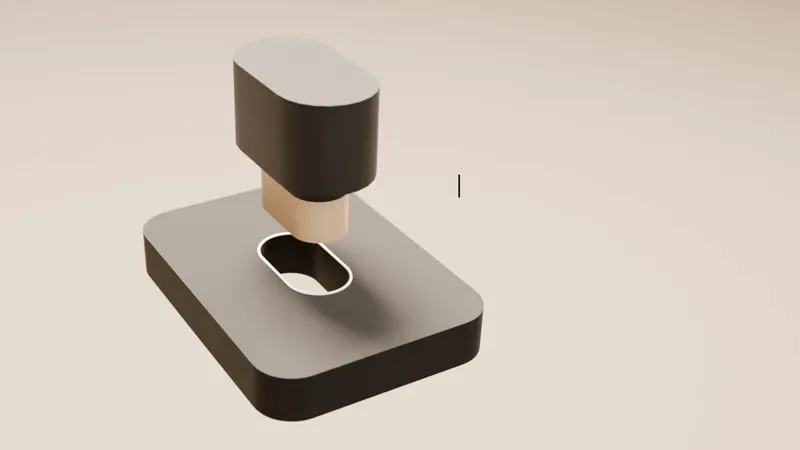
Every robot already carries high-resolution contact sensors: its own joints. Legged robots and humanoids exploit them to walk, run, and track whole-body motions without vision, but there the contacts are large and forceful. Is joint sensing also enough for precise, contact-rich assembly, where the robot must find a millimeter-scale opening, mesh gear teeth, or catch a thread through light contact? We study this question by training blind assembly policies that observe only a short history of joint positions, velocities, and their own actions, without visual, force, torque, or tactile sensing. The poses of both the fixture and the part are unknown to the policy, and the grasp is randomized substantially. The policy must therefore assemble the parts through contact, sensed exclusively through its own proprioception. Trained with reinforcement learning entirely in simulation over randomized parts, grasps, and contacts, such policies learn peg insertion, gear meshing, and nut threading. The peg insertion policy transfers zero-shot to the real world and inserts pegs of different shapes and sizes in 73% of trials. Controlled comparisons with matched visual policies in simulation show that blind policies generalize far better to unseen part shapes and sizes, though they can be slower. Training such policies needs thousands of different assemblies, each simulated with its clearance intact, so we also release an open-source generator that builds them procedurally from exact convex pieces for MuJoCo; it is more accurate and faster than convex decomposition or MuJoCo's signed-distance collision. Videos and interactive simulations are at https://younghyopark.me/blind-proprioceptive-assembly/.

Antonia Bronars, Younghyo Park, Kushal Kedia · 253 views · Oct 16, 2026
Peg-in-HoleSim-to-Real
Oct 16, 2026
A Model-Based Decoupling Strategy for Proprioception and Contact Sensing in an Architected Soft Manipulator

A Model-Based Decoupling Strategy for Proprioception and Contact Sensing in an Architected Soft Manipulator

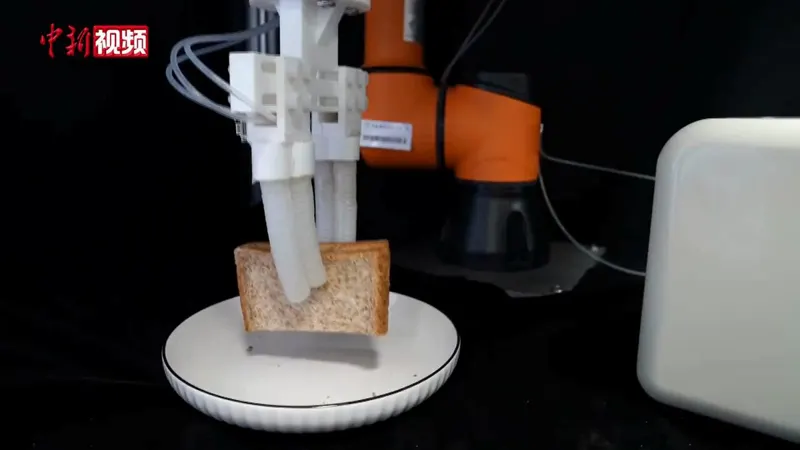
Soft continuum robots require embedded sensing for proprioception and contact detection, yet integrating sensors into sparse, highly deformable architected structures remains challenging. We present a model-based strategy that decouples proprioceptive and contact signals from a common set of fluidic pressure sensors embedded in a soft architected segment. Each segment of the Innervated Trimmed Helicoid (ITH) contains six air channels routed in a localized zigzag pattern along the circumference. With only three principal kinematic degrees of freedom (axial compression, bending in x, bending in y), the six pressure readings form an overdetermined system. A piecewise constant curvature model maps pressures to shape, and Huber regression identifies outlier channels whose residuals indicate external contact. On a single ITH segment, this approach achieves proprioceptive shape estimation with a relative bending error of 0.11 +/- 0.02 and a contact detection rate of 97% across 178 trials. We integrate eight ITH segments into Air-Helix, a tendon-driven soft continuum manipulator, and present exploratory whole-arm demonstrations that include tactile teaching by demonstration, admittance-controlled force regulation, and tactile object reconstruction. The results suggest that localized fluidic innervation combined with model-based redundancy resolution is a practical path toward concurrent proprioception and contact sensing in architected soft robots.

Francesco Stella, Annan Zhang, Cosimo Della Santina · 406 views · Jul 17, 2026
Soft robotsProprioception
Jul 17, 2026

As an Amazon Associate, we earn from qualifying purchases.