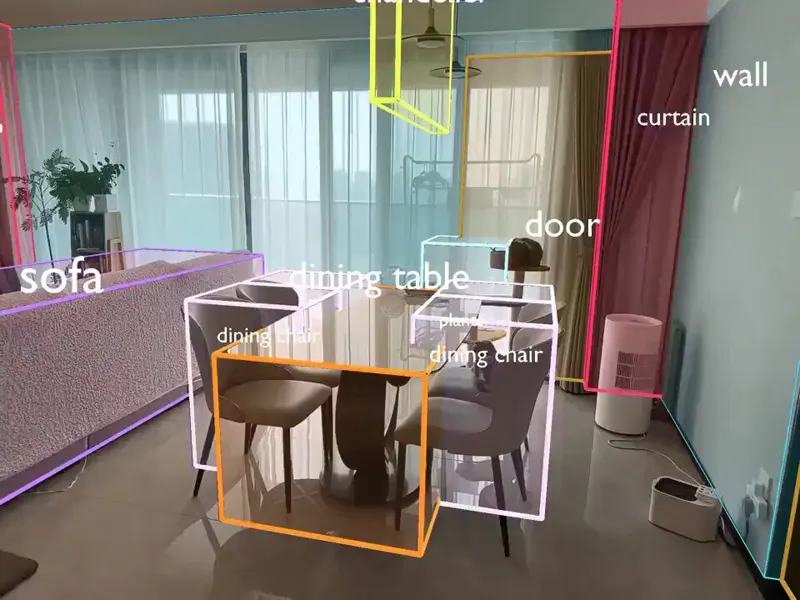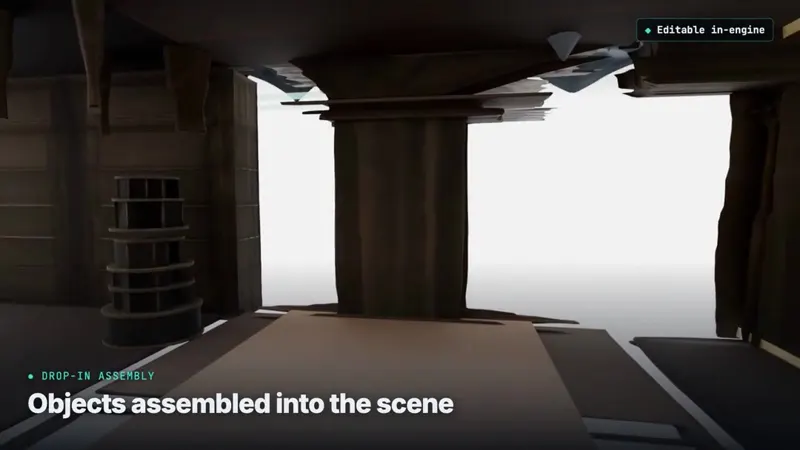
3:53Lumera turns an image into an editable UE5 world with meshes, lights, and layouts@HaoZhao_AIRSUN · 281 views · 2026-08-293D reconstructionUnreal EngineUE5
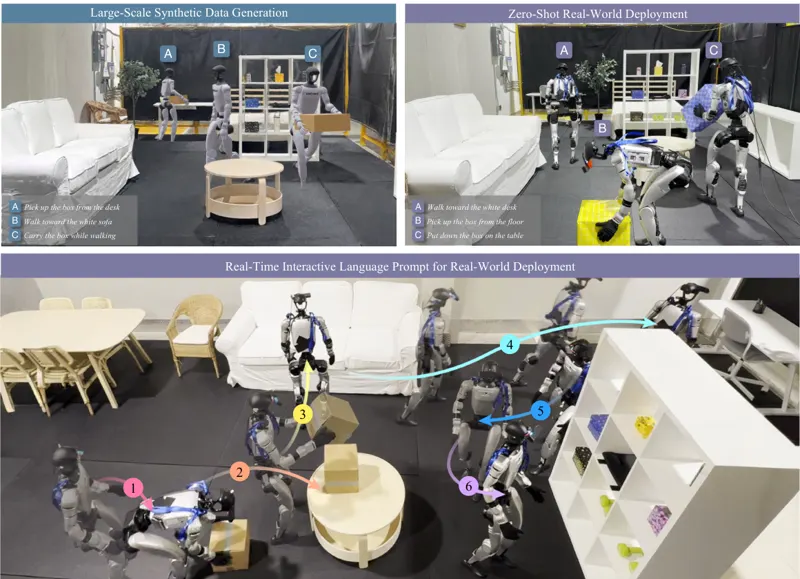
VLK: Learning Humanoid Loco-Manipulation from Synthetic Interactions in Reconstructed ScenesVLK synthesizes paired vision-language-kinematics supervision inside 3DGS-reconstructed real scenes: it generates navigation and object-interaction trajectories with privileged scene info, renders egocentric views after the fact, and produces 48,000 paired trajectories to train a policy predicting Unitree G1 whole-body motion, enabling sim-to-real perception-based humanoid loco-manipulation.Yen-Jen Wang, Jiaman Li, Sirui Chen·Jun 29, 2026Humanoidloco-manipulationSynthetic DataJun 29, 2026
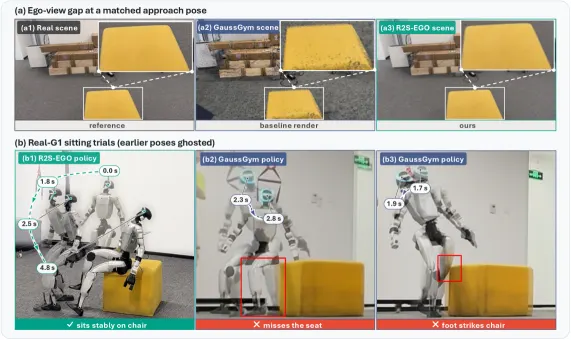
R2S-EGO: Dual-Proxy Refinement for Sparse-Capture Real-to-SimReal-to-sim (R2S) depends on scene representations that render observations along robot ego trajectories, yet dense multi-view capture limits per-environment real-image capture-count efficiency, and sparse human capture can leave behavior-scoped robot views under-supported. Camera-controlled synthesis can fill missing views, but its use in R2S requires behavior-admissible queries and capture-anchored structural conditioning. We present R2S-EGO, which couples a simulator-derived robot proxy that represents the behavior-scoped executable query domain with a capture-anchored geometry proxy that supplies scene-specific structural conditions. Within this domain, fixed- budget selection targets current support deficits for which geometry support is available. The generated observations are assimilated as pseudo-observations to refine the visual asset, while real captures remain anchors. The fused geometry proxy also supplies the scene collision surface, which is refreshed between rounds. Together, these updates refine the existing simulation scene while its robot dynamics and control stack stay fixed. Across 48 frozen Unitree G1 ego views in three Replica scenes, six-view R2S-EGO reaches 19.062 dB PSNR, compared with 14.226 dB for the strongest reported R2S baseline. Across five paired policy-training seeds, R2S-EGO achieves 82.5% +/- 6.8% real-G1 sitting success, compared with 10.0% +/- 10.5% for GaussGym.Shuai Fang, Xin Deng, Yuchen Kang·Aug 7, 2026R2SUnitree G1Physical AIAug 7, 2026
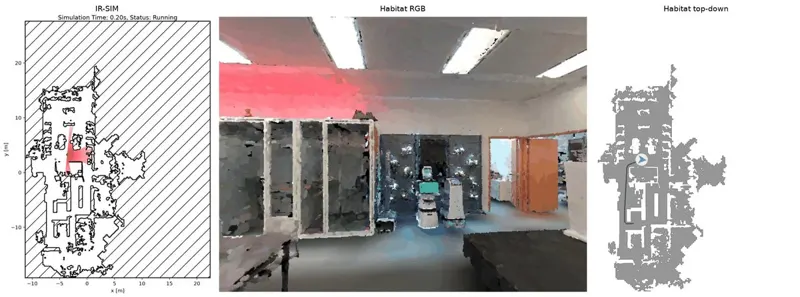
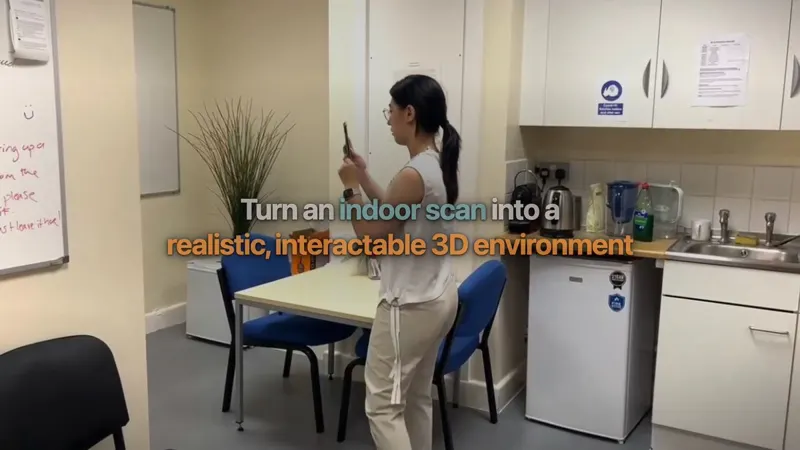
0:58LiteReality-Agent turns room scans into interactive 3D scenes@ZheningHuang · 72 views · 2026-08-07LiteRealityRGB-DScene Reconstruction
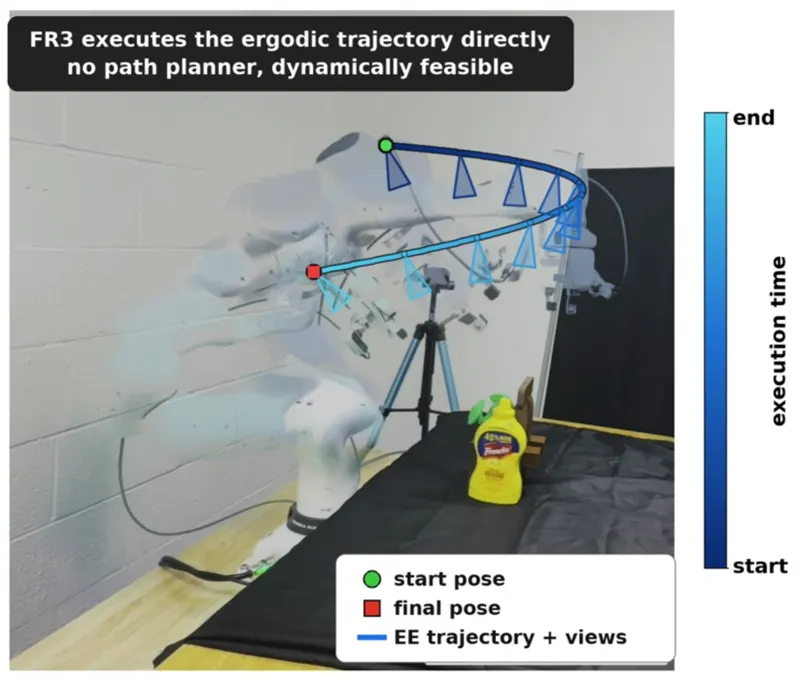
TRACE: Ergodic Trajectory Optimization for Active Scene ReconstructionExisting active reconstruction systems with Gaussian-splatting maps select observations greedily, optimizing a single next-best-view (NBV) at each step and connecting the chosen views by short-horizon path planning. This greedy decoupling disregards the global structure of scene information, producing inefficient trajectories that waste sensing capacity in transit between selected views. In this work, we study active reconstruction as an ergodic coverage problem: the time-averaged spatial statistics of the sensor trajectory should match a target information distribution induced by the current map. Our approach derives this target distribution online from uncertainty and visibility, and calculates ergodic trajectories via a kernel-ergodic horizon planner with gradient flow and footprint depletion, closing the loop between mapping and trajectory optimization. We thoroughly evaluate TRACE on the Replica dataset against the Next-Best-View (NBV) baselines, improving PSNR by 1.5 dB. Code: https://github.com/spikelab-jhu/trace-active-reconstruction.Ziyue Zheng, Linli Shi, Bingkun He·Aug 3, 20263D Gaussian SplattingNBVTRACEAug 3, 2026
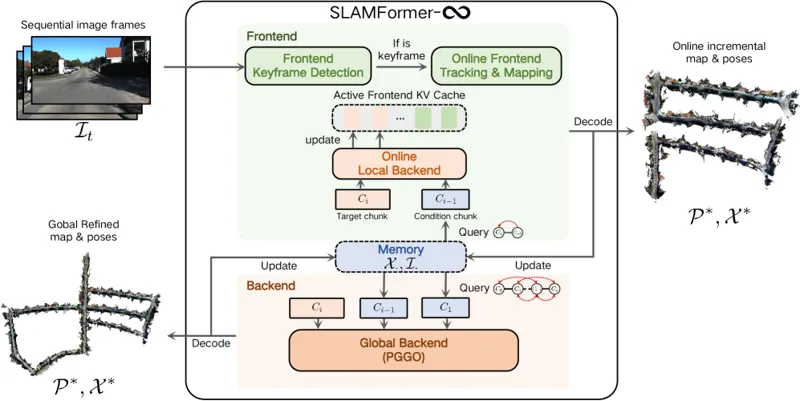
SLAMFormer-∞: Infinite SLAM Transformer for Unbounded Frontend and Backend ProcessingWe introduce the Infinite SLAM Transformer (SLAMFormer-∞), the first geometric transformer capable of supporting both long-range frontend and backend processing without an explicit distance bound. Instead of relying on a first-frame-anchored formulation, SLAMFormer-∞ employs memory conditions to define flexible coordinate systems and scales for input frames, enabling more expressive structural conditioning. Built upon this formulation, the frontend preserves efficient local computation, while the backend jointly optimizes long-range trajectories and scene geometry in a globally consistent manner. Experimental results demonstrate that SLAMFormer-∞ achieves superior or highly competitive performance in both trajectory estimation and scene reconstruction across large-scale datasets. Notably, SLAMFormer-∞ generalizes to extremely long trajectories, successfully operating on sequences exceeding 17km.Zhijian Fang, Weicheng Zheng, Yijun Yuan·Aug 4, 2026SLAM3D reconstructionTransformerAug 4, 2026