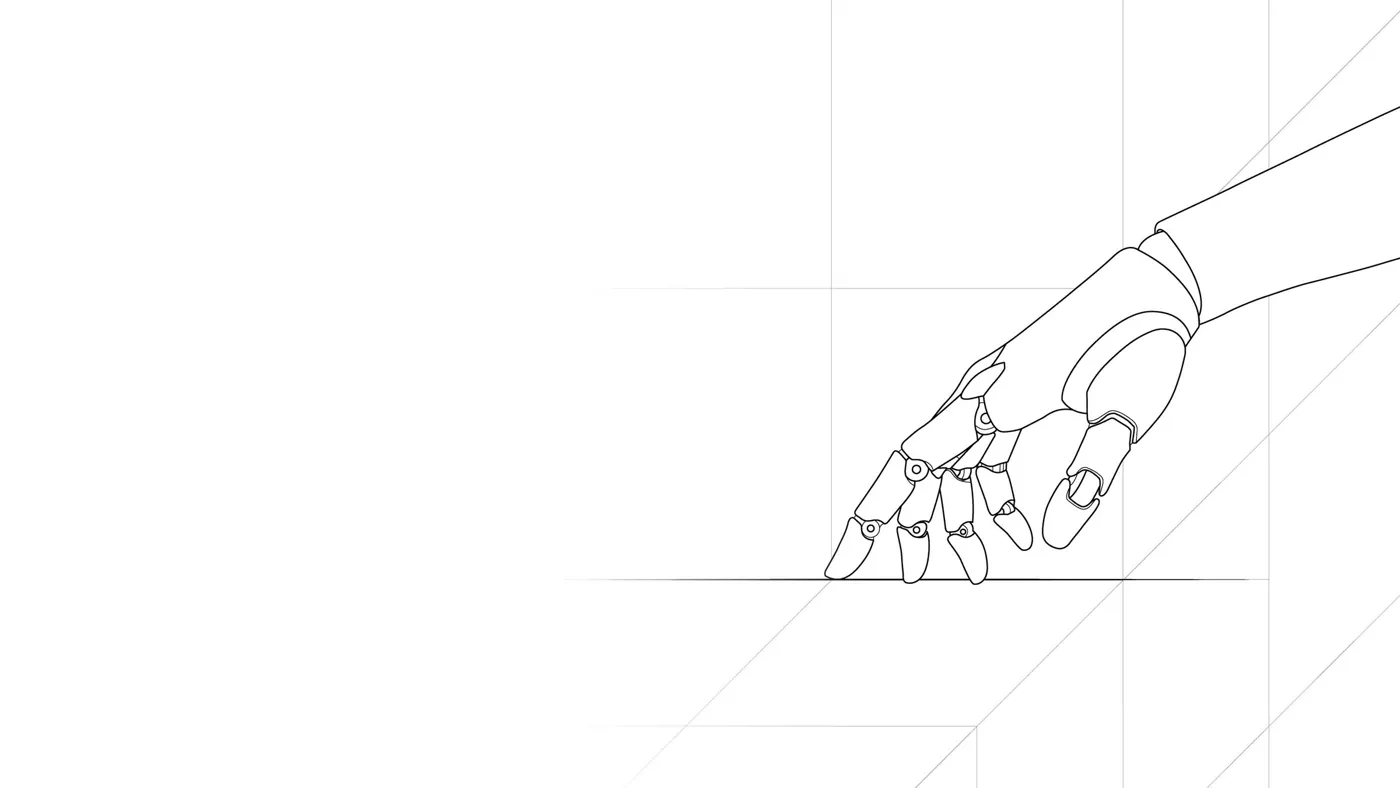
Meta Open-Sources Project SuperDex: A Unified Dexterous Manipulation Platform with a Contact-First Physics Engine and Zero-Shot Sim2Real
Meta Reality Labs Research open-sourced Project SuperDex, a unified dexterous-manipulation simulation platform built on a custom contact-first physics engine with soft-body/rod/non-convex contact support, VR teleoperation for synthetic data, and a Gymnasium-style RL stack that achieved zero-shot sim2real shape sorting.
What is Project SuperDex?
Meta Reality Labs Research has open-sourced Project SuperDex, a unified simulation platform for robotic dexterous manipulation. First published on GitHub on August 20, 2026 under the Apache-2.0 license (facebookresearch/project_superdex), the project is built around a custom, contact-first physics engine designed for exactly the interactions that make dexterous manipulation hard: multi-finger grasps, in-hand reorientation, deformable objects, and non-convex contact.
The platform is organized as four building blocks that stack into a complete research pipeline:
- SuperDex Physics — a contact-first physics engine purpose-built for tactile manipulation; the simulation backbone of the project.
- SuperDex Robotics — a robotics SDK with declarative robot definitions, controllers, sensors, and actuators.
- SuperDex Studio — a desktop GUI for authoring robots, task objects, and scenes to production and simulation-ready quality.
- SuperDex Lab — a Gymnasium-style reinforcement learning harness (early preview) connecting simulation to policy development.
VR-based teleoperation is planned for future releases (SuperDex Teleop is slated for Q4 2026). The end goal, in Meta's words: researchers and engineers building the foundation for robots, "starting with the hardest problem: dexterous manipulation."
Why a new physics engine?
Most robotics simulators bolt contact handling onto a general-purpose rigid-body engine. Dexterous manipulation is the opposite regime: contact is not an edge case, it is the task. A hand regrasping a cereal box, fingertips squeezing a sponge, a tendon-driven finger curling around a rope — these require stable force distributions across non-convex, deforming surfaces at high simulation cadence. SuperDex Physics is designed around that premise, which Meta calls contact-first: stable contact and accurate sensing wherever they matter.
Physics capabilities
- Multi-physics simulation — a unified solver for rigid bodies, soft bodies, rods and tendons, and shells and cloth, with more physics on the way.
- Arbitrary rigid and soft articulations — articulated bodies with varying joint types, supporting both rigid links and deformable elements in a single model.
- Non-convex collision — accurate contact force distributions for arbitrary geometries, including non-convex and deforming objects.
- Numerical stability — robust simulation without the restrictive time-step stability limits of explicit or semi-implicit methods.
- Inverse kinematics — constraint-aware IK built on the same nonlinear optimization core as the forward dynamics, solving physically accurate poses under collision, end-effector, and trajectory constraints.
- Tactile sensors and soft contact — aimed at contact-rich manipulation where sensing the interaction matters as much as producing it.
SuperDex Robotics: the robotics layer
SuperDex Robotics extends the physics engine to robotics workflows: declarative robot definitions and composition, controllers, sensors, and actuators.
- Declarative bots — a human-readable
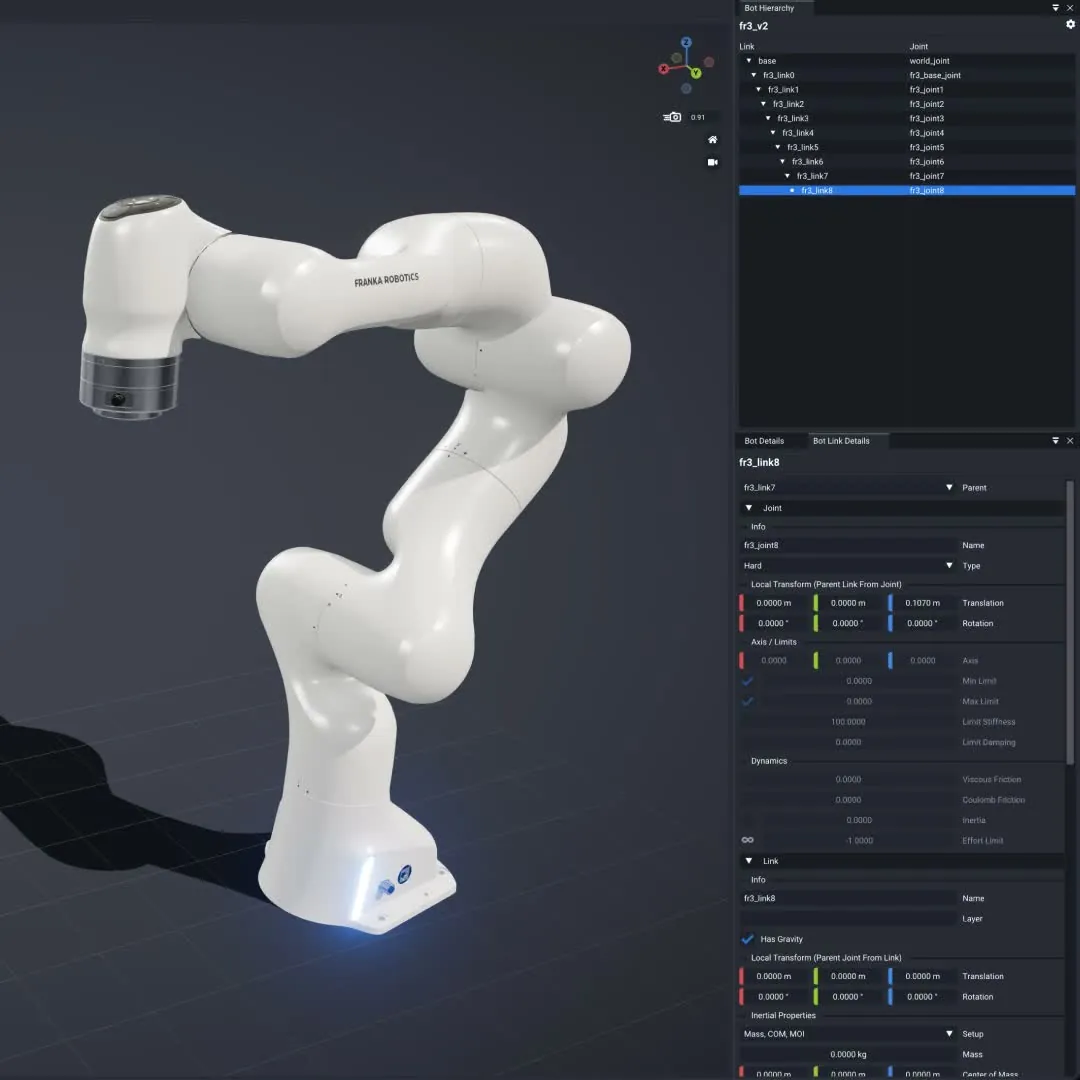
.superdex_botfile describes a complete robot (links, joints, mesh references). It extends the physics engine's articulations with the fields robotics workflows demand, and is the source of truth from Studio through simulation. - Ready-to-load bots — a library of arms, robot hands, human hands, sensors, and torsos, each loadable directly into a scene as a
.superdex_botfile. - Bring-your-own bots — load a URDF directly at runtime, or upgrade it into a native bot with SuperDex Studio for production-quality collision meshes.
- Controllers, sensors, actuators — one uniform, extensible framework; ships with operational-space and joint-space PD controllers out of the box.
SuperDex Studio: the authoring layer
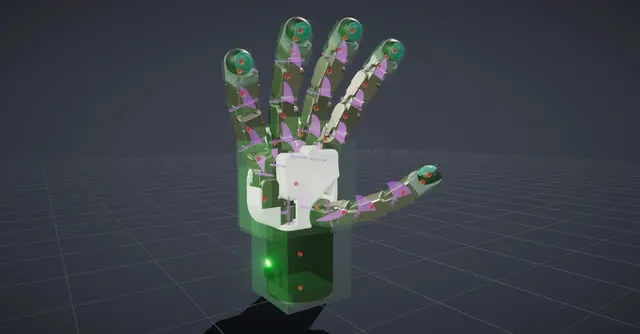
SuperDex Studio is the desktop content-authoring tool where raw CAD and robot descriptions become native SuperDex assets — bots, prefabs, and scenes — at production and simulation-ready quality.
- Compose, edit, and combine bots — assemble complex robots from vetted components or import from URDF; iterate on kinematics, dynamics, joint limits, and self-collision until the model behaves like the hardware. Bolt a hand onto an arm, or replace OEM fingertips with custom sensors.
- Direct-from-CAD meshing — simulation-ready collision meshes generated straight from CAD, so contact behavior matches the real part.
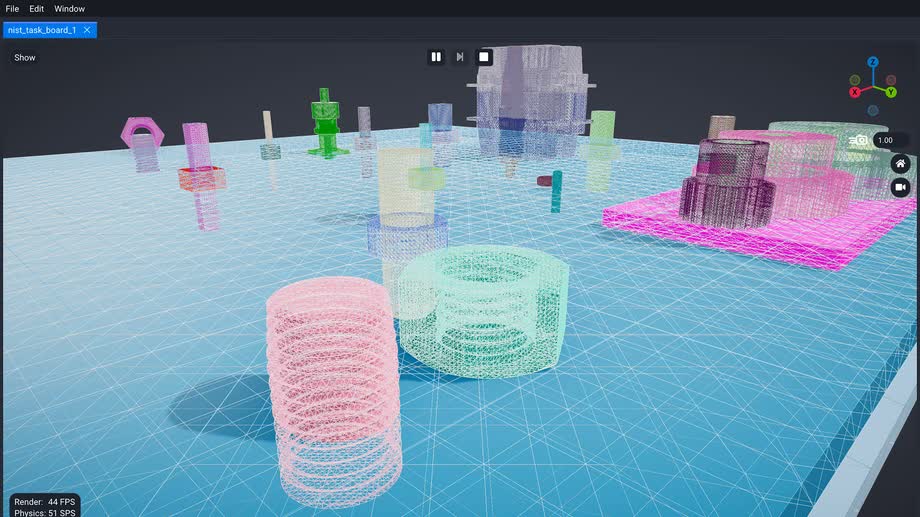
- Scene and task authoring — task objects and scenes authored in the same environment, ready for policy training.
SuperDex Lab: reinforcement learning at scale
SuperDex Lab connects simulation and policy development through a Gymnasium-style API. It is currently in early preview; a general abstraction for partially observable Markov decision processes will underpin applications in reinforcement learning, system identification, and model predictive control.
- SuperDex Gym — a Gymnasium-compatible RL framework built on SuperDex Physics, with a suite of manipulation and locomotion environments.
- Batched, vectorized training — run batched simulations with scene sharing and multi-threaded execution; train policies across vectorized environments.
- Ray / RLlib integration — off-the-shelf RL training straight from the Gym environments.
The headline result shown on the project site is a zero-shot sim-to-real transfer: a shape-sorting manipulation policy trained entirely in simulation with SuperDex Gym, then deployed directly on a real-world robotic hand without fine-tuning on physical data.
Teleoperation and synthetic data at scale
Virtual teleoperation lets human operators drive simulated robots, generating demonstration datasets at a fraction of the cost and risk of real-world collection. The gallery on the project site shows interactive VR teleoperation — a person using a Meta Quest 3 headset performing dexterous manipulation tasks with the physics simulated in real time — aimed at synthetic data collection and policy development. SuperDex Teleop, the teleoperation stack used to record the demo videos, is scheduled for release in Q4 2026.
Getting started
Project SuperDex has first-class Python support. The quickest path is uv with PyPI wheels:
- Install uv (Linux GUI tools also need an X11 display and OpenGL 4.1 support).
- Create a venv and install:
uv venvthenuv pip install superdex. - Run the examples: a tendon-comparison physics example (
superdex_physics/examples/example_tendon_comparison.py), an operational-space / joint-space control example (superdex_robotics/examples/control/example_osc_jsc_control.py), or launch SuperDex Studio (superdex-studio). - Optional double precision: set
SUPERDEX_PRECISION=double(double-precision builds via--extra doublewhen building from source).
Building from source uses CMake 3.25+, Ninja, and Clang 17+ on Linux (Xcode CLT on macOS, MSVC/ClangCL on Windows); uv sync flags select the build scope — --extra core for physics/robotics/lab, --extra gui to add Studio and the physics debugger, --all-extras for everything. Core modules are written in C++ with Python bindings; a lean C++-only CMake build is also documented.
Licensing and caveats
First-party SuperDex source code is Apache-2.0; assets and documentation are CC-BY-4.0. Two caveats worth reading before you build on it: the optional superdex_mesh_cli tool is GPLv3 (due to OCCT and CGAL), and — more importantly — certain third-party dependencies and assets in the repo are licensed for non-commercial/academic use only. The repository's LICENSE and NOTICE files are authoritative per component, so commercial users should audit the specific assets they ship.
Where it fits
SuperDex lands in a field that is rapidly instrumenting dexterous manipulation: NVIDIA's Isaac Lab and GR00T ecosystem for humanoid policy training, Google DeepMind's simulation pipelines, and a wave of open dexterous-hand hardware. Its differentiator is the physics layer — a solver built specifically for stable, high-cadence contact with soft bodies, rods, and non-convex geometry, plus a zero-shot sim2real demo as evidence that the contact fidelity translates. Combined with VR teleoperation for cheap demonstration data and a Gymnasium-native RL stack, it is a full-stack bet on simulation-first dexterous manipulation research.
References
- Project website: projectsuperdex.com
- GitHub: facebookresearch/project_superdex
- Docs: SuperDex Physics · Robotics · Studio · Lab
Source: Project SuperDex and the project_superdex README (Meta Reality Labs Research). Adapted for RobotWorld.
Source:projectsuperdex.comhttps://projectsuperdex.com/