Skip to content
Tags

#Physics simulation (9)

GS-Agent: Creating 4D Physical Worlds With Generative Simulation

GS-Agent: Creating 4D Physical Worlds With Generative Simulation

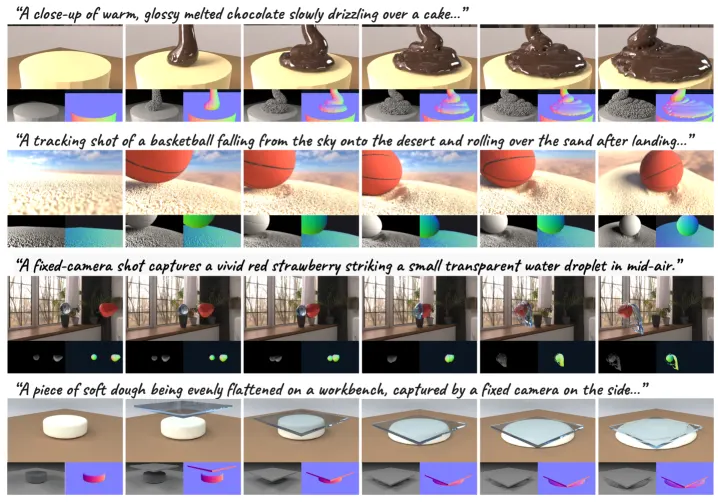
Creating dynamic and physically realistic 4D worlds from natural language descriptions is both fascinating and challenging. Traditional computer graphics methods rely on manual creation, requiring extensive human effort to fine-tune materials, motions, and visual fidelity. Recent advances in generative foundation models have sparked interest in learning to generate such 4D worlds from large-scale data; however, existing methods still struggle to ensure physical plausibility and controllability. In this work, we take a different path by leveraging foundation models to construct an agentic system that emulates how humans traditionally create 4D worlds, yet automates the entire process. We present GS-Agent, an end-to-end multi-agent framework that integrates physics engines in the loop to generate realistic, dynamic, and controllable 4D physical worlds from natural language. Inspired by how humans build 4D worlds, GS-Agent decomposes the task into entity management, covering 3D asset curation, material tuning, placement, and motion control, and rendering configuration, including camera and lighting manipulation. Multiple agents with distinct expertise interact with the physics engine via code, seek multimodal feedback, and collaborate to iteratively construct 4D worlds that align with the given descriptions. Experimental results show that GS-Agent effectively converts natural language into diverse and physically plausible 4D worlds exhibiting rich interactions among liquids, deformable objects, and rigid bodies, while achieving cinematic camera and lighting control. We envision GS-Agent as a foundation for a new paradigm in 4D world generation, empowering creative content creation and physical AI. Project page at https://umass-embodied-agi.github.io/gs-agent/

Hongxin Zhang, Chunru Lin, Junyan LiJul 23, 2026
3D Gaussian Splatting4D GenerationWorld ModelsJul 23, 2026
Agentic Real2Sim: Physics-based World Modeling with Vision-Language Agents

Agentic Real2Sim: Physics-based World Modeling with Vision-Language Agents

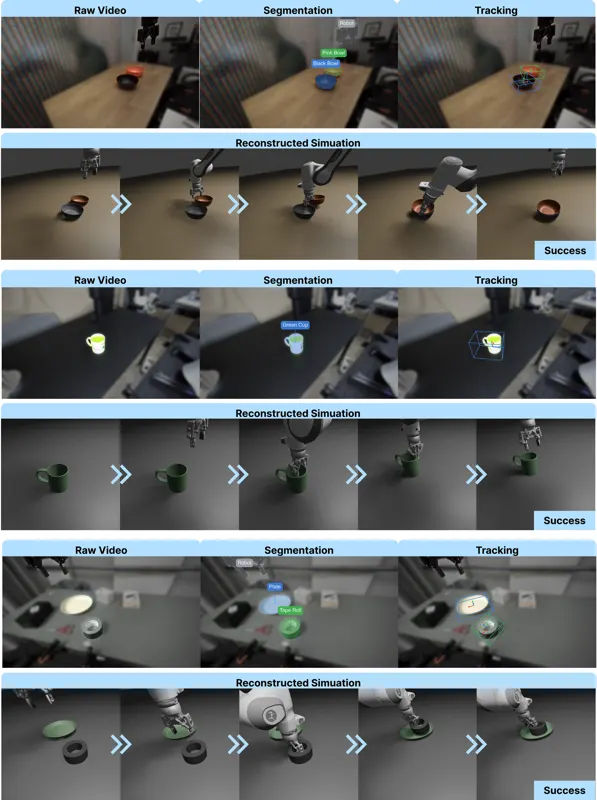
Real-to-sim conversion for robotic interaction with objects remains labor-intensive because it requires more than visual reconstruction: a streamlined real2sim process must recover scene geometries and object states, infer physical parameters, and assemble actors, objects, cameras, poses, and trajectories into a runnable physical simulation. Today this process still depends on manual tuning of visual foundation models, mesh cleanup, coordinate-frame alignment, and brittle workflow glue across visual perception tools and simulators. We introduce Agentic Real2Sim, a framework for generalized physical world modeling with vision-language agents, converting a real-world recording of object-robot interaction into a simulatable episodic twin which preserves observations, geometries, robot interactions, and object states. We evaluate Agentic Real2Sim on rigid-object manipulation, deformable-object interaction, and humanoid motion scenes, spanning domains that are usually handled by separate Real2Sim pipelines, marking a first step toward scalable conversion. The framework's agentic decisions can be driven by an open-weight VLM backend at a small fraction of the cost of frontier models, while attaining comparable conversion success rate. We aim to use the resulting real-world-aligned twins for downstream robotics tasks, specifically policy learning and evaluation. The project site is available at https://agentic-real2sim.github.io/.

Guanxiong Chen, Qianjun Xia, Jiawei PengJul 21, 2026
Sim-to-RealWorld ModelsVision-language modelsJul 21, 2026
PhysCoRe: Physics-Corrected Residual World Models for Material-Aware Deformable Dynamics

PhysCoRe: Physics-Corrected Residual World Models for Material-Aware Deformable Dynamics

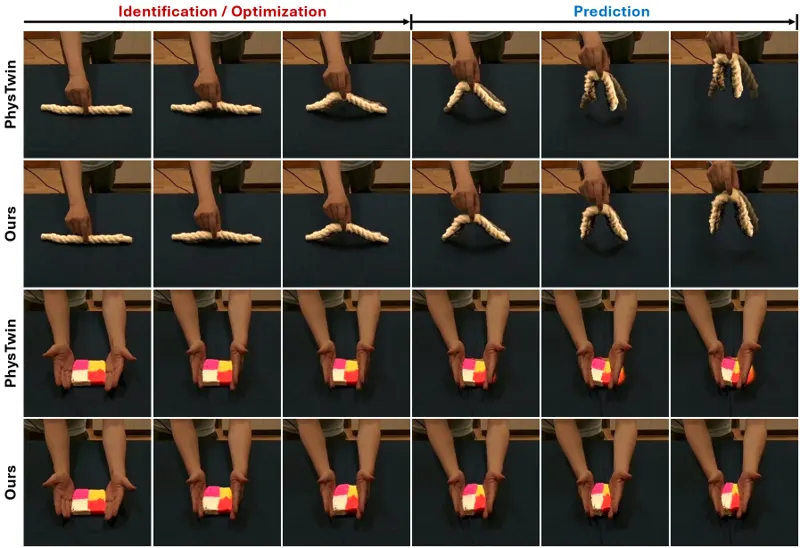
Predicting how deformable objects evolve under robotic manipulation is a longstanding challenge. Existing approaches typically rely on per-object optimization to fit material parameters, which can be slow and cannot generalize, while end-to-end learned alternatives extrapolate poorly and often violate basic physical structure. We present PhysCoRe, a physics-corrected residual world model that couples a differentiable Material Point Method (MPM) simulator with two feed-forward neural networks. A material refinement module, Material from Motion (MfM), infers per-particle elasticity from visual observations, grounding the simulator in object-specific physics. A residual correction module, Residual from Dynamics (RfD), learns the discrepancy and predicts corrections to the simulator's internal dynamics, absorbing systematic biases that the analytical model cannot capture. This design also supports online material identification on novel objects. MfM adapts from limited interactions, and its predictive uncertainty steers further exploration toward the regions where its estimate is least confident. Experiments on real deformable-object manipulation sequences show that PhysCoRe outperforms state-of-the-art baselines in prediction accuracy, and that its predicted confidence forms a reliable distribution across the object's geometry, providing a natural signal for future confidence-guided exploration.

Haocheng Yin, Shuohan Tao, Yongsheng ChenJul 22, 2026
World ModelsPhysics simulationDeformable ObjectsJul 22, 2026