PAPER DEEP DIVE
X-WBC: A Cross-Embodiment Foundation Model for Humanoid Whole-Body Control
Scaling humanoid whole-body control toward general-purpose deployment requires large human motion corpora and training experience shared across robot bodies. Existing methods usually train one policy per robot, leaving motion experience isolated across embodiments. We introduce X-WBC, a cross-embodiment foundation framework that separates relatively shared human motion semantics from embodiment-specific physical execution. Human-centered command tokens align full human motion, robot reference motion, and sparse VR observations. A causal Transformer learns reusable temporal structure from mixed multi-robot rollouts, while lightweight robot-specific modules map the shared representation to each robot's proprioception and action space. Across nine simulated embodiments, external motions, and four real robots, experiments show that joint training improves tracking, the aligned representation supports consistent control across command sources, and the learned policy remains competitive beyond the training corpus. These results support heterogeneous humanoids as joint data sources and establish cross-embodiment joint training as a practical route toward whole-body control foundation models.
X-WBC: A Cross-Embodiment Foundation Model for Humanoid Whole-Body Control
Original title: X-WBC: A Cross-Embodiment Foundation Model for Humanoid Whole-Body Control
Authors: Juntong Zhang, Chun Gu, Li Zhang (corresponding author)
Institutions: Tongji University, School of Big Data at Fudan University, Shanghai Innovation Institute
arXiv: arXiv:2609.15213v1 (2026-09-14)
Venue: CoRL 2026 (Austin, Texas)
Code status: the official repository LogosRoboticsGroup/x-wbc exists but currently hosts only the project page and release notes; training/evaluation code, checkpoints and deployment examples are still unchecked items on the README "Planned Release" list and are marked as being prepared for release. The project page logosroboticsgroup.github.io/x-wbc hosts the demo videos.
In One Sentence
Replace "one robot, one policy" with "nine humanoids training one shared backbone": a human-centric command token space aligns full human motion, robot reference motion and sparse VR observations, a shared causal Transformer learns the temporal motion structure that transfers across bodies, and lightweight robot-specific modules translate that shared semantics into executable joint actions per embodiment.
Background and Motivation
Humanoid whole-body control (WBC) has converged on a working recipe over the past few years: use large-scale human motion data for motion tracking, then treat the resulting tracking policy as a low-level interface for teleoperation, skill learning and autonomous behaviour. H2O, OmniH2O and HumanPlus built RGB/VR teleoperation and dexterous loco-manipulation on top of that interface, while BeyondMimic and SONIC pushed motion tracking toward composable behaviours and "motion foundation tasks" at scale. The route has proven one thing convincingly: given good enough reference motion, reinforcement learning produces whole-body behaviour far beyond what hand-designed controllers achieve.
But the unit of training in almost all of these systems is a single robot. Every platform does its own retargeting, trains its own policy and tunes its own deployment parameters, so the motion diversity sitting in datasets such as AMASS, LAFAN1 and BONES-SEED gets sliced into mutually incompatible "data for robot X" before it ever reaches training. What an H1 learns about kicking contributes nothing to a GR3. This contrasts sharply with what the robot foundation model community is doing: RT-2, OpenVLA, the π0 family and GR00T treat heterogeneous robot data as a scalable training mixture, using corpora such as Open X-Embodiment, DROID, RoboMIND and AgiBot to train a shared backbone, then adapting it to different bodies with trainable interfaces like HPT's embodiment stems, CrossFormer's shared policy and X-VLA's soft prompts.
The question this paper asks is whether that cross-embodiment sharing can be carried over to closed-loop humanoid whole-body control. Manipulation foundation models share vision-language-action mappings, whereas a shared WBC representation must also respect balance, contact dynamics and joint-space control: the cost of falling is much higher than the cost of a sloppy grasp. The authors enter through an intuition: humans learn movement by watching others whose height, arm length, strength and joint ranges differ from their own. A martial-arts student does not need the instructor's exact body proportions to understand the intent of a kick, a turn or a squat. Motion intent therefore admits a representation that is largely body-independent.
That yields the paper's central observation: human motion carries embodiment-agnostic motion semantics, while the way a robot executes those semantics is embodiment-specific. Walking, kicking, squatting and reaching share temporal structure and geometric intent across bodies; humanoids differ mainly in how that intent becomes executable motion through their own kinematics, joint limits, actuation and body layout. Retargeting the same piece of human motion onto many robots produces exactly several physical realisations of one intent, so robot diversity stops being a burden and becomes extra supervision for the shared backbone.
On that observation, X-WBC changes the training unit from "an isolated single-robot policy" to "joint multi-robot motion tracking": rollouts from different humanoids are mixed into the same PPO batch and jointly optimise one shared policy backbone, while a human-centric command token space aligns full human motion, robot reference motion and sparse VR observations as three views of the same motion intent. The paper validates the design on nine simulated embodiments, an external motion set and four real robots.
Preliminaries
Tracking-based WBC and PPO. The control problem is written as a tracking task over a Markov decision process: the state contains robot proprioception plus one motion command, the action is a joint target converted to torques by a low-level PD controller, and training uses PPO with an asymmetric actor-critic. The critic additionally observes privileged information such as body-link positions/orientations and base linear velocity, while the actor only sees deployable observations. This configuration is the de-facto standard for modern humanoid tracking policies.
Human motion data and retargeting. AMASS, LAFAN1 and BONES-SEED provide mocap human motion and SMPL provides a unified description of the human body, but human joints cannot drive a robot directly: retargeting is required to map human movement into robot body space. The paper follows the GMR retargeting pipeline with added smoothing and per-robot parameters, because GMR has shown that retargeting quality directly caps tracking performance and yields cleaner robot references.
Cross-embodiment interfaces. The shared pattern among cross-embodiment foundation models is "shared backbone plus trainable embodiment interface": HPT projects heterogeneous observations into a shared space with embodiment stems, X-VLA distinguishes embodiments with soft prompts. X-WBC brings the same idea to closed-loop WBC, where what is shared is the temporal motion backbone and what is embodiment-specific is the command encoder (robot route), the proprioception encoder and the action decoder.
Method in Detail
3.1 Formalising cross-embodiment whole-body motion tracking
The paper first formalises multi-robot tracking. Each robot $i$ defines an MDP $\mathcal{M}_{i}=(\mathcal{S}_{i},\mathcal{A}_{i},\mathcal{T}_{i},\mathcal{R},\gamma)$: the state space $\mathcal{S}_{i}$, action space $\mathcal{A}_{i}$ and transition dynamics $\mathcal{T}_{i}$ are embodiment-specific, while the reward family $\mathcal{R}$ and the discount factor $\gamma$ are shared across all robots. The shared reward family is the crucial constraint, because it guarantees that different embodiments provide comparable tracking supervision; without it the gradients inside a mixed batch would not share a common scale. The objective is solved jointly with PPO over the rollouts of all robots.
Observations use an asymmetric design. The actor observation $s_{t}^{i}$ consists of proprioception $s_{t}^{p,i}$ and one motion command $s_{t}^{c}$, where proprioception is $s_{t}^{p,i}=(q_{t}^{i},\dot{q}_{t}^{i},\omega_{t}^{i},g_{t}^{i},a_{t-1}^{i})$: joint positions, joint velocities, base angular velocity, the gravity projection in the body frame and the previous action. The command is chosen among robot reference motion, full human motion and sparse VR motion. Position, orientation and velocity commands are by default expressed in a root-centred or robot-centred frame. On top of the actor observation, the critic stacks privileged terms: body-link positions and orientations in the body frame and base linear velocity.
The action side is engineered precisely to serve the mixed batch. Each robot's policy output is only valid inside its own action space and is converted to torques by a PD controller; because observation and action dimensions differ per robot, training pads these vectors to the maximum dimension across the robot set so that transitions from different robots can enter the same batch, and at execution time the embodiment-specific decoder keeps only the valid action dimensions of that robot. The reward is written as $r_{t}^{i}=\mathcal{R}_{\mathrm{track}}+\mathcal{P}$, where the tracking terms cover root orientation, body-link pose and body velocity, and the penalty terms cover action rate, joint-limit violation and disallowed contacts.
Appendix A.1 gives the exact form of every reward term: exponential tracking rewards plus indicator penalties. Taking root position and relative body position as examples:
$$r^{\mathrm{root}}_{\mathrm{pos}}(t)=\exp\!\big(-\|\mathbf{p}^{g}_{t,\mathrm{root}}-\mathbf{p}^{p}_{t,\mathrm{root}}\|_{2}^{2}/0.3^{2}\big)$$
$$r^{\mathrm{body}}_{\mathrm{pos}}(t)=\exp\!\big(-\frac{1}{|\mathcal{B}|}\sum_{b\in\mathcal{B}}\|\mathbf{p}^{g,\mathrm{rel}}_{t,b}-\mathbf{p}^{p,\mathrm{rel}}_{t,b}\|_{2}^{2}/0.3^{2}\big)$$
The first measures root position error (weight 0.5); the second averages relative position error over the tracked body set $\mathcal{B}$ (weight 1.0). Superscript $g$ denotes the commanded reference and $p$ the robot's current state, while "rel" marks quantities expressed in the command frame. Penalties are equally explicit: the joint-limit term $r_{\mathrm{jlim}}(t)=\sum_{j}\mathbf{1}[q_{t,j}\notin[q^{\min}_{j},q^{\max}_{j}]]$ carries weight -10.0, and the disallowed-contact term $r_{\mathrm{contact}}(t)=\sum_{k\notin\mathcal{C}_{\mathrm{allow}}}\mathbf{1}[\|\mathbf{f}_{k}\|>1.0\,\mathrm{N}]$ carries weight -0.1. All robots share this reward family, which is the concrete meaning of "shared supervision".
3.2 Human-centric command encoding
Command encoding is the most consequential design in the paper. Three command routes are encoded into one human-centric token space. The full human motion encoder (shared) maps mocap whole-body motion to a human motion token; it is not tied to any robot joint definition and therefore acts as the semantic anchor for command alignment. The robot motion encoder (embodiment-specific) maps reference motion in robot body space to a robot motion token; the reference usually comes from human-to-robot retargeting but may also come from robot replay, generated motion or other sources. The sparse VR encoder (shared) maps sparse observations to a sparse VR token: during training the five keypoints of the head and limb extremities are extracted from full human motion, and at deployment the identical signal format is produced in real time by a VR device.
All three routes go through the same representation and normalisation before entering the encoders. Target motion is described by body position, orientation and velocity rather than by robot joint angles alone; each body or keypoint contributes 12 dimensions (3 position + 6 orientation in 6D form + 3 linear velocity), normalised in the root-centred or robot-centred frame so that tokens attend to relative motion structure and stay robust to global coordinate drift and operator body-shape differences. In terms of dimensions, the full human command is 22 joints × 12 = 264, the sparse VR command is 5 keypoints × 12 = 60, and the robot command is 14 bodies × 12 = 168. A command token alignment loss during training encourages human, robot and sparse VR tokens describing the same underlying movement to be used consistently by the shared backbone. One caveat the authors state explicitly: sparse VR is a low-bandwidth control interface, but it does not remove the training-time dependence on dense robot references, nor the per-robot calibration and control configuration.
3.3 Shared causal Transformer and embodiment-specific modules
Why not an MLP? Most humanoid tracking policies use an MLP to regress actions directly from the current state and reference motion. That single-step mapping is adequate for local single-robot tracking, but cross-embodiment control has to learn shared motion structure from many robots and many command forms, and resolving motion phase, velocity trends and temporal dependencies requires history. The paper therefore processes an observation-token history with an attention-based temporal backbone. For robot $i$, each control step concatenates the selected command token $z_{c,t}$ with the embodiment-specific proprioception token $z_{p,t}^{i}$ into the current observation token, and a causal Transformer aggregates current and historical observation tokens inside a causal window of length $L$ to output an action token:
$$h_{t}^{i}=B_{\theta}\left(\{[z_{c,\tau};z_{p,\tau}^{i}]\}_{\tau=t-L+1}^{t}\right)$$
Here $B_{\theta}$ is the policy backbone shared by all robots and $h_{t}^{i}$ is the action token at the current observation-token position. During online rollouts a KV cache stores the keys and values of historical tokens, so each control step processes only the new observation token and updates the cache instead of recomputing the whole window; this compresses the cost of a 32-step history into something real-time control can absorb. As for network sizes, actor and critic each own an independent Transformer backbone with embedding dimension 224, depth 3, 8 heads, head dimension 32 and causal window 32; the four command/state encoders are MLPs of [256, 256, 64]; the actor fusion layer and critic embedding layer are linear maps of [128→224] and [399→224]; the output heads are [224→32] and [224→1].
Proprioception encoding and action decoding are embodiment-specific, because humanoids differ in state dimension, joint ordering, actuation limits and action space. Like the robot command encoder, both are lightweight modules selected by robot ID: the first maps padded proprioceptive observations to a fixed-dimension proprioception token, the second maps the action token $h_{t}^{i}$ to robot $i$'s valid joint actions. This division of labour lets the shared Transformer concentrate on motion semantics that are reusable across embodiments and leaves the translation from semantics to executable motion to each robot's own small modules.
flowchart TB
    subgraph CMD["Three command routes of the same motion intent"]
        H[Full human motion
22 joints x 12 = 264 dim]
        R[Robot reference motion
14 bodies x 12 = 168 dim]
        V[Sparse VR observation
5 keypoints x 12 = 60 dim]
    end
    HE[Shared human encoder]
    RE[Robot-specific encoder
routed by robot ID]
    VE[Shared sparse-VR encoder]
    TOK[Aligned command token space
pairwise MSE alignment loss]
    PROP[Robot proprioception
padded to 102 dim]
    PE[Robot-specific proprioception encoder]
    BB[Shared causal Transformer
dim 224, depth 3, heads 8, window 32
KV cache at rollout]
    DEC[Robot-specific action decoder]
    PD[Low-level PD controller
joint targets to torques]
    MIX[Mixed multi-robot PPO batch
1024 envs per robot, 8x H100]
    H --> HE --> TOK
    R --> RE --> TOK
    V --> VE --> TOK
    TOK --> BB
    PROP --> PE --> BB
    BB --> DEC --> PD
    MIX -. joint update .-> BB
    MIX -. joint update .-> DEC
3.4 Joint training
Training happens in a multi-robot environment built on Isaac Lab: several robots roll out inside one training framework while each keeps its own state, action, contact and termination logic; after every simulation step the transitions of all robots are collected and mixed into a single PPO batch that jointly updates the shared modules and whichever embodiment-specific modules were active. For each motion clip the policy encodes the robot motion, the full human motion and the sparse VR motion into three command tokens, samples one of them at the ratio 1:1:1 when the rollout starts and feeds it to the backbone for the whole episode. The training objective is the PPO tracking objective plus command token alignment:
$$\mathcal{L}=\mathcal{L}_{\mathrm{PPO}}+\lambda_{\mathrm{align}}\mathcal{L}_{\mathrm{align}}$$
where $\mathcal{L}_{\mathrm{PPO}}$ contains the clipped policy loss, value regression and entropy regularisation, $\mathcal{L}_{\mathrm{align}}$ computes pairwise MSE over the three normalised command tokens produced from the same clip, and $\lambda_{\mathrm{align}}=1.0$ with the three pairs weighted equally. Termination conditions remove obvious tracking failures: an episode ends when root vertical position error, root orientation error or end-effector vertical position error exceeds its threshold (0.25 m, 0.8 rad and 0.25 m in training), and these failure events simultaneously feed the statistics for adaptive motion sampling.
Adaptive motion sampling follows the failure-rate idea established in tracking work: motion is cut into 1-second time bins, bins that frequently trigger early termination get a higher sampling probability, and a uniform mixture of 0.1 is kept to preserve coverage. Since persistent failure can also mean broken retargeting, wrong contacts or physical infeasibility, the paper additionally hard-removes chronically unsuccessful bins from the training pool (failure rate 0.98, at least 96 attempts, at least 32 cap hits, with a global warmup of 500 PPO iterations). Domain randomisation is of moderate strength: static friction $\mu_{s}\sim\mathcal{U}[0.3,1.6]$, dynamic friction $\mu_{d}\sim\mathcal{U}[0.3,1.2]$, restitution $e\sim\mathcal{U}[0,0.5]$, default joint positions perturbed by $\mathcal{U}[-0.01,0.01]$, base centre-of-mass offsets $\Delta x\sim\mathcal{U}[-0.075,0.075]$ with $\Delta y,\Delta z\sim\mathcal{U}[-0.1,0.1]$, and periodic root-velocity pushes ($v_{x},v_{y}\sim\mathcal{U}[-0.5,0.5]$, $v_{z}\sim\mathcal{U}[-0.2,0.2]$, lasting 1-3 s).
In terms of scale, training uses roughly 200 hours of BONES-SEED motion resampled to 50 Hz, 1024 parallel environments per embodiment across nine embodiments, running on 8 NVIDIA H100 GPUs; the final model trains for about two days with a 50 Hz control frequency and a 32-step history window. The nine embodiments cover Unitree G1-29DoF, G1-23DoF, H1, H1-2, R1 and H2, Booster T1, Fourier GR3 and PND Adam Lite, with action dimensions from 19 to 32, heights from 118 cm to 182 cm and masses from 29 kg to 71 kg: heterogeneous enough to test whether the "shared semantics plus specific execution" division actually holds.
Experimental Results
The experiments are organised on four levels: policy architecture and joint training, transfer to external motion, the structure of the command token space, and real-robot deployment. In-distribution evaluation is done on the BONES-SEED training motions themselves (Table 1, evaluated on G1 and H2) and measures architecture and fitted behaviour; the external evaluation uses 100STYLE, where 100 walking styles of one actor combined with eight locomotion categories form 800 clips totalling 133.02 minutes, with all policy weights frozen (Table 2). The protocol is unified: the same G1 reference trajectory, the same clip windows and method-agnostic scoring; a clip terminates when pelvis height error exceeds 0.25 m, the difference in the vertically projected gravity component exceeds 0.8, or wrist/ankle height error exceeds 0.25 m; each clip gets one deterministic rollout (seed 42, flat ground, no randomisation).
| Setting | Command | G1 SR(%) | G1 MPKPE(m) | G1 vel. err(m/s) | H2 SR(%) | H2 MPKPE(m) | H2 vel. err(m/s) |
|---|---|---|---|---|---|---|---|
| X-WBC (shared Transformer + joint training) | VR | 98.60 | 0.0412 | 0.2120 | 93.22 | 0.0629 | 0.4172 |
| X-WBC (MLP backbone) | VR | 97.70 | 0.0411 | 0.2272 | 91.33 | 0.0652 | 0.4542 |
| Single robot (same architecture, per-robot training) | VR | 97.69 | 0.0412 | 0.2195 | 92.22 | 0.0698 | 0.4417 |
| X-WBC | Robot | 98.21 | 0.0409 | 0.2164 | 92.08 | 0.0634 | 0.4274 |
| X-WBC | Human | 98.66 | 0.0397 | 0.2098 | 93.02 | 0.0610 | 0.4124 |
| without human and robot routes | VR | 95.34 | 0.0492 | 0.2494 | 85.71 | 0.0722 | 0.5016 |
| without alignment loss | VR | 95.41 | 0.0496 | 0.2469 | 85.68 | 0.0735 | 0.5100 |
| without embodiment-specific modules | VR | 96.54 | 0.0474 | 0.2241 | 88.65 | 0.0724 | 0.4575 |
Architecture and joint training. On G1, X-WBC reaches a success rate of 98.60%, above the 97.70% of the MLP backbone and the 97.69% of per-robot training; on the harder H2 the gap widens to 93.22% against 91.33% and 92.22%. The full model also achieves the lowest body velocity error on both robots. What stands out is that the position error (MPKPE) on G1 is nearly identical across the three settings (0.0411-0.0412 m) while success rate and velocity tracking improve, which suggests the shared Transformer mainly buys closed-loop stability rather than single-step precision; the larger gap on H2 then suggests that shared supervision coming from other robots is worth more on the harder embodiment.
Consistency across command sources. Within one full model, the three routes (VR, robot motion, full human motion) give very close success rates on the training motions (G1: 98.60 / 98.21 / 98.66; H2: 93.22 / 92.08 / 93.02), which is evidence that the aligned encoders really do feed compatible inputs to the shared backbone. Human commands are slightly better on several body metrics (G1 MPKPE 0.0397 m), while robot commands have lower root rotation error (0.3554 rad versus 0.4354 rad for VR) because they already live in the target reference space. Sparse VR, using only five keypoints, stays close to the dense routes, which is the direct evidence that it can serve as a deployment interface. One clarification: the robot command here is an inference-time input to the jointly trained model, not a separately trained robot-only policy.
Component ablations. Removing either or both dense command routes, removing the alignment loss, or removing the embodiment-specific modules all lower the training-motion success rate on both robots; on H2 the largest drop comes from removing the dense routes (93.22% down to 83.84%-85.71%). More intriguing is that "without embodiment-specific modules" still reaches 96.54% / 88.65%, which the authors read as evidence that proprioception itself already carries useful embodiment information and that the role of the dedicated modules is to make that information explicit and structured.
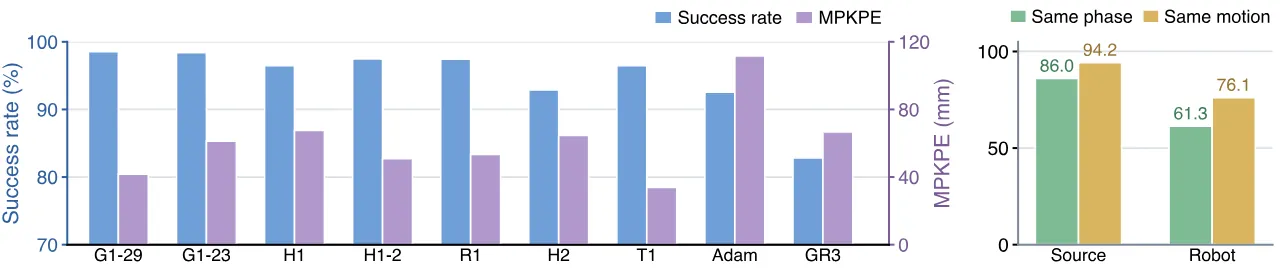
Figure 3: left, training-motion success rate and MPKPE of the nine embodiments under sparse VR commands; right, Recall@1 of command token retrieval. Cross-source retrieval reaches 86.0% for the same phase and 94.2% for the same motion, cross-robot retrieval 61.3% and 76.1%, against random baselines of only 0.17% and 1.04%.
Embodiment coverage and token semantics. The left panel gives the shared Transformer's training-motion performance across the nine embodiments: G1-29 and G1-23 sit near 98% success, H1, H1-2, R1 and T1 in the 96%-97% band, H2 and Adam near 93%, and the hardest, Fourier GR3, near 83%; MPKPE ranges from about 35 mm on T1 to about 115 mm on Adam. The rankings of success rate and MPKPE do not agree, because the former measures whether a rollout avoids termination while the latter measures tracking precision inside the active steps; reporting both is what separates "surviving long" from "tracking accurately". The right panel tests whether tokens retain motion identity: cross-source retrieval (different command routes of the same movement) gives Recall@1 of 86.0% for the same phase and 94.2% for the same motion, and cross-robot retrieval (using robot motion tokens) gives 61.3% and 76.1%, far above the 0.17% and 1.04% random baselines. Same-motion recall is consistently higher than same-phase recall, meaning motion identity is more stable than precise temporal phase; cross-robot recall being lower than cross-source recall means the tokens still retain embodiment-specific execution information, which is both required by design (decoding needs it) and a sign that the space is a mixture of shared semantics plus an execution residual rather than a fully embodiment-invariant code.
| Model | Command | SR(%) | Completion(%) | MPKPE(m) | Vel. err(m/s) |
|---|---|---|---|---|---|
| X-WBC (frozen weights) | VR5 | 91.13 | 91.66 | 0.0649 | 0.5400 |
| SONIC | SMPL | 93.00 | 93.35 | 0.0687 | 0.3419 |
| TWIST | SMPL-GMR | 75.62 | 78.18 | 0.0565 | 0.5261 |
External motion evaluation. On the full 800-clip 100STYLE grid, X-WBC with frozen weights and its default sparse VR interface completes 729 clips (91.13%), SONIC completes 744 (93.00%) and TWIST completes 605 (75.62%). SONIC has lower velocity error (0.3419 versus 0.5400 m/s), while TWIST has lower MPKPE (0.0565 versus 0.0649 m) but a success rate 15.51 points lower. Because per-step errors stop accumulating after termination, TWIST's low MPKPE must be read together with its low completion rate: it is obtained inside a shorter survival window. The trade X-WBC makes is a small position-error gap in exchange for much broader rollout survival, with a success rate close to SONIC, while consuming only five VR keypoints as input where the other two use SMPL or SMPL-through-GMR dense inputs.
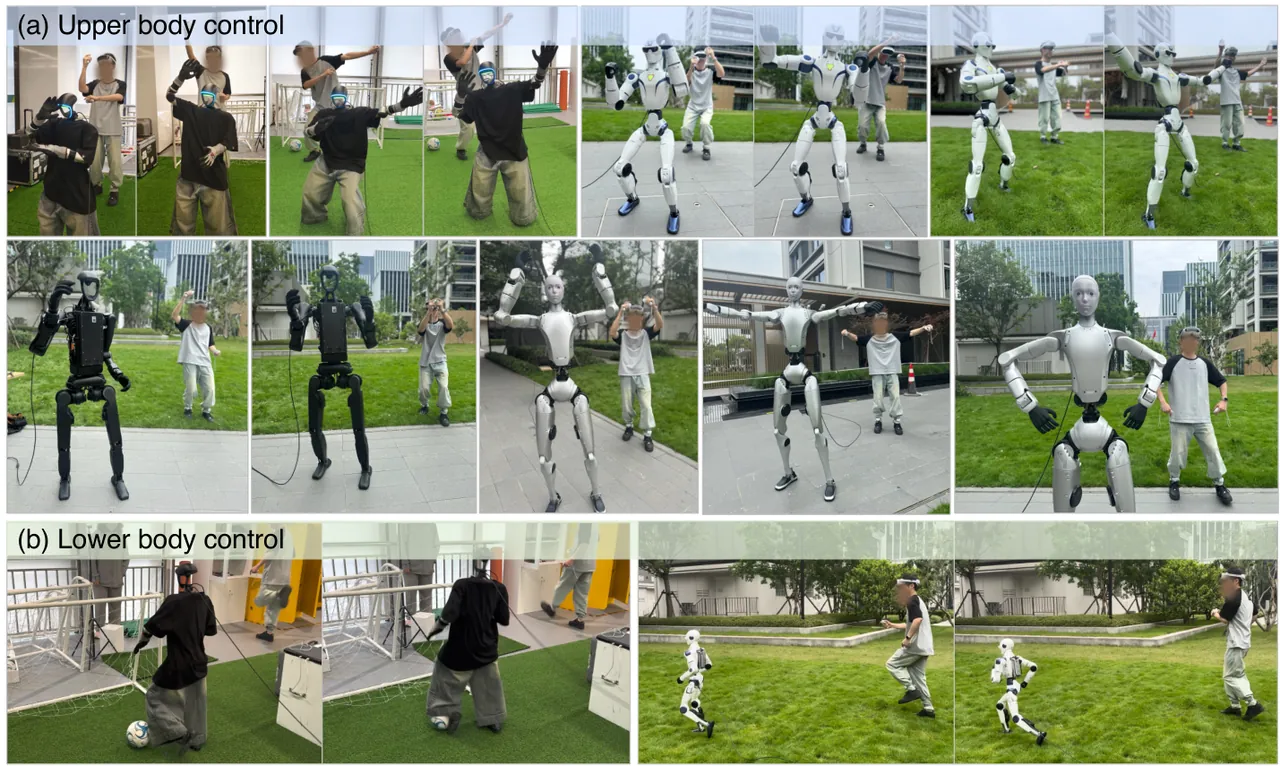
Figure 4: real-robot deployment. X-WBC controls Unitree G1, R1, H1-2 and H2, four humanoids that differ markedly in size and joint count, through the same sparse VR interface; (a) shows upper-body pose control, (b) shows kicking and running on grass.
Real-robot deployment. The same policy architecture and sparse VR interface are deployed on Unitree G1, R1, H1-2 and H2: the operator uses one command format, and the embodiment-specific branch maps it to each robot's proprioception and action space. The demonstrations cover upper-body pose and lower-body locomotion, including kicking and running on grass, which shows that one human-centric command interface with a shared backbone can support bodies that differ greatly in scale and kinematic structure. The authors are equally explicit that quantitative cross-method hardware comparisons and cross-vendor deployment remain for broader evaluation.
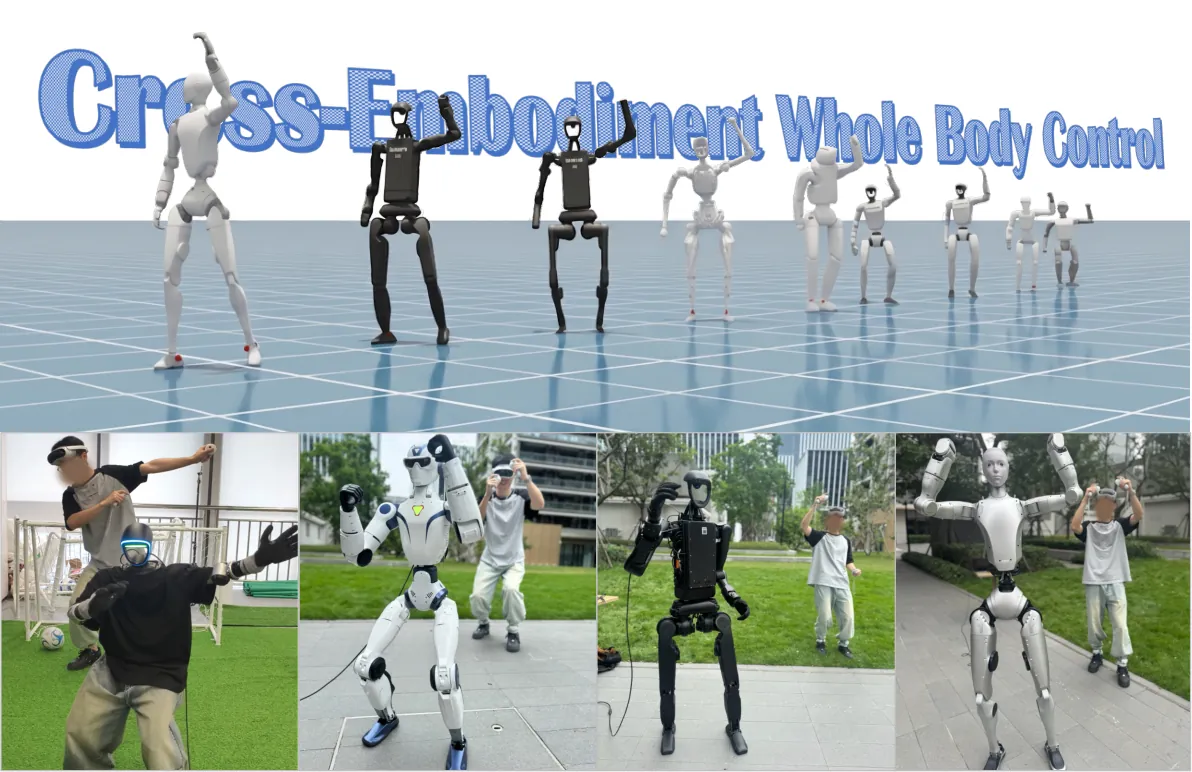
Figure 1: the concept of X-WBC. Several humanoids jointly train one shared whole-body controller in simulation, where shared modules learn reusable human motion semantics and embodiment-specific modules handle body-dependent execution; real-robot VR teleoperation demonstrates one human-centric interface across differing bodies.
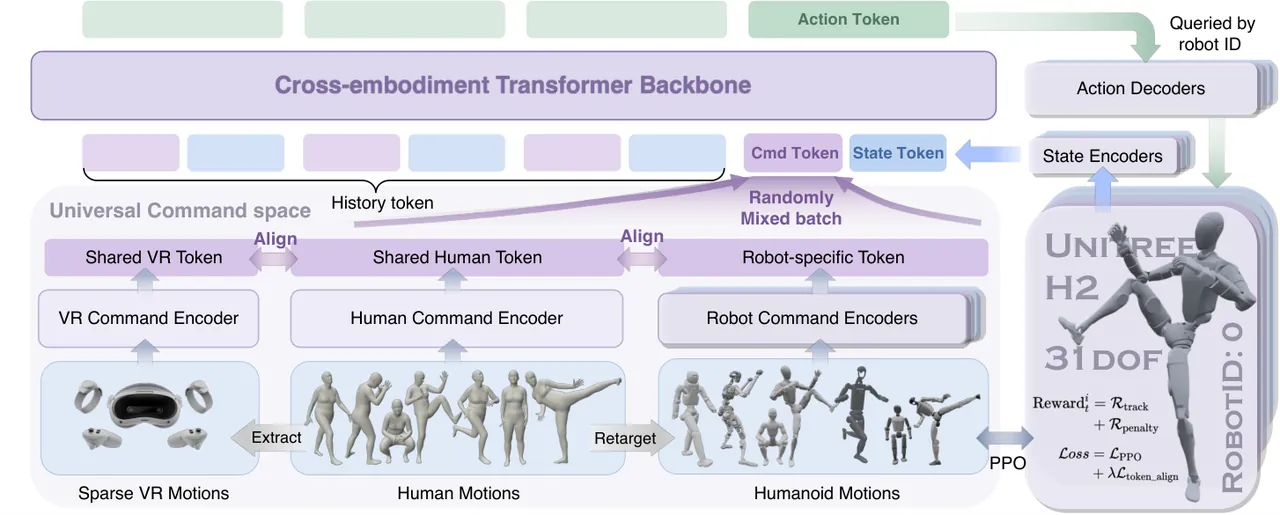
Figure 2: method overview. Full human motion, robot motion commands and sparse VR commands are encoded into a shared motion token space; the shared Transformer backbone combines the mixed token batch with robot proprioception and history; embodiment-specific modules route each sample to the correct body interface and decode executable joint actions.
Limitations
Stated by the authors, part one: morphology coverage and embodiment-specific preparation. The current study covers humanoids only, and whether the learned motion representation transfers to more diverse morphologies, body proportions and joint layouts remains open. Even though the shared backbone accumulates cross-robot experience, X-WBC still needs embodiment-specific command and proprioception encoders, action decoders, control logic and per-robot retargeting to preserve an executable action space on each platform, and these interfaces remain part of the deployment pipeline.
Stated by the authors, part two: hardware evidence and robustness. Real-robot validation was done on four Unitree machines and a limited set of upper- and lower-body behaviours; broader hardware evidence should include other vendors, longer task sequences and more diverse contacts and terrains. Robustness to sensor dropout, communication latency, state-estimation noise and sustained disturbances has not been systematically evaluated. The authors list zero-shot X-WBC, where a policy trained across known embodiments directly controls an unseen humanoid without training new embodiment-specific modules, as future work, noting that it may require morphology-conditioned interfaces that derive perception and action mappings directly from a robot description.
Our reading, part one: in-distribution gains are not generalisation. Table 1 evaluates the BONES-SEED training motions themselves, and the paper states plainly that it measures "in-distribution architecture and fitted behaviour"; the +0.91 / +1.00 point success-rate advantage of joint training over per-robot training should therefore be read as architectural and optimisation-level evidence, not as evidence of generalisation to unseen motion or unseen embodiments. The external evaluation (Table 2) covers G1 only, because the available released checkpoints cover G1 only, and X-WBC's velocity error (0.5400 m/s) is clearly higher than SONIC's (0.3419 m/s): the sparse interface buys deployment convenience at the price of velocity tracking.
Our reading, part two: the alignment mechanism is naive and lacks a sensitivity analysis. Command alignment is nothing more than pairwise MSE over normalised tokens, with $\lambda_{\mathrm{align}}$ fixed at 1.0 and the three pairs weighted equally, and the paper provides no ablation over the weight or the alignment form. Cross-robot retrieval Recall@1 is 61.3% for the same phase, below the 86.0% of cross-source retrieval, so the shared space has not fully stripped embodiment information. This is closer to a design trade-off than a defect (decoding needs execution information), but it means the purity of "shared semantics" is currently measured only indirectly, by retrieval.
Conclusion and Outlook
The contribution of X-WBC can be summarised in three layers. First, it changes the training unit of humanoid WBC from an isolated single-robot policy to cross-embodiment joint training, turning different humanoids into one data source. Second, it gives a human-centric policy architecture: aligned command tokens, a shared causal Transformer backbone and lightweight embodiment-specific modules, which explicitly separate shared motion semantics from embodiment-specific execution. Third, it supports those claims with in-distribution comparisons, a frozen-weight evaluation on external motion, token-space retrieval and deployment on four real robots, showing that joint training improves tracking, that the aligned representation supports consistent control across command sources, and that the policy stays competitive outside its training corpus.
Looking forward, this work establishes multi-robot motion tracking as a viable foundation-task route: if heterogeneous humanoids can become a joint data source the way heterogeneous arms have, then the accumulation of whole-body control experience is no longer partitioned by platform. The key open questions are how transfer scales with the size of the robot set, how thin the embodiment-specific preparation can become, and whether morphology-conditioned interfaces can support zero-shot control of unseen bodies. That last one is the real test of the phrase "cross-embodiment foundation model".