PAPER DEEP DIVE
Reinforcement Learning-Based Control for an Inline Skating Humanoid Robot
As humanoid robots become increasingly dynamic, coupling them with reinforcement learning offers a promising approach to solving the complex, underactuated mechanics of passive inline skating. Equipping a humanoid robot with passive inline skating wheels presents an opportunity to combine the versatile agility of humanoids with the high-speed, energy-efficient locomotion strategies utilized by human skaters. In this paper, we train and deploy a reinforcement learning control policy that enables novel locomotion strategies for a humanoid robot modified to equip consumer inline skates instead of conventional feet. Unlike previous work limited to quadrupedal robots or actively driven wheels, our system allows for precise 6-DoF control of the skates to execute dynamic, edge-driven propulsion strategies. Our skating strategies emerge entirely from our reward structure, without reliance on human motion data, imitation learning, or kinematic priors. We overcome the inherent instability of passive wheels and simulation contact artifacts by utilizing different geometric wheel models (spherical and ellipsoidal) during training and validation, along with a custom success-based command curriculum and a specialized rolling reward. Consequently, our policy demonstrates up to a 50% reduction in Cost of Transport (CoT) compared to standard walking gaits. The resulting policy successfully transfers zero-shot to the physical Booster T1 hardware. Real-world deployments demonstrate dynamic balance, the ability to reject active physical perturbations, and agile locomotion strategies capable of turning at speed. A video of our results can be found at https://www.youtube.com/watch?v=-_APcOS7uFo.
Reinforcement Learning-Based Control for an Inline Skating Humanoid Robot
Paper: Reinforcement Learning-Based Control for an Inline Skating Humanoid Robot
Authors: Ethan Marot, Thomas Bi, Clemens Schwarke, Victor Klemm, Marco Hutter, Raffaello D'Andrea (ETH Zurich)
Link: arXiv:2606.31807 | Platform: Booster T1 (retrofitted consumer inline skates) | Simulator: Isaac Gym + MuJoCo
One-line summary: Without any human motion data or imitation learning, pure reward-driven RL lets a humanoid robot learn stroke-and-glide inline skating strategies, achieving 50% CoT reduction over walking with zero-shot sim-to-real transfer.
Background and Motivation
Advances in humanoid hardware and RL have enabled whole-body control for complex dynamic locomotion, but bipedal locomotion via unactuated skates remains a largely underexplored frontier. Inline skating introduces inherent instability compared to standard walking or actuated wheeled-legged systems, but offers potential for highly efficient locomotion across long flat distances. This paper focuses on inline skates rather than quad roller skates—though co-linear wheel arrangement reduces each foot's support polygon to a narrow line, increasing difficulty, inline skates enable higher forward velocities and are designed for long-distance traversal.
Unlike actuated wheeled-legged systems, inline skating propulsion cannot utilize direct motor torques at wheel axles. The controller must execute precise 6-DoF maneuvers, strategically angling skate edges to generate lateral ground reaction forces for propulsion. This highly dynamic process is complicated by partial observability—without encoders on passive wheels, the system must infer wheel speed and slippage entirely through secondary sensors. Existing methods relying on ZMP require explicit phase modeling and enforce conservative constraints (e.g., all wheels in continuous contact, no swing leg) to maximize stability margins.
The core innovation: without relying on human motion data, imitation learning, or precomputed trajectories, stroke-and-glide strategies emerge purely from the reward structure. Different geometric wheel models during training and validation overcome passive-wheel instability and simulation contact artifacts.
Method
1. Mechanical Design
The hardware platform is Booster T1 (23 DoF) with 6-DoF legs (3-DoF hips, 1-DoF knees, 2-DoF ankles) well suited for skating—allowing precise control over skate position and wheel edge angles. Standard feet are replaced with consumer children's inline skates; the boot is detached from the metal frame and wheels, which are slotted onto a custom SLA mount connecting to the robot's heel joint. Formlabs Tough 1500 resin withstands high-speed impacts; bearings upgraded to ILQ-9 Twincam Pro to minimize friction; wheels replaced with less compressible material (Hydrogen Street 60/92A) to better match rigid-body simulation properties.
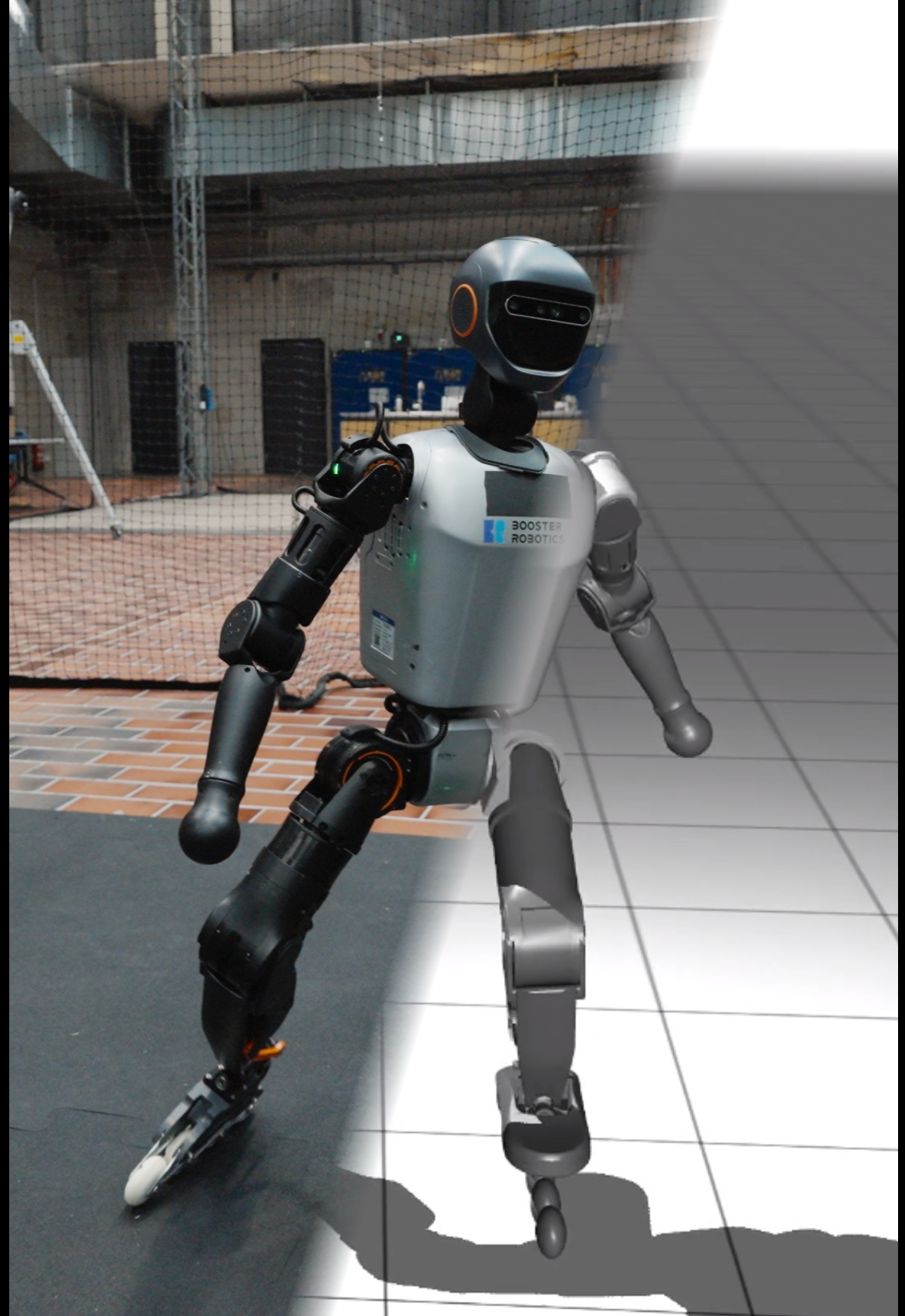
Figure 1: Zero-shot sim-to-real transfer of inline skating policy. MuJoCo simulation model (left) and physical Booster T1 robot (right).
2. Problem Formulation
The environment is modeled as an infinite-horizon POMDP $M=(S,O,A,p,r,\gamma)$. An asymmetric actor-critic architecture is used: the actor uses a 74-dimensional proprioceptive observation $o_t\in\mathbb{R}^{74}$ (projected gravity, base angular velocity, velocity commands, gait phase clock, joint positions/velocities, previous actions), while the critic uses an 88-dimensional state $s_t\in\mathbb{R}^{88}$ (noiseless ground-truth plus privileged variables like base linear velocity, height, external forces/torques). The actor outputs 21-dimensional target joint positions for a high-frequency PD controller. The policy objective:
$$\theta^{*}=\arg\max_{\theta}\;J(\pi_{\theta})=\arg\max_{\theta}\;\mathbb{E}_{\tau\sim p_{\pi}}\left[\sum_{t=0}^{\infty}\gamma^{t}r(s_{t},a_{t})\right]$$
3. Contact Modeling for Passive Wheels
The fundamental challenge in simulating passive inline skates is physics engine artifacts. High-resolution meshes suffer the "sticky contact patch" phenomenon where multi-point collision resolution artificially dampens rolling. Standard cylindrical primitives cause edge clipping when the skate tilts to engage edges; Isaac Gym's PhysX resolves this by applying artificial restitution impulses that the RL agent rapidly learns to exploit for cost-free propulsion.
The solution decouples training and validation wheel geometries: training (Isaac Gym) uses spherical primitives matching the bottom curvature of physical wheels, ensuring stable single-point contact; validation (MuJoCo) uses ellipsoidal primitives for sim-to-sim testing. A policy robust across both geometric approximations is assumed to generalize well to true physical wheel geometry.
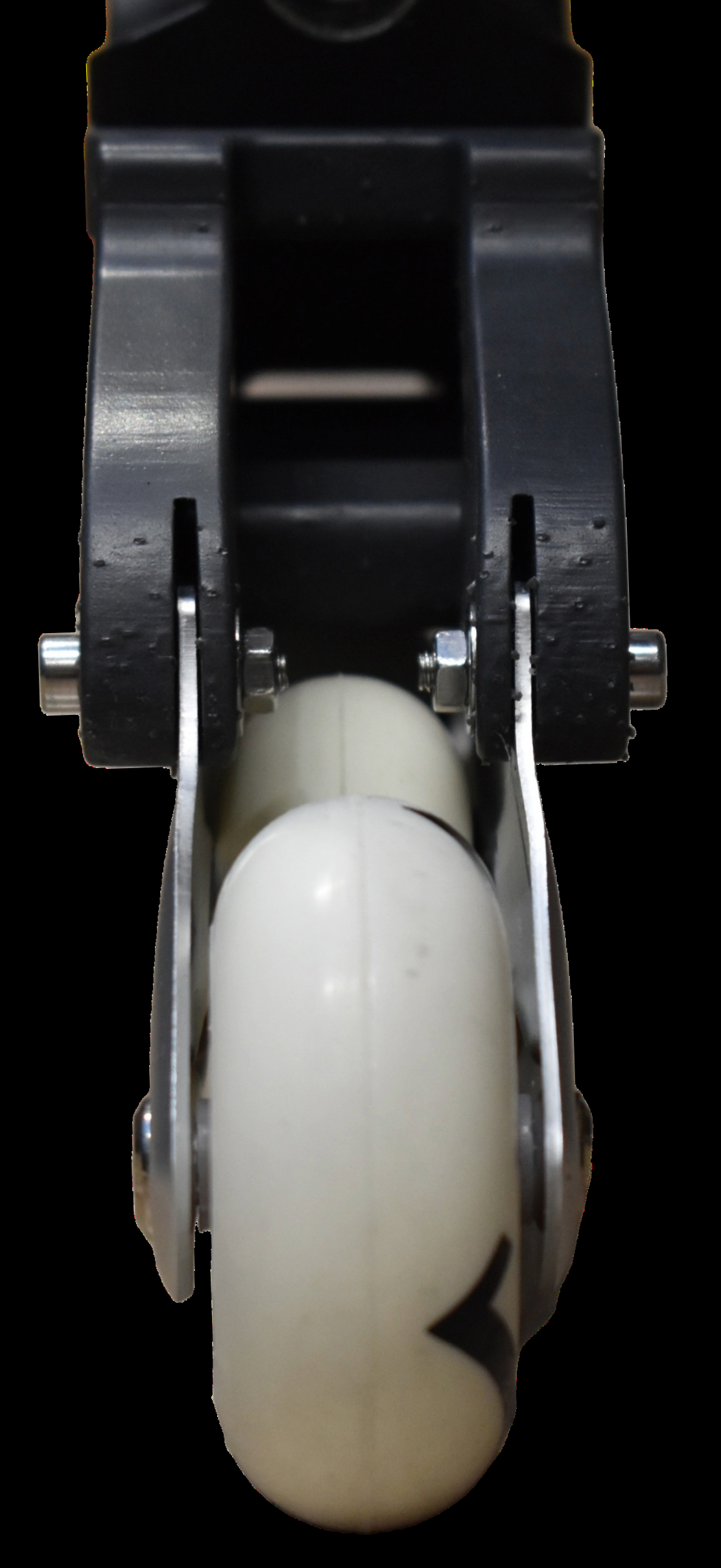
Figure 3: Spherical primitives in Isaac Gym (top) and ellipsoidal wheels in MuJoCo (bottom).
4. Rolling Reward
Standard bipedal reward functions result in stepping or shuffling—agents avoid rolling instability. To incentivize authentic skating, a kinematic rolling reward is formulated. First, average linear velocity of each foot is calculated by mapping wheel angular velocities to linear motion, only for ground-contact wheels:
$$v^{*}=\frac{r\sum_{n=1}^{N}\omega_{n}^{*}c_{n}^{*}}{\sum_{n=1}^{N}c_{n}^{*}}$$
where $r$ is wheel radius, $N$ is wheels per skate, and $c_n^*$ is a binary contact indicator. Effective linear velocity: $v_{\text{wheel}}=\max(|v_{\text{left}}|,|v_{\text{right}}|)$. The rolling reward uses a Gaussian kernel penalizing squared error between base forward velocity and wheel speed:
$$r_{\text{wheel}}=\exp\left(-\frac{(v_x-v_{\text{wheel}})^2}{\sigma}\right)$$
5. Success-Based Command Curriculum
Passive-wheel instability makes initial exploration prone to terminal falls with sparse rewards. The velocity command space is discretized into a 2D grid over linear velocity $v_x^{\text{cmd}}$ and angular velocity $\omega_z^{\text{cmd}}$. The agent starts training at zero velocity (mastering basic balance). At each episode's end, average velocity tracking performance is evaluated:
$$\bar{e}_v=\frac{1}{T}\sum_{t=1}^{T}\exp\left(-|v_{x,t}-v_x^{\text{cmd}}|\right)$$
Success metric $S\in\{0,1\}$: $S=1$ iff $\bar{e}_v>\tau_{\text{track}}$ and $T\geq T_{\min}$. When the agent consistently succeeds for a command bin, the curriculum dynamically unlocks adjacent higher-velocity bins. This dynamic boundary expansion lets the policy incrementally synthesize complex skating behaviors—transitioning from standing to gliding to high-speed dynamic turning—without collapsing the value function.
graph TD
  A[Zero-velocity cmd: learn standing balance] --> B[Unlock low-velocity bins: learn gliding]
  B --> C[Unlock mid-velocity bins: learn acceleration]
  C --> D[Unlock high-velocity bins: learn dynamic turning]
  D --> E[Full command space coverage]
  style A fill:#7ed321,stroke:#4a8a14,color:#fff
  style B fill:#4a90d9,stroke:#2c5f8a,color:#fff
  style C fill:#f5a623,stroke:#b97316,color:#fff
  style D fill:#e74c3c,stroke:#a93226,color:#fff
  style E fill:#9b59b6,stroke:#6c3483,color:#fff
Experimental Results
Sim-to-Sim Ablation
Training requires ~3 billion steps, 20,000 PPO iterations (~1.9 years simulated experience). Validated on MuJoCo ellipsoidal wheels over 100 trials:
| Method | Sim Time (s) | v_x Error (m/s) | ω_z Error (rad/s) |
|---|---|---|---|
| Cylindrical wheels (exploits artifacts) | 60.0 | 1.34 | 0.56 |
| No rolling reward | 55.7 | 1.47 | 0.25 |
| No curriculum | 56.7 | 0.70 | 0.13 |
| Deployed policy (full) | 60.0 | 0.43 | 0.12 |
The cylindrical-wheel policy achieves high Isaac Gym rewards but almost completely fails velocity tracking in MuJoCo, confirming the necessity of the spherical-to-ellipsoidal pipeline. No rolling reward leads to stepping/shuffling instead of gliding. No curriculum approaches the full policy but with unstable skating techniques.
Cost of Transport Analysis
CoT is defined as:
$$\text{CoT}=\frac{\sum_{i=1}^{n}|\tau_i\dot{q}_i|}{mgv_x}$$
At $v_x^{\text{cmd}}=1$ m/s, $\omega_z^{\text{cmd}}=0$, walking CoT is 0.665 vs skating 0.326—a 50% reduction. At higher velocities, skating maintains low CoT while walking collapses. Real-world deployment on padded mats (out-of-distribution surface) still validates skating's significant efficiency advantage at higher speeds.
| Velocity (m/s) | Walking CoT | Skating CoT | Improvement |
|---|---|---|---|
| 0.5 | ~0.5 | ~0.5 | Parity |
| 1.0 | 0.665 | 0.326 | -50% |
| 1.5+ | collapses | ~0.33 | Walking infeasible |
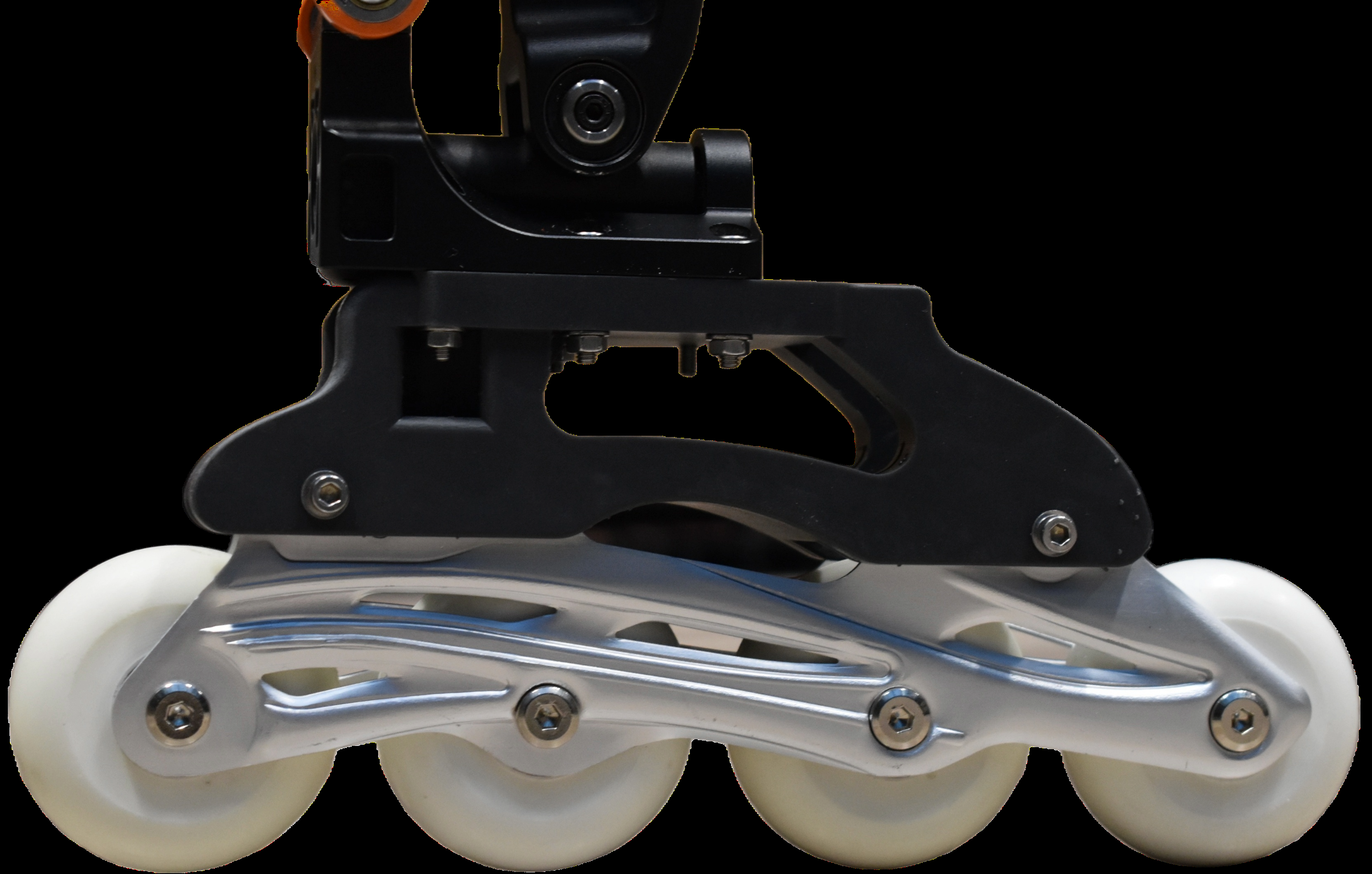
Figure 2: SLA mounts and inline skate bracket and wheels. Mounts optimized for weight efficiency with arch designs to resist high-speed impacts.
Hardware Deployment
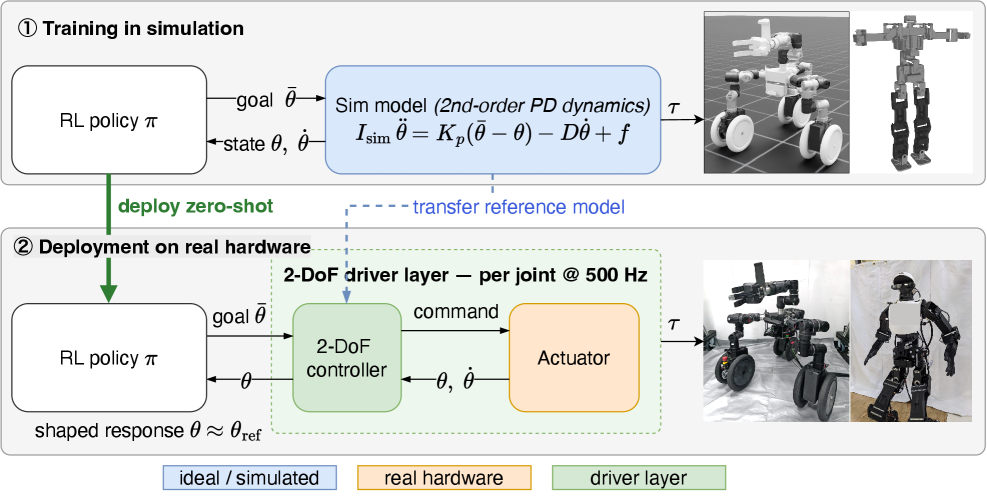
The policy transfers zero-shot to physical Booster T1. Untethered deployment demonstrates forward acceleration, deceleration, and dynamic turning while in motion. The robot also rejects active physical perturbations. Effective on wooden flooring and brick paving surfaces.
Limitations
Author-stated: Physical space constraints prevent testing the full velocity command range and accuracy on hardware. The RL optimization landscape leads to a "dominant leg" propulsion strategy—despite efforts to enforce symmetrical constraints, the policy favors one leg for pushing off. This local optimum increases immediate survivability by minimizing weight-transfer instability but deviates from alternating high-power strokes characteristic of human skaters, indicating the gait may still be suboptimal and less energy-efficient.
Analysis: Training requires 3 billion steps (~1.9 years simulated experience), incurring high computational cost. Passive wheels without encoders create partial observability—wheel speed and slippage are inferred entirely from secondary sensors, potentially causing significant estimation errors at high speeds or low-friction surfaces. The "dominant leg" issue is not merely aesthetic—it causes CoT asymmetry along the yaw velocity axis, limiting turning-direction flexibility. Simulation uses spherical/ellipsoidal approximations; real wheel contact characteristics (edge wear, surface irregularities) are not modeled. Real-world testing is only on padded mats; performance on hard smooth surfaces (the ideal surface for inline skating) is not thoroughly reported.
Conclusion and Future Work
This work presents the first real-world deployment of a bipedal humanoid robot executing emergent stroke-and-glide propulsion on passive consumer inline skates, with strategies emerging entirely from reward structure rather than imitating human data. The decoupled spherical-training + ellipsoidal-validation wheel geometry approach effectively prevents RL from exploiting physics engine artifacts. The success-based command curriculum enables progressive development from standing balance to high-speed dynamic turning. The 50% CoT reduction and zero-shot sim-to-real transfer validate passive inline skating as a practical efficient locomotion mode for humanoid robots. Future directions include incentivizing alternating-leg propulsion, extending to ice skating (introducing complex friction and phase-change dynamics), and developing control frameworks for autonomous switching between standard walking and skating configurations.
The essence of teaching a robot to skate isn't mimicking every human motion—it's designing the right reward so that "rolling" itself becomes the optimal solution, and the policy naturally finds the stroke-and-glide path.
SOURCE LINKS