PAPER DEEP DIVE
Robust bipedal locomotion on flowable slopes via foot-driven terrain manipulation
Bipedal robots are challenging to control because they operate close to instability, where small variations in foot-terrain contact can rapidly destabilize locomotion. On rigid terrain, bipedal robots mitigate this fragility by using well-established contact mechanics and control strategies. On flowable surfaces such as granular slopes, foot contact can induce large surface deformations and solid-fluid-like transitions, coupling terrain effects with robot dynamics, leading to underperformance or failure. This is partly due to the lack of reliable methods to represent the dynamics of flowable terrain, making it difficult to account for terrain effects in locomotion design. Here, we investigate how controlling terrain response can improve bipedal locomotion on granular slopes by studying the terradynamics of cleated feet, thin plates emanating from the foot soles. Systematic studies of a small-scale (1.4 kg) robophysical biped reveal that cleats with sparse and dense spacing lead to excessive terrain yielding and resistance, respectively, degrading performance and leading to failure. An intermediate cleat spacing distributes interaction forces to maintain substrate stresses near (or below) the yield threshold, enabling walking on granular slopes up to 30 degrees. Guided by these principles, we design a foot that actively adjusts cleat depth and accommodates both rigid and granular terrain. We also demonstrate that the principles of effective foot-terrain interaction translate to a larger (15 kg) autonomous biped. Our study presents an alternative to conventional body-centric robot control approaches, which regulate terrain-induced effects through body motion, by instead regulating terrain interactions through limb-centric approach.
Robust Bipedal Locomotion on Flowable Slopes via Foot-Driven Terrain Manipulation
Paper: Robust bipedal locomotion on flowable slopes via foot-driven terrain manipulation | Authors: Deniz Kerimoglu, Junnosuke Kamohara, Jiyeon Maeng et al. | Institutions: Georgia Tech / Northeastern Univ. | Link: https://arxiv.org/abs/2607.11855
One-Sentence Summary
This paper studies controlling terrain response rather than just body motion to improve bipedal robot locomotion on granular slopes, finding that intermediate cleat spacing (4cm) distributes interaction forces to maintain substrate stresses near the yield threshold, enabling a 1.4kg biped to walk on 30° granular slopes with scalability validated on a 15kg autonomous biped.
Background and Motivation
Bipedal robots are difficult to control because they operate close to instability—small variations in foot-terrain contact can rapidly destabilize locomotion. On rigid terrain, bipedal robots mitigate this fragility through established contact mechanics and control strategies that regulate center-of-mass dynamics and ground reaction forces, assuming terrain response is predictable and decoupled from body dynamics. However, many natural terrains (deserts, drylands, soil) comprise yielding substrates that deform and flow once contact forces exceed yield stress. Granular slopes are particularly challenging as foot interactions induce excessive deformations, downward flow, and solid-fluid-like transitions, coupling terrain effects with robot dynamics.
This challenge is partly due to the lack of efficient terrain models. Current granular terrain models (RFT, MPM, DEM) are either computationally intensive or low-fidelity. Most bipedal locomotion strategies remain "body-centric"—treating terrain effects as external disturbances. Biological systems actively regulate substrates through limb interactions. This paper proposes a "limb-centric" approach: leveraging foot morphology to regulate terrain response.
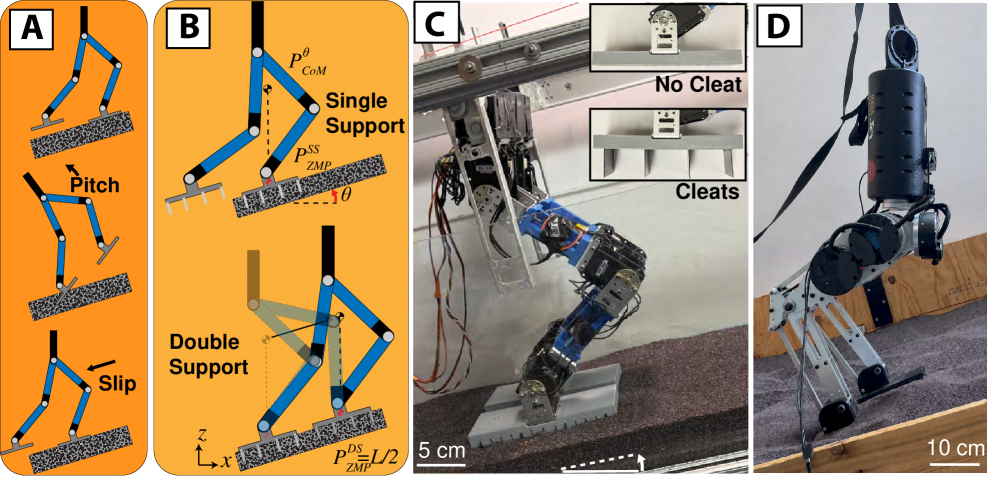
Figure 1: Cleat-foot morphology overview. A) Primary failure modes: pitching and slipping. C) BLUEY small-scale biped. D) HECTOR 3D autonomous biped.
Method
Experimental Platform and Gait Design
The robophysical biped platform BLUEY (1.4kg) uses a quasi-static open-loop gait designed to minimize pitching. In the slope-adept gait, CoM motion is constrained during single support to generate no ankle torque, with CoM progression during double support. Gait parameters: stride 10cm, CoM height 18cm, step period 1s.
Cleat Parameterization Study
Cleats consist of rigid plates protruding perpendicularly from the foot sole. Systematic variation of cleat spacing, depth, and slope angle quantifies robot slip. Key finding: displacement varies non-monotonically with spacing—sparse (12cm) causes failure, effective (4cm) achieves peak displacement, dense (1cm) shows declining performance.
On 20° slope: no cleats achieve 6% of commanded displacement, sparse cleats fail, effective cleats reach 82%, dense cleats reach 67%. Effective spacing distributes interaction forces uniformly beneath the foot, maintaining substrate stresses near or below the yield threshold for solid-like response.
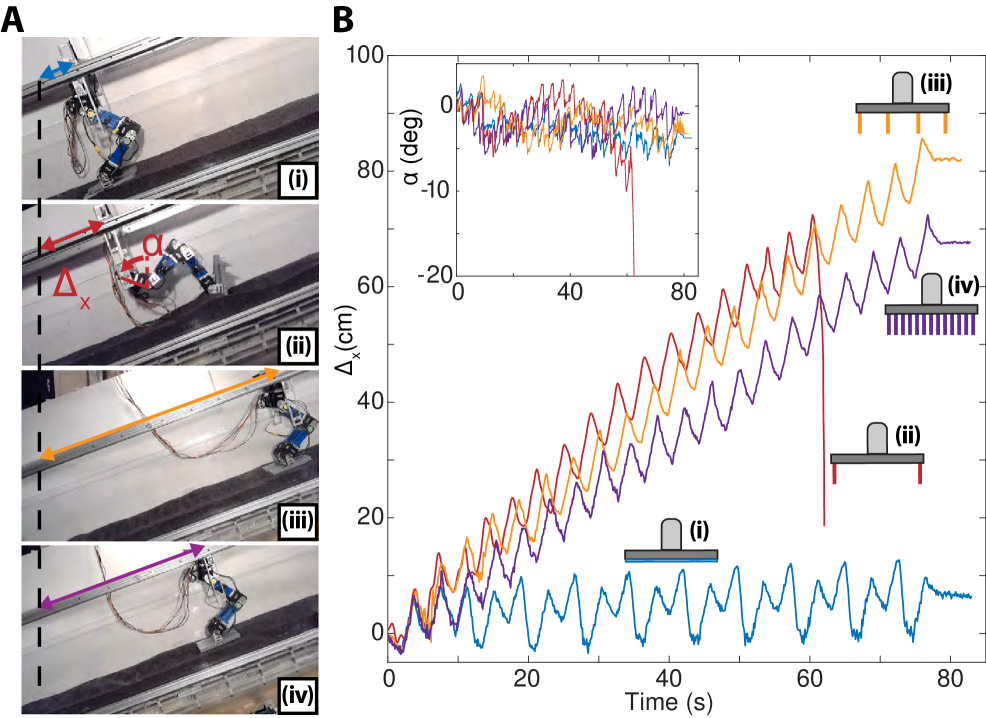
Figure 2: BLUEY walking on 20° granular slope with different cleat configurations.
Granular Intrusion Mechanics
Dual-plate intrusion and drag experiments study how cleat spacing affects granular forces. Normal force $F_\perp$ and tangential force $F_\parallel$ are measured. At 1cm spacing, peak $F_\perp$ differs by ~20% between level and 20° incline. At 5cm spacing, peak $F_\perp$ is ~40% lower than dense configuration, with higher drag resistance. The force balance is:
$$F_{net} = F_\parallel^{traction} - F_\parallel^{gravity} - F_\parallel^{drag}$$
where $F_\parallel^{traction}$ is tangential traction from cleats, $F_\parallel^{gravity}$ is gravity along slope, and $F_\parallel^{drag}$ is granular drag resistance. Effective spacing maximizes $F_\parallel^{traction}$ while minimizing insertion resistance.
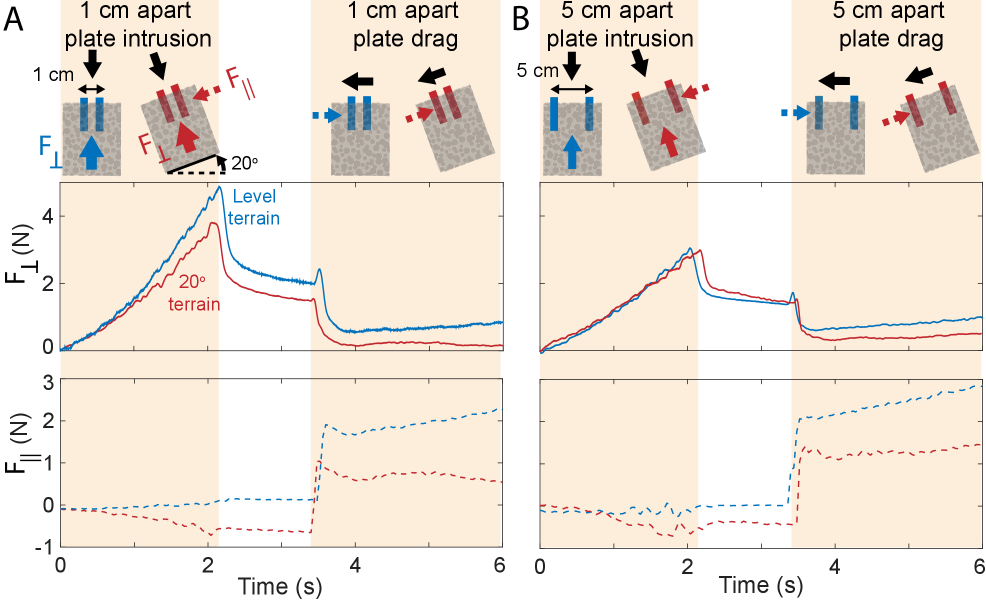
Figure 5: Dual-plate intrusion and drag experiments. Normal and tangential forces for 1cm and 5cm spacing.
Retractable Cleat Foot Design
A motor-driven cleat extension-retraction mechanism monitors motor current as a penetrability proxy: negative current on rigid ground (retract), near-zero current in granular media (deploy). The yield stress condition is:
$$\sigma_{substrate} = \frac{F_{foot}}{A_{contact}} \leq \sigma_{yield}$$
where $F_{foot}$ is foot-applied force and $A_{contact}$ is effective contact area. Effective spacing increases $A_{contact}$, keeping $\sigma_{substrate}$ below $\sigma_{yield}$. Retractable cleats adjust depth $d_{cleat} = f(I_{motor})$ based on terrain penetrability.
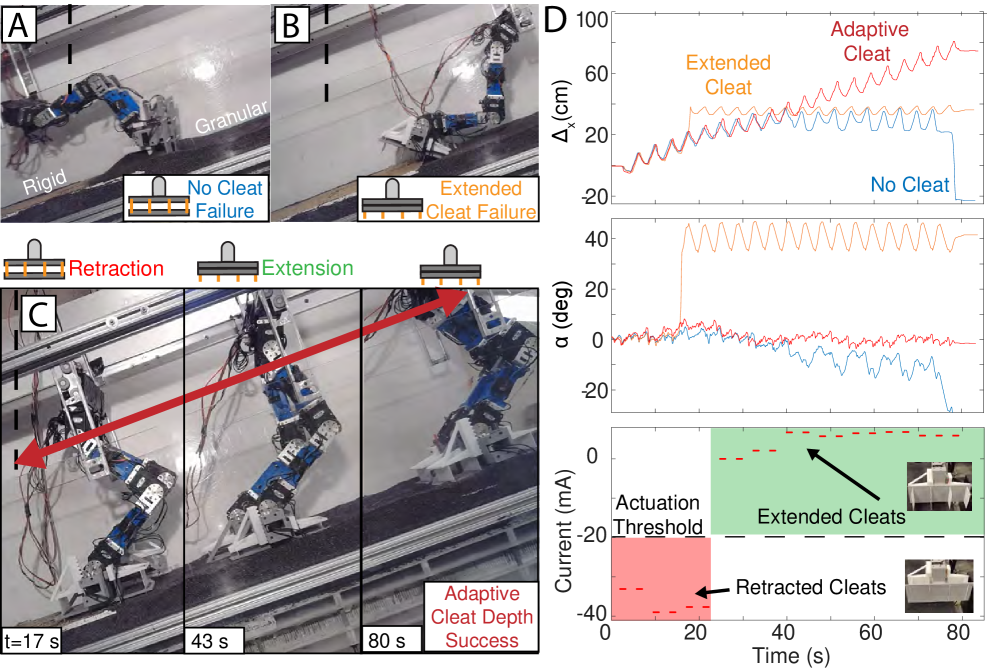
Figure 6: Retractable cleat foot experiments. Adaptive cleat depth enables transition between rigid and granular terrain.
flowchart TB
    A["Foot contacts terrain"] --> B{"Motor current detection
penetrability check"}
    B -->|negative current: rigid| C["Retract cleats
d_cleat = 0"]
    B -->|zero current: granular| D["Deploy cleats
d_cleat = 2.5cm"]
    C --> E["Walk on rigid surface"]
    D --> F["Walk on granular slope
effective spacing 4cm"]
    F --> G["Distribute interaction forces
maintain sigma < sigma_yield"]
    G --> H["Solid-like substrate response
stable walking"]
Experimental Results
The heatmap of slip vs. cleat depth/spacing/slope shows: on level and 10° slopes, nearly all configurations have 0-10% slip (except 3cm deep dense cleats fail on level). On 20°, effective spacing achieves stable walking across all depths with slip improving to 16%. On 30°, no cleats slide continuously, sparse cleats fail all depths, effective cleats improve with depth (35% slip).
| Slope | No cleat | Sparse (12cm) | Effective (4cm) | Dense (1cm) |
|---|---|---|---|---|
| Level | ~10% | ~10% | ~5% | ~10% (3cm fails) |
| 10° | ~10% | ~10% | ~5% | ~10% |
| 20° | 94% slip | Fail (depth<3cm) | 16% slip | 32-39% slip |
| 30° | Fail | Fail | 35% slip | Partial success |
Table 1: Slip rates by slope and cleat configuration. Effective spacing (4cm) performs most stably across all slopes.
PIV visualization shows sparse cleats produce localized fluidization at trailing edges causing backward pitching failure. Effective cleats distribute particle motion uniformly, with PIV vector fields showing solid-like response. Dense cleats fail to fully penetrate on level terrain but penetrate fully on steeper slopes due to reduced insertion resistance.
| Force Component | 1cm spacing | 5cm spacing | Difference |
|---|---|---|---|
| Peak $F_\perp$ (level vs 20°) | ~20% diff | — | Dense cleats: similar insertion force |
| Peak $F_\perp$ (spacing comp.) | Higher | ~40% lower | Effective spacing lowers insertion resistance |
| $F_\parallel$ steady drag | Lower | Higher | Effective spacing provides more traction |
Table 2: Dual-plate intrusion force measurements. Effective spacing lowers insertion resistance while providing higher drag resistance (traction).
HECTOR (15kg, untethered 3D biped) validates scalability on 15° granular slope. No cleats fail after a few steps; effective cleats achieve stable dynamic locomotion. HECTOR uses single-rigid-body MPC at 7.5cm/s commanded speed.
CoM position
$$ p_{CoM}^{0}=[y_{CoM}^{0},z_{CoM}^{0}]^{T} $$
Rotated CoM
$$ p_{CoM}^{\theta}=R_{x}(\theta)p_{CoM}^{0} $$
ZMP in single support
$$ P_{ZMP}^{SS}=\frac{\tau}{mg}=0 $$
Limitations- Limited experimental scale and terrain range: BLUEY experiments use specific granular material (poppy seeds, ~58% volume fraction); generalization to other materials (sand, mud) is not validated.
- Limited cleat depth adjustment: Retractable cleats use binary motor current judgment (rigid vs. granular), unable to handle intermediate penetrability or mixed terrain.
- Limited HECTOR validation slope: Large-scale validation only on 15° slope; steeper slopes (20-30°) scalability not tested.
Conclusion and Outlook
This paper proposes a "limb-centric" bipedal locomotion paradigm—regulating terrain response through foot morphology rather than just controlling body motion. Effective cleat spacing (4cm) distributes interaction forces to maintain substrate stresses near the yield threshold, achieving solid-like granular response and stable walking on 30° slopes. The retractable cleat design adapts to terrain penetrability for seamless rigid-to-granular transitions. HECTOR validation demonstrates scalability from 1.4kg to 15kg.
This work integrates granular terradynamics into legged robot design and control, providing a mechanistic foundation for robust locomotion on flowable terrain. Future work can explore more granular material types, complex mixed terrain, and closed-loop sensing-driven cleat depth control.
Golden insight: Rather than having the robot fight the flowing terrain, let its feet "shape" the terrain—the right cleat spacing isn't about piercing deeper, but about making each step create a "solid" foundation.
SOURCE LINKS