PAPER DEEP DIVE
E3DGS: Unified Geometric-Photometric Equivariance for 3D Gaussian Splatting via Color-as-Geometry Embedding
3D Gaussian Splatting (3DGS) captures scenes by coupling explicit geometry (position, covariance) with view-dependent photometry (Spherical Harmonics). However, building $\mathrm{SE}(3)$-equivariant architectures on these primitives presents a fundamental representation bottleneck. Color has been treated as a signal rather than a geometric entity, making it nontrivial to unify symmetry across geometry and appearance as the camera frame changes. While translations are handled by relative coordinates, rotations act heterogeneously across attributes: $μ\mapsto Rμ$, $Σ\mapsto RΣR^\top$, and $f_\ell\mapsto D^\ell(R)f_\ell$. This mismatch complicates strict equivariance, leading existing methods to either discard or flatten SH coefficients, thereby breaking symmetry. We propose a unified solution rooted in representation theory: for SH degrees $\ell\le2$, photometry is algebraically isomorphic to a rank-2 geometric tensor. We prove that the Wigner-$D$ action on these SH coefficients can be exactly reformulated as the conjugation action on $3\times3$ matrices. Leveraging this, we introduce the Unified Matrix Embedding, a lifting that maps all Gaussian attributes into a unified carrier space, $\mathfrak{gl}(3)$. Building on the "Color-as-Geometry" formulation, we present E3DGS, a rigid-body ($\mathrm{SE}(3)$) equivariant architecture that processes 3D Gaussians without Clebsch-Gordan tensor products. Evaluations on object vision and action-conditioned Gaussian world modeling demonstrate that our unified approach yields strong robustness under camera-frame changes and improved data efficiency.
One-line summary
E3DGS proves spherical harmonics (SH ≤2) are equivalent to 3×3 matrix conjugation, unifying Gaussian position/covariance/photometry into a single $\mathfrak{gl}(3)$ matrix carrier processed by a rigid-body equivariant backbone — without Clebsch–Gordan tensor products, maintaining 95.26% classification under zero-shot rotation while baselines collapse to 18.28%.
Abstract
3D Gaussian Splatting (3DGS) captures scenes by coupling explicit geometry (position, covariance) with view-dependent photometry (Spherical Harmonics). Building SE(3)-equivariant architectures on these primitives hits a fundamental representation bottleneck: color is treated as a signal rather than a geometric entity. Rotations act heterogeneously across attributes ($\mu\mapsto R\mu$, $\Sigma\mapsto R\Sigma R^\top$, $f_\ell\mapsto D^\ell(R)f_\ell$). This mismatch complicates strict equivariance, leading existing methods to discard or flatten SH coefficients. E3DGS proposes a representation-theoretic solution: for SH $\ell\leq 2$, photometry is isomorphic to a rank-2 geometric tensor, and the Wigner-D action reformulates exactly as 3×3 matrix conjugation. The Unified Matrix Embedding maps all Gaussian attributes into a single carrier space $\mathfrak{gl}(3)$, enabling E3DGS — a rigid-body SE(3)-equivariant architecture without CG tensor products. Evaluations on object vision and action-conditioned Gaussian world modeling demonstrate strong robustness and improved data efficiency.
1. Background and Motivation
3D Gaussian Splatting (3DGS) models the duality of geometry and light by assigning Spherical Harmonic (SH) coefficients to each primitive for view-dependent appearance. Yet in deep representation learning, this rich photometric information is often discarded — state-of-the-art methods strip away view-dependent SH coefficients to avoid rotational symmetry complexity, reducing glossy textured scenes to matte colored point clouds. This architectural compromise limits the model's ability to distinguish objects with identical geometry but different materials (e.g., matte plastic cup vs. shiny metal mug).
The fundamental bottleneck is strict SE(3) equivariance. Translation equivariance is elegantly handled by relative coordinates, but rotation is severe: geometric attributes (position $\mathbf{x}$, covariance $\Sigma$) transform by standard tensor rules, while SH coefficients transform via Wigner-D matrices. Integrating these disparate types into a single equivariant pipeline typically requires Tensor Field Networks (TFNs), and Clebsch–Gordan (CG) tensor products are computationally prohibitive for million-Gaussian scenes.
E3DGS's paradigm shift: treat photometry as geometry. For SH $\ell\leq 2$, the coefficient spaces $\mathbb{R}^{2\ell+1}$ realize the same irreducible representations ($V_0\oplus V_1\oplus V_2$) that appear in the 3×3 matrix space $\mathfrak{gl}(3)$ under conjugation, replacing the Wigner-D action with the simple conjugation rule governing geometric tensors.
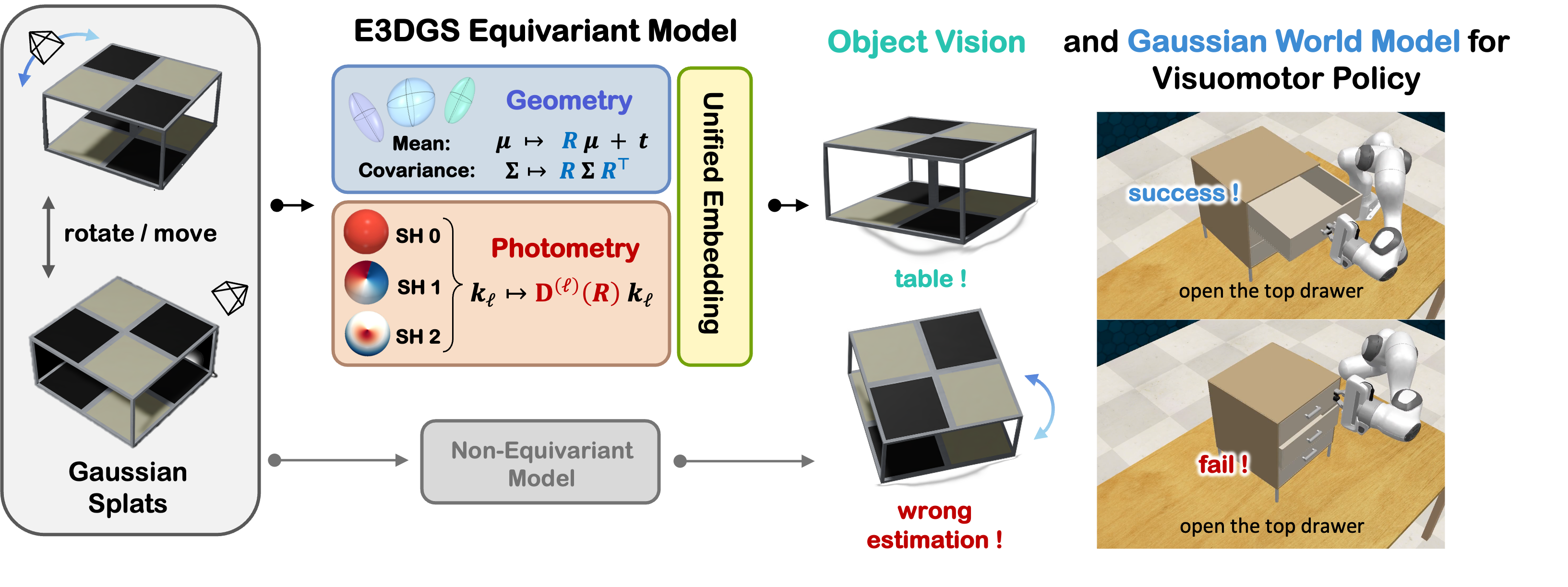
Figure 1: E3DGS overview. Gaussian primitives couple geometry (mean/covariance) and photometry (SH), transforming by heterogeneous SO(3) rules. E3DGS lifts both into a unified matrix carrier processed by a rigid-body equivariant backbone.
2. Core Method: Unified Geometric-Photometric Equivariance
2.1 Gaussian Primitives and Group Actions
A Gaussian primitive $\mathcal{G}_i=(\mu_i,\Sigma_i,\alpha_i,\{f_{i,\ell}^{(c)}\}_{\ell=0}^2)$. Under rotation $R\in\mathrm{SO}(3)$: $\mu_i\mapsto R\mu_i$, $\Sigma_i\mapsto R\Sigma_iR^\top$, $\alpha_i\mapsto\alpha_i$, SH $f_{i,\ell}^{(c)}\mapsto D^\ell(R)f_{i,\ell}^{(c)}$. Centered coordinates $\bar{\mu}_i$ isolate the rotational component.
2.2 Unified $\mathfrak{gl}(3)$ Carrier (Core Theorems)
Matrix space $\mathfrak{gl}(3)=\mathbb{R}^{3\times3}$ with conjugation $\mathrm{Ad}_R(M):=RMR^\top$ decomposes into SO(3)-irreducibles:
$$\mathfrak{gl}(3)=\langle I\rangle\oplus\mathfrak{so}(3)\oplus\mathrm{Sym}_0(3)$$
matching SH types up to $\ell=2$. Since $\mathfrak{gl}(3)\cong V_1\otimes V_1\cong V_0\oplus V_1\oplus V_2$, the 3×3 carrier realizes exactly SH $\ell\leq 2$.
Theorem 1: For each $\ell\in\{0,1,2\}$ there exists a linear SO(3)-equivariant map $\Phi_\ell$ with:
$$\Phi_\ell(D^\ell(R)f_\ell)=\mathrm{Ad}_R(\Phi_\ell(f_\ell))=R\,\Phi_\ell(f_\ell)\,R^\top$$
Theorem 2 extends to any degree: each SH band $L$ is realized exactly as conjugation on a suitable carrier $\mathrm{End}(V_k)$, without runtime CG tensor products.
flowchart TB
    G["3D Gaussian primitive
mu, Sigma, alpha, SH f_l"] --> SPLIT["Heterogeneous SO(3) actions"]
    SPLIT --> MU["mu -> R*mu"]
    SPLIT --> COV["Sigma -> R*Sigma*R^T"]
    SPLIT --> SH["f_l -> D^l(R)*f_l
(Wigner-D)"]
    MU --> LIFT["Unified Matrix Lifting
Phi_<=2 into gl(3)"]
    COV --> LIFT
    SH --> LIFT
    LIFT --> H["H_i = [P_i, C_i, S_i^r,g,b]
all transform as M -> R*M*R^T"]
    H --> ENC["SE(3)-equivariant backbone
(no CG tensor products)"]
    ENC --> TASK["Object recognition
(Gaussian-MAE) +
Action world model
(ManiGaussian)"]
    style LIFT fill:#e0e7ff,stroke:#2563eb
    style ENC fill:#dcfce7,stroke:#16a34a
2.3 Unified Matrix Embedding
Covariance lift: $C_i:=\log(\Sigma_i)\in\mathrm{Sym}(3)$; $\log(R\Sigma_iR^\top)=R\log(\Sigma_i)R^\top=\mathrm{Ad}_R(C_i)$. Position lift: $P_i:=\widehat{\bar{\mu}_i}\in\mathfrak{so}(3)$. Photometry lift: $S_i^{(c)}:=\Phi_{\leq 2}(f_{i,\leq 2}^{(c)})\in\mathfrak{gl}(3)$. Equivariant features $H_i:=[P_i,C_i,S_i^{(r)},S_i^{(g)},S_i^{(b)}]$ plus Type-0 invariants $s_i$ (opacity, diffuse color, task semantics).
2.4 Action-Conditioned Gaussian World Model
Action $a_t=(v_t,q_t,c_t)$ converted to axis-angle $\omega_t$, lifted via hat map to $\mathfrak{so}(3)$: $H_t^\text{act}=[\widehat{v}_t,\widehat{\omega}_t]$. The world model predicts state deformation:
$$\Delta H_{t+1}=f_\text{wm}^\text{eq}([H_t^\text{state},H_t^\text{act}],c_t)$$
guaranteeing SO(3)-equivariant dynamics $\Delta H_{t+1}\mapsto\mathrm{Ad}_R(\Delta H_{t+1})$.
3. Key Experiments
3.1 Object Recognition (ShapeSplat / Gaussian-MAE)
| Method | ID/ID | ID/SE(3) zero-shot | SE(3)/SE(3) |
|---|---|---|---|
| Point-BERT | 94.82 | × | × |
| Gaussian-MAE; SH(0) | 94.71 | 18.28 | 88.32 |
| Gaussian-MAE; SH(0,1,2) | 94.05 | 12.89 | 88.87 |
| E3DGS-MAE; SH(0) | 95.15 | 95.15 | 94.82 |
| E3DGS-MAE; SH(0,1) | 95.26 | 95.26 | 95.26 |
| E3DGS-MAE; SH(0,1,2) | 94.79 | 94.79 | 94.49 |
Table 1: ModelNet10 classification accuracy(%). Baselines collapse under zero-shot transform; E3DGS stays consistent.
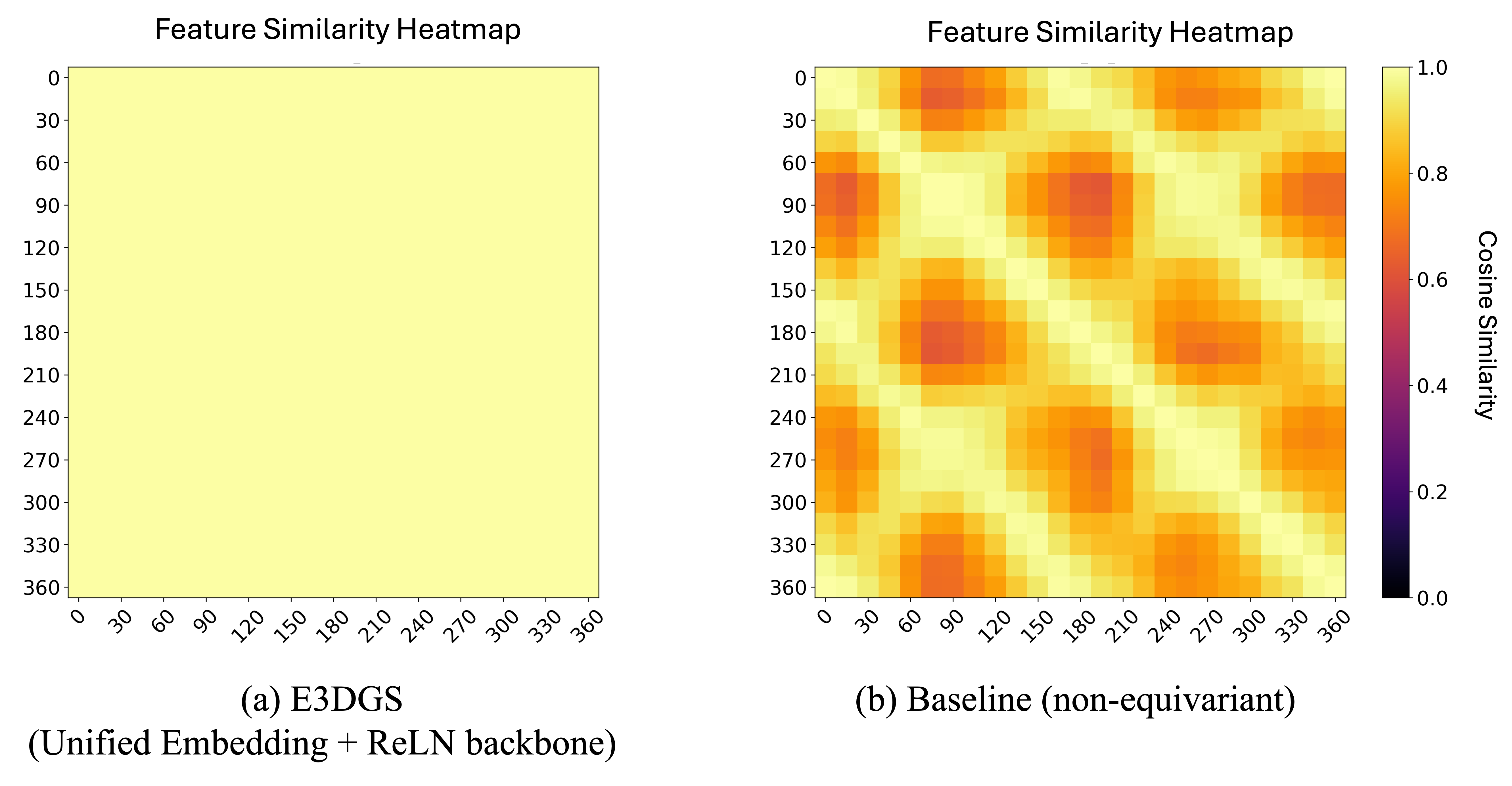
Figure 2: Pooled invariant descriptor similarity across input rotations. E3DGS (left) stays stable; G-MAE (right) shows severe drift.
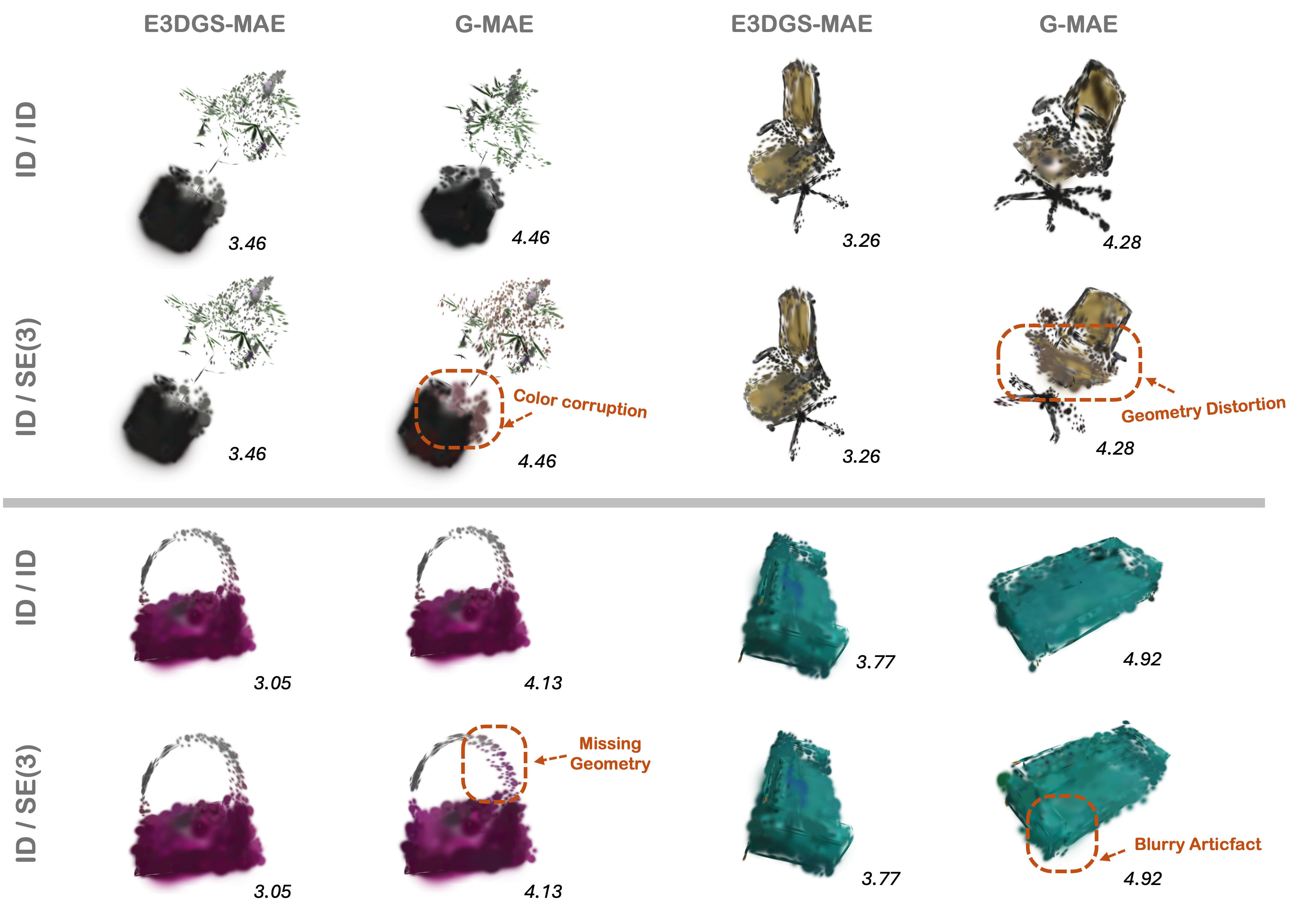
Figure 3: MAE reconstruction. G-MAE collapses under arbitrary rotation; E3DGS-MAE consistently reconstructs geometry and photometry.
3.2 Action-Conditioned World Modeling (RLBench)
| Method | close_jar | open_drawer | sweep_dustpan | meat_offgrill | put_in_drawer | drag_stick | Avg |
|---|---|---|---|---|---|---|---|
| PerAct | 18.7 | 54.7 | 0.0 | 40.0 | 2.7 | 5.3 | 20.4 |
| GNFactor | 25.3 | 76.0 | 28.0 | 57.3 | 0.0 | 37.3 | 31.7 |
| ManiGaussian | 28.0 | 76.0 | 64.0 | 60.0 | 16.0 | 92.0 | 44.8 |
| E3DGS | 16.0 | 88.0 | 80.0 | 72.0 | 36.0 | 92.0 | 50.4 |
Table 2: RLBench multi-task success rate(%). E3DGS excels on rigid-body articulation tasks.
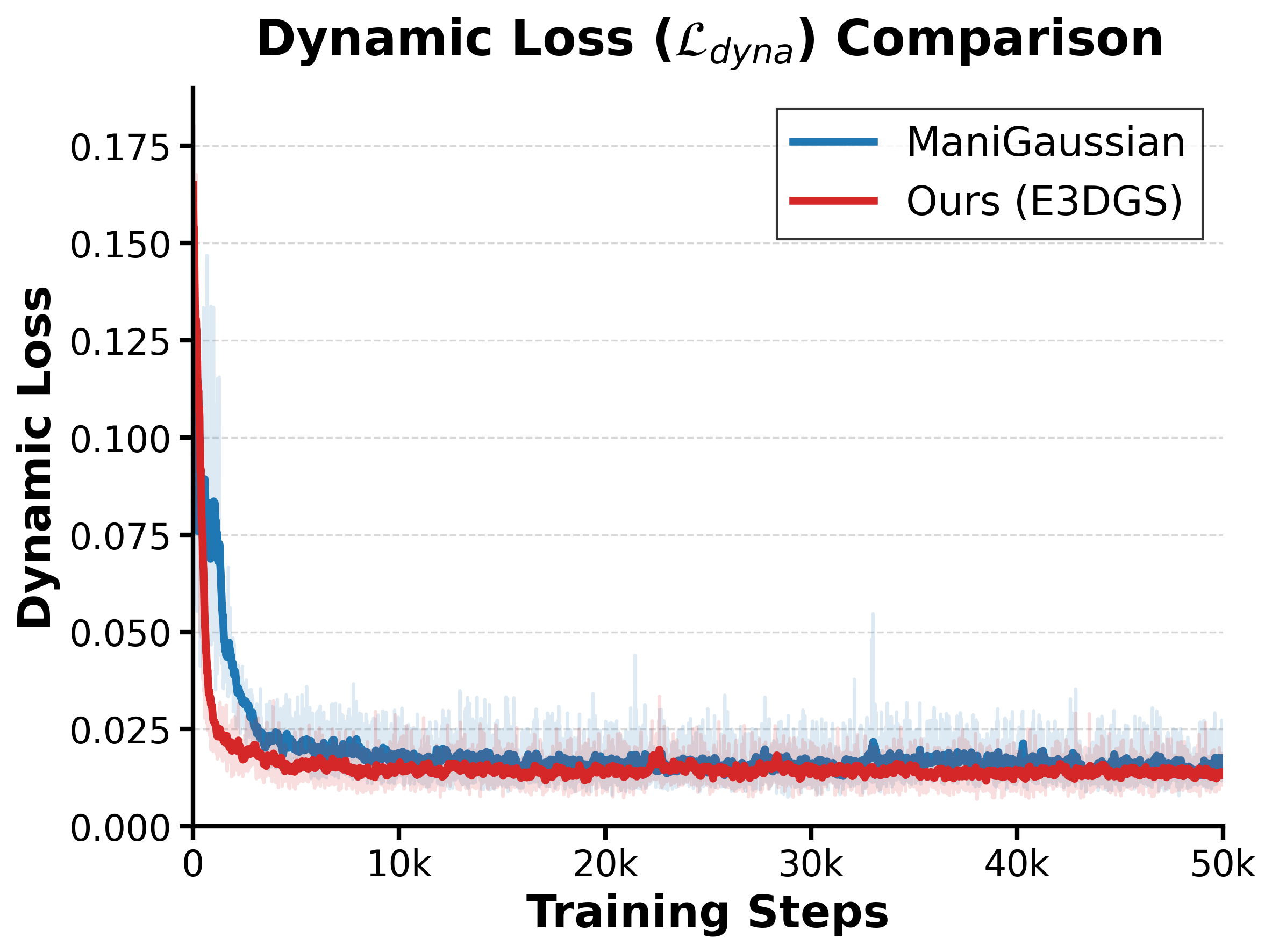
Figure 4: Dynamic loss. E3DGS accelerates rigid-body state-transition learning, converging faster to lower loss.
4.
位姿参数化
$$ g=(R,t)\in\mathrm{SE}(3) $$
高斯椭球参数
$$ \mathcal{G}_{i}=\bigl(\mu_{i},\Sigma_{i},\alpha_{i},\{f^{(c)}_{i,\ell}\}_{\ell=0}^{2}\bigr) $$
Limitations and Future WorkAuthor-stated limitations:
- The $\mathfrak{gl}(3)$ formulation is mathematically bounded to SH $\ell\leq 2$. While original 3DGS often uses degree 3, SH(0–2) captures a substantial photometric subspace and is the maximal bandwidth of the lightweight 3×3 carrier; higher bands need larger carriers (Theorem 2), empirical evaluation left to future work.
- Parameter-efficient but not runtime-efficient — matrix contractions and invariant bilinear operations increase GMACs; described as parameter-efficient rather than broadly runtime-efficient.
Analysis: The core contribution is mathematizing the "color-as-geometry" paradigm — the exact equivalence of SH(0–2) to $\mathfrak{gl}(3)$ conjugation enables strict equivariance of geometry and photometry under a unified carrier, bypassing the CG tensor-product computational bottleneck. Experimental evidence is strong: 95.26% vs. 18.28% under zero-shot rotation is a dramatic gap proving the value of equivariant constraints over data-augmentation approximations. RLBench gains are largest on rigid-body tasks (open_drawer +12%, sweep +16%, put_in_drawer +20%), but close_jar and stack_blocks (contact-heavy, long-horizon) are weaker than baseline, suggesting the equivariant inductive bias may be too strong where contact dynamics have more complex symmetries. Future work should include empirical evaluation of higher-order carriers and extensions for contact/deformation.
5. Conclusion
The core idea of E3DGS is treating photometry as geometry — proving spherical harmonics equivalent to matrix conjugation so geometry and photometry are strictly equivariant under a unified carrier without computationally expensive Clebsch–Gordan tensor products. It proves Theorem 1 (SH $\ell\leq2$ ↔ $\mathfrak{gl}(3)$ conjugation) and Theorem 2 (matrix realization of any SH degree), builds a unified matrix embedding lifting position/covariance/photometry to $\mathfrak{gl}(3)$, and processes them with a rigid-body equivariant backbone. Empirically, 95.26% classification under zero-shot rotation (vs. 18.28% baseline collapse), 50.4% average RLBench success (vs. 44.8%), and faster dynamic-loss convergence. The work provides a mathematically elegant and practical unified framework for equivariant 3DGS learning, though SH bandwidth limits, runtime efficiency, and applicability to contact-dynamics tasks remain open.
SOURCE LINKS