PAPER DEEP DIVE
Exploration Matters for Escaping the Blur Trap in 3D Gaussian Splatting
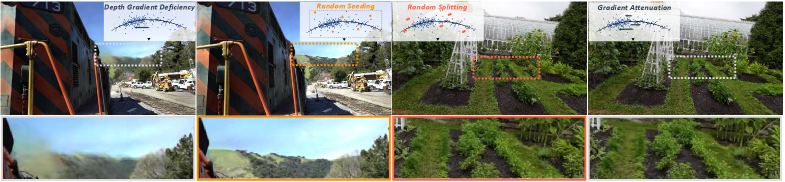
3D Gaussian Splatting (3DGS) employs Gaussian primitives for explicit scene representation, facilitating real-time, high-fidelity reconstruction and novel view synthesis of complex scenes. However, the explicit modeling inherent in 3DGS introduces a gradient bias during optimization, rendering its non-convex optimization process highly susceptible to convergence toward local suboptimal solutions. This constitutes a fundamental limitation in 3DGS optimization, which we term the Blur Trap. To address this limitation, we integrate simple explicit exploration into the 3DGS optimization framework. First, through rigorous mathematical analysis of the 3DGS optimization formulation, we identify the underlying optimization bias responsible for the Blur Trap and categorize it into two distinct subtypes: the Far-Side Blur Trap and the Near-Side Blur Trap. Subsequently, we propose two highly straightforward exploration strategies (Random Seeding and Random Splitting) to mitigate the far-side and near-side blur traps, respectively. Experimental validation demonstrates that the incorporation of these exploration operators effectively and complementarily overcome the Blur Trap, achieving high-quality rendering performance across multiple datasets. Project page: https://chengbo-wang.github.io/ExploreGS/
1. Background and Motivation
3D Gaussian Splatting (3DGS) represents scenes explicitly through anisotropic Gaussian primitives, achieving breakthrough performance in real-time rendering and photorealistic novel view synthesis. Unlike implicit neural representations such as NeRF, each Gaussian in 3DGS is updated by gradients derived directly from the camera projection model, with no intermediate neural network. This physically grounded design brings efficiency but also plants a fundamental hidden danger.
In practice, researchers and users repeatedly observe a systematic failure pattern: certain regions in rendered scenes remain persistently blurry regardless of how many training views are provided. These blurry regions are not randomly distributed but concentrate in two types of locations — distant background content (mountains, skylines) and occluded near-field regions (grass behind a rack). The persistence of blur under abundant supervision indicates the problem lies not in insufficient data but in the optimization process itself. The authors name this systematic failure the Blur Trap.
Existing 3DGS improvement efforts fall into three lines, none touching the root cause: the first refines the densification criterion (AbsGS, Pixel-GS) but still depends on the same biased gradient signal; the second (HoGS) reparameterizes positions in homogeneous coordinates to better represent far-field content but introduces no new depth-direction optimization signal; the third (3DGS-MCMC) injects Langevin noise into positions, closest in spirit to this work, but applies noise uniformly across the scene without diagnosing the two distinct geometric failure origins.
2. Mathematical Roots of the Blur Trap
2.1 The 2D Gradient Dominance Effect
In 3DGS, Gaussian position updates comprise three gradient branches: the 2D projected position gradient, the 2D covariance gradient, and the spherical harmonics coefficient gradient. The authors empirically find that the 2D position component dominates the other two by two to three orders of magnitude throughout training, so the 3D position update is effectively governed entirely by 2D reprojection error. This means the optimizer is essentially performing greedy screen-space exploitation.
2.2 The Gradient Orthogonality Theorem
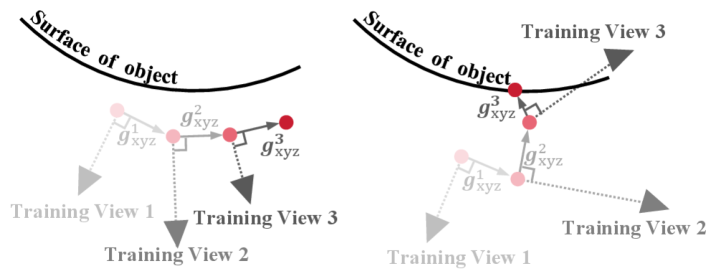
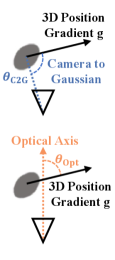
The core finding: through rigorous derivation of the camera projection pipeline, the authors prove that the 3D position gradient derived from the 2D gradient is always orthogonal to the viewing ray from the camera center to the Gaussian primitive. In other words, the optimizer can only move primitives within the plane perpendicular to the viewing ray and never along the depth direction. This is the mathematical root of the Far-Side Blur Trap.
Specifically, let $\mathbf{P}_{\mathrm{3D}}$ be the world-space position and $\mathbf{P}_{\mathrm{cam}}$ the camera position. The rendering pipeline passes through view transform $\mathbf{V}$, projection $\mathbf{P}$, perspective division, and viewport transformation. The 2D position gradient decomposes into a product of three Jacobian matrices:
The viewport Jacobian $\frac{\partial\mathbf{p}_{\mathrm{2D}}}{\partial\mathbf{p}_{\mathrm{ndc}}}$ has its third column identically zero, and the null space of the perspective division Jacobian contains the homogeneous coordinate vector ${}^{h}\mathbf{p}$. These two geometric facts combined force the inner product of the gradient with the viewing direction to be exactly zero:
This theorem profoundly reveals that the differentiable rendering formulation of 3DGS provides no optimization signal along the depth direction. Primitives cannot move to their correct depth through gradient descent, causing distant geometry to remain permanently blurred.
2.3 Alpha-Blending-Induced Gradient Attenuation
The second failure mechanism comes from the alpha-blending pipeline. In forward rendering, pixel color is accumulated from depth-sorted Gaussians:
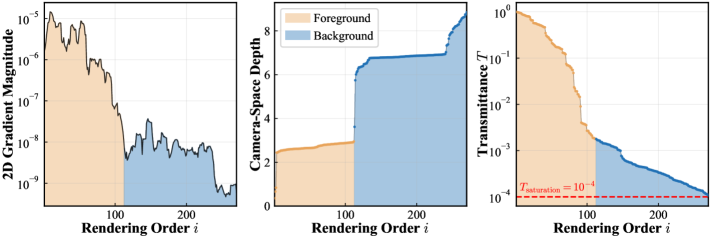
where $T_i$ is the accumulated transmittance of the first $i-1$ primitives. Since $T_i$ decreases monotonically with index $i$, later occluded primitives contribute minimally to the final pixel color and their backpropagated gradients are severely attenuated. The authors further prove an upper bound on the 2D position gradient magnitude:
Since each $\alpha_j \in [0,1]$, the transmittance sequence is monotonically non-increasing: $T_0=1\geq T_1\geq T_2\geq\cdots\geq T_N\geq 0$. Rear Gaussians receive progressively weaker gradient signals, and their periodic average gradient magnitude consistently fails to reach the densification threshold $\tau_{\text{split}}$, causing densification failure. This is the formation mechanism of the Near-Side Blur Trap — occluded primitives cannot obtain densification opportunities because their gradients are attenuated by alpha blending.
2.4 Formation of the Blur Trap
Combining screen-space gradient dominance, depth-gradient deficiency, and blending-induced densification failure, the 3DGS optimization forms an exploitation-only dynamic. Deterministic gradient descent cannot escape this local optimum basin because the required depth-probing signals are mathematically suppressed by the rendering formulation itself. This systematic stagnation is not a transient optimization phase but an inherent consequence of the differentiable rendering pipeline.
3. Method: Two Minimal Exploration Operators
3.1 Design Principles
The root cause of the Blur Trap lies in the physics-based formulation of the differentiable rendering pipeline. Both parameter updates and adaptive densification rely exclusively on backpropagated gradients, inheriting a systematic bias. The core design principle to break this: bypass purely gradient-driven exploitation by injecting explicit exploration that operates independently of 2D gradient magnitude.
The authors deliberately adopt the simplest possible operators to validate the intrinsic efficacy of exploration. For the Far-Side Blur Trap, exploration must establish update pathways along the depth axis; for the Near-Side Blur Trap, it must proactively trigger densification for primitives whose gradients fall below $\tau_{\text{split}}$. This minimalist philosophy aims to prove that what 3DGS optimization is missing is the exploration principle itself, not sophisticated engineering.
3.2 Random Seeding
The Random Seeding operator uniformly samples $N_{\text{seed}}=20$ candidate positions within the minimum bounding box of all existing Gaussians at each densification iteration, injecting new seed Gaussians into the primitive collection. These seeds directly probe depth intervals inaccessible to gradient updates, bypassing the viewing-gradient orthogonality constraint.
The elegance lies in its self-cleaning mechanism: seeds in invalid or empty regions fail to reduce photometric loss and are automatically removed by native opacity pruning; seeds in geometrically plausible regions are guided by the standard 2D reprojection loss, refining their positions within the plane orthogonal to the viewing ray, eventually triggering adaptive densification. This forms a complementary optimization loop: Random Seeding provides global depth exploration while deterministic gradients drive local planar exploitation.
3.3 Random Splitting
The Random Splitting operator bypasses the gradient-dependent densification criterion by proactively targeting large-scale Gaussians across the entire scene for exploratory splitting. Specifically, it samples primitives based on their mean scale and splits only a small subset ($N_{\text{split}}=20$) per iteration to preserve training stability. This allows occluded regions to circumvent 2D gradient suppression and actively participate in densification.
Once these regions are populated with finer primitives, they rapidly converge to optimal configurations under unoccluded training views. Random Splitting directly addresses the fundamental limitation: in occluded areas, alpha-blending attenuation dilutes 2D position signals, preventing primitives from reaching the statistical splitting threshold. Random Splitting restores this capability by decoupling structural refinement from gradient magnitude.
4. Experimental Results
4.1 Cross-Dataset Reconstruction Quality
The authors comprehensively evaluated on five benchmarks: Mip-NeRF 360, Tanks & Temples, Deep Blending, OMMO, and DL3DV. Both Seed Exploration and Split Exploration consistently improve reconstruction fidelity, with their combination achieving optimal performance on most benchmarks.
| Method | Mip-360 PSNR↑ | Mip-360 LPIPS↓ | T&T PSNR↑ | T&T LPIPS↓ | DB PSNR↑ | OMMO PSNR↑ | DL3DV PSNR↑ |
|---|---|---|---|---|---|---|---|
| 3DGS | 27.52 | 0.215 | 23.73 | 0.169 | 29.80 | 30.49 | 27.16 |
| HoGS (50K) | 27.55 | 0.201 | 24.23 | 0.160 | 29.21 | 30.66 | 28.16 |
| Seed Exp. | 27.68 | 0.214 | 24.30 | 0.163 | 29.78 | 30.85 | 27.74 |
| Split Exp. | 27.95 | 0.192 | 24.30 | 0.139 | 30.01 | 31.29 | 28.47 |
| Seed & Split | 27.96 | 0.195 | 24.37 | 0.139 | 29.98 | 31.27 | 28.43 |
Several important patterns emerge: Seed Exploration improves unbounded scenes (T&T) by effectively probing distant depths; Split Exploration excels in occluded regions (OMMO), boosting PSNR from 30.49 to 31.29 and reducing LPIPS from 0.142 to 0.121. Their combination reaches optimum in most scenarios, validating that both Blur Trap variants can be simultaneously resolved.
4.2 Gaussian Primitive Allocation
| Method | Mip-360 | T&T | DB | OMMO | DL3DV |
|---|---|---|---|---|---|
| 3DGS | 2.72M | 1.57M | 2.48M | 1.78M | 1.14M |
| HoGS (50K) | 4.40M | 2.16M | 2.43M | 2.01M | 1.61M |
| Seed Exp. | 2.62M | 1.51M | 2.33M | 1.68M | 1.11M |
| Split Exp. | 2.58M | 2.13M | 0.86M | 1.77M | 2.13M |
| Seed & Split | 2.53M | 2.11M | 0.79M | 1.77M | 2.11M |
This table reveals a key insight: on Deep Blending, Split Exploration reduces Gaussian count by 65% (2.48M to 0.86M) while maintaining superior geometric fidelity. In complex scenes (T&T, DL3DV), the strategy adaptively increases primitive allocation to resolve fine geometric details. This adaptive allocation reduces redundancy in simple areas while refining complex structures, embodying the principle of allocating computation where it most improves fidelity.
4.3 The Blur Trap in 4D Gaussian Splatting
Due to the shared optimization pipeline, the Blur Trap naturally propagates from 3DGS to 4D Gaussian Splatting. On the Neu3D dataset, despite extensive multi-view coverage, occlusion-susceptible regions remain severely blurred — distant buildings through windows, text on indoor bottles, steak textures dynamically obscured by flames. The authors integrated only $N_{\text{split}}=5$ extremely sparse Random Splitting into 4DGS and successfully bypassed the Blur Trap.
| Method | PSNR↑ | SSIM↑ | MS-SSIM↑ | LPIPS-vgg↓ | LPIPS-alex↓ |
|---|---|---|---|---|---|
| 4DGS | 30.575 | 0.9314 | 0.9659 | 0.1507 | 0.0602 |
| Split Exp. | 30.820 | 0.9369 | 0.9689 | 0.1380 | 0.0488 |
| Split & Seed | 31.085 | 0.9379 | 0.9702 | 0.1377 | 0.0483 |
Gains are most pronounced in perceptual fidelity (LPIPS), dropping from 0.1507 to 0.1377. That such minimal intervention resolves severe blur confirms that standard splitting mechanisms, which strictly rely on 2D positional gradients, are fundamentally bottlenecked by signal attenuation.
4.4 Ablation: Depth Supervision vs. Stochastic Exploration
To validate the critical role of depth-directed signals, the authors used Depth Anything V2 to generate pseudo-depth maps and integrated a depth regularization term $\mathcal{L}_{\text{Depth}}$ into standard 3DGS. While pseudo-depth supervision consistently improved fidelity (confirming depth supervision absence as the primary driver of the Far-Side Blur Trap), its gains remained inferior to sparse Random Seeding. More critically, combining $\mathcal{L}_{\text{Depth}}$ with stochastic exploration yielded diminishing returns — inaccurate depth signals deterministically constrain the optimizer, actively suppressing stochastic exploration dynamics.
Another ablation compared Random Splitting against simply lowering the threshold $\tau_{\text{split}}$. Lowering the threshold fails to yield meaningful fidelity improvements and instead introduces excessive redundant primitives. In contrast, even sparse Random Splitting efficiently enhances reconstruction quality while maintaining a significantly leaner primitive allocation, confirming that performance gains originate from targeted structural exploration rather than brute-force densification.
5. Method Workflow
6. Limitations and Discussion
7. Conclusion and Implications
The most important contribution is not the two specific operators themselves but the diagnosis: it mathematically proves that 3DGS's Blur Trap stems from the physics-based rendering formulation — viewing-gradient orthogonality and alpha-blending attenuation systematically suppress depth-directed signals. The success of two minimal stochastic exploration operators proves a profound conclusion: reconstruction bottlenecks stem from optimization dynamics, not model capacity.
This finding carries methodological significance for the entire differentiable rendering field: it introduces the classic exploration-exploitation balance concept from reinforcement learning into 3D reconstruction optimization, showing that deterministic gradient descent has systematic blind spots in non-convex optimization. Explicit exploration is a necessary component of differentiable rendering. Future work can design more sophisticated exploration strategies on this foundation, but this paper has already demonstrated that even the simplest random exploration suffices to break the fundamental deadlock in 3DGS optimization.