PAPER DEEP DIVE
Embodying Multi-Hand Manipulation Policies by Searching the Assignment and Null Spaces
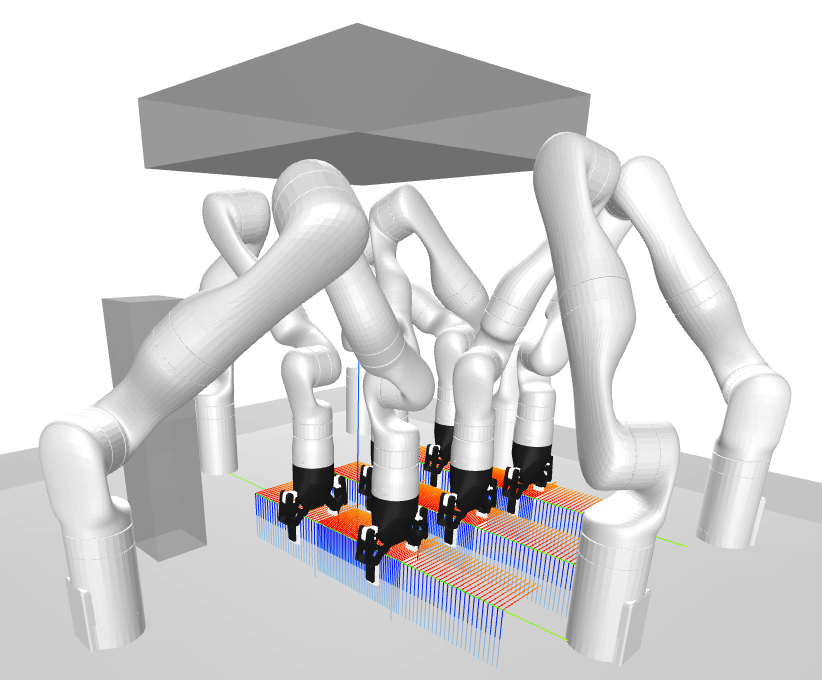
Learned manipulation policies increasingly predict motions for abstract "hands" and are attractive in practice because they rely on easily collected demonstrations and transfer across robot platforms. Executing these trajectories on multi-arm robots, however, is not trivial. Multi-hand policy outputs must be assigned to physical arms, each arm must realize a configuration-space motion that tracks its prescribed end-effector trajectory, and all arms must respect kinematic limits and avoid collisions. In the absence of algorithms that directly address this problem, practitioners typically extend single-arm inverse-kinematics (IK) pipelines in an ad hoc way, with no guarantees of feasibility or safety. In this work, we close this execution gap with a search-based framework that is theoretically complete for grounding policy-generated multi-hand trajectories onto physical multi-arm systems. Building on Conflict-Based Search, our method explicitly searches over both the discrete assignment of trajectories to arms and the continuous Jacobian null spaces of redundant manipulators, using redundancy to avoid inter-arm collisions while tracking the prescribed motions. This unified treatment of assignment and null-space motion yields a practically efficient planner that safely realizes coordinated manipulation-policy outputs on multi-arm robots. See omcbsa.github.io for more.
Ω-CBSA: Embodying Multi-Hand Manipulation Policies by Searching the Assignment and Null Spaces
Authors: Yorai Shaoul, Jiaoyang Li, Maxim Likhachev | Institution: Carnegie Mellon University | arXiv: 2607.22020v1 | Project: omcbsa.github.io
One-Sentence Summary
This paper introduces Ω-CBSA (On-Manifold Conflict-Based Search with Assignments), a search-based framework that jointly searches over the discrete assignment of trajectories to arms and the continuous Jacobian null-space motions of redundant manipulators to safely and completely ground learned multi-hand manipulation policy outputs onto physical multi-arm robots.
Background and Motivation
Modern manipulation policies (e.g., π₀, ACT) increasingly output end-effector trajectories rather than joint commands, making demonstrations easy to collect and enabling cross-platform transfer. However, in multi-arm settings, a critical execution gap arises: policies do not specify which arm should execute each motion, nor how multiple manipulators should coordinate to avoid collisions while leveraging redundancy.
In current practice, engineers extend single-arm IK pipelines ad hoc to multi-arm systems, with no guarantees of feasibility or safety. Standard single-arm IK-tracking fails in multi-arm settings even when feasible realizations exist, because it commits early to one configuration-space trajectory and cannot explore redundant configurations on the manifold that might avoid collisions later.
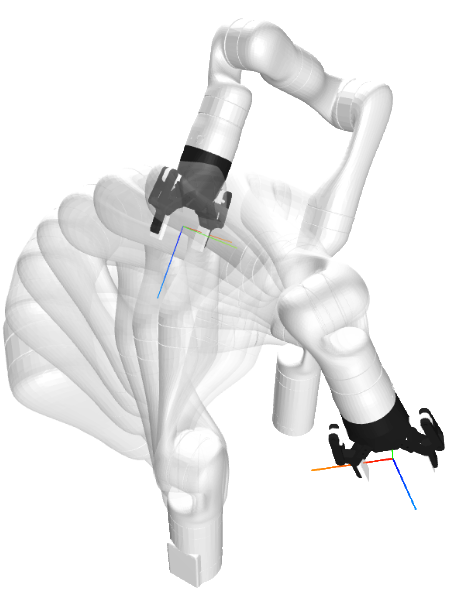
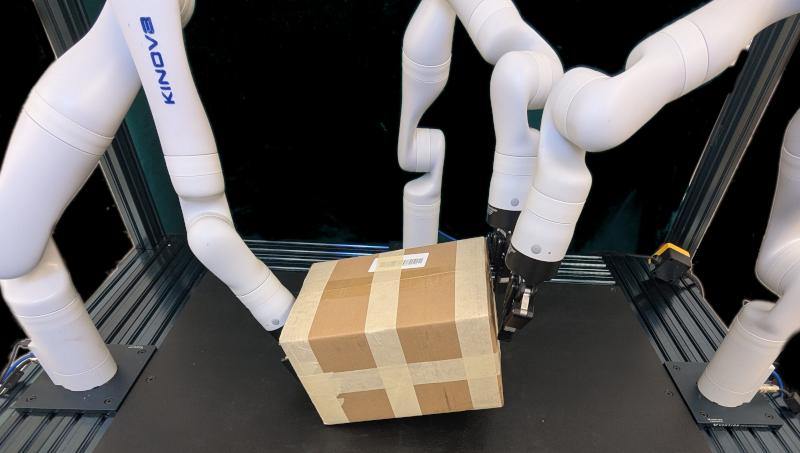
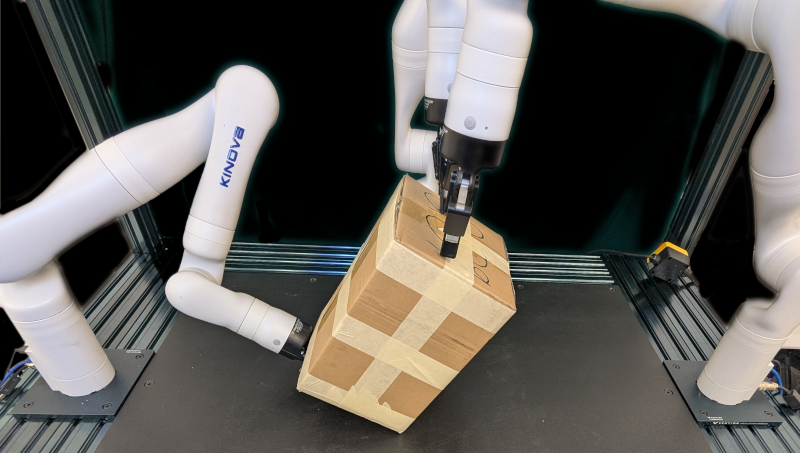
Figure 1: Left — the redundancy manifold $\mathcal{M}$ with multiple configurations $q$ sharing the same end-effector pose $FK(q)=x$; Right — three arms collaboratively flipping or pushing objects.
The paper formalizes this as OM-AMRAMP (On-Manifold Anonymous Multi-Robot-Arm Motion Planning). The core challenge lies in simultaneously handling three types of decisions: (1) the bijection $\sigma$ assigning $N$ trajectories to $N$ arms; (2) each arm's configuration-space motion on the redundancy manifold; (3) avoiding inter-arm and obstacle collisions.
Problem Formulation (OM-AMRAMP)
Consider $N$ manipulators $\{R^i\}_{i=1}^N$, each with $d$ joints and configuration space $\mathcal{Q}_R^i \subset \mathbb{R}^d$. The forward-kinematics map $FK^i: \mathcal{Q}_R^i \rightarrow SE(3)$ maps configurations to end-effector poses. The input is $N$ end-effector trajectories $X^j = \{x_1^j, \dots, x_H^j\}$ with $x_t^j \in SE(3)$.
The goal is to find a bijection $\sigma: \{1,\dots,N\} \to \{1,\dots,N\}$ and configuration-space trajectories $\tau^i = \{\tau_1^i, \dots, \tau_H^i\}$ satisfying:
$$FK^i(\tau_t^i) = x_t^{\sigma(i)}, \quad R^i(\tau_t^i) \cap R^k(\tau_t^k) = \emptyset, \quad R^i(\tau_t^i) \cap \mathcal{O} = \emptyset$$where $R^i(q^i) \subset \mathbb{R}^3$ is the workspace volume occupied by arm $i$ at configuration $q^i$, and $\mathcal{O} \subset \mathbb{R}^3$ is the static obstacle region.
Method Details
1. Jacobian Null Space and Redundancy Exploration
For redundant manipulators with more than six joints, $FK(q) = x_t$ admits infinitely many solutions, forming a low-dimensional manifold:
$$\mathcal{M}_t = \{q \in \mathcal{Q}_R \mid FK(q) = x_t\}$$Numerical IK returns only a single solution determined by its seed, unable to explore other configurations on $\mathcal{M}_t$ that might avoid collisions. This work exploits the Jacobian null space for systematic manifold exploration. At configuration $q$, the null space $\mathrm{Null}(J(q))$ consists of all joint-space directions that leave the end-effector pose unchanged:
$$\Delta q = N(q)\,\alpha$$where $N(q)$ is a basis matrix for the null space and $\alpha$ is a small coefficient vector. These null-space motions provide systematic "neighbors" on the constraint manifold.
2. Ω-A* (Single-Trajectory Variant)
Ω-A*$_\text{single}$ performs A* search directly on the pose-constraint manifold induced by a single end-effector path. States are $s = (q, t)$ with $FK(q) = x_t$. The Open list is initialized with multiple IK solutions for $x_1$. Each state stores cost-to-come $g(s)$, heuristic $h(s) = H - t$, collision count $c(s)$, and priority:
$$f(s) = g(s) + w_h\,h(s) + w_c\,c(s)$$Successors from $(q, t)$ are generated by first computing a nominal projection $q' = IK(x_{t+1}, q)$, then exploring redundant realizations via null-space motion: for each basis direction $n \in N(q')$ and step size $\pm\epsilon$, proposing $q'' = q' + \epsilon n$ followed by a correction $q'' \leftarrow IK(x_{t+1}, q'')$. Parameters: $\epsilon = 0.2, w_h = 10, w_c = 0.1$.
3. Ω-A* (Multi-Goal Variant)
To handle settings where a robot can choose among multiple trajectories $\{X^1, \dots, X^M\}$, the multi-goal Ω-A* initializes Open with IK solutions for the first pose of every candidate trajectory. States become $(q, t, j)$, encoding a timed configuration tracking $X^j$. Assignment decisions are handled implicitly — the planner determines both which trajectory to embody and how to track it during search.
4. Prioritized Planning (OM-PP-A*)
A simple multi-arm coordination approach: robots are ordered by priority and planned sequentially. Higher-priority robots plan first; subsequent robots treat previously planned trajectories as moving obstacles. Produces OM-PP-A* and OM-PP-A*$_\text{single}$, which are efficient but incomplete.
5. Ω-CBSA: The Core Algorithm
Ω-CBSA integrates multi-goal Ω-A* into the Conflict-Based Search (CBS) framework. Initial trajectories are planned for each robot; these may contain two types of conflicts:
- Assignment conflicts: two robots select the same trajectory $X^j$
- Geometric conflicts: two robots collide at time $t$
Ω-CBSA organizes the search in a constraint tree (CT). Each CT node contains: (1) per-robot constraints; (2) trajectories computed under constraints using Ω-A*; (3) detected conflicts. Each iteration selects the CT node with the fewest conflicts; if none, the solution is returned. Otherwise, one conflict is resolved by generating two child nodes, each adding a different constraint and replanning one robot.
For assignment conflicts, one child forbids $R^i$ from selecting $X^j$, the other forbids $R^k$. For geometric conflicts, a collision point $p$ is selected, and one child forbids $R^i$ from occupying $p$ at time $t$, the other forbids $R^k$.
The cost of each CT node is defined as the sum of all robot trajectory costs plus a conflict penalty:
$$ \text{cost}(n) = \sum_{i=1}^{N} g(\tau^i) + \lambda \cdot |\text{conflicts}(n)| $$where $g(\tau^i)$ is the cost of robot $R^i$'s trajectory, $|\text{conflicts}(n)|$ is the number of conflicts in node $n$, and $\lambda$ is the conflict penalty weight. Ω-CBSA expands the CT node with the lowest cost at each iteration.
flowchart TD
    A["Initialize: plan trajectories for each robot using Ω-A*"] --> B["Select CT node with fewest conflicts"]
    B --> C{"Any conflicts?"}
    C -- "No conflicts" --> D["Return solution"]
    C -- "Has conflicts" --> E["Select one conflict"]
    E --> F{"Conflict type?"}
    F -- "Assignment" --> G["Generate two children:
forbid Ri from Xj / forbid Rk from Xj"]
    F -- "Geometric" --> H["Generate two children:
forbid Ri at p@t / forbid Rk at p@t"]
    G --> I["Replan constrained robot using Ω-A*"]
    H --> I
    I --> B
Theoretical Analysis: Resolution-Completeness
Ω-CBSA adopts a finite-resolution discrete-time abstraction with motion primitives. The paper proves resolution-completeness.
Lemma 1 (Resolution-Completeness of Ω-A*): If a feasible pose-constrained trajectory $\tau^i$ following a fixed path $X^j$ exists for robot $R^i$ under motion-primitive discretization, then Ω-A* will find it. Proof: Ω-A* searches a finite graph whose nodes are triples $(q, t, j)$, systematically exploring all reachable nodes.
Lemma 2 (Mutual Disjunctiveness of Constraints): The assignment and geometric point constraints in Ω-CBSA are mutually disjunctive. For an assignment conflict where $R^1$ and $R^2$ both select $X^j$, constraints $c^1 = \{R^1 \text{ may not select } X^j\}$ and $c^2 = \{R^2 \text{ may not select } X^j\}$ are generated. Any joint solution violating both necessarily assigns $X^j$ to both robots, contradicting the bijection requirement of $\sigma$.
Theorem 1 (Resolution-Completeness of Ω-CBSA): By Lemma 2, all constraints are mutually disjunctive; by Lemma 1, the low-level planner Ω-A* is resolution-complete. Since CBS with a complete low-level planner and mutually disjunctive constraints is complete, Ω-CBSA is resolution-complete for OM-AMRAMP.
Experimental Results
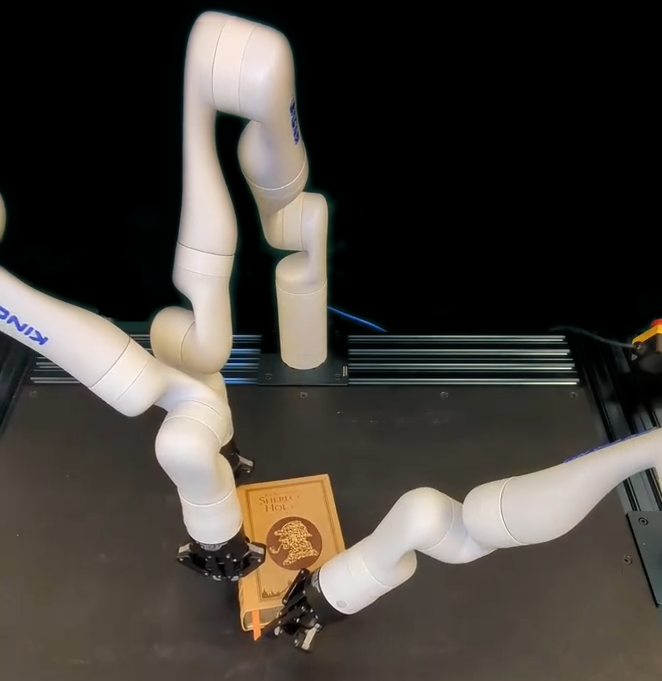
The experiments simulated 450 benchmark problems with up to six end-effector trajectories and robots in diverse layouts with obstacles. The test suite included motions resembling learned manipulation-policy outputs and humanoid-inspired setups requiring tight coordination. Physical demonstrations on a 3-arm platform included cloth rotation, box flipping, and planar pushing.
| Method | Type | Completeness | Characteristics |
|---|---|---|---|
| IK-Tracking | IK tracking | Incomplete | Enumerates all assignments; fast but myopic; low success rate |
| PP-Descartes | Pose-constrained roadmap | Incomplete | Enumerates assignments and priorities; costly roadmap construction |
| Composite A* | Implicit graph search | Complete | State space grows exponentially with robot count |
| Ω-CBSA | CBS + manifold search | Resolution-complete | Joint assignment and null-space search; highest success rate |
| OM-PP-A* | Priority + manifold | Incomplete | Favorable speed-performance tradeoff |
Across all 450 benchmarks, the proposed methods consistently outperformed all baselines in success rate. Ω-CBSA achieved the highest overall success, followed closely by prioritized variants OM-PP-A* and OM-PP-A*$_\text{single}$. Disaggregated by robot count, the gap widens as the number of arms increases.
| Metric | Ω-CBSA | IK-Tracking | Notes |
|---|---|---|---|
| 2-robot avg. planning time | ~150 ms | ~160 ms | IK faster but low success |
| All-benchmark avg. runtime | ~640 ms (σ=990) | — | min 16ms, max 4.9s |
| Prioritized variants | <1s for most | — | Good speed-performance tradeoff |
Descartes suffered from costly roadmap construction. Composite A* struggled due to exponential branching factor growth with assignments. IK-Tracking was fastest when it succeeded (~160ms) but its low success rate limited practical utility.
Implementation: Pinocchio for kinematics, Kinova Gen3 arms, Intel Core i9-12900H CPU (5.2 GHz). Root CT nodes were warm-started with repeated IK-tracking (capped at 500ms), producing initial trajectories with fewer collisions without affecting theoretical guarantees.
Physical Experiments
Physical 3-arm demonstrations of cloth rotation, box flipping, and planar pushing validated Ω-CBSA's feasibility on real multi-arm systems.
Limitations
- Resolution-completeness depends on motion-primitive discretization; higher resolution increases search space and computational cost.
- The null-space step size $\epsilon$ and weights $w_h, w_c$ require tuning for different robot platforms.
- Only validated up to six robots; scalability to larger systems needs further study.
- Reaching the initial configuration $\tau_1^i$ relies on standard multi-arm motion planners, not unified within this framework.
Conclusion and Outlook
This work introduced Ω-CBSA, a theoretically complete planner for embodying multi-hand manipulation policies on multi-arm robots. By combining on-manifold single-robot planning with a CBS-based coordination scheme, the method systematically reasons about redundancy, collisions, and assignments. Experiments with up to six arms show that Ω-CBSA and its prioritized variants achieve higher success rates than IK, sampling-based, and implicit graph-search baselines while maintaining real-time performance.
Key insight: "We hope this work will lower the practical barriers associated with deploying multi-hand manipulation policies." — By unifying assignment and null-space search, Ω-CBSA provides a theoretically complete and practically efficient bridge from learned manipulation policies to real multi-arm deployment.
Deep analysis generated by RobotWorld paper-detail-generator based on full-text reading | arXiv:2607.22020v1
SOURCE LINKS