PAPER DEEP DIVE
Design and Human Evaluation of Tactile Withdrawal Reflexes for a Skin-Covered Robot Arm
Nociception is a protective biological mechanism that links harmful stimulation to a reaction. This paper investigates artificial nociception for a robotic arm with whole-body tactile sensing. We present a complete pipeline that maps pressure changes from sensitive skin on a robot manipulator to bio-inspired withdrawal motions. The system first converts skin pressure into a scalar pain gain using a nonlinear continuous model. We compare three reflexes: (i) uniform reflex moves four robot joints by a fixed amount, whereby the withdrawal is approximated by a movement of the arm "toward the base", independent of where the robot was touched; (ii) biologically motivated location-dependent joint-space withdrawal derived from human withdrawal reflex characteristics; (iii) Cartesian space withdrawal along the surface normal of the contacted skin pad. All behaviors are integrated in a reflex controller that interrupts the task, executes the withdrawal, and returns to a pre-contact pose. A user study with 15 participants compared the strategies using Godspeed questionnaire subscales, custom perceived-naturalness and safety items, forced-choice comparisons, and qualitative feedback. Interestingly, participants rated more highly the uniform reflex behavior over one or both competitors on the anthropomorphism, animacy, and likeability Godspeed subscales and on the Naturalness and Realism custom scale. When asked to compare the conditions, the uniform reflex was scored best in "felt safest", "most human-like", and "most natural". This suggests that predictability of the robot behavior is key for user acceptance. The Cartesian reflex was judged the most appropriate reaction to touch. The bio-inspired reflex did not lead any evaluated measure. This may be partly attributed to the embodiment gap between the robot arm and human arm and participants having different expectations from a robot manipulator.
Design and Human Evaluation of Tactile Withdrawal Reflexes for a Skin-Covered Robot Arm
Paper: Design and Human Evaluation of Tactile Withdrawal Reflexes for a Skin-Covered Robot Arm
Authors: Laura Babayeva, Lukas Rustler, Matej Hoffmann (Czech Technical University in Prague)
Link: arXiv:2607.22249 | Platform: UR10e + AIRSKIN whole-body tactile skin | Code: humanoids-ctu.github.io/Nociceptive-Reflexes
One-line summary: On a UR10e arm covered with whole-body tactile skin, skin pressure changes are mapped to a scalar pain gain, and three withdrawal strategies (uniform, location-dependent, Cartesian) are compared. A 15-participant user study finds that the most predictable uniform reflex scores highest on anthropomorphism and naturalness, while the Cartesian reflex is judged the most appropriate touch reaction.
Background and Motivation
More than a century ago, Čapek in R.U.R. imagined robots that, feeling almost no bodily pain, failed to protect themselves from damage. Dr. Gall's remedy was adding pain sensitivity as an automatic protective mechanism. This engineering insight remains strikingly current: robots sharing physical space with people require distributed tactile sensitivity and rapid, intelligible protective responses. Artificial nociception — the detection and encoding of potentially damaging stimulation — rather than subjective pain, is the relevant contemporary construct.
Humanoid and human-centered robots increasingly operate in cluttered environments in close physical contact with people. Safety cannot rely only on distance separation or emergency stops on contact — the robot must interpret collisions and react safely for both humans and robots. Biological pain provides a useful design metaphor: nociception is a protective sensorimotor mechanism where potentially damaging stimuli trigger rapid withdrawal before tissue damage. Prior work covers several links in the tactile-to-reflex chain: Kuehn and Haddadin introduced an artificial robot nervous system; Vorndamme et al. developed a context-sensitive reflex engine. The missing element is not a complete pipeline per se, but a within-platform comparison of three withdrawal mappings with human-centered evaluation.
The core question: how should a robot arm withdraw when touched with different pressure levels at different body regions? This matters for HRI because the same movement can serve both functional safety and communicative roles. A reflex that is mechanically protective but illegible may still feel unsafe; conversely, a predictable and understandable reflex may be preferred even when less faithful to biological joint recruitment.
Method Details
1. Hardware and System
A Universal Robots UR10e 6-axis manipulator is equipped with AIRSKIN whole-body sensitive skin. Ten pads cover the entire robot surface — links covered by two semicylindrical pads, joints by additional pads. Each pad is a closed shell with a compressor and pressure sensor inside, sending one pressure value. The system can detect which pad is touched and the pressure change, but not exactly where on the pad. Pads are grouped into upper-limb analogues: shoulder (yellow), upper arm (green), elbow (blue), forearm (purple), wrist (pink), with 1-3 pads per group. The system runs on ROS Noetic, computing pressure change relative to a no-contact baseline. The robot is controlled in joint position or velocity mode depending on the selected reflex.
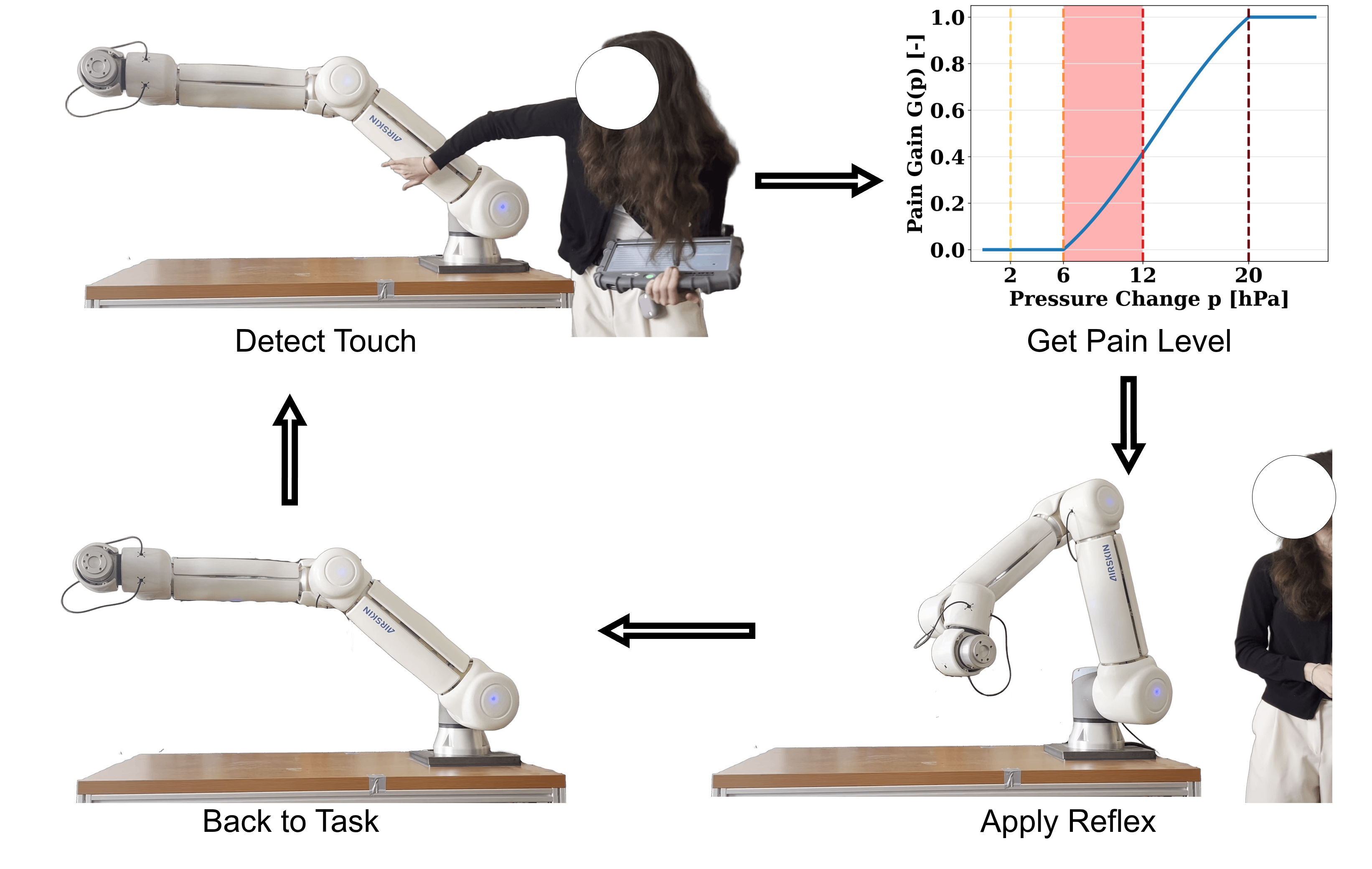
Figure 1: Pipeline schematic. The robot performs a task, detects touch, estimates pain gain G(p), executes a reflex, and returns to the pre-contact pose.
2. Pressure-to-Pain Gain Mapping
Let $p$ denote the pressure change from a non-touch baseline. The controller outputs a scalar gain $G(p)\in[0,1]$, where $G(p)=0$ means no withdrawal and $G(p)=1$ means full withdrawal. The discrete pain model is based on Serrao et al.: Pain Levels 1-2 produce no measurable movement ($G_d(p)=0$), PL 3 is a mild reflex ($G_d(p)=0.35$), PL 4 is full withdrawal ($G_d(p)=1$):
$$G_{d}(p)=\begin{cases}0,&p<2\ \text{hPa}\\0,&2\leq p<6\ \text{hPa}\\0.35,&6\leq p<12\ \text{hPa}\\1,&p\geq 12\ \text{hPa}\end{cases}$$
The continuous pain model uses a sigmoid centered at 0.5 to capture the graded nonlinear nature of biological pain:
$$\sigma(x;k)=\frac{1}{1+e^{-k(x-0.5)}},\quad \sigma_{s}(x;k)=\frac{\sigma(x;k)-\sigma(0;k)}{\sigma(1;k)-\sigma(0;k)}$$
with steepness $k=3$. The continuous model piecewise interpolates within each PL range, ensuring boundary continuity:
$$G(p)=\begin{cases}0,&p<6\ \text{hPa}\\0.35\cdot\sigma_{s}\!\left(\frac{p-6}{6};k\right),&6\leq p<12\ \text{hPa}\\0.35+0.65\cdot\sigma_{s}\!\left(\frac{p-12}{8};k\right),&12\leq p<20\ \text{hPa}\\1,&p\geq 20\ \text{hPa}\end{cases}$$
3. Three Withdrawal Reflexes
Human upper-limb joints are mapped to the manipulator: shoulder internal rotation/adduction to base and shoulder joints ($J_b, J_s$), elbow flexion to elbow joint ($J_e$), wrist movements to wrist joints. The maximum displacement vector is extracted from human range-of-motion literature:
$$\mathbf{q}_{\max}=[40°, 70°, 146°, 73°, 0°, 0°]^{T}$$
Uniform Reflex (UR): applies a fixed increment to the first four joints regardless of touch location, corresponding to $G(p)=0.5$:
$$\mathbf{q}_{\text{ref}}=\frac{1}{2}\mathbf{q}_{\max}=[20°, 35°, 73°, 36.5°, 0°, 0°]^{T}$$
Location-dependent Reflex (LR): biologically inspired joint-space behavior scaling maximum displacement by pain gain and a location-dependent weight matrix:
$$\mathbf{q}_{\text{ref}}=G(p)\,\mathbf{W}(p,\ell)\,\mathbf{q}_{\max}$$
where $\ell$ is the activated body region and $\mathbf{W}(p,\ell)$ contains per-joint weights selected from upper-limb NWR literature. The reflex is dominated by shoulder adduction and elbow flexion, with base and wrist involvement depending on contact location.
Cartesian Reflex (CR): an engineering solution using the manipulator Jacobian to move the contacted pad along its surface normal away from contact. Let $\mathbf{n}$ be the activated pad normal in the robot base frame:
$$\mathbf{v}_{c}=-v_{\max}\,G(p)\,\mathbf{n}$$
Joint velocities are computed via resolved-rate control:
$$\dot{\mathbf{q}}_{\text{ref}}=\mathbf{J}^{\dagger}(\mathbf{q})\begin{bmatrix}\mathbf{v}_{c}\\\mathbf{0}\end{bmatrix}$$
where $\mathbf{J}^{\dagger}$ is the Jacobian pseudoinverse. Joint velocities are streamed for a fixed reflex duration (0.5 s).
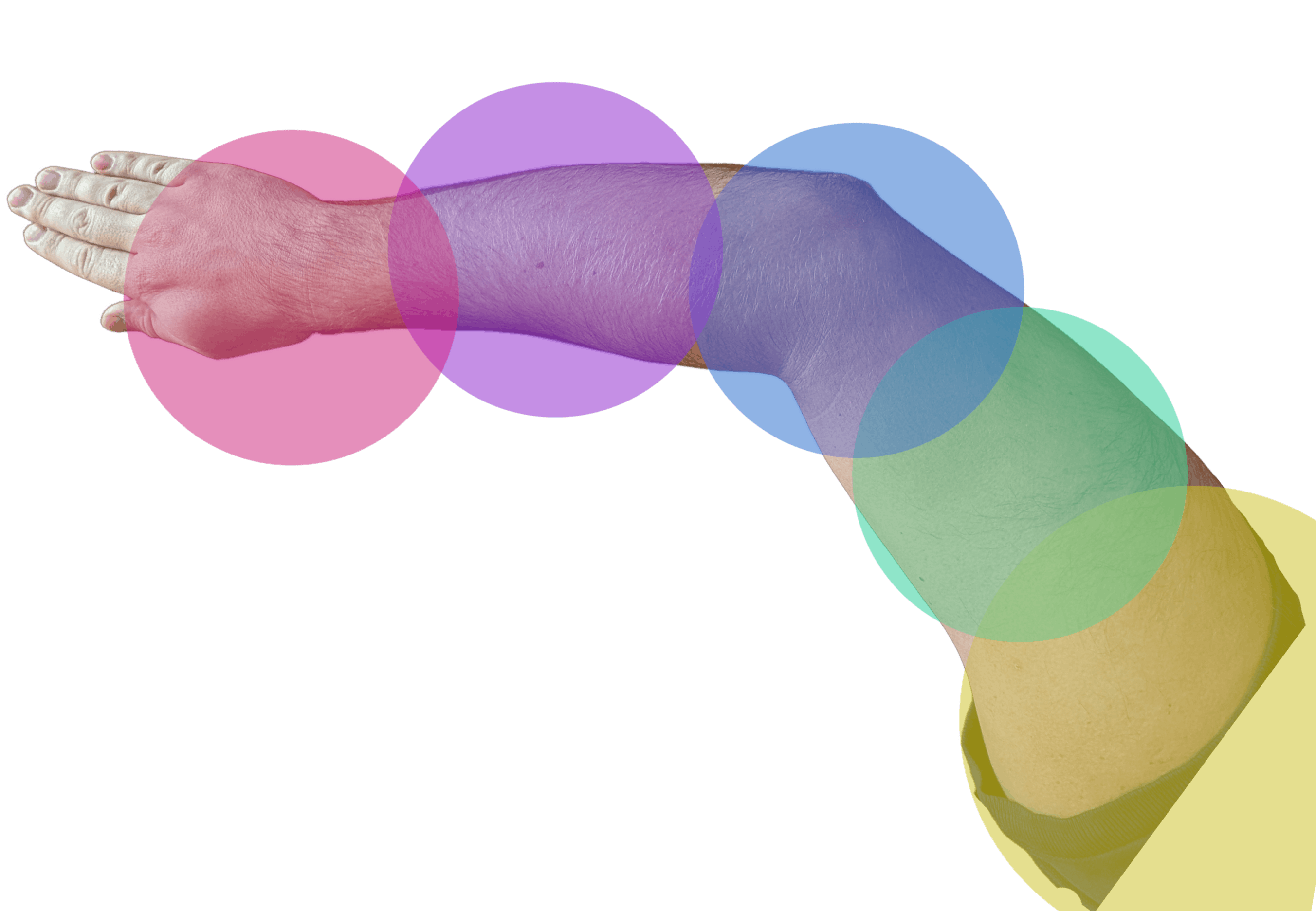
Figure 2: Three reflex types illustrated. G(p)=1. Grey is the initial pose, colored circles indicate touch points, colored robots show corresponding reflexes.
4. State Machine Controller
Reflex behaviors are integrated in a finite-state machine with three states: TASK (task execution), REFLEX (reflex execution), RETURNING (return). In TASK, the robot executes a predefined trajectory while continuously sensing skin data. When nonzero pain gain is detected, the robot saves the current pose, pauses trajectory execution, and switches to REFLEX — if a new or stronger contact occurs during REFLEX, the trajectory and duration can be updated. After execution, it switches to RETURNING, returns to the saved configuration, and continues TASK.
graph TD
  A[TASK: execute trajectory + sense skin] -->|nonzero pain gain detected| B[save current pose]
  B --> C[REFLEX: execute withdrawal]
  C -->|new contact?| C
  C -->|reflex complete| D[RETURNING: return to saved pose]
  D --> A
  style C fill:#f5a623,stroke:#b97316,color:#fff
  style A fill:#4a90d9,stroke:#2c5f8a,color:#fff
  style D fill:#7ed321,stroke:#4a8a14,color:#fff
Experimental Results
User Study Design
15 participants (8 male, 7 female; ages 20-51, median 26) participated in a within-subjects study. In each condition, the robot executed the same trajectory (∞ sign boundary), and participants touched the color-changing skin pad with one finger at varying pressure levels. Three conditions (UR, LR, CR) were counterbalanced across three orders, 5 participants per order, each condition ~5 minutes with at least 10 touches. After each condition, participants completed questionnaires; after all conditions, forced-choice comparisons and open-ended questions. Friedman tests and Wilcoxon signed-rank post-hoc tests were used.
Godspeed Scale Results
| Subscale | UR | LR | CR | Significance |
|---|---|---|---|---|
| Anthropomorphism | Highest | Second | Lowest | UR>CR***, UR>LR* |
| Animacy | Highest | Second | Lowest | UR>CR** |
| Likeability | Highest | Second | Lowest | UR>CR* |
| Perceived Safety | ≈ | ≈ | ≈ | No significant diff |
The Uniform Reflex (UR) scored highest in Anthropomorphism, Animacy, and Likeability, with significant differences versus CR in all three and versus LR in Anthropomorphism. Perceived Safety showed almost no difference across reflexes.
Custom Scales and Comparative Questions
| Body Region | Spinal Segments | Dominant Muscle Activation | Resulting Movement |
|---|---|---|---|
| Shoulder | C5-C6 | Anterior deltoid activation/posterior inhibition | Shoulder anteflexion, abduction/adduction, internal rotation, elbow flex |
| Upper arm | C5-C7 | Biceps/brachioradialis activation, triceps inhibition | Elbow flexion, minor shoulder flexion |
| Elbow | C5-C7 | Biceps brachii and brachioradialis activation | Elbow flexion |
| Forearm | C5-T1 | Pronators/supinators depending on stimulus location | Forearm pronation/supination with elbow flex |
| Wrist and hand | C5-T1 | Wrist flexor activation, extensor inhibition | Wrist adduction/abduction with wrist and elbow flex |
Custom scales showed UR was perceived as more natural (significantly different from LR) and safe, but its speed/trajectory was not perceived as proportional to touch. LR had the highest variance across all subscales. In forced-choice comparisons, UR received the most votes for "most human-like" and "most natural" (leading by 1 and 2 votes respectively), and led by 7 votes for "safest" — suggesting this simple reflex may be best for HRI. As the most appropriate touch reaction, participants selected CR (leading by 1 vote).
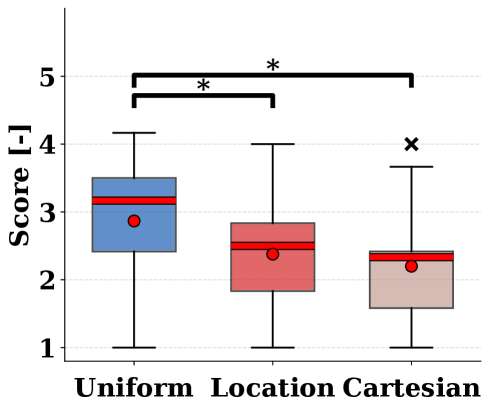
Figure 3: Custom scale Likert scores. UR scores higher on naturalness and safety; LR has the highest variance.
Qualitative Feedback
Open-ended feedback was consistent with quantitative results. UR feedback was dominated by predictability and controllability — participants reported the robot's action was easy to learn, making the interaction feel safer, though some described the motion as repetitive or less expressive. LR feedback was polarized: some interpreted variability as more lifelike, others as uncertainty. The most important criticism was directional — in certain postures, the selected joint combination could cause part of the robot to move toward the participant while another part withdrew. CR was easier to explain after observation — participants recognized the touched pad moving away from contact. However, participants were mainly concerned about the motion and velocity profiles — the behavior was perhaps too abrupt and brief. A smoother and longer movement could be better perceived.
Limitations
Author-stated: AIRSKIN sends data at ~25Hz, sufficient for responsive behavior, but pressure-to-force mapping is difficult — it depends not only on touch force but also on contact area, robot velocity, and touch location, so the same touch could result in different pain gains.
Analysis: The biologically inspired LR did not lead any evaluated measure, partly attributable to the embodiment gap between the robot arm and human arm and participants' different expectations from a robot manipulator. LR in certain configurations could cause the touched pad to move toward rather than away from contact — an inherent limitation of joint-space reflexes, while CR always moves the contacted surface away, making physical safety more important than perceived safety in physical HRI. CR is also more transferable across morphologies than a manually chosen joint-weight table. The 15-participant sample size means small differences in forced-choice comparisons (1-2 votes) should be interpreted cautiously. AIRSKIN's closed-pad design cannot locate the exact touch position on a pad, limiting location-dependent reflex precision. The study was only on UR10e; generalization to different morphologies (e.g., humanoid robots) is unverified.
Conclusion and Outlook
The core finding is that predictability is key for user acceptance — the baseline uniform reflex scored highest in anthropomorphism, naturalness, and safety due to predictability and controllability, while the most biologically inspired location-dependent reflex did not lead any measure. This challenges the "more biologically inspired is better" intuition, showing that in HRI, movement legibility and consistency matter more than biological fidelity. The Cartesian reflex was judged the most appropriate reaction because it always moves away from contact, making it physically safer than joint-space reflexes and more transferable across morphologies. Pressure-to-force mapping difficulty and skin data frequency limitations expose current tactile skin technology shortcomings — higher-resolution and faster-response skins would improve pain gain estimation reliability. Future work plans to repeat experiments on different robot morphologies or introduce recorded human motions or motion retargeting frameworks. The complete artificial nociception framework implementation and controlled user study provide an empirical foundation for tactile reflex design in safe HRI.
The value of a robot reflex lies not in how biological it is, but in how predictable it is — when humans can learn and anticipate the robot's withdrawal direction, a sense of safety is truly established. Legibility beats biological fidelity; this is the core lesson of HRI reflex design.
SOURCE LINKS