PAPER DEEP DIVE
Physical AI Governance: From Theory to Practice Across Life Cycle
With the emergence of Physical AI, artificial intelligence is extending beyond screen-based applications to embodied systems that perceive, interact with, and act in the physical world. Unlike traditional AI, Physical AI operates under real-time safety constraints, continuously interacts with dynamic environments, and coexists with humans, introducing governance challenges that existing AI governance frameworks do not explicitly address. This paper presents a comprehensive survey of Physical AI governance from both scientific and operational perspectives. We synthesize existing governance principles and organize them into a unified governance framework tailored to physical AI systems. Building on this foundation, we propose a five-stage Physical AI lifecycle comprising research, design, data, model development, and deployment, and demonstrate how governance can be operationalized across each stage through concrete implementation practices. By connecting governance principles with engineering workflows, this survey provides a structured reference for researchers, developers, and policymakers to build Physical AI systems that are safe, trustworthy, and aligned with societal values.
Physical AI Governance: From Theory to Practice Across the Life Cycle
arXiv:2607.22877 | Domain: Physical AI governance/survey | Keywords: Physical AI life cycle, physical AI governance
One-Sentence Summary
This survey proposes a Physical AI governance framework P-Gov (five principles: Robust & Safe Operation, Human-Centered Values, Integrity/Privacy/Equity, Accountability & Oversight, Sustainability) and an end-to-end life cycle E-PAL (Research, Design, Data, Model, Deployment), translating high-level governance principles into concrete stage-specific engineering practices, organized via a three-tier life-cycle framework (Fundamental, Knowledge Generation, Building/Operation).
Background and Motivation
Physical AI refers to physics-aware intelligent systems that perceive, learn, reason, and plan to enable or augment actions in the physical world. The concept traces to Wiener's 1940s cybernetics and the 1960s Shakey robot, gaining mainstream recognition since 2024 with embodied intelligence, world models, and physics-grounded reasoning. Physical AI extends AI beyond digital environments into the physical world, enabling human-made agents to operate in unstructured real-world environments with an intelligent brain and body; it also marks the transformation of robots from deterministic pre-programmed machines into intelligent systems that perceive, reason, and act.
Robotics history divides into three generations: first (1950-1970) playback/programmable robots with fixed repeated motions and no sensory feedback; second (1970-2000) sensory and adaptive capabilities via vision/force/tactile sensors within fixed if-then rule systems; third (2010-present) intelligent autonomous robots leveraging AI to plan, learn from experience, and generalize beyond original programming. Physical AI enables two major capabilities: improving robotics robustness and performance, and letting AI systems better understand and interact through actual physical touch.
Yet current governance approaches are largely developed for digital AI systems and do not explicitly account for embodiment, physical safety, lifecycle adaptation, or human-machine interaction. Documented incidents reveal critical challenges: in July 2025 a Unitree H1 humanoid lost control during testing due to control-system malfunction; a lawsuit alleged Figure AI humanoids could generate impact forces more than double those required to fracture an adult human skull; an autonomous taxi dragged a pedestrian after misclassifying the situation. These cases show Physical AI failures are not limited to single-point breakdowns, and physical consequences are immediate—making failures, unintended behaviors, and ethical concerns substantially more severe than in digital AI, reinforcing the need for standardized end-to-end governance.
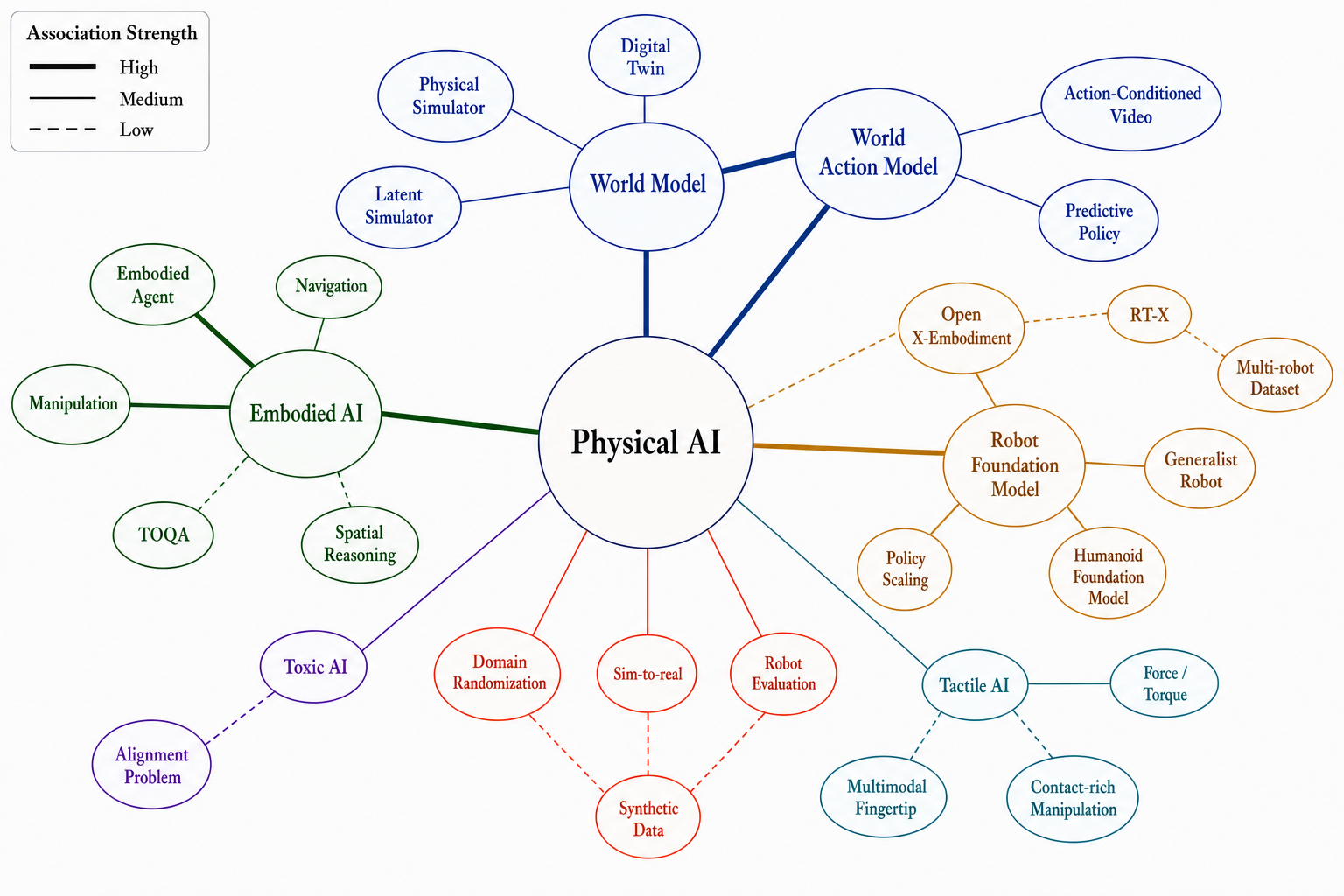
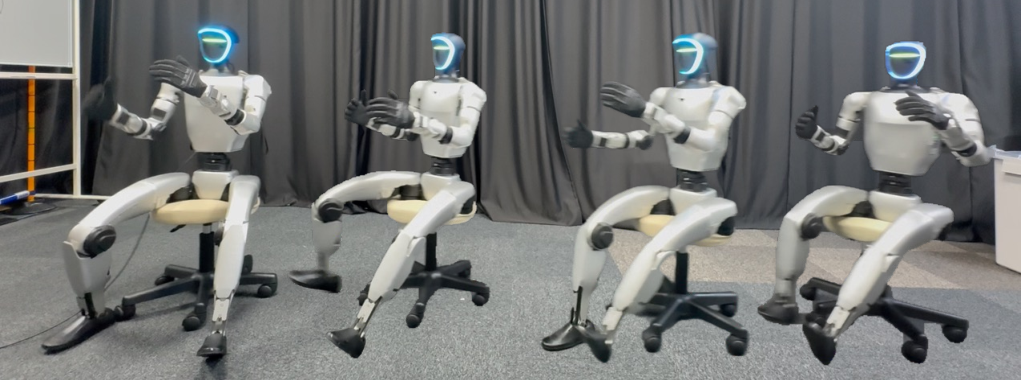
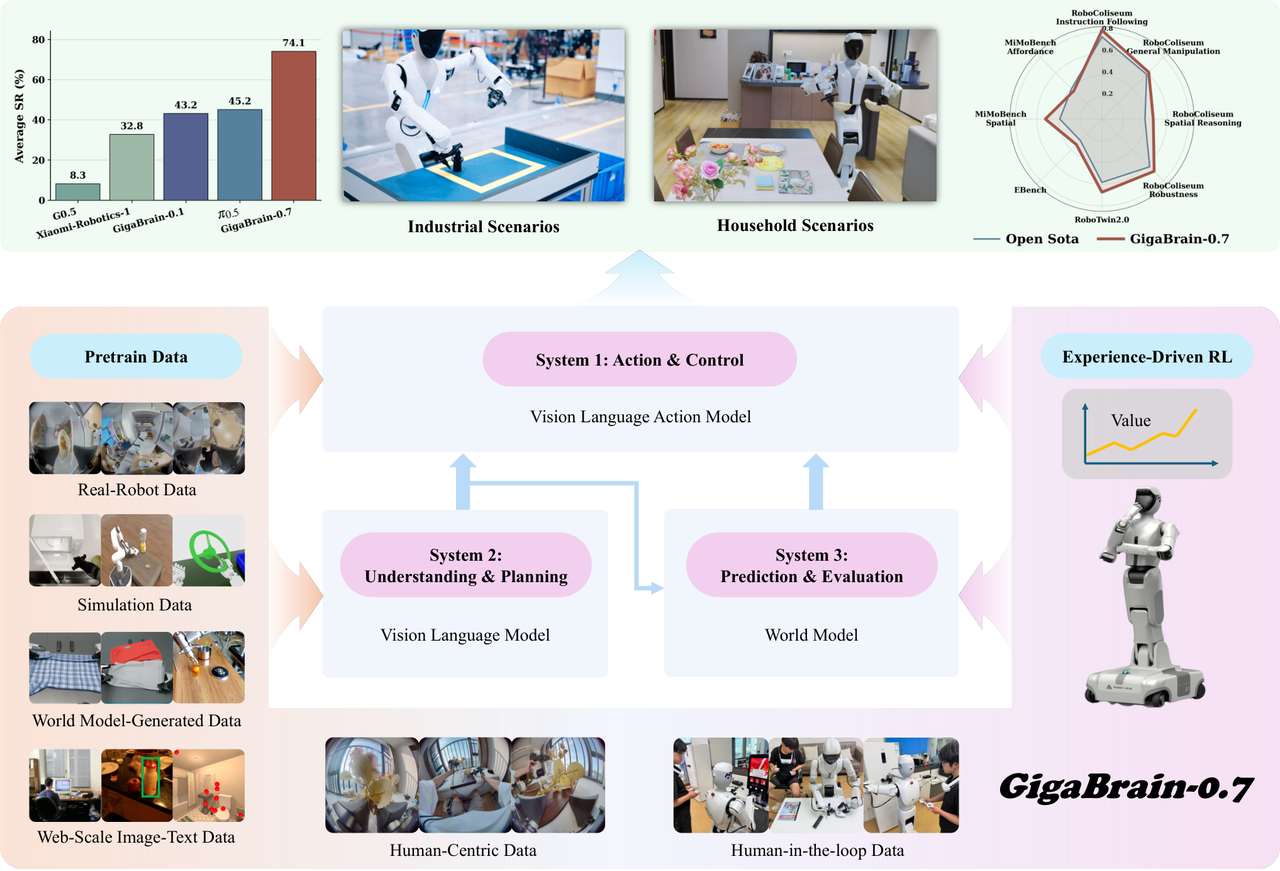
Figure 1: Physical AI is a broader umbrella, emphasizing that robots are beginning to think, plan, and act, with associated models (e.g., world models) or a functional robot "brain" enabling the process.
Governance Framework P-Gov: Five Principles
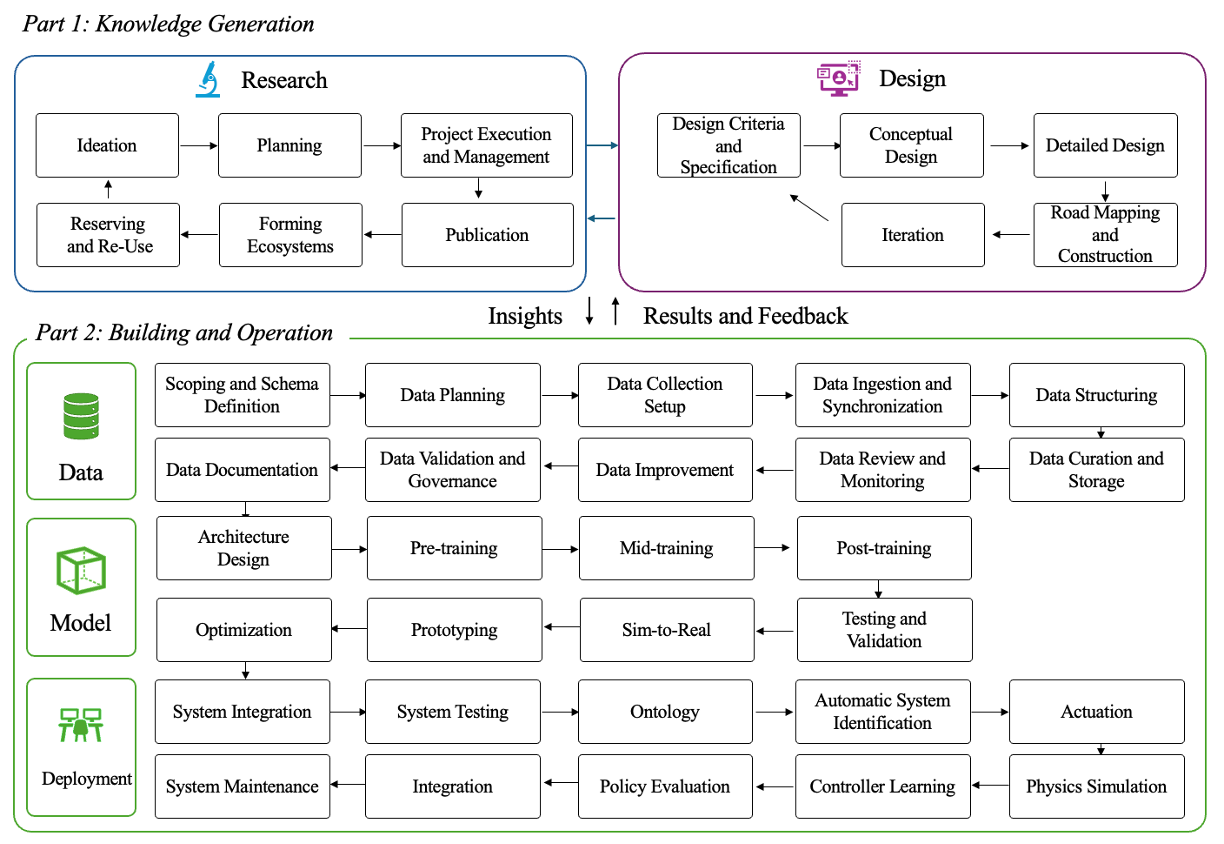
Figure 2: Taxonomy of Physical AI governance principles (PAL-GF)—17 sub-components grouped into five categories, each anchored by representative standards, frameworks, and literature.
P-Gov organizes governance into five fundamental principles, each differing essentially from its conventional-AI counterpart in the Physical AI context:
| Principle | Sub-components | Physical AI-specific Considerations |
|---|---|---|
| Robust & Safe Operation | Robustness/Efficiency/Safety; Stability/Consistency/Reliability; Adaptability | Physical harm risk, real-time safety constraints, continuous adaptation in dynamic environments |
| Human-Centered Values | Human-Centered; Value Alignment; Accessibility | Physical human-robot coexistence, force control, social interaction trust |
| Integrity/Privacy/Equity | Responsible Data; Privacy/Confidentiality; Bias/Representativeness; Fairness | Multimodal sensor data privacy, physical-environment collection compliance |
| Accountability & Oversight | Transparency/Accountability; Control; Copyright/Compliance; Explainability; Auditability | Physical action traceability, accident liability, runtime control authority |
| Sustainability | Resource Efficiency; Circularity | Hardware energy consumption, material circularity, full-life-cycle carbon footprint |
Table 1: P-Gov five principles and their Physical AI-specific considerations—each differs essentially from conventional AI governance once embodiment, physical safety, and continuous human interaction are incorporated.
The Robust & Safe Operation principle is anchored in standards like ISO 10218-1:2025 (industrial robot safety), ISO/TS 15066:2016 (collaborative robots), and ISO 21448:2022 (SOTIF). Physical AI safety is not just information security but physical safety—robot impact forces can directly harm humans, so force limiting, collision detection, and safe stops are mechanisms digital AI governance does not need. Adaptability requires continuous safe operation in dynamic unseen environments, linked to closing the sim-to-real gap and low-latency edge inference.
Formalizing Governance Coverage
A governance system's completeness can be measured by its coverage of life-cycle stages and principles. Let the governance matrix $\mathbf{G} \in \{0,1\}^{S \times P}$, where $S=5$ stages and $P=5$ principles, with $G_{sp}=1$ if principle $p$ is operationalized in stage $s$. The coverage rate is:
$$\text{Coverage}(\mathbf{G}) = \frac{1}{SP} \sum_{s=1}^{S} \sum_{p=1}^{P} \mathbf{1}[G_{sp} = 1]$$
The framework's key assertion: omitting the stage-specific form of a governance element leaves a corresponding governance gap—any zero entry in $\mathbf{G}$ is a risk point. The risk corresponding to a governance gap can be modeled as a weighted sum of gap severities $w_{sp}$:
$$\text{RiskGap}(\mathbf{G}) = \sum_{s,p} w_{sp} \cdot \mathbf{1}[G_{sp} = 0]$$
This provides a basis for quantifying governance maturity—moving from static one-time certification toward adaptive governance that co-evolves with continuously learning systems.
End-to-End Life Cycle E-PAL: Five Stages
E-PAL divides the Physical AI life cycle into two complementary parts: Knowledge Generation (Research + Design) establishes scientific knowledge, engineering principles, and system requirements; Building and Operation (Data + Model + Deployment) operationalizes these through data engineering, model development, system integration, and continuous operation. Deployment feedback informs subsequent research and design, forming a closed-loop life cycle.
Research Stage
Physical AI research follows the scientific method but extends to embodiment and environmental interaction, forming continuous feedback loops. Robotics research increasingly treats software, datasets, simulation environments, and hardware designs as first-class research outputs released alongside publications—open-source code, pretrained models, simulation environments, benchmark datasets, hardware designs, and demo videos—improving reproducibility and accelerating community adoption. Governance elements include reliability, reproducibility, inclusiveness, and generalizability.
Design Stage
Design is not standalone but an iterative process spanning the entire life cycle, with four interconnected phases: design criteria and specification, conceptual design, detailed design, and road-mapping/construction. Physical AI design requires co-design of AI models, software, and hardware rather than independent optimization—AI design determines learning algorithms, perception, reasoning, planning, and control; software design provides system architecture, middleware, communication, and real-time execution; hardware design covers mechanical structure, sensors, actuators, embedded computing, and power. Human-centered design keeps humans in the loop, and for companion/assistive robots must also cover social interaction, user experience, trust, accessibility, and long-term acceptance.
Data Stage
Physical AI data falls into six categories: foundation and human knowledge data; embodied robot experience; synthetic and simulation data; spatial/semantic/reasoning data; evaluation/safety/reliability data; governance and ecosystem data. Different modalities are used at different life-cycle stages with trade-offs: web-scale video provides rich visual information and semantic world knowledge but lacks explicit action annotations and physical interaction data, so models trained predominantly on passive video may exhibit poor spatial reasoning. A data pyramid can jointly co-train action-labeled and action-free data for a unified policy.
Model Stage
Physical AI models are organized into five functional aspects (perception, reasoning, control and skill learning, action generation, world modeling), implemented by eight major model families: Vision-Language Foundation Models (CLIP/SigLIP/LLaVA), Visual & Spatial Representation Models (DINOv2/SAM), Robot Foundation Models (Octo/GR00T/$\pi_0$), VLA models, Large Behavior Models, Diffusion/Flow-matching policy models, World Foundation Models (DreamerV3/Genie), and Embodied Reasoning & Planning Models (SayCan/ThinkAct). The model stage progresses from raw data to a functioning learned system: architecture design → pretraining → fine-tuning → post-training → prototyping → sim-to-real transfer → optimization → testing and validation, reflecting a consistent pattern of building general capability first, then progressively specializing, transferring, and hardening.
Deployment Stage
The deployment stage addresses how a trained model is integrated into and maintained within a live physical system, with interconnected phases: system integration, hardware deployment and calibration, safety verification, real-world commissioning, operational monitoring, and continuous maintenance and model updates. Policy evaluation assesses learned behavior under real or near-real conditions; automatic system identification characterizes hardware physical properties (dynamics, friction, mass distribution) for control-policy calibration; ontology provides structured knowledge representation. Deployment shows Physical AI systems require continuous integration of control theory, hardware calibration, and knowledge representation, not a one-time handoff from trained model to running system.
Governance Operationalization: Three-Tier Framework
Operationalizing governance across the life cycle is a continuous iterative process requiring cross-functional coordination. The framework is organized into three tiers: (1) Fundamental—cross-cutting principles spanning every life-cycle stage; (2) Knowledge Generation—Research and Design; (3) Building/Deployment/Operation—Data, Model, Deployment. Governance elements may appear in multiple stages because they are operationalized differently across the life cycle.
Figure 2 (recap): Governance principle taxonomy—fundamental-tier principles cross-cut all life-cycle stages, each operationalized differently per stage.
Operationalization Highlights per Stage
| Tier | Stage | Key Governance Elements | Engineering Practices |
|---|---|---|---|
| Knowledge Gen | Research | Reliability/Reproducibility/Inclusivity/Generalizability | Open-source code/models/datasets, benchmark release |
| Knowledge Gen | Design | Co-design/Human-in-loop/Accessibility | AI-software-hardware co-design, stakeholder feedback |
| Build/Operate | Data | Privacy/Transparency/Traceability/Bias/Fairness | Data provenance, multimodal privacy, representativeness audit |
| Build/Operate | Model | Explainability/Bias audit/Sim-to-real reliability | Explainable policies, bias detection, sim-to-real testing |
| Build/Operate | Deployment | Resilience/Safety assurance/Value alignment/Sustainability | Runtime monitoring, safety verification, continuous maintenance |
Table 2: Governance element operationalization across the three-tier life-cycle framework—the same principle is realized as different engineering practices per stage.
Risk Accumulation Over Time
A unique Physical AI feature is post-deployment continuous learning and updating, making one-time certification insufficient. Let system risk at time $t$ be inherent risk $R_0$ minus the effect of implemented governance controls $C(t)$, plus residual risk from environmental drift $D(t)$:
$$R(t) = R_0 - \alpha \cdot C(t) + \beta \cdot D(t)$$
where $\alpha$ is the governance-control effectiveness coefficient and $\beta$ the environmental-drift risk growth rate. As the system continuously learns, $D(t)$ grows over time, requiring $C(t)$ to grow in sync to keep risk controllable—the mathematical motivation for moving from static certification to adaptive governance.
Data Pyramid Co-Training
The data-stage data-pyramid strategy jointly trains action-labeled data $\mathcal{D}_{ ext{act}}$ with action-free data $\mathcal{D}_{ ext{free}}$. The co-training objective is a weighted sum of both losses:
$$\mathcal{L}_{ ext{co-train}} = \mathcal{L}_{ ext{act}}( heta; \mathcal{D}_{ ext{act}}) + \lambda_{ ext{free}} \mathcal{L}_{ ext{free}}( heta; \mathcal{D}_{ ext{free}})$$
where $\lambda_{ ext{free}}$ controls the contribution of action-free data (typically larger in scale). This lets the model learn world knowledge from large-scale passive observation while learning behavioral policy from limited action annotations—a key to Physical AI data efficiency.
Quantifying the Sim-to-Real Gap
A core model-stage challenge is sim-to-real transfer. Let simulated-domain policy performance be $J_{ ext{sim}}$ and real-domain performance $J_{ ext{real}}$; the gap is:
$$\Delta_{ ext{sim2real}} = |J_{ ext{sim}} - J_{ ext{real}}|$$
System identification and domain randomization reduce $\Delta_{ ext{sim2real}}$ by narrowing the dynamics distribution gap between simulation and reality. The governance framework requires this gap to be quantified and within an acceptable threshold for safety-critical applications—the formal basis of "sim-to-real reliability testing."
Life-Cycle Feedback Closed Loop
From a systems perspective, E-PAL's deployment feedback loop makes governance a dynamic process. Let governance maturity at cycle $k$ be $M_k$, governance improvement from deployment feedback be $\Delta_g(k)$, and governance depreciation from environmental drift be $\Delta_d(k)$:
$$M_{k+1} = M_k + \Delta_g(k) - \Delta_d(k)$$
Sustainable governance requires $\Delta_g(k) \geq \Delta_d(k)$ to hold continuously—governance improvement must keep pace with environmental drift. This recurrence is the mathematical characterization of adaptive governance moving from static certification to dynamic evolution, specifying the sustainability condition of a governance system.
From a systems-design perspective, the three-tier framework's elegance is that fundamental-tier principles cross-cut all stages rather than belonging to any one. This means the same principle (e.g., "explainability") manifests as reproducible experimental design in research, data-provenance documentation in data, explainable policy architectures in model, and runtime decision logs in deployment. This "same principle, multiple operational forms" design ensures governance comprehensiveness (no stage gaps) while acknowledging that different stages need different engineering practices (not one-size-fits-all), reflecting the framework's adaptability to the complex Physical AI life cycle.
From the governance lessons of incident cases, the three accident types map to different governance gaps. The Unitree H1 loss of control corresponds to a "Robust & Safe Operation" gap at deployment—control-system malfunction or testing instability not captured by runtime resilience monitoring. The Figure AI impact-force lawsuit corresponds to a "Human-Centered Values" gap at design—force-limiting and physical safety mechanisms insufficiently constrained in design criteria. The autonomous-vehicle pedestrian-dragging corresponds to an "Accountability & Oversight" gap at deployment—lack of a safe fallback after situation misclassification. These cases show governance gaps are not abstract risks but concrete failures already realized as real harm; the framework's value lies in providing a vocabulary for systematically identifying and filling these gaps.
System Architecture Diagram
flowchart TB
  subgraph Knowledge["Knowledge Generation Tier"]
    R["Research
Reliability/Reproducibility/Generalizability"]
    D["Design
AI-software-hardware co-design"]
  end
  subgraph Build["Building/Operation Tier"]
    DA["Data
6 categories Provenance/Privacy/Fairness"]
    M["Model
8 families Pretrain to Validation"]
    DEP["Deployment
Integration/Calibration/Monitoring/Maintenance"]
  end
  subgraph Found["Fundamental Tier Cross-cutting"]
    P1["Robust & Safe Operation"]
    P2["Human-Centered Values"]
    P3["Integrity/Privacy/Equity"]
    P4["Accountability & Oversight"]
    P5["Sustainability"]
  end
  R --> D --> DA --> M --> DEP
  DEP -- deployment feedback --> R
  Found -.-> R
  Found -.-> D
  Found -.-> DA
  Found -.-> M
  Found -.-> DEP
Limitations
Descriptive rather than causal (author-acknowledged). The framework is descriptive—satisfying each element does not guarantee a well-governed system; omitting the stage-specific form of an element only leaves a corresponding governance gap. It does not claim causal guarantees and needs validation against real development processes.
Lacks stage-specific quantitative metrics (author-acknowledged). The current framework is largely qualitative; future work needs stage-specific and quantitative metrics for each governance element to make governance maturity measurable and comparable.
Adaptive governance not yet realized (author-acknowledged). Systems continuously learn and are updated after deployment, requiring a move from static one-time certification to adaptive governance that co-evolves with systems, but the concrete mechanisms remain an open direction.
Lacks empirical validation as a survey. The framework is based on literature synthesis rather than empirical case studies; its applicability and effectiveness in real Physical AI development projects have not been end-to-end validated. The cited incident cases are illustrative but not a systematic assessment.
Summary and Outlook
As Physical AI moves AI off the screen into embodied systems sharing physical space with people, its failures acquire immediate real-world consequences that existing digital-AI governance frameworks were not designed to contain. This survey argues that governing Physical AI requires treating governance as a concern spanning the entire life cycle, not a compliance step appended after deployment. P-Gov's five principles clarify how each differs from its conventional-AI counterpart once embodiment, physical safety, and continuous human interaction are incorporated; E-PAL's five-stage life cycle translates high-level values into concrete engineering practices.
From a broader perspective, the core tension in Physical AI governance is that systems need continuous learning and adaptation for dynamic environments, yet continuous learning invalidates one-time certification—governance itself must co-evolve with the system. The three-tier framework provides a vocabulary and systematic foundation; the real challenge lies in developing adaptive governance mechanisms matching continuously learning systems. This may be the last piece of the puzzle for scaling Physical AI: technology can put humanoid robots in factories and homes, but only governance can keep them trusted there.
Golden Lines
"Governing Physical AI requires treating governance as a concern spanning the entire life cycle of an embodied system, not a compliance step appended after deployment."
"Omitting the stage-specific form of a governance element leaves a corresponding governance gap—satisfying every element does not guarantee good governance, but any absence corresponds to a risk point."
SOURCE LINKS