PAPER DEEP DIVE
Action from Adjacent Set in Physical Space Outperforms the Best Prediction in World Models
Controllers based on sampling and latent world models assign a predicted terminal cost to each candidate action sequence, choose the minimum, execute its first action block, and replan. This rule can fail even when the terminal cost perfectly and accurately reflects the true task objective in the physical world. Residual prediction error can give an infeasible sequence an anomalously low cost, and a larger proposal pool gives such errors more chances to outrank feasible alternatives. We call this conditional failure proposal overgeneration. In Cube candidate execution audits, increasing the total proposal budget from 72 to 288 reduces the feasibility of selection by minimum latent cost from .375 to .062 for position targets and from .344 to .031 for targets defined by position and yaw, although every larger pool contains a feasible sequence. We introduce Adjacent Set Action Reconstruction (ASAR). Among proposals with low cost, ASAR measures density from standardized early action prefixes and reconstructs a full sequence from an adjacent set with a light anchor from the sequence with minimum cost. On a Carry and Release evaluation set of 75 queries, Kernel ASAR improves event completion success over matching selection by 28.0, 24.0, and 18.7 percentage points under latent cost and by 18.7, 20.0, and 17.3 points under a trajectory reachability cost at 72, 144, and 288 proposals. Analysis of finite proposal pools characterizes selection risk from the lower tail, separation by a related radius support statistic, and sequence containment under an explicit local feasibility condition.
Action from Adjacent Set in Physical Space Outperforms the Best Prediction in World Models
Authors: Liangyu Li, Qingwen Liu, Mingqing Liu | Institution: Tongji University | arXiv: 2607.23602v1
One-Sentence Summary
This paper identifies "proposal overgeneration" in sampling-based latent world model controllers — larger candidate pools reduce minimum-cost selection reliability — and proposes ASAR (Adjacent Set Action Reconstruction): identifying an adjacent set among low-cost candidates via prefix distances and reconstructing a new action sequence via weighted aggregation. On Carry-and-Release, ASAR improves over minimum-cost selection by 28.0/24.0/18.7 percentage points at 72/144/288 proposals.
Background and Motivation
Sampling-based latent world model controllers assign predicted terminal costs to candidate action sequences, select the minimum, execute its first action block, and replan. This can fail even when the terminal cost perfectly reflects the true objective: residual prediction error can give an infeasible sequence an anomalously low cost, and larger pools give such errors more chances to outrank feasible alternatives.
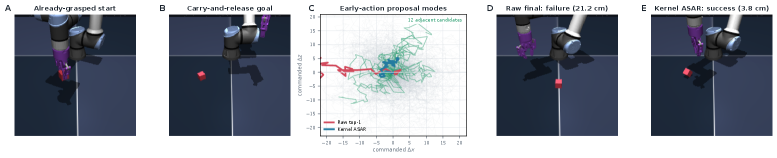
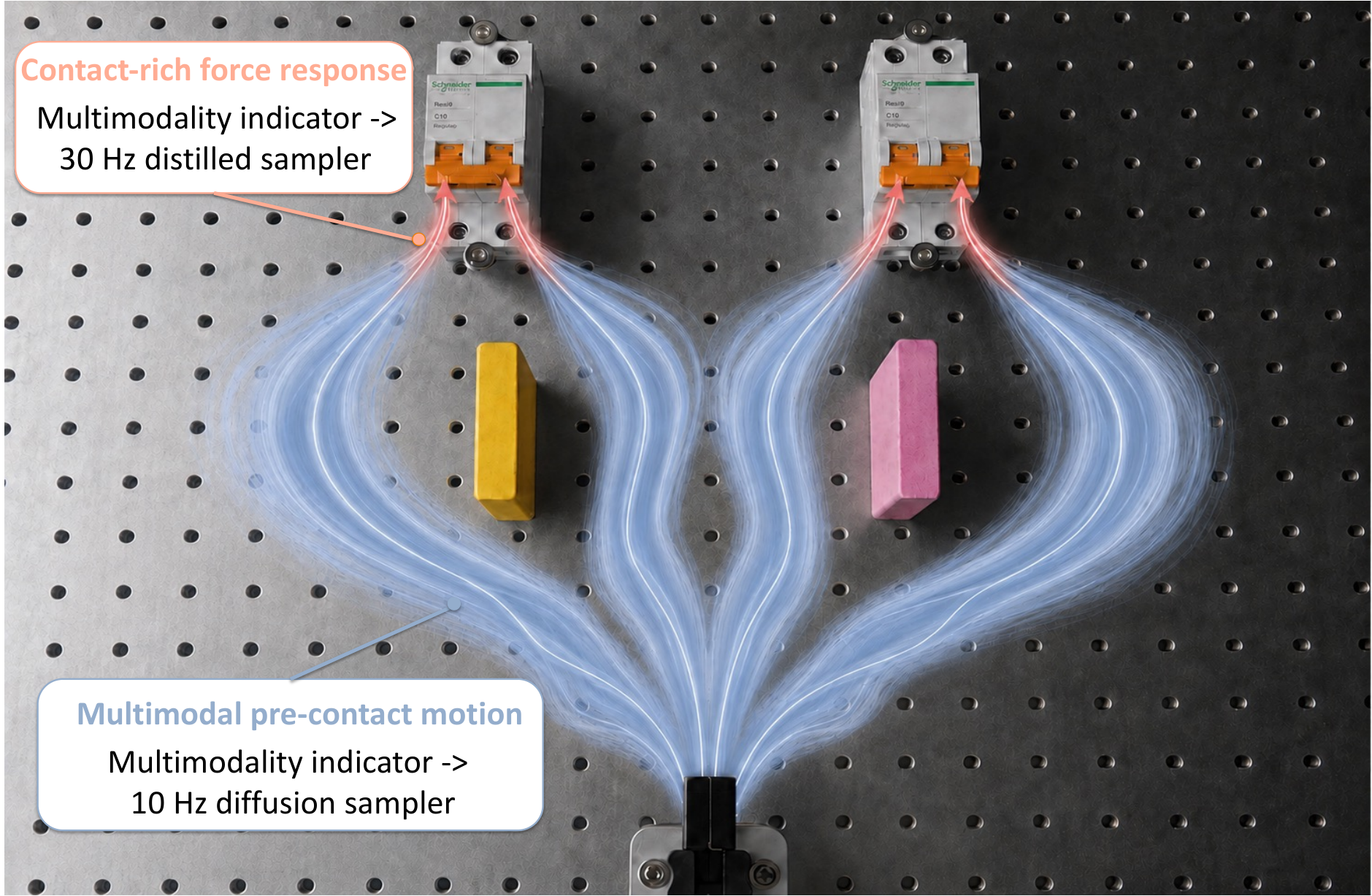
Figure 1: Minimum-cost sequence (red) is isolated in prefix space; closed-loop execution leaves cube 21.2cm from target. 12 low-cost sequences (green) form an adjacent set; Kernel ASAR reconstruction (blue) leaves cube 3.8cm away.
Proposal overgeneration: Increasing budget from 72 to 288 reduces minimum latent cost selection feasibility from .375 to .062 (position targets) and .344 to .031 (position+yaw), despite every larger pool containing feasible sequences.
Problem Formulation
Encoder $e$ maps observations to latent space. Candidate sequence $\mathbf{A}_i \in \mathcal{A}^H$. Predicted terminal:
$$\hat{\mathbf{z}}_{i,H}=\hat{f}_{H}(\mathbf{z}_{t},\mathbf{A}_{i})$$Terminal cost $q_i = Q(\hat{\mathbf{z}}_{i,H}, \mathbf{z}_g)$. Feasible set:
$$\mathcal{E}_{\epsilon}(\mathbf{x}_{t},o_{g})=\{\mathbf{A}\in\mathcal{A}^{H}:\ell_{H}(F_{H}(\mathbf{x}_{t},\mathbf{A}),o_{g})\leq\epsilon\}$$Ranking blocker — infeasible proposal $b$ with $q_{b}<\min_{i:Y_{i}=1}q_{i}$.
Proposal Scaling under Model Error
Top-$k$ feasibility decomposition:
$$\Pr(T_{B,k})=\Pr(P_{B})\,\Pr(T_{B,k}\mid P_{B})$$Probability of low-cost infeasible sequence in finite pool:
$$\Pr\!\left(\min_{b:Y_{b}=0}q_{b}\leq t\right)=1-\left(1-F_{-}(t)\right)^{n_{-}}$$| Target | Cost | B=72 Top-20 | B=288 Top-20 | B=72 Blockers | B=288 Blockers |
|---|---|---|---|---|---|
| Position | Latent | .969 | .656 | 4.31 | 16.91 |
| Position | Reachability | .875 | .750 | 6.66 | 16.66 |
| Pos+yaw | Latent | .969 | .625 | 4.34 | 18.31 |
| Pos+yaw | Reachability | .906 | .719 | 7.59 | 17.75 |
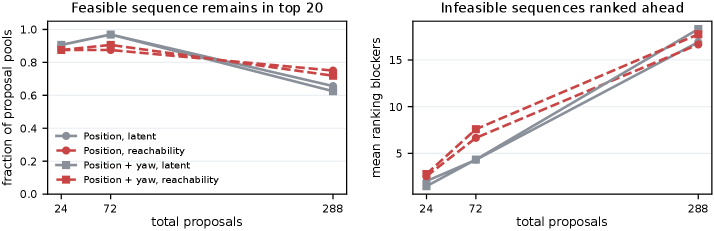
Figure 2: Top-20 feasibility declines from 72 to 288 proposals; mean blockers increase. Reachability cost changes levels but doesn't remove the effect.
ASAR Method
Adjacent Set Identification
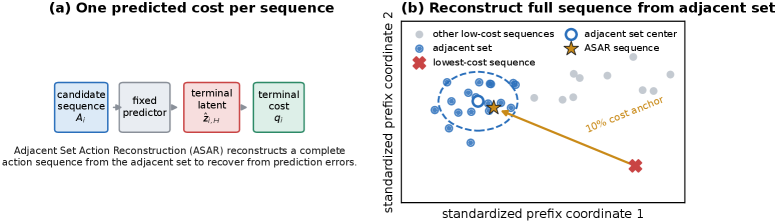
Among $M$ lowest-cost candidates $\mathcal{R}_M(Q)$, vectorize first $h$ action blocks into prefix $\mathbf{p}_i$. Local prefix isolation score:
$$u_{i}=\frac{1}{K}\sum_{j\in\mathcal{N}_{K}(i)}\|\mathbf{p}_{i}-\mathbf{p}_{j}\|_{2}$$Hoeffding bound on radius support reversal: if $\mathbb{E}S_r(e) \geq p_+$ (feasible) and $\mathbb{E}S_r(b) \leq p_-$ (infeasible blocker):
$$\Pr(S_{r}(e)\leq S_{r}(b))\leq 2\exp\!\left[-\frac{n(p_{+}-p_{-})^{2}}{2}\right]$$Full Action Sequence Reconstruction
Kernel ASAR selects candidate $c$ with smallest $u_i$, identifies adjacent set $\mathcal{S}$, assigns weights:
$$w_{i}\propto\exp\!\left(-\frac{\|\mathbf{p}_{i}-\mathbf{p}_{c}\|_{2}^{2}}{\tau_{d}}-\lambda\tilde{q}_{i}\right)$$Reconstruction:
$$\mathbf{A}_{\mathrm{rec}}=(1-\alpha)\sum_{i\in\mathcal{S}}w_{i}\mathbf{A}_{i}+\alpha\mathbf{A}_{Q}$$Conditional containment: $\|\mathbf{A}_{\mathrm{rec}}-\mathbf{A}_{c}\|\leq(1-\alpha)R+\alpha D$ where $R$ is neighborhood radius and $D=\|\mathbf{A}_Q - \mathbf{A}_c\|$.
flowchart TD
    A["CEM generates candidate pool
B action sequences"] --> B["World model predicts terminal
ẑ_i,H = f̂_H(z_t, A_i)"]
    B --> C["Terminal cost ranking
q_i = Q(ẑ_i,H, z_g)"]
    C --> D["Keep M lowest-cost
R_M(Q)"]
    D --> E["Prefix isolation score
u_i = KNN mean distance"]
    E --> F["Select candidate c with min u_i
Identify adjacent set S"]
    F --> G["Kernel-weighted reconstruction
A_rec = (1-α)Σw_i·A_i + α·A_Q"]
    G --> H["Execute A_rec first action block
Replan"]
Experimental Results
Carry-and-Release (75 queries, 44 seeds)
| Proposals | Latent-min | Latent-least iso. | Latent-ASAR | Reach-min | Reach-ASAR |
|---|---|---|---|---|---|
| 72 | .067 | .187 | .347 | .147 | .333 |
| 144 | .053 | .213 | .293 | .133 | .333 |
| 288 | .133 | .147 | .320 | .133 | .307 |
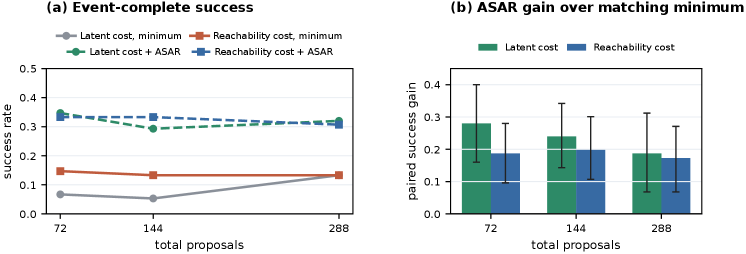
ASAR gains 28.0/24.0/18.7 pp under latent cost (95% CIs exclude 0); 18.7/20.0/17.3 pp under reachability cost.
Reconstruction Beats Existing Candidate Selection
73-query targeted test: least isolated existing sequence .493, Kernel ASAR reconstruction .630 (+13.7 pp, CI [1.9, 23.8]). Independent world model weights: ASAR .738 vs .717.
Where ASAR Helps
At 288 proposals: ASAR rescues 19 queries, loses 5. On 42 long multi-behavior queries (grasp-lift-transport-lower-release), ASAR .048 < baseline .119 — single adjacent set cannot supply multiple distinct behaviors.
Limitations
- Limited effectiveness on long-horizon queries requiring multiple distinct behaviors.
- Conditional containment is local; doesn't extend to arbitrary pools.
- Only validated on Cube manipulation; scalability to complex tasks unverified.
- Prefix isolation is a density proxy, not a feasibility label.
Conclusion and Outlook
This paper identifies proposal overgeneration in world model control — larger candidate pools reduce minimum-cost selection reliability under residual model error. ASAR identifies adjacent sets in prefix space among low-cost candidates and reconstructs new action sequences via weighted aggregation, without modifying the world model, proposal generator, or terminal cost. The reconstructed sequence need not exist in the sampled pool, providing intermediate behaviors unavailable through existing candidate selection. Formal analysis provides guarantees on lower-tail ranking errors, local support separation, and sequence containment.
Key insight: "Action from adjacent set in physical space outperforms the best prediction in world models" — when residual prediction error makes minimum-cost selection unreliable, leveraging prefix distance relations within the candidate pool to identify locally regular regions and reconstruct actions is a more direct solution than improving predictors or increasing pool size.
Deep analysis generated by RobotWorld paper-detail-generator based on full-text reading | arXiv:2607.23602v1
SOURCE LINKS