PAPER DEEP DIVE
LabRobFail: A Benchmark for Robotic Failure Analysis in Chemical Self-driving Laboratories
The deployment of embodied agents in self-driving laboratories could accelerate scientific discovery, yet their reliability is constrained by the irreversible and safety-critical nature of chemical experiments. Progress is further hindered by scarce failure data and the lack of fine-grained evaluation protocols. To address these challenges, we introduce LabRobFail, a failure-centric framework for learning and evaluating robotic failure analysis in chemical laboratories. LabRobFail-Sim injects controllable failures at the control, physics, and semantic levels, enabling the construction of LabRobFail-Data, which contains over 20,000 trajectories across 70+ task scenarios, five failure categories, and 11 fine-grained failure types. LabRobFail-Bench evaluates six capabilities spanning task understanding, failure detection, temporal localization, severity assessment, failure classification, and actionable correction. We further develop LabRobFail-VLM, a domain-specialized vision-language model that generates structured failure diagnoses and recovery instructions. On seen environments, it achieves 92.58% failure-detection accuracy and 85.58% temporal-localization accuracy, substantially outperforming general-purpose VLMs. When integrated as a real-time supervisor, it improves downstream VLA task success rates by 10-20 percentage points, demonstrating the value of fine-grained failure understanding for closed-loop recovery and reliable laboratory autonomy. Our code and data are available at https://github.com/Su-ISE-2001/SciRobo
LabRobFail: A Benchmark for Robotic Failure Analysis in Chemical Self-driving Laboratory
Paper: LabRobFail: A Benchmark for Robotic Failure Analysis in Chemical Self-driving Laboratory
Authors: Haobo Wang, Baoli Sun, Anqi Zou, Dongsheng Huang, Zelin Lv, Ning Wang, Rui Li, Dongzhan Zhou, Weiyu Guo, Zhihui Wang, Wanli Ouyang
Link: arXiv:2607.23704 | Code: GitHub
One-Sentence Summary
LabRobFail is a failure-centric framework for chemical self-driving laboratories that injects controllable failures at control/physics/semantic levels via LabRobFail-Sim, builds a dataset of 20,000+ trajectories with 11 fine-grained failure types, develops a six-dimensional evaluation benchmark, and a domain-specialized VLM achieving 90.83% failure-detection accuracy and 77.21% temporal-localization accuracy, improving downstream task success rates by 4-16 percentage points as a real-time supervisor.
Background and Motivation
Deploying embodied agents in self-driving laboratories can accelerate scientific discovery, but reliability is constrained by the irreversible and safety-critical nature of chemical experiments. Progress is further hindered by scarce failure data and the lack of fine-grained evaluation protocols. Existing robotic failure detection datasets (RLBench-Fail, AHA, RoboFAC) do not support chemical laboratory environments or specialized instruments, and lack fine-grained correction, temporal localization, and severity assessment capabilities.
The uniqueness of chemical lab scenarios lies in: transparent glassware, reflective liquid surfaces, and irreversible hazardous mixtures, making failure detection more challenging than household scenarios. LabRobFail is designed to fill this gap.
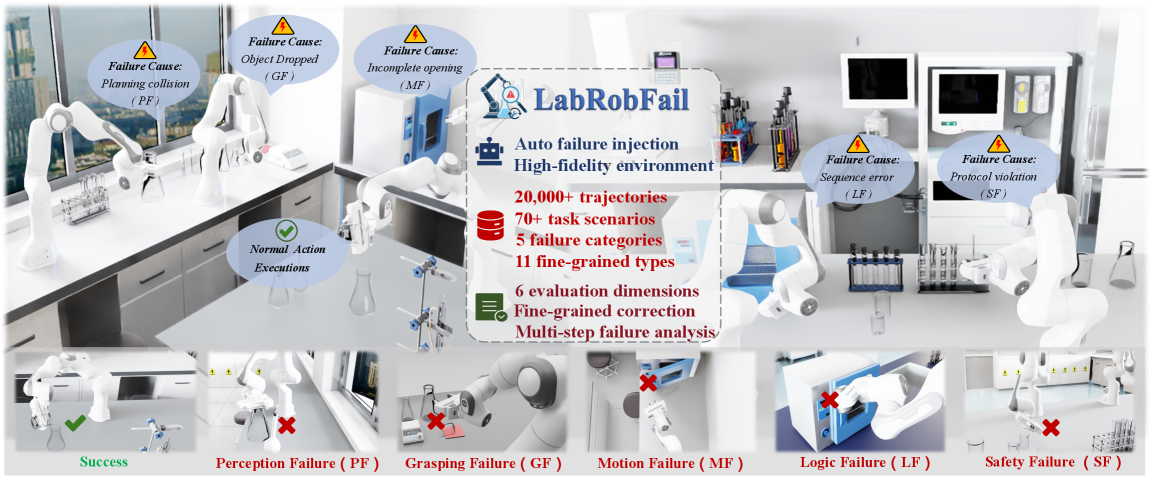
Figure 1: LabRobFail Framework. A high-fidelity simulation platform automatically injects five failure categories: Perception (PF), Grasping (GF), Motion (MF), Logic (LF), and Safety (SF).
Method Details
1. LabRobFail-Sim: Multi-level Failure Injection
LabRobFail-Sim injects controllable failures at three levels to generate diverse failure trajectories.
Control-level Perturbation ($\Phi_{ctrl}$): Simulates execution errors by injecting stochastic noise into keyframe parameters. Gaussian perturbation on translation $\mathbf{p}_i$ and Lie algebra noise on rotation $\mathbf{R}_i$:
$$ \tilde{p}_i = p_i + \xi_{trans}, \quad \tilde{R}_i = R_i \cdot \text{Exp}(\xi_{rot}) $$where $\xi \sim \mathcal{N}(0, \Sigma)$. Gripper commands are corrupted with failure probability $\lambda_{grip}$ to model actuator faults.
Physics-level Perturbation ($\Phi_{phy}$): Dynamically adjusts simulation dynamics parameters $\Psi = \{\mu, m, \nu, \dots\}$ (friction, mass, viscosity) via uniform scaling to induce emergent failures like slippage:
$$ \tilde{\psi} = \psi \cdot (1 + \delta), \quad \delta \sim \mathcal{U}(-\alpha, \alpha) $$Semantic-level Perturbation ($\Phi_{sem}$): Introduces task logic errors modeled as a permutation operator $\pi$ on sequence indices to simulate step reversals or skips ($\tilde{\tau}_{seq} = \{T_{\pi(1)}, \dots\}$), and a mapping function $\mathcal{M}(o_i)$ for target object substitution (e.g., wrong reagent), leading to safety constraint violations.
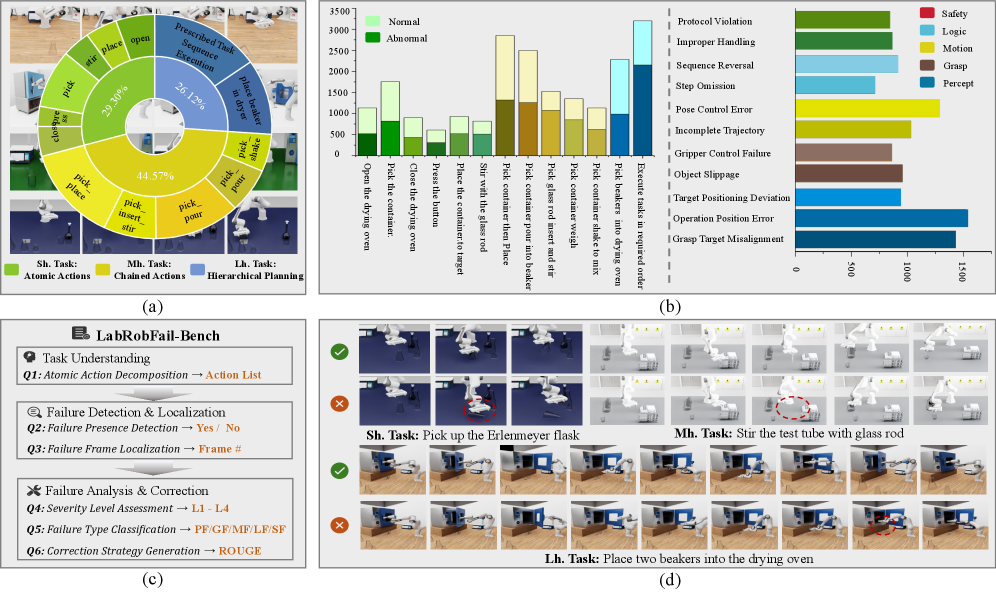
Figure 2: LabRobFail-Sim Framework. (a) Multi-level failure generator; (b) LLM-driven semantic annotation pipeline.
2. LabRobFail-Data Dataset
A large-scale dataset with 20,000+ interaction trajectories across 70+ laboratory task scenarios. Tasks are organized into three complexity levels:
- Short-horizon ($\leq 10$ frames): Atomic operations (pick, place, pour); failures are typically instantaneous execution errors
- Medium-horizon (10-30 frames): Chain 2-3 atomic operations, examining failure detection at critical action transitions
- Long-horizon ($> 50$ frames): Complex multi-stage workflows requiring hierarchical planning and precise fault localization
The failure taxonomy covers 5 major categories and 11 fine-grained types: Perception Failure (PF), Grasping Failure (GF), Motion Failure (MF), Logic Failure (LF), and Safety Failure (SF). Paired success-failure trajectories are generated to minimize confounds.
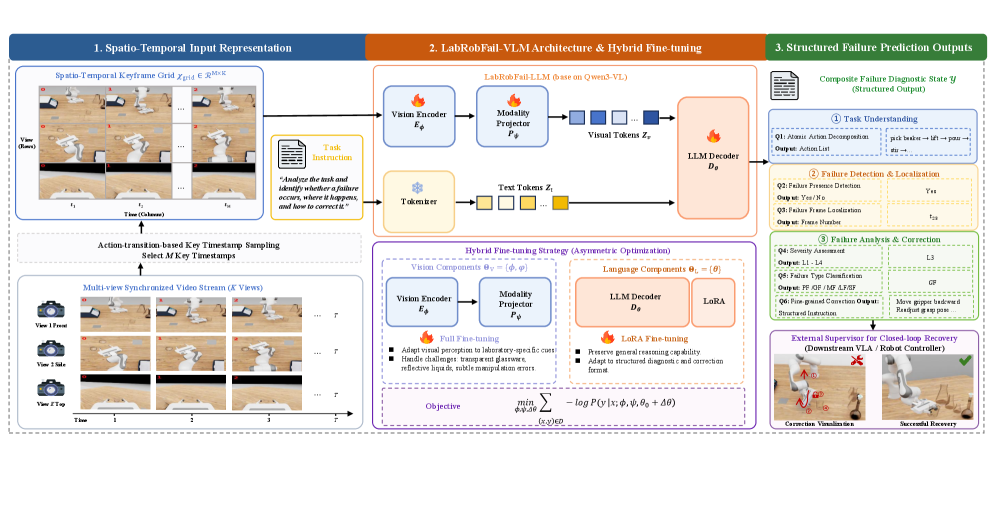
Figure 3: LabRobFail-Data and LabRobFail-Bench. (a) Task complexity distribution; (b) Failure type distribution; (c) Six-dimensional benchmark.
3. LabRobFail-Bench Six-Dimensional Evaluation
The failure analysis task is defined as a mapping from multi-modal observations to a structured diagnostic report. Given input $\mathcal{X} = \langle\mathcal{V}, \mathcal{Q}\rangle$ (RGB video stream $\mathcal{V}$ and task instruction $\mathcal{Q}$), the model predicts a composite failure state $\mathcal{Y}$:
$$ \mathcal{Y} = \langle \underbrace{y_{task}}_{L1},\, \underbrace{y_{dete},\, y_{loca}}_{L2},\, \underbrace{y_{type},\, y_{risk},\, y_{corr}}_{L3} \rangle $$encompassing task status, detection flags, temporal localization, failure type, risk severity, and actionable correction policies, organized into three progressive cognitive levels.
4. LabRobFail-VLM Vision-Language Model
Built upon Qwen3-VL, consisting of a vision encoder $E_\phi$, modality projector $P_\psi$, and language decoder $D_\theta$. Given input $\mathcal{X} = (X_{\text{grid}}, \mathcal{Q}_{\text{instruct}})$, it extracts visual and textual representations:
$$ Z_v = P_\psi(E_\phi(X_{\text{grid}})), \quad Z_t = \text{Tokenizer}(\mathcal{Q}_{\text{instruct}}) $$Then autoregressively predicts the failure output:
$$ P(\mathcal{Y} \mid \mathcal{X}) = \prod_{j=1}^{L} D_\theta(y_j \mid y_{<j}, Z_v, Z_t) $$Hybrid Fine-tuning Strategy: Parameters are divided into vision-related $\Theta_V = \{\phi, \psi\}$ and language-related $\Theta_L = \{\theta\}$. Vision encoder and projector are fully fine-tuned (lr $2 \times 10^{-6}$ and $1 \times 10^{-5}$), while the language decoder uses LoRA (rank 64, scaling 128, dropout 0.05, lr $1 \times 10^{-4}$). Training objective:
$$ \min_{\phi, \psi, \Delta\theta} \sum_{(\mathcal{X}, \mathcal{Y}) \in \mathcal{D}} -\log P(\mathcal{Y} \mid \mathcal{X};\, \phi, \psi, \theta_0 + \Delta\theta) $$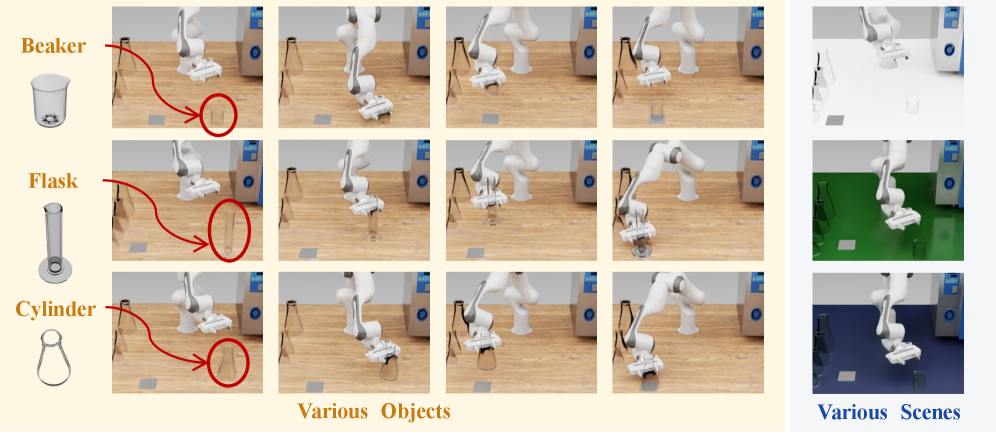
Figure 4: LabRobFail-VLM Overview. Temporally indexed multi-view keyframes processed by hybrid-tuned Qwen3-VL.
flowchart TD
    A["Chemical Lab Simulation"] --> B["LabRobFail-Sim
Three-level failure injection"]
    B --> B1["Control: Gaussian+Lie algebra
Translation/rotation/gripper"]
    B --> B2["Physics: Dynamics parameter scaling
Friction/mass/viscosity"]
    B --> B3["Semantic: Step permutation+object substitution
Logic errors+safety violations"]
    B1 --> C["LabRobFail-Data
20K+ trajectories, 11 failure types"]
    B2 --> C
    B3 --> C
    C --> D["LLM Semantic Annotation
GPT-5.4 VQA pipeline"]
    D --> E["LabRobFail-Bench
Six-dimensional evaluation"]
    E --> F["LabRobFail-VLM
Qwen3-VL hybrid fine-tuning"]
    F --> F1["Vision: Full fine-tuning"]
    F --> F2["Language: LoRA adaptation"]
    F1 --> G["Structured failure diagnosis+correction"]
    F2 --> G
    G --> H["Downstream policy recovery
+4-16pp success rate"]
    style B fill:#e1f5fe
    style F fill:#fff3e0
    style G fill:#e8f5e9
Experimental Results
Main Results (Seen Environments)
| Method | Q1 Task | Q2 Detection | Q3 Localization | Q4 Severity | Q5 Classification | Q6 ROUGE-L |
|---|---|---|---|---|---|---|
| Qwen3-VL-8B | 47.45 | 59.50 | 5.59 | 47.84 | 35.88 | 0.2976 |
| LLaVA-1.6-13B | 35.80 | 52.96 | 13.24 | 33.53 | 31.18 | 0.2598 |
| Gemini-2.5-flash | 38.92 | 57.13 | 15.53 | 48.84 | 39.68 | 0.1231 |
| GPT-5.4 | 45.16 | 52.34 | 15.88 | 47.06 | 38.54 | 0.1520 |
| LabRobFail-VLM | 94.45 | 90.83 | 77.21 | 83.18 | 73.21 | 0.7542 |
LabRobFail-VLM dramatically outperforms general-purpose VLMs across all dimensions: failure detection 90.83% (vs GPT-5.4's 52.34%), temporal localization 77.21% (vs 15.88%), correction ROUGE-L 0.7542 (vs 0.1520).
Ablation Study
| Variant | Q2 Detection | Q3 Localization | Q5 Classification | Q6 ROUGE-L |
|---|---|---|---|---|
| Full fine-tuning | 85.24 | 72.24 | 70.24 | 0.7142 |
| Frozen vision | 81.13 | 60.21 | 61.24 | 0.4529 |
| Without temporal index | 86.45 | 70.58 | 69.24 | 0.6471 |
| LabRobFail-VLM (full) | 90.83 | 77.21 | 73.21 | 0.7542 |
Hybrid fine-tuning outperforms full fine-tuning (Q2: 90.83 vs 85.24). Freezing vision drops Q6 from 0.7542 to 0.4529, proving the critical role of visual full fine-tuning for lab-specific perceptual cues.
Downstream Policy Recovery
| Task | Policy | Baseline(%) | +Ours(%) | Improvement |
|---|---|---|---|---|
| Pick | OpenVLA | 76 | 84 | +8% |
| Pour | OpenVLA | 16 | 28 | +12% |
| Pour | ACT | 32 | 48 | +16% |
| Open drying oven | OpenVLA | 28 | 40 | +12% |

Figure 5: Safety failure example — protocol violation (hazardous mixture).
Limitations
- Sim-to-real gap: Training relies entirely on synthetic data, leaving a visual domain gap for real-world deployment; rendering fidelity for transparent glassware and reflective liquids may be insufficient.
- Deterministic Action Dictionary: Correction strategies are converted to control primitives via a deterministic Action Dictionary, limiting recovery flexibility and unable to handle open-ended language corrections.
- Low absolute success on hard tasks: Pour task reaches only 48% even after +16pp improvement, indicating reliable laboratory recovery remains an open challenge.
Conclusion and Outlook
LabRobFail provides a complete framework for chemical laboratory robotic failure analysis: a physics-based simulation platform (Sim), a 20K+ trajectory dataset (Data), a six-dimensional benchmark (Bench), and a specialized VLM. LabRobFail-VLM substantially outperforms generalist baselines in failure reasoning and improves downstream task success rates by 4-16pp through closed-loop recovery, paving the way for reliable autonomous scientific discovery.
Key Insight: "The irreversibility and safety-criticality of chemical experiments make failure understanding non-optional — LabRobFail transforms failures from unpredictable black-box events into engineerable objects that can be detected, localized, and corrected through three-level controllable injection and six-dimensional structured diagnosis."