PAPER DEEP DIVE
The Physics of Multi-Turn Long-Horizon Planning: From Pre-training to Post-training via Single- and Multi-Teacher On-Policy Agentic Distillation
Multi-turn long-horizon planning is critical for foundation model agents, yet how to fundamentally improve it remains unclear. Existing models are trained on uncontrollable and opaque Internet data, making it difficult to identify how planning ability is acquired, shaped, and integrated. To address this challenge, we introduce a unified and controlled multi-turn environment that enables precise control. It allows systematically study long-horizon planning across three stages. (1) Planning ability acquisition during pre-training. We study data format, distribution, and quality. Explicit world model construction through CoT state transition modeling yields stronger long-horizon generalization. Atomic skills alone are insufficient for compositional generalization, whereas a litte long-horizon data works. Moreover, suboptimal trajectories severely impair performance because errors amplify over long horizons. (2) Planning ability shaping via GRPO and OPD post-training. Through mutual information, we distinguish general planning patterns from task-specific planning knowledge. For planning patterns, we identify three application regions of post-training: unnecessary, effective, and unsupported. OPD has a broader effective region than GRPO under low-quality and long-horizon settings, as it provides more consistent update directions. For planning knowledge, distilling unseen procedures from a teacher with different knowledge may impair student's prior world modeling without fully establishing new knowledge. (3) Planning ability integration through MOPD post-training. We show that multi-teacher on-policy distillation (MOPD) integrates capabilities by converging to shared planning-pattern across environments. Compatible patterns enable cross-environment generalization, partially shared patterns support continual learning, while completely conflicting patterns cause severe interference.
The Physics of Multi-Turn Long-Horizon Planning: From Pre-training to Post-training via Single- and Multi-Teacher On-Policy Agentic Distillation
Institutions: CASIA, UCAS | arXiv: 2607.24720v1
One-Sentence Summary
This work proposes a unified controlled multi-turn environment to systematically study how long-horizon planning ability is acquired (pre-training), shaped (GRPO/OPD post-training), and integrated (MOPD multi-teacher distillation), revealing the roles of world model internalization, mutual information differences between planning patterns and knowledge, and multi-teacher compatibility for cross-environment generalization.
Background and Motivation
As foundation models advance toward agentic systems, multi-turn long-horizon planning becomes critical. Unlike single-turn QA, long-horizon planning requires decomposing complex tasks, tracking environment states, modeling state transitions, and composing atomic skills through long-horizon interactions. Existing benchmarks (OSWorld 2.0, EdgeBench, DeepPlanning) show models have basic short-horizon capability but struggle significantly with long-horizon tasks.
The core problem: existing models are trained on uncontrollable, opaque Internet data, making it difficult to identify how planning ability is acquired, shaped, and integrated. This work poses three progressive questions across three training stages.
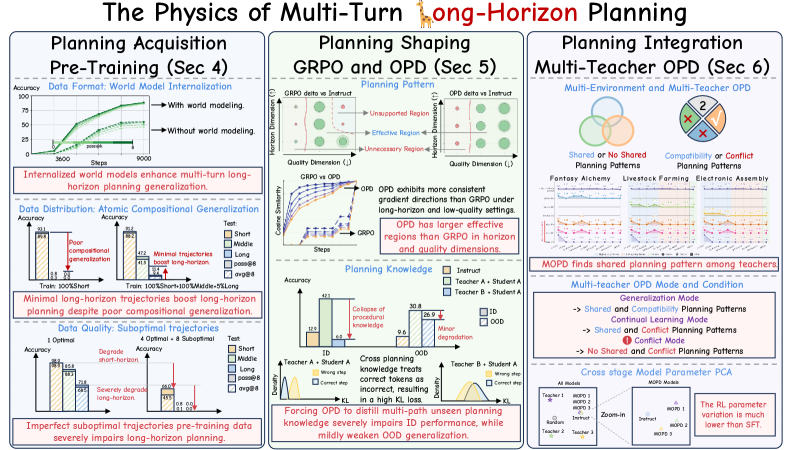
Figure 1: Three-stage research framework — large-scale pre-training, RL post-training (OPD/GRPO), and multi-teacher consolidation (MOPD).
Controlled Planning Environment
A unified controlled multi-turn environment supports precise control over environment numbers, levels, task length, data quality, planning knowledge, and planning patterns. Skill graph construction converts item composition rules (AND/OR logic) into DAGs, mapped to planning tasks with difficulty controlled by search depth and branching factor.
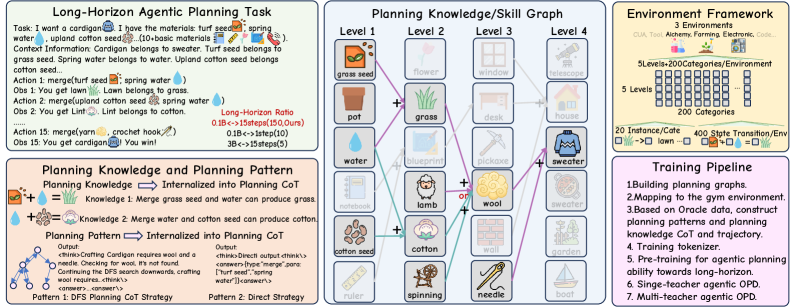
Figure 2: Controlled multi-turn environment — skill graph construction, graph-to-Gym mapping, difficulty control.
Stage 1: Planning Ability Acquisition during Pre-training
World Model Internalization
The world model is defined by a state transition function:
$$\mathcal{T}: \mathcal{S} \times \mathcal{A} \rightarrow \mathcal{S}$$Given state $s_t$ and action $a_t$, it predicts $s_{t+1} = \mathcal{T}(s_t, a_t)$. Skill internalized world modeling plans via DFS over an internal simulated state space. Each atomic skill $k \in \mathcal{K}$ is a transition function $f_k: \mathcal{S} \rightarrow \mathcal{S}$:
$$s_{t+1} = f_{k_{t,m_t}} \circ \cdots \circ f_{k_{t,1}}(s_t)$$Models with world models (w/ WM) consistently outperform direct answering baselines (w/o WM) across all difficulty levels. Chain-of-thought state transition modeling yields stronger long-horizon generalization than direct action prediction.
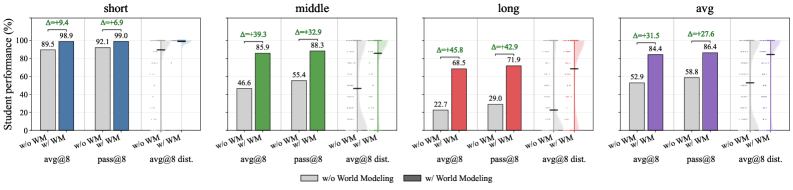
Figure 3: Final performance comparison between students with and without world modeling.
Atomic Skill Compositional Generalization
Models trained only on atomic skills cannot achieve compositional generalization. Adding a small amount of long-horizon data substantially improves planning ability, showing that long-horizon composition requires explicit long-horizon training signals.
Impact of Suboptimal Trajectories
Suboptimal trajectories severely impair performance due to error accumulation. With per-step error rate $\epsilon$ over $T$ steps:
$$P_{\text{fail}}(T) = 1 - (1-\epsilon)^T \approx 1 - e^{-\epsilon T}$$Even small $\epsilon$ causes $P_{\text{fail}} \to 1$ as $T$ grows, explaining why suboptimal data is particularly harmful for long-horizon planning.
Stage 2: Planning Ability Shaping via GRPO and OPD
Mutual Information Framework
Planning patterns ($P$) and planning knowledge ($K$) are distinguished via mutual information:
$$I(T;P) = H(P) - H(P|T), \quad I(T;K) = H(K) - H(K|T)$$Since $P$ is abstract and reusable (reflection, backtracking), $I(T;P)$ is low. Since $K$ is task-specific, $I(T;K)$ is high. Thus $I(T;P) < I(T;K)$, which profoundly affects post-training effectiveness.
Planning Patterns: RL Applicability Regions
| Region | Characteristic | RL Effect |
|---|---|---|
| A: Unnecessary | Similar performance across patterns | RL selection pointless |
| B: Effective | Clear performance differences | RL discovers better patterns |
| C: Unsupported | Better patterns exist but RL can't find them | RL may fail |
GRPO has a narrower effective region. Under low-quality data and long horizons, OPD has a broader effective boundary because RL's sparse credit assignment introduces both correct and incorrect gradients, while OPD provides consistent update directions when the teacher is ideal.
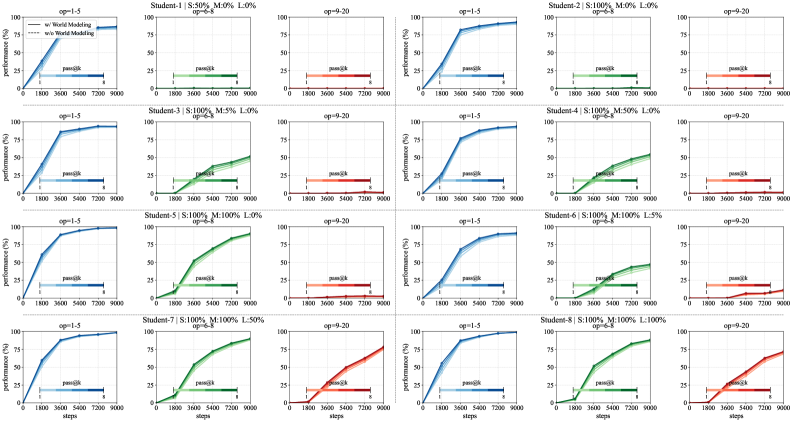
Figure 5: Applicability boundaries and capability upper bounds of multi-turn GRPO and OPD.
Planning Knowledge: Distillation Limitations
When teacher and student have different procedural knowledge, direct OPD distillation of unseen multi-path knowledge cannot guarantee effective transfer. The student may enter an intermediate state where old knowledge is impaired while new knowledge is not fully established:
$$\Delta\theta_{\text{OPD}} \propto \nabla_\theta \sum_{k,t} D_{\text{KL}}(p_{k,t} \| q_{k,t}^{\text{teacher}})$$Stage 3: MOPD Multi-Teacher Integration
Multi-teacher on-policy distillation integrates capabilities via sequential training. The $m$-th teacher's loss:
$$\mathcal{L}_{\text{Agent-OPD}}^{(m)}(\theta) = \mathbb{E}_{\tau \sim \pi_\theta} \left[ \sum_{k=1}^{K} \sum_{t=1}^{T_k} D_{\text{KL}}(p_{k,t} \| q_{k,t}^{(m)}) \right]$$MOPD integrates by converging to shared planning-pattern distributions. Three cases: compatible patterns enable cross-environment generalization, partially shared support continual learning, and fully conflicting cause catastrophic forgetting.
Token-level KL divergence measures student-teacher closeness:
$$\text{KL}^{\sigma,\gamma}(\tau) = \frac{1}{\sum_{k=1}^{K} T_k} \sum_{k=1}^{K} \sum_{t=1}^{T_k} \sum_{v \in \mathcal{V}_{k,t} \cup \{\text{tail}\}} P_{k,t}^{\sigma}(v) \log \frac{P_{k,t}^{\sigma}(v)}{Q_{k,t}^{\gamma}(v)}$$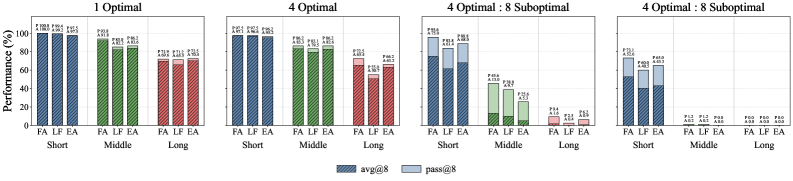
Figure 6: MOPD analysis framework — non-shared and conflicting planning patterns across environments.
graph TD
    A["Pre-training
Ability Acquisition"] --> B["World Model Internalization"]
    A --> C["Atomic Skill Composition
Needs long-horizon data"]
    A --> D["Trajectory Quality
Suboptimal data harmful"]
    B --> E["RL Post-training
Ability Shaping"]
    C --> E
    D --> E
    E --> F["Planning Pattern P
Low mutual information"]
    E --> G["Planning Knowledge K
High mutual information"]
    F --> H["OPD broader effective region
GRPO limited by sparse credit"]
    G --> I["Distilling unseen knowledge
May impair existing modeling"]
    H --> J["MOPD Multi-Teacher Integration"]
    I --> J
    J --> K["Compatible: Cross-env generalization"]
    J --> L["Partial: Continual learning"]
    J --> M["Conflicting: Catastrophic forgetting"]
Key Findings
| Finding | Key Conclusion | Evidence |
|---|---|---|
| World model | w/ WM consistently outperforms w/o WM | avg@8 and pass@8 across 3 difficulties |
| Compositional gen. | Atomic skills insufficient, need long-horizon data | Small amount of LH data helps substantially |
| Suboptimal data | 4 Opt:8 Sub much worse than 4 Opt | Error accumulation amplification |
| OPD vs GRPO | OPD better under low-quality data + long horizon | More consistent gradient directions |
| Knowledge distillation | Unseen knowledge distillation may impair | KL dynamics show intermediate state |
| MOPD compatibility | Compatible → generalize, conflicting → forget | Cross-environment success rates |
Limitations
- Experiments use synthetic controlled environments, with a gap to real Internet data distribution
- Model scale is 100M parameters; conclusions may differ at larger scales
- Knowledge distillation intermediate-state analysis relies mainly on KL divergence
- MOPD conflict detection and resolution mechanisms need further study
Conclusion and Outlook
This work systematically studies multi-turn long-horizon planning across three stages: pre-training requires world model internalization, long-horizon data, and high-quality trajectories; RL post-training shows OPD has a broader effective region for planning patterns but knowledge distillation has limitations; MOPD integrates via shared distribution convergence, with compatible patterns enabling generalization and conflicting causing forgetting. These findings provide practical guidance for developing stronger agentic foundation models.
Key Insight: Errors in long-sequence decision-making accumulate and amplify — even with low per-step error rate, the overall failure rate of long-horizon trajectories approaches 1.
SOURCE LINKS