Skip to content
GaitSpan: Growing Humanoid Locomotion from Walking to Running

GaitSpan: Growing Humanoid Locomotion from Walking to Running

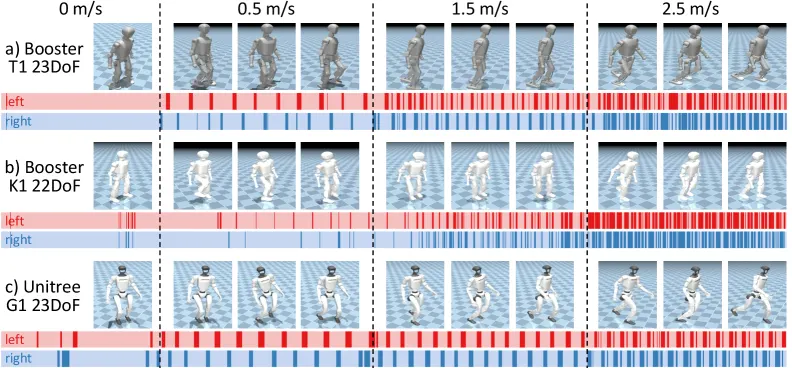
A humanoid that can walk should not relearn locomotion from scratch to jog or run. Yet current approaches often obtain gait diversity by prescribing gait schedules, imitating motion clips, training experts to switch between or distilling skills into one policy. These strategies can produce impressive behaviors, but offer limited flexibility across continuous speed commands, terrains, and morphologies. We study skill growth with GaitSpan, a framework that expands a pretrained, basic walking policy into faster locomotion. It treats walking as a seed skill: reusable motor structure for balance, support, body coordination, and contact transition that can be regenerated at new rhythms, extended into longer/higher strides, and corrected by residual adaptation. This expansion has three aspects: 1) rhythm generation, which modulates the frozen walking policy with multiple internal clocks and learns command-conditioned combinations of the resulting canonical actions; 2) stride shaping, which rewards dynamic locomotion patterns appropriate for higher commanded speeds using a physically grounded objective inspired by spring-loaded inverted pendulum dynamics; and 3) residual adaptation, which captures motion details not accounted for by rhythm generation or stride shaping. GaitSpan is the first to deliver a single command-conditioned humanoid policy that spans walking, jogging, and running-like regimes covering a continuous speed range, transfers across morphologies, and deploys zero-shot on unseen sim-to-sim, and real-world terrains. Compared with baselines either trained with multi-experts or imitation from humans, it learns faster and achieves stronger gait performance.
HumanoidGait
Kwan-Yee Lin, Zilin Wang, Janelle J. Liu · 486 views · Jul 13, 2026
Learning Reusable Hybrid Motion Priors for Humanoid Locomotion from Motion Imitation

Learning Reusable Hybrid Motion Priors for Humanoid Locomotion from Motion Imitation

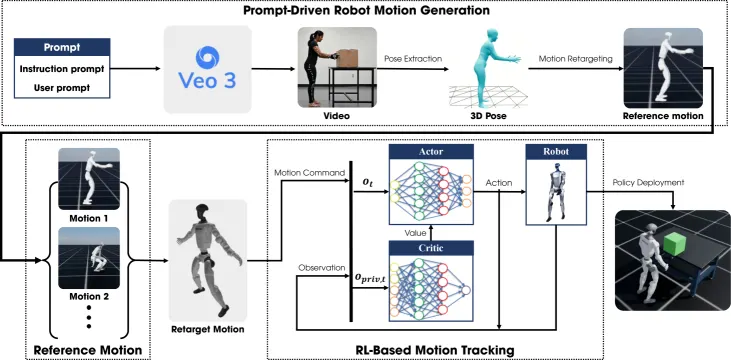
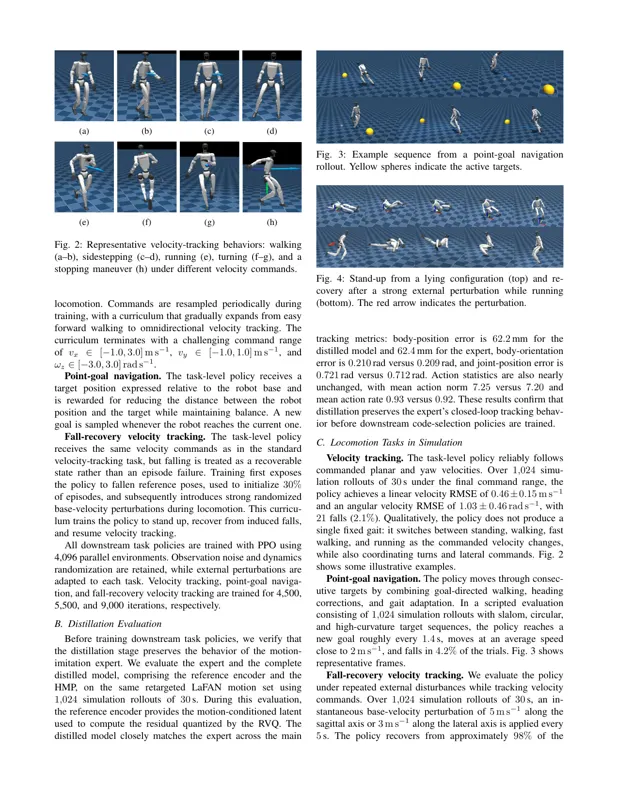
Reinforcement learning can produce robust humanoid controllers, but each new task is typically trained as a separate policy with its own reward design and training process. Motion imitation provides an alternative source of motor competence by training policies to track retargeted human motions, yet the resulting controllers remain reference trackers and are not directly usable as task policies. We propose a three-stage pipeline that turns motion-imitation skills into a reusable hybrid motion prior (HMP) for humanoid locomotion. First, an expert policy is trained to imitate retargeted human motion-capture clips. Second, the expert is distilled into a frozen architecture composed of a proprioceptive encoder, a residual vector-quantized (RVQ) codebook, and an action decoder. Third, task-level policies are trained to solve locomotion tasks by selecting discrete codebook entries while the HMP remains frozen. We evaluate the method on velocity tracking, point-goal navigation, and fall-recovery velocity tracking in simulation, and deploy the velocity-tracking policy on a real Unitree G1 robot. The distillation process preserves the tracking behavior of the expert, while the resulting HMP can be reused without retraining as the action interface for different downstream locomotion policies. The learned HMP reveals an interpretable codebook structure in which the number of active RVQ stages modulates the available gait patterns. We further show that training the codebook with the rotation trick improves latent organization and reduces downstream falls compared with a standard straight-through estimator.

Motion ImitationHumanoid
Valerio Belli, Valerio Modugno, Enrico Mingo Hoffman · 450 views · Jul 27, 2026
Closing the Loop in Humanoid VLA: Persistent 3D Object Tokens for Verifiable Loco-Manipulation

Closing the Loop in Humanoid VLA: Persistent 3D Object Tokens for Verifiable Loco-Manipulation

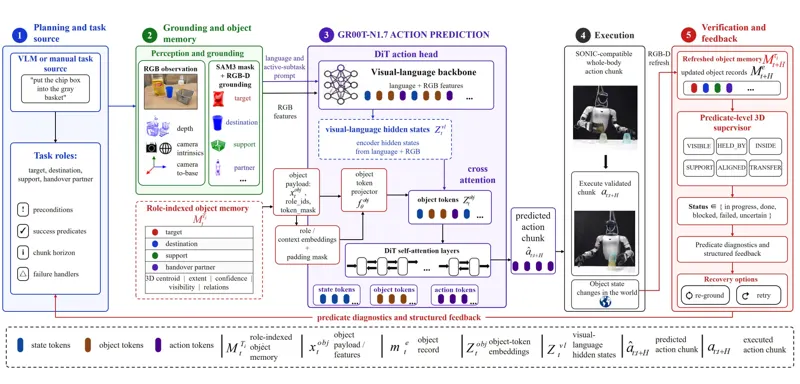
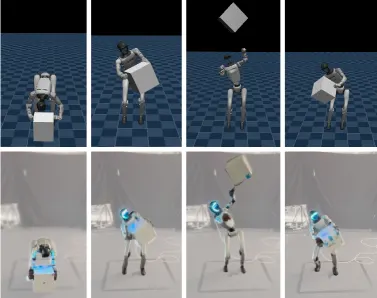
Vision-language-action policies are a promising foundation for general robot control, but long-horizon humanoid loco-manipulation requires the robot to treat task objects as persistent physical entities across movement, contact, occlusion, and recovery. We study this problem as object-state divergence: the object state used to condition a whole-body action can differ from the state used to decide whether the action achieved the intended physical relation. We propose Persistent Object Tokenization (POT), which maintains role-indexed 3D object records from RGB-D observations and converts them into object tokens for a whole-body action expert. Instantiated as POT-VLA, the same object records condition action generation and support geometric predicate checks, yielding a closed-loop execution system in which object state is both actionable and verifiable. On a Unitree G1, POT-VLA improves a matched direct GR00T-N1.7 baseline from 39/80 to 71/80 successes over eight real-world task families. In an external Being-0-aligned reference, POT-VLA achieves 44/50 successes on aligned service tasks, compared with the 37/50 success reported by the Being-0 paper. The largest gains occur on tasks requiring maintained 3D relations, suggesting that persistent object-centered state is a useful abstraction for verifiable humanoid VLA execution.

VLARGB-D
Peng Ren, Haoyang Ge, Jiang Zhao · 758 views · Jul 20, 2026
PRISM: Polynomial Representations for Interaction-Structured Motor Control

PRISM: Polynomial Representations for Interaction-Structured Motor Control

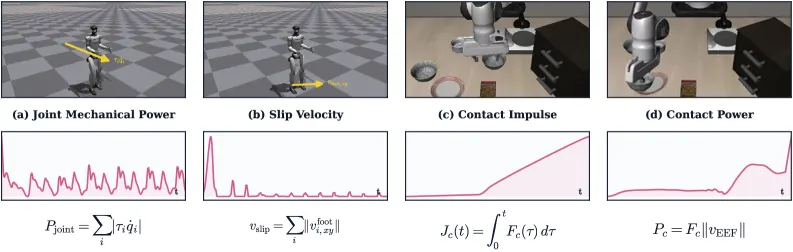
Robot policies are typically MLPs mapping observations to actions. Yet robot observations are physical variables, and many action-relevant cues arise not from individual variables but from their interactions; power, inertial effects, contact, slip, and compliance depend on products among observable signals. We introduce PRISM, a policy representation that makes polynomial interactions among observable physical variables explicit, learnable, and compact. Rather than listing all polynomial terms, PRISM uses a factorized polynomial module to expose higher-order interaction features efficiently. In reinforcement learning, it keeps the standard MLP backbone but applies a gradually activated element-wise polynomial function after it. In imitation learning, it replaces linear proprioceptive conditioning in Diffusion Policy with a polynomial layer trained end-to-end. Across humanoid locomotion and contact-rich manipulation, PRISM improves performance over standard MLP policies and larger MLPs with matched capacity, showing that interaction structure cannot be replaced by capacity alone. It also yields sensorless compliant behavior without force, wrench, tactile input, contact labels, or admittance control. These results suggest that polynomial representations should become a standard architectural choice for embodied motor control. The project page is available at https://lsh3163.github.io/prism/

PrismMotion Control
Seung Hyun Lee, Stella X. Yu · 600 views · Jul 26, 2026
Extreme-RGMT: Continual Learning of Highly Dynamic Skills for Robust Generalist Humanoid Control

Extreme-RGMT: Continual Learning of Highly Dynamic Skills for Robust Generalist Humanoid Control

Humans can progressively acquire highly dynamic motor skills while preserving reliable everyday motor abilities. In contrast, existing humanoid controllers face a trade-off between generalist and specialist capabilities: generalist motion tracking policies struggle to reliably execute rare highly dynamic motions, whereas specialist training can degrade previously acquired behaviors. We introduce Extreme-RGMT, a two-stage continual learning framework for robust generalist humanoid control. The method first learns a generalist motion-tracking base policy from diverse multi-source motion data, then employs an asymmetric skill acquisition and capability consolidation mechanism to constrain policy drift on mastered motions while emphasizing difficult dynamic segments. To address the scarcity of highly dynamic motions, their high failure rates, and the resulting shortage of informative samples, Extreme-RGMT combines difficulty-aware sampling with advantage-prioritized trajectory resampling to emphasize critical segments. Experiments show that Extreme-RGMT achieves state-of-the-art generalist whole-body motion-tracking performance, including substantially improved completion of challenging highly dynamic motions. The resulting controller directly executes diverse unseen highly dynamic motions under fixed references and online inertial motion-capture inputs, advancing generalist whole-body motion-tracking controllers toward highly dynamic motor capabilities at the human-expert level.

HumanoidContinual learning
Yubiao Ma, Han Yu, Kai Guo · 554 views · Jul 22, 2026
Scaling Behavior Foundation Model for Humanoid Robots

Scaling Behavior Foundation Model for Humanoid Robots

Humanoid control requires natural whole-body coordination, precise real-time responses to control signals, and robust generalization across diverse environmental contexts, making it a cornerstone for generalist embodied agents. Behavior Foundation Models (BFMs) have recently emerged as a promising solution to address these challenges by leveraging large-scale behavioral data to achieve superior expressiveness, versatility and generalization. However, despite growing interest in scaling BFMs to further improve their capabilities, it remains unclear how key factors, including the learning paradigm, behavioral data and model architecture should be coordinated to enable effective scaling. In this work, we revisit the scaling recipe for BFMs and demonstrate that substantial performance gains can be achieved through the coordination of three core components: 1) the learning paradigm of motion tracking that reformulates diverse humanoid control problems as the reproduction of integrated whole-body behaviors in the global frame; 2) the strategic synergy between on-policy rollout quantity and reference motion diversity; and 3) the expressive and scalable model architecture termed Humanoid Transformer that facilitates the natural emergence of structured behavioral representations. Through extensive experiments in both simulation and real-world deployment, we demonstrate that our approach yields significant improvements in control fidelity and task generalization, reducing Mean Per-Keypoint Position Error (MPKPE) on the test set by over 10% in local mode and 82% in global mode compared with existing humanoid controllers. These results establish BFM as a principled and effective foundation for scalable and general-purpose humanoid control.

HumanoidBFM
Weishuai Zeng, Kangning Yin, Xiaojie Niu · 588 views · Jul 16, 2026
RAVEN: Reinforcement-Adaptive Visibility-Graph Planning for Robust Humanoid Navigation with Collision-Free MPC

RAVEN: Reinforcement-Adaptive Visibility-Graph Planning for Robust Humanoid Navigation with Collision-Free MPC

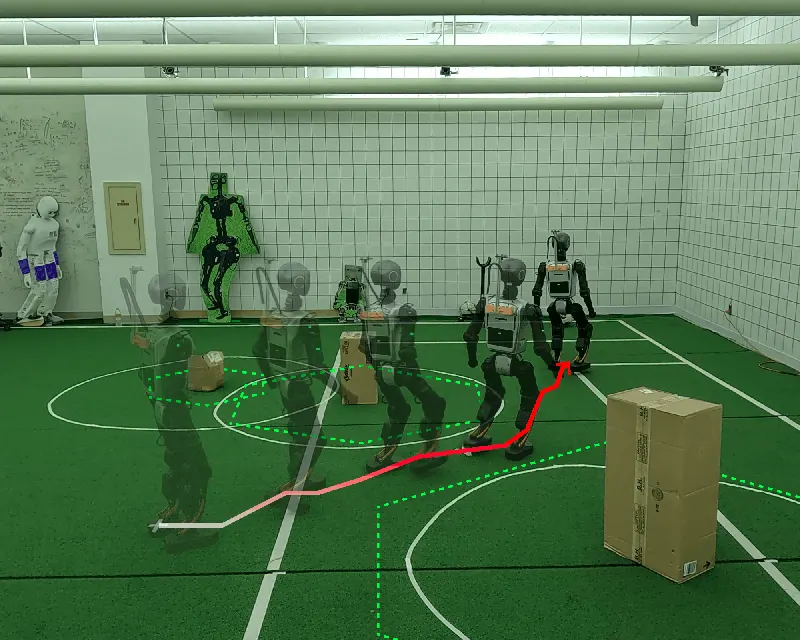
Humanoid navigation in dynamic environments requires long-horizon planning while respecting short-horizon dynamic and safety constraints. Classical visibility-graph planners combined with model predictive control (MPC) can efficiently generate collision-free trajectories, but their performance depends on manually tuned parameters and accurate system modeling. In real robotic systems, control delays, state-estimation noise, and locomotion uncertainties can cause overshoot and constraint violations even when the nominal path is geometrically optimal. We propose RAVEN, a hierarchical reinforcement learning (RL)-MPC framework for robust humanoid navigation. Unlike prior approaches that use learning to tune cost weights or replace planning entirely, RAVEN employs RL to adapt the geometric construction of a visibility-graph planner by modifying obstacle inflation and related graph parameters. By directly reshaping the free-space geometry, the learned planner alters the topology of the global path to compensate for delay and tracking imperfections. A collision-free MPC layer then tracks the planned trajectory while explicitly enforcing velocity bounds and obstacle-avoidance constraints. By training under realistic delays and observation noise, RAVEN learns planning adaptations that improve robustness while retaining explicit long-horizon geometric planning and constrained optimization, in contrast to end-to-end learning approaches. We evaluate RAVEN against a manually tuned visibility-graph MPC baseline and a pure RL navigation policy. Results demonstrate reduced overshoot near obstacles, improved robustness in narrow passages, and more reliable navigation under delay and noise. These findings indicate that reinforcement-adaptive graph construction combined with constrained MPC provides an effective and interpretable alternative to end-to-end learning for robust humanoid navigation.

MPCNavigation
Ruochen Hou, Shiqi Wang, Beom Jun Kim · 563 views · Jul 17, 2026

As an Amazon Associate, we earn from qualifying purchases.