PAPER DEEP DIVE
GaitSpan: Growing Humanoid Locomotion from Walking to Running
A humanoid that can walk should not relearn locomotion from scratch to jog or run. Yet current approaches often obtain gait diversity by prescribing gait schedules, imitating motion clips, training experts to switch between or distilling skills into one policy. These strategies can produce impressive behaviors, but offer limited flexibility across continuous speed commands, terrains, and morphologies. We study skill growth with GaitSpan, a framework that expands a pretrained, basic walking policy into faster locomotion. It treats walking as a seed skill: reusable motor structure for balance, support, body coordination, and contact transition that can be regenerated at new rhythms, extended into longer/higher strides, and corrected by residual adaptation. This expansion has three aspects: 1) rhythm generation, which modulates the frozen walking policy with multiple internal clocks and learns command-conditioned combinations of the resulting canonical actions; 2) stride shaping, which rewards dynamic locomotion patterns appropriate for higher commanded speeds using a physically grounded objective inspired by spring-loaded inverted pendulum dynamics; and 3) residual adaptation, which captures motion details not accounted for by rhythm generation or stride shaping. GaitSpan is the first to deliver a single command-conditioned humanoid policy that spans walking, jogging, and running-like regimes covering a continuous speed range, transfers across morphologies, and deploys zero-shot on unseen sim-to-sim, and real-world terrains. Compared with baselines either trained with multi-experts or imitation from humans, it learns faster and achieves stronger gait performance.
One-Sentence Summary
GaitSpan treats a pretrained walking policy as a "seed skill" and expands it into walking→jogging→running through three modules: rhythm generation (GaitWave), dynamic stride shaping (H-SLIP), and residual adaptation — all within a single command-conditioned policy.
1. Background & Motivation
Humanoid locomotion control is a core challenge in embodied AI. When humans accelerate, they don't discard walking and relearn running — they reuse motor structure for balance, support, weight shifting, and foot coordination, only changing rhythm, stride, and contact timing. Existing methods cannot achieve this "skill growth."
Current mainstream approaches each have limitations:
- Model-based control: Provides structure and robustness but depends on hand-designed templates, phase variables, and morphology-specific controllers.
- Imitation learning: Reproduces rich motions from human mocap data but is tied to the demonstration distribution, generalizing unreliably across terrains and embodiments.
- Reinforcement learning: More flexible across terrain and embodiment, but diverse-speed locomotion remains hard — walking-stabilizing rewards suppress running, while dynamic-motion rewards are difficult to balance as speed increases.
The common workaround — training discrete skills/experts then distilling or switching — is inefficient for continuous speed ranges and introduces cross-skill interference, averaged behaviors at regime boundaries, and brittle transitions. No published open model or codebase demonstrates a single learned humanoid policy covering walking, jogging, and running as a continuous family.
GaitSpan's premise: walking can serve as a seed skill. A humanoid that walks already possesses reusable motor structure. To move faster, it should not relearn from scratch but regenerate at new rhythms, extend into longer strides, and add residual corrections.
2. Method
2.1 Problem Formulation
Humanoid gait emergence is formulated as a whole-body skill expansion problem. At each timestep $t$, the robot receives proprioceptive observation $\mathbf{s}_{t}\in\mathcal{S}$ and velocity command $\mathbf{v}_{t}\in\mathcal{V}$, outputting joint-level action $\mathbf{a}_{t}\in\mathcal{A}$. The goal is a single command-conditioned policy $\pi_{\theta}$ smoothly spanning walking to running. A pretrained walking policy $\pi_{\mathrm{seed}}$ is assumed (frozen during training).
The core architecture uses seed-residual adaptation where the frozen walking policy acts not as a static base action but as a generator of reusable motor structure:
$$\mathbf{a}_{t}=\underbrace{\mathcal{G}_{\psi}\left(\left\{\mathbf{a}^{\mathrm{seed}^{(k)}}_{t}\right\}_{k=0}^{K},\boldsymbol{\alpha}^{\psi}_{t}\right)}_{\mathbf{a}^{\mathrm{wave}}_{t}}+\mathbf{a}^{\mathrm{res}}_{t}\quad\text{clipped to }(\mathbf{a}_{\min},\mathbf{a}_{\max})$$Here $\mathbf{a}^{\mathrm{seed}^{(k)}}_{t}=\pi_{\mathrm{seed}}\left(\mathcal{T}_{k}(\mathbf{s}_{t}),\tilde{\mathbf{v}}_{t}\right)$ are "seed-derived action waves" obtained by applying temporal transforms $\mathcal{T}_{k}$ to the frozen seed policy, and $\boldsymbol{\alpha}^{\psi}_{t}$ are command-conditioned composition coefficients from learnable hierarchical memory.
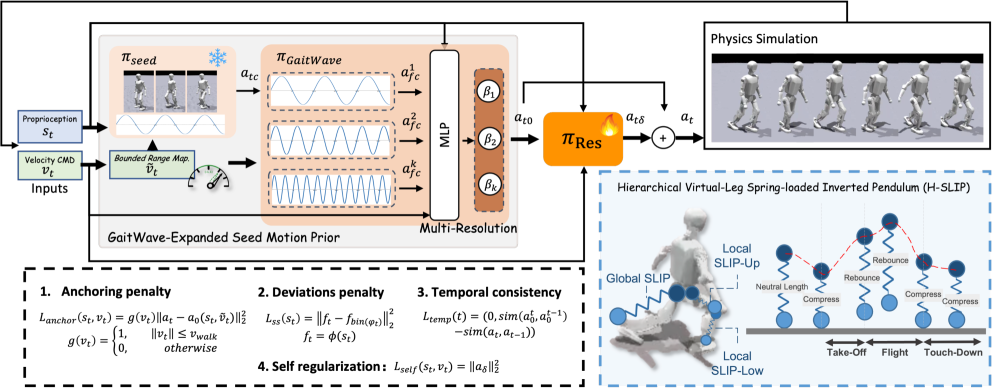
Figure 2: GaitSpan framework. GaitWave grows rhythm via hierarchical composition of seed-derived action waves, H-SLIP shapes dynamic stride events, and a residual branch provides additional adaptation.
2.2 GaitWave: Hierarchical Rhythm Growth
The vanilla seed-residual architecture queries the seed policy only within its walking domain, forcing all growth toward dynamic regimes through the residual — insufficient as shown in experiments. GaitWave grows the seed policy into a family of command-conditioned action waves.
Key idea: Apply $K$ internal rhythm transforms $\mathcal{T}_{k}(\cdot)$ to the frozen seed policy, obtaining $K$ seed-derived actions. Hierarchical memory $\mathcal{M}_{\psi}^{l}$ produces composition coefficients $\boldsymbol{\alpha}^{\psi}_{t}$:
$$\mathbf{\beta}^{(L)}_{t,j}=m^{(L)}_{\psi,j}\left(\mathbf{s}_{t},\mathbf{v}_{t}\right)\in\mathbb{R}^{K}$$The hierarchy $\mathcal{H}=\{2,4,\cdots,l\}$ uses $L$ learnable memory units per resolution, ensuring both global coherence and local expressiveness. Soft blending at boundaries avoids discontinuities. The aggregated coefficient field $\boldsymbol{\alpha}_{t}=\sum_{L\in\mathcal{H}}\omega^{(L)}_{t}\boldsymbol{\alpha}^{(L)}_{t}$ produces the action wave:
$$\mathbf{a}^{\mathrm{wave}}_{t}=\mathbf{a}^{\mathrm{seed}}_{t}+\sum_{k=1}^{K}\alpha_{t,k}\mathbf{a}^{\mathrm{seed}}_{t}$$
flowchart TB
    subgraph Seed["Frozen Walking Policy"]
        S1[s_t + v_t] --> SP[pi_seed]
    end
    subgraph GW["GaitWave"]
        T1[T_k transforms] --> SA1[Seed actions]
        SA1 --> HM[Hierarchical Memory]
        HM -->|alpha| CO[Composition]
        CO --> AW[Action wave]
    end
    subgraph HS["H-SLIP"]
        VL[Virtual Leg l]
        VL --> CR[Compression + Rebound + Flight]
        CR --> RE[Dynamic Reward]
    end
    SP --> T1
    AW --> SUM[a = a_wave + a_res]
    RE --> SUM
    SUM --> ROBOT[Humanoid Robot]
2.3 H-SLIP: Hierarchical Virtual-Leg Dynamic Shaping
Rhythmic expansion alone doesn't guarantee physically meaningful dynamic gaits at high speeds. H-SLIP draws inspiration from the Spring-Loaded Inverted Pendulum (SLIP) model, defining three virtual-leg levels per foot $i$:
$$\ell^{\mathrm{root}}_{t,i}=\left\|\mathbf{p}^{\mathrm{root}}_{t}-\mathbf{p}^{\mathrm{foot}}_{t,i}\right\|_{2},\quad\ell^{\mathrm{upper}}_{t,i}=\left\|\mathbf{p}^{\mathrm{root}}_{t,i}-\mathbf{p}^{\mathrm{knee}}_{t,i}\right\|_{2},\quad\ell^{\mathrm{lower}}_{t,i}=\left\|\mathbf{p}^{\mathrm{knee}}_{t,i}-\mathbf{p}^{\mathrm{foot}}_{t,i}\right\|_{2}$$Compression and rebound terms using temporal changes in virtual-leg length, modulated by contact $c_{t,i}$:
$$r^{x}_{\mathrm{comp},t}=\sum_{i}c_{t,i}\operatorname{ReLU}\left(-\dot{\ell}^{x}_{t,i}\right),\quad r^{x}_{\mathrm{reb},t}=\sum_{i}c_{t,i}\operatorname{ReLU}\left(\dot{\ell}^{x}_{t,i}\right)$$Rebound is gated by velocity tracking $g^{\mathrm{track}}_{t}=\exp\left(-\frac{\left\|\mathbf{v}^{\mathrm{base}}_{t,xy}-\mathbf{v}_{t,xy}\right\|_{2}^{2}}{\sigma_{\mathrm{track}}^{2}}\right)$ to contribute to commanded locomotion rather than task-irrelevant bouncing.
3. Experiments
3.1 Setup
Evaluated on five humanoid configurations: Unitree G1 (29/23 DoF), Booster T1 (29/23 DoF), Booster K1 (22 DoF). Trained with 4096 parallel environments in IsaacGym; sim-to-sim evaluation on MuJoCo. Metrics: Tracking Error, Flight Time, Energy (joint torque-velocity product integral).
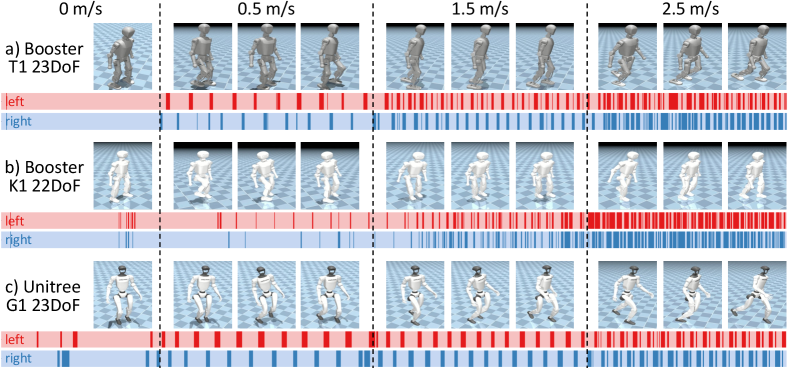
Figure 3: Emergent gaits across speeds and embodiments. Foot-contact plots show smooth transitions from standing/walking to increasingly dynamic flight-producing patterns.
3.2 Gait Emergence
As commanded speed increases, GaitSpan exhibits continuous progression from stable walking to longer-stride jogging and running. Low speeds produce regular alternating support with minimal flight; high speeds show reorganized contact frequencies and denser contact-flight transitions.
Key finding: gait emergence is embodiment-specific. At the same speed, Booster T1, K1, and G1 exhibit distinct foot-contact patterns — GaitSpan doesn't impose a unified gait schedule but provides a shared skill-growth principle allowing each embodiment to develop its own locomotion patterns.
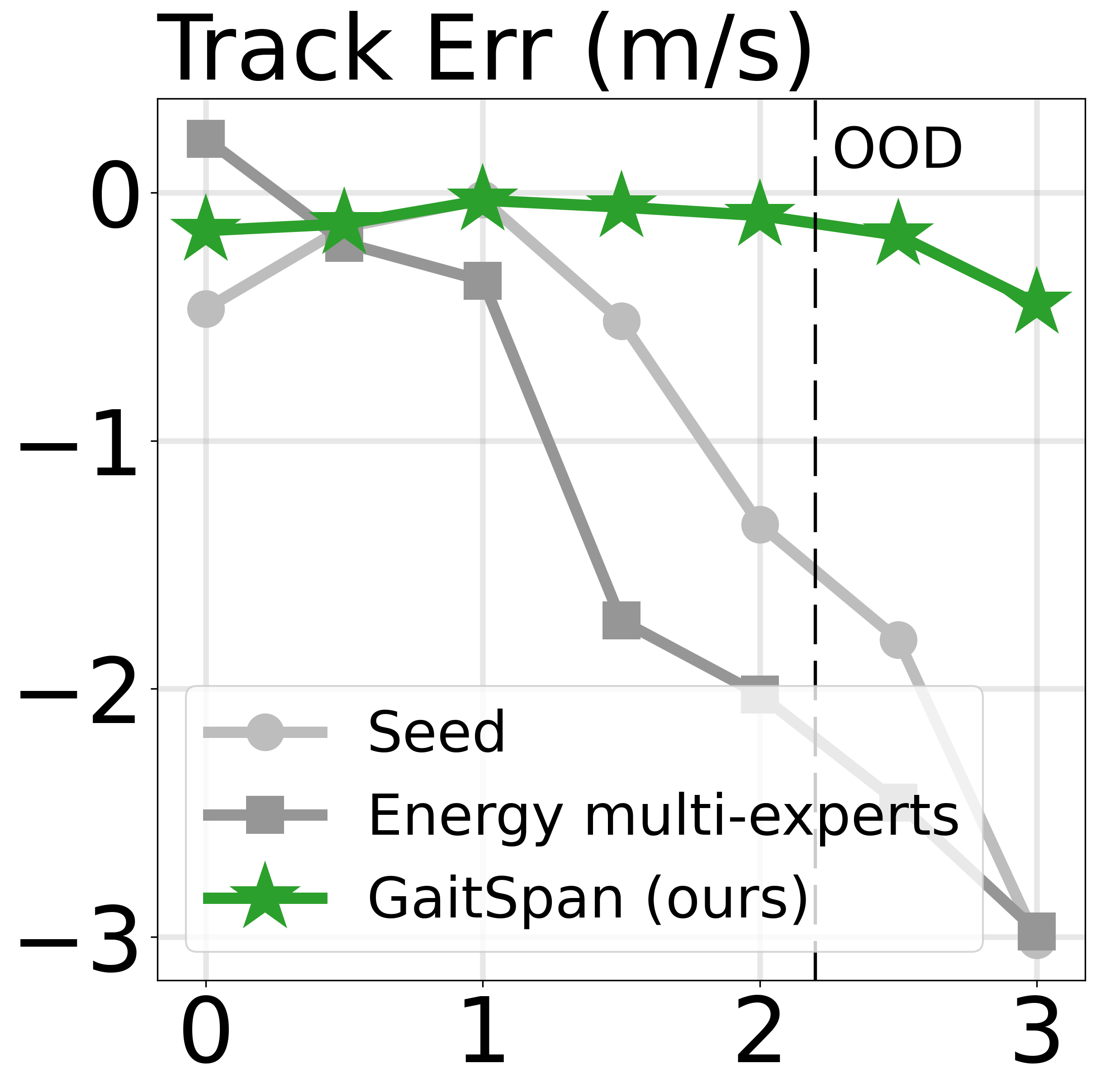
Figure 4: Tracking accuracy and dynamic gait emergence across three embodiments. GaitSpan maintains low tracking error while developing substantial flight time at high speed.
3.3 Baseline Comparison
| Baseline | Tracking Error | Flight Time | Energy |
|---|---|---|---|
| Walking seed (extrapolation) | Severe degradation | ~None | — |
| Energy multi-experts | High-speed degradation | ~None | Conservative |
| Human demo (AMP) | Moderate | Moderate | Higher |
| GaitSpan | Lowest across range | Increases with speed | Lowest for most range |
Three findings: (1) Gait emergence doesn't sacrifice command tracking. (2) Growing gaits from one walking skill is more effective than assembling energy-shaped experts. (3) Seed-skill growth can be more command-responsive than human-motion priors.
3.4 Ablation Study
| Component | Tracking | Flight | OOD Robustness |
|---|---|---|---|
| Vanilla seed-residual | Medium | Low | Poor |
| GaitWave only | Slightly lower | Limited | Insufficient |
| H-SLIP only | Degrades at speed | High | Poor |
| Full GaitSpan | Low | Progressive | Strong |
GaitWave and H-SLIP are complementary: GaitWave provides structured command-conditioned rhythm expansion, while H-SLIP supplies the physical bias to organize that expansion into controlled dynamic strides.
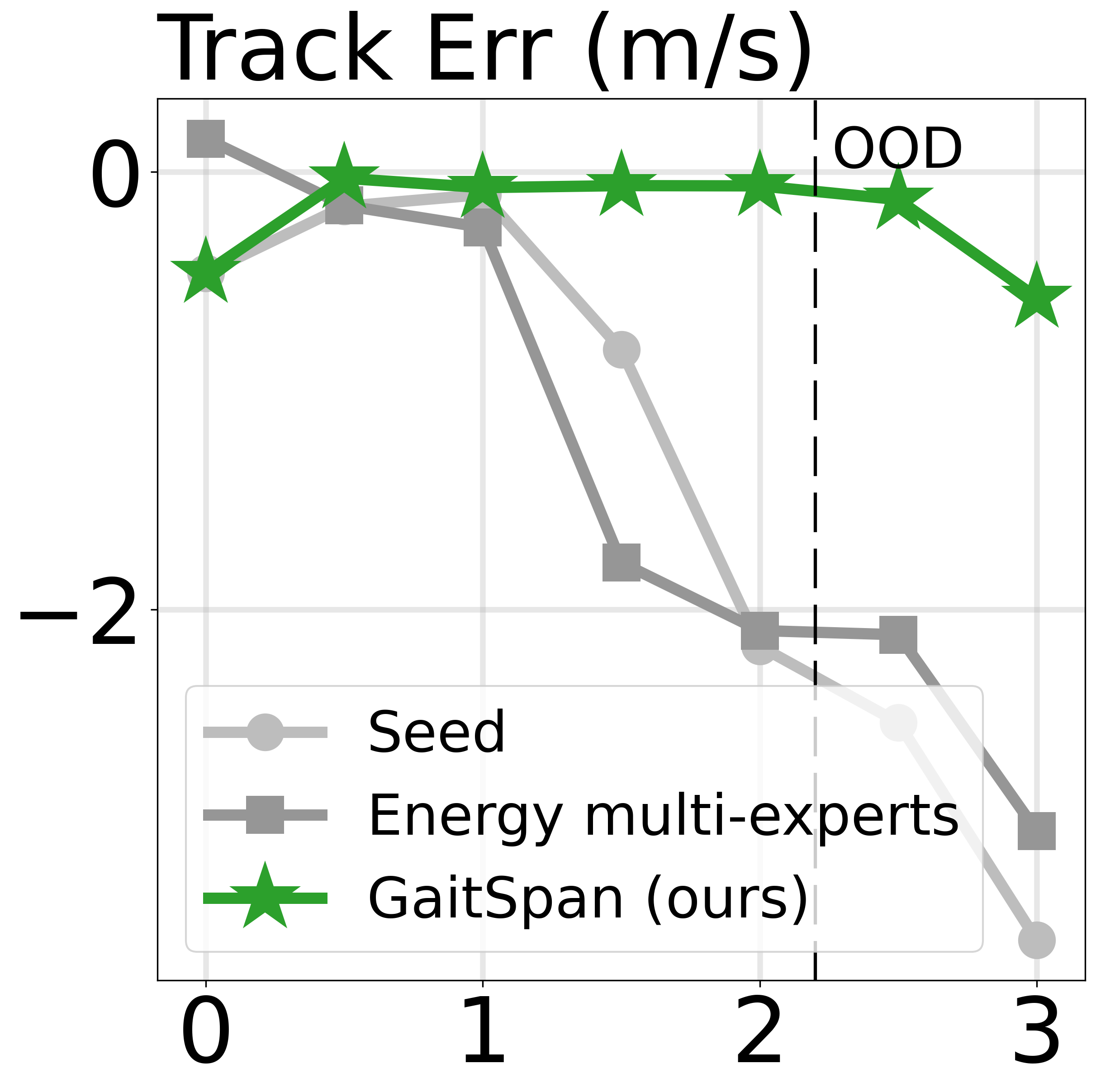
Figure 6: Ablation study of key components and training strategies on Booster T1.
4. Discussion
GaitSpan demonstrates the viability of "skill growth": acquired motor skills need not remain training endpoints but can serve as seeds for structured expansion into richer behavior families. Cross-embodiment transfer is a significant finding — the same growth principle lets different morphologies develop their own gait patterns rather than imposing a unified schedule.
5. Limitations
Author-stated: GaitSpan depends on the quality and coverage of its walking seed. It demonstrates one-step skill growth (walking→jogging→running) rather than continual self-expansion that folds newly acquired behaviors back into the seed.
Independent assessment: While covering the walking-to-running continuum, GaitSpan doesn't address lateral movement, turning, stair climbing, or more complex locomotion modes. The SLIP abstraction in H-SLIP may also have limited applicability on non-flat terrain.
6. Conclusion
GaitSpan grows a humanoid's foundational walking skill into a broader locomotion repertoire through GaitWave rhythm generation, H-SLIP stride shaping, and residual adaptation. The core contribution is not yet another gait controller but a demonstration that learned motor skills can transcend training endpoints — when treated as seeds for structured expansion, they generate richer families of related humanoid behaviors.