Skip to content
Juno: Taming Predictive Latents for Vision-Language-Action Models

Juno: Taming Predictive Latents for Vision-Language-Action Models

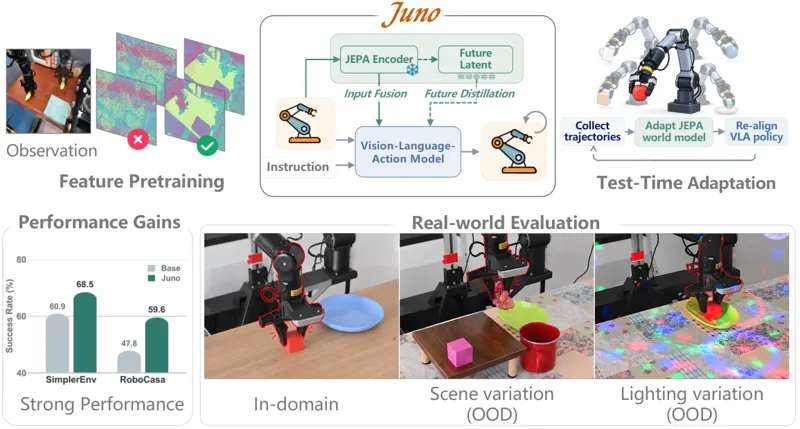
Joint-embedding predictive architectures (JEPAs) predict masked or future observations in representation space, offering a natural source of predictive latents for vision-language-action (VLA) models. Yet making these latents useful across pretraining, policy learning, and deployment requires addressing three failures: mismatch with embodiment-specific control, interference with action learning, and teacher miscalibration under distribution shifts. We introduce Juno, a unified framework built around one action-conditioned JEPA that serves as a control-aligned representation backbone, a predictive teacher, and an adaptable dynamics model. During pretraining, we train it on embodiment-matched trajectories and use a dynamic CLS loss to transfer motion-weighted patch dynamics to a compact global state. During policy learning, we fuse current-frame JEPA patches into VLA perception and use a decoupled reasoning branch with separate transformation parameters to distill future latent states for action generation. During deployment, we adapt the world model on all observed transitions, including failed rollouts, freeze the adapted teacher, and re-align the policy on verified executions using LoRA adapters and a trainable action head, without expert corrections or task rewards. On SimplerEnv, Juno raises average success from 60.9% to 68.5% over Qwen3GR00T, the strongest baseline, and test-time adaptation further reaches 72.7%; on a real robot, it retains 70%–75% success under background, height, and object shifts where the base policy collapses to 0%.

Vision-language-action (VLA)World Models
Yuchen Zhu, Chenyi Xu, Yulin Zhang · 347 views · Oct 7, 2026
LoopWAM: Closed-Loop Generalist Policy Improvement from Deployment Rollouts

LoopWAM: Closed-Loop Generalist Policy Improvement from Deployment Rollouts

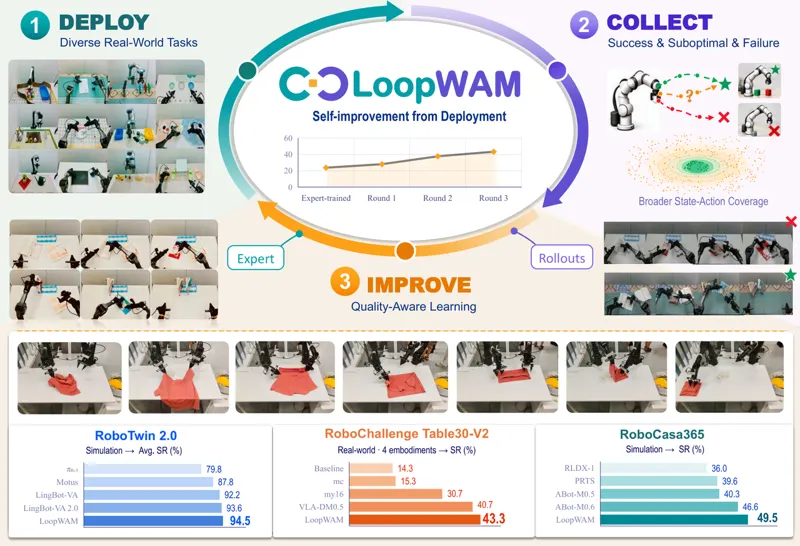
Scaling expert demonstrations alone does not enable generalist robot policies to improve from deployment. Real-world rollouts contain successes, suboptimal behavior, and failures: imitating every recorded action can reinforce poor behavior, while filtering out failures discards evidence of physical interactions and their consequences. We introduce LoopWAM, a closed-loop world-action model that learns directly from this full quality spectrum, using rollouts from both itself and other deployed policies. Source-dependent noise sampling unifies behavior learning and action-conditioned world modeling, while quality steering and quality-weighted supervision retain full video supervision across qualities and regulate action imitation. Video and action tokens interact throughout parallel denoising, allowing learned consequences to inform action generation directly. On RoboChallenge Table30-V2, three deployment-and-training rounds raise success from 23.67% to 43.33%, a 19.7-percentage-point gain, with a final score of 56.80. LoopWAM also achieves 94.5% average success on RoboTwin 2.0 and 49.5% overall success on RoboCasa365 without additional embodied pretraining, obtaining the best overall results among the compared methods across all three benchmarks. On challenging shirt folding task, two rounds of deployment-driven improvement after single-task post-training raise success from 13.20% to 55.56%. These results demonstrate closed-loop improvement from mixed-quality experience under both multi-task learning and single-task post-training. Project page: https://loop-wam.github.io/

World-action modelsSelf-Improvement
Wenxuan Guo, Yingping Liang, Zhaoguo Wang · 555 views · Oct 13, 2026
PanTact: Teaching Whole-Body Dexterity with a Wearable Contact Interface

PanTact: Teaching Whole-Body Dexterity with a Wearable Contact Interface

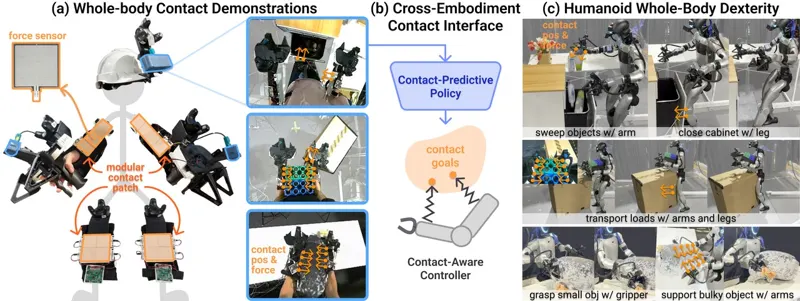
PanTact treats contact, not joint trajectories, as the transfer currency from people to humanoids. Wearable patches are assembled magnetically from 44x44 mm FSR modules; a custom 50x50 mm PCB streams 16 channels at 1 kHz over a CRC-checked RS-485 daisy chain, one Vive tracker per patch maps sensor centers into the world frame, and contact states are binarized against a per-channel adaptive baseline with threshold max(0.35 beta, r_min). The policy observes body-masked 3D egocentric point clouds, both wrist images and proprioception, and at 10 Hz predicts an action chunk of H=16 steps containing a look-at point, EEF poses with gripper widths, and per-sensor contact goals (binary state plus 3D position). A soft-minimum proximity d(p,q) with T = 0.02 m hands each active contact to whichever robot surface is currently nearest, and active goals are offset by delta along the pressing direction to form virtual goals that generate pressing force, so the G1 holds objects without any tactile sensor on its body. Three control formulations trade off differently: training-free upper-body IK, WBIK whose dense reference is executed by SONIC, and a sparse contact tracker trained with PPO over 4096 simulation environments for 30k iterations (50 Hz, 29 joints, S=8 upper-body / S=16 whole-body contact slots). On a 29-DoF Unitree G1: Grasp-and-Embrace reaches 85% with upper-body IK and 80% with the sparse tracker against 0% for Humanoid UMI; Sweep-and-Stow reaches 90.63% end to end while Humanoid UMI++ scores 18.75% on each stage and 0% end to end; Carry-and-Push is 90% versus 40%. In simulation replay, adding contact goals lowers contact distance for all three controllers at almost no cost in EEF accuracy.

Whole-Body ManipulationTactile Sensing
Xu, Xiaomeng, Zhang, Han, Ruan, Zhian · 770 views · Oct 8, 2026
MobileVISTA: Generative Data Augmentation for Pose Generalization in Mobile Manipulation

MobileVISTA: Generative Data Augmentation for Pose Generalization in Mobile Manipulation

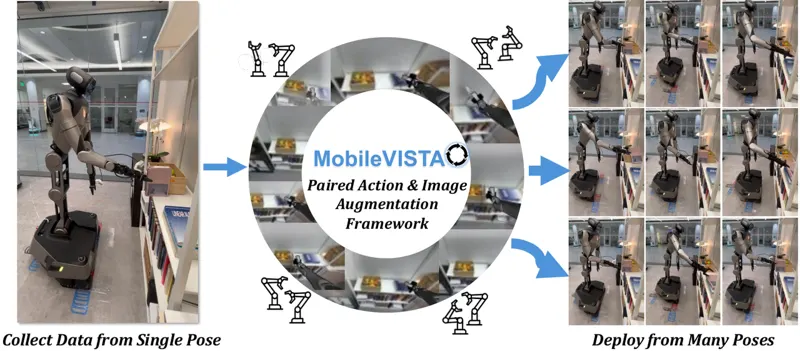
Mobile manipulators such as humanoid robots are increasingly deployed in dynamic, unstructured environments to perform dexterous manipulation tasks. However, end-to-end manipulation policies trained to imitate demonstration data collected from a single robot pose are brittle: even centimeter-scale deviations in robot pose at deployment can drive ego-centric observations and end-effector trajectories out of the training distribution, leading to sharp drops in performance. We introduce MobileVISTA, a data generation framework that transforms demonstrations captured at canonical poses into diverse, pose-perturbed training data by jointly (1) augmenting egocentric visual observations and (2) retargeting actions to compensate for base pose changes. Unlike prior methods, which assume a camera rigidly mounted off the actuated chain or non-trivial articulated robot geometry largely out of frame, MobileVISTA targets compatibility with egocentric platforms (e.g., humanoids) where the camera is both influenced by and must observe the robot's kinematic chain as it moves. We study MobileVISTA in simulated tasks spanning humanoid and bimanual embodiments, and on a real Galaxea R1 Pro. We find policies trained on MobileVISTA-augmented data demonstrate improved robustness to previously out-of-distribution poses encountered at test time, without additional demonstration collection or a trained generative model. Additionally, we find MobileVISTA's benefit is largest on tested humanoids, where the camera rides the actuated chain and the robot fills much of the frame. Additional videos and appendix can be found on our website: https://mobilevista.github.io

Mobile ManipulationData Augmentation
Wistreich, Suzannah, Tian, Stephen, Huang, Isabella · 443 views · Oct 5, 2026
RoboPrompt: Intuitive Robot Policy Steering with Sparse Human Input

RoboPrompt: Intuitive Robot Policy Steering with Sparse Human Input

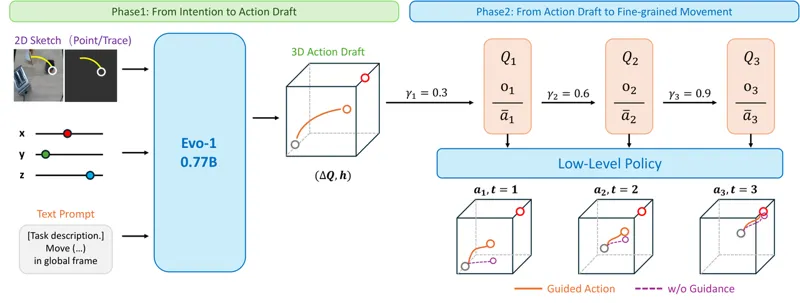
End-to-end robot policies trained through imitation learning remain constrained by limited data diversity, making reliable zero-shot deployment in real-world settings challenging. Shared-autonomy methods enable human correction through teleoperation, but specialized hardware and operator training hinder deployment at scale. Other approaches incorporate human guidance as additional policy inputs, often requiring architectural changes and dedicated training for steerability, which limits their applicability across policies. We present RoboPrompt, a general-purpose, lightweight robot policy steering system that enables users to guide policy behavior through intuitive, sparse inputs, including drawn traces, target points, and coarse directional instructions. RoboPrompt decouples human-intention translation from the underlying policy: a reusable module converts human guidance into action drafts, which are refined through the diffusion or flow-matching dynamics of the base policy. By controlling action generation in noise space, RoboPrompt balances human intent with the policy prior without modifying the base policy architecture or fine-tuning it for steerability. Experiments demonstrate effective steering across Diffusion Policy, π_0.5, and FastWAM. We further use steered rollouts for online policy improvement through DAgger. After 2-3 rounds of iteration, average success rates increase by 15.5% for π_0.5 across three tasks and by 21.3% across three policies(Diffusion Policy, π_0.5, FastWAM) on the Insert Bread task, while average human intervention counts decrease by 44.0% (2.86 to 1.60) and 81.9% (2.60 to 0.47), respectively.

ManipulationImitation Learning
Yanwen Zou, Chenyang Shi, Guoxuan Xu · 668 views · Oct 7, 2026
HIL-UMI: Bringing Human-in-the-Loop Post-Training of Vision-Language-Action Models to Universal Manipulation Interface

HIL-UMI: Bringing Human-in-the-Loop Post-Training of Vision-Language-Action Models to Universal Manipulation Interface

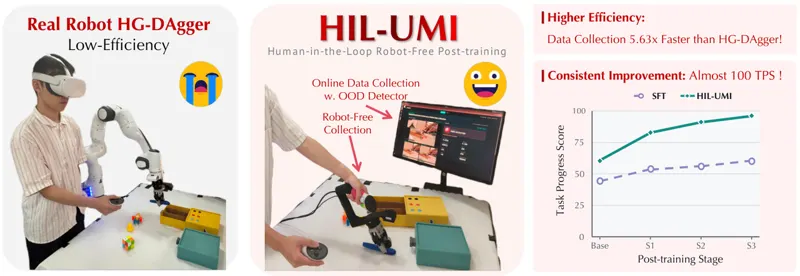
Large-scale vision-language-action (VLA) models provide powerful priors for robot manipulation, yet adapting them to a specific deployment remains challenging. Supervised fine-tuning (SFT) on task-specific demonstrations provides a step toward deployment, but faces two persistent limitations: static data provide limited coverage of out-of-distribution states, and standard imitation objectives do not distinguish progressing behavior from less useful data. Interactive post-training can address these limitations, but typically requires repeated policy execution and human intervention on a physical robot. We introduce HIL-UMI, a policy-guided Universal Manipulation Interface (UMI) framework for robot-free human-in-the-loop VLA post-training. During handheld UMI demonstrations, HIL-UMI queries the current policy on the same observation stream without executing its predictions. The Energy Score compares the human action trajectory with policy inference and triggers collection when their discrepancy indicates an out-of-distribution region. In a separate feedback loop, low online advantage predictions identify essential segments for refining a progress-based advantage estimator. The updated estimator then guides advantage-conditioned behavioral cloning using a balanced mixture of base demonstrations and new policy data. This design preserves the iterative and policy-aware nature of human-in-the-loop learning while decoupling data collection from robot deployment. Experiments on four real-world tasks spanning long-horizon and precise manipulation show that HIL-UMI achieves consistent improvement over SFT and benefits from both targeted collection and advantage refinement. Moreover, HIL-UMI outperforms HG-DAgger on Clean Up Table with lower per-frame collection time, suggesting a scalable path for VLA post-training across operators and locations.

VLAHuman-in-the-Loop
Han, Zimu, Zeng, Yiming, Zhang, Jiyao · 1.4k views · Sep 17, 2026
HiFi-UMI: Learning Deployable Manipulation Policies from High-Fidelity UMI Data Alone

HiFi-UMI: Learning Deployable Manipulation Policies from High-Fidelity UMI Data Alone

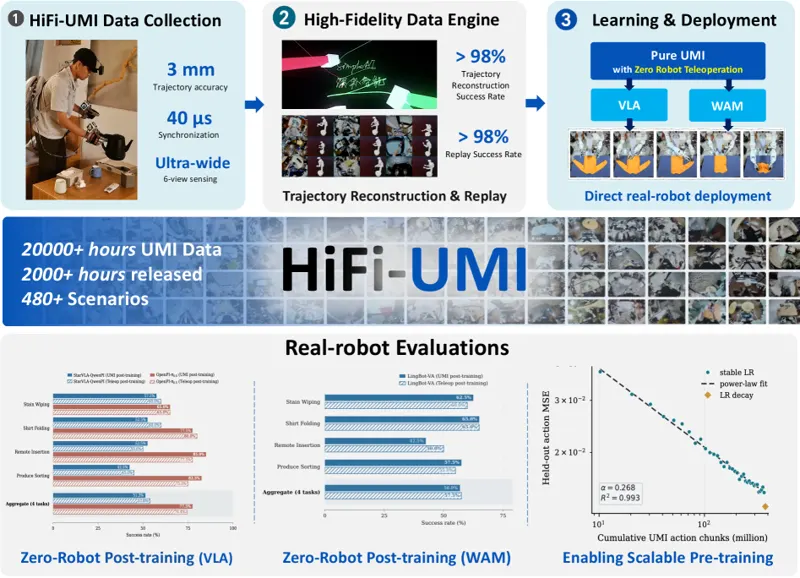
Learning deployable manipulation policies is bottlenecked by the scarcity of data that is both high-fidelity and scalable. Real-robot teleoperation is accurate but costly to scale; robot-free UMI capture scales readily, and current practice uses the resulting data mainly for pre-training, adding a small real-robot "anchor" at post-training. We ask whether raising the fidelity of robot-free UMI data, rather than shrinking the real-robot fraction, can remove that anchor. We present HiFi-UMI, a portable UMI data-production system co-designed for trajectory accuracy, inter-gripper relative pose, synchronization, and field of view: head-mounted offline stereo-inertial SLAM, native rather than reconstructed relative pose, a shared microsecond GPIO trigger, and two wide-angle cameras per hand covering ~200 degrees. It reaches 3 mm workspace-local end-effector accuracy without external tracking infrastructure. Using this corpus, we demonstrate zero-robot post-training: a policy post-trained solely on HiFi-UMI demonstrations deploys directly on a real robot and matches in-domain teleoperation across three backbones spanning the vision-language-action and world-action-model families, with success-rate differences of -2.5, +3.1, and -0.6 percentage points on StarVLA-QwenPI, OpenPI-pi_0.5, and LingBot-VA; the strongest policy reaches 85% on a precision insertion task, even though the teleoperation baseline is collected in the evaluation scene and no HiFi-UMI trajectory is. Pre-training on 4,000 hours from the same corpus lowers action error on ten unseen tasks by 41% and, on StarVLA-QwenPI, raises real-robot success by a further 18.1 percentage points. We open-source HiFi-UMI-2K, 2,000 hours of microsecond-synchronized, ultra-wide-FoV demonstrations, each automatically reconstructed and validated through simulation replay, as a large-scale, high-fidelity resource for the robot-learning community.
UMIVLA
Simple AI, :, Yuteng Wei · 622 views · Jul 28, 2026

As an Amazon Associate, we earn from qualifying purchases.