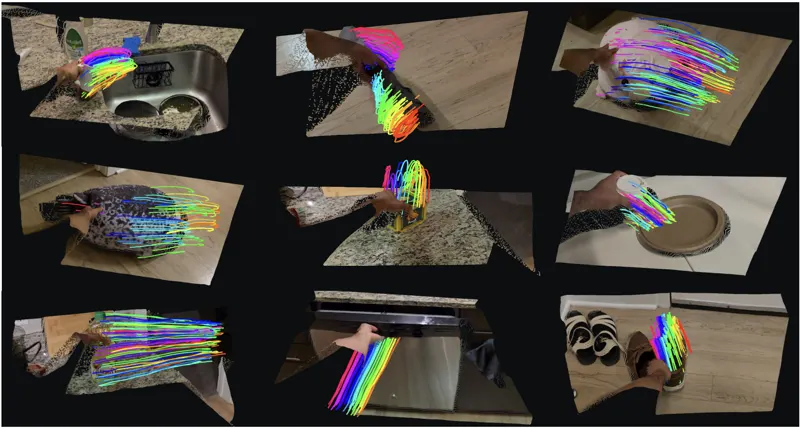
Humans can infer how objects are likely to move from passive observation: a cup may be lifted, a drawer may slide, and a lid may rotate shut. Such predictions expose the physical consequences of interaction needed to act in the real world. We study how to learn this anticipation from ordinary monocular videos of human-object interaction. Given a short observed video context, MotionForesight predicts future 3D trajectories for points on the manipulated object. This casts interaction prediction as object-centered 3D motion forecasting without any assumptions on the object properties. Our key insight is that video prediction models already encode rich priors about how objects move during human interactions. We redirect these priors from pixel prediction toward future 3D scene flow. We start from a dense 3D tracker built on a pretrained video model, generate pseudo-ground-truth tracks from complete clips, and train the forecaster using only the observed frames. We replace future RGB and geometry with learned mask latents and train a lightweight adapter to turn the retrospective tracking representation into a forward predictor, while freezing the large video and tracking components. Using just 40k human videos and no auxiliary inputs such as language, MotionForesight generalizes across diverse out-of-distribution objects, environments, viewpoints, and interactions. It also outperforms substantially larger models that use over a million training videos. These results show that we can efficiently re-purpose video priors into explicit geometric forecasts for embodied intelligence. https://motionforesight.github.io/
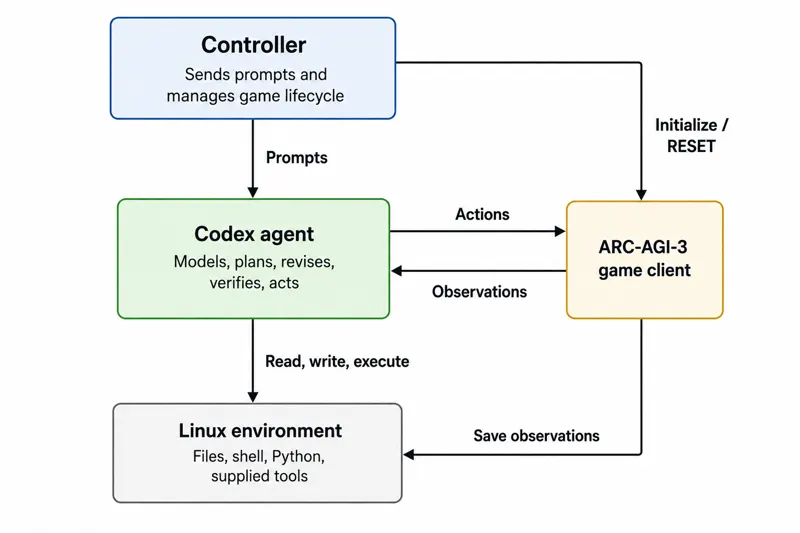
Our previous ARC-AGI-3 agent bundled executable world modeling, scheduled simplification, and exact replay verification, leaving unclear which idea accounted for its performance. We address this attribution question with four nested Codex-based agents: a textual baseline; a flexible-interface executable world model without replay verification; the same executable model with scheduled simplification; and a fixed-interface verification treatment that retains simplification and requires exact reproduction of recorded observations. The main study evaluates all four agents with gpt-5.4 and gpt-5.5 at high and xhigh reasoning effort on the public ARC-AGI-3 games. Exploratory follow-ups evaluate the textual and verification variants with gpt-5.6-sol at xhigh and max. The most robust result is that every agent variant improves with a stronger model and with greater reasoning effort. Within each model-effort setting, differences among variants are smaller than anticipated, while the effects of individual components vary across settings. Requiring a persistent executable deliverable is not universally beneficial: the textual variant outperforms the flexible-interface executable variant in both gpt-5.5 settings. Simplification improves performance in three of the four model-effort settings, with the weakest setting as the only exception. The complete verification treatment ranks first in all four settings, although it uses substantially more resources. In the gpt-5.6-sol follow-up, the verification variant fully solves every public game at both reasoning efforts, achieves about 99% RHAE, and uses fewer than half the total actions of the human baseline. Because the model postdates these games and held-out performance remains untested, this result should be interpreted as saturation of the public set only.
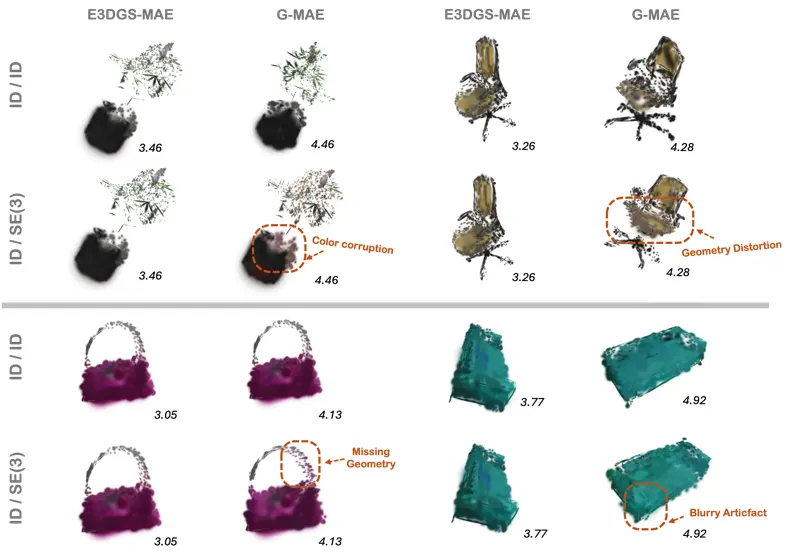
3D Gaussian Splatting (3DGS) captures scenes by coupling explicit geometry (position, covariance) with view-dependent photometry (Spherical Harmonics). However, building SE(3)-equivariant architectures on these primitives presents a fundamental representation bottleneck. Color has been treated as a signal rather than a geometric entity, making it nontrivial to unify symmetry across geometry and appearance as the camera frame changes. While translations are handled by relative coordinates, rotations act heterogeneously across attributes: μ↦ Rμ, Σ↦ RΣR^, and f_ℓ↦ D^ℓ(R)f_ℓ. This mismatch complicates strict equivariance, leading existing methods to either discard or flatten SH coefficients, thereby breaking symmetry. We propose a unified solution rooted in representation theory: for SH degrees ℓ≤2, photometry is algebraically isomorphic to a rank-2 geometric tensor. We prove that the Wigner-D action on these SH coefficients can be exactly reformulated as the conjugation action on 3×3 matrices. Leveraging this, we introduce the Unified Matrix Embedding, a lifting that maps all Gaussian attributes into a unified carrier space, gl(3). Building on the "Color-as-Geometry" formulation, we present E3DGS, a rigid-body (SE(3)) equivariant architecture that processes 3D Gaussians without Clebsch-Gordan tensor products. Evaluations on object vision and action-conditioned Gaussian world modeling demonstrate that our unified approach yields strong robustness under camera-frame changes and improved data efficiency.
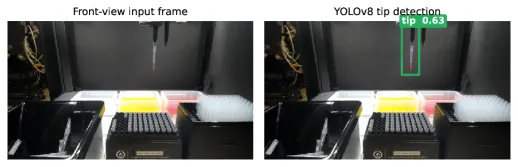
Self-driving laboratories increasingly rely on low-cost liquid handlers such as the Opentrons OT-2, which ship without the pressure-based aspiration monitoring of Hamilton or Tecan systems and are typically run open-loop. Two failure modes go undetected: protocols that are syntactically valid but violate assay-specific invariants (e.g., tip reuse between a PCR template and a no-template control), and physical execution failures (partial dispense, air bubbles, missing tips) at runtime. We present AEGIS, a two-layer guardian for both. Layer 1 pairs a curated machine-readable assay rule database with an LLM that reasons over OT-2 Python code, reaching an adjusted F1 of 0.97 on a 24-protocol benchmark across five assay families and beating rules-only and LLM-only ablations across five backends; a free open-weight model ties the best proprietary one, so no paid API is required. Layer 2 fits a PCA world model to YOLO-cropped four-frame pipette trajectories; under a leakage-free leave-one-plate-out evaluation it reaches average precision 0.89 and operating-point F1 0.71 (AUROC 0.80), a deployment-faithful number that matches the live demonstration, and we characterize the small-pipette (p20) resolution limit (F1 0.47). A live demonstration on a physical OT-2 (five replicates per condition) catches planted no-tip failures deterministically and partial dispense on coloured dyes, with an always-VLM self-vote gate lifting partial-dispense recall to 5/5; transparent water is a principled limit of any front-view-only monitor, which AEGIS surfaces as low-confidence VLM reasoning rather than a wrong verdict. Cascade triage holds VLM cost near $1.63 per plate versus $10.33 for an always-VLM baseline. AEGIS is open source and, to our knowledge, the first system to unify pre-flight assay-aware validation with runtime visual monitoring for an open-source liquid handler.
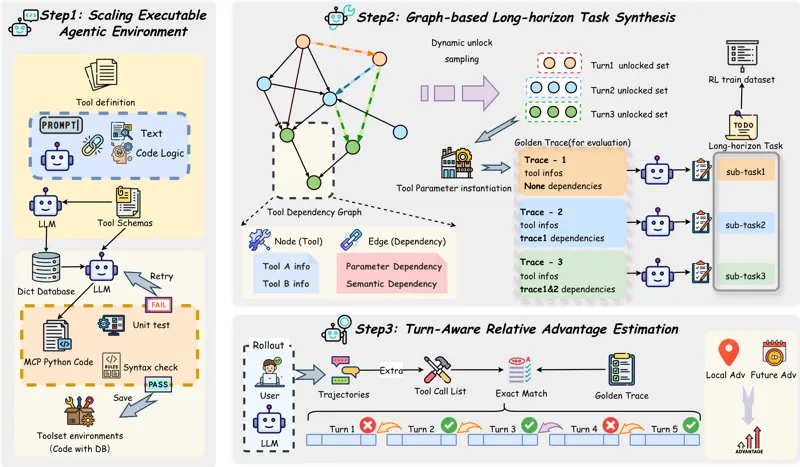
While LLM agents demonstrate strong reasoning abilities in compact and well-defined scenarios, they struggle to maintain robustness and effectiveness when faced with large-scale, diverse, and dynamic real-world environments that demand seamless tool integration. To address this gap, we introduce ToolVerse, a comprehensive framework that scales up agentic RL environments and enables agents to perform complex long-horizon reasoning in Tool-Integrated Reasoning (TIR) tasks. First, ToolVerse automatically builds the massive executable agent training environments from nearly 400 real-world Model Context Protocols (MCPs) that contain about 4500 tools. Second, we propose a task design strategy based on a tool dependency graph, utilizing Dynamic Unlocking Sampling Algorithm to generate long-horizon tasks, and produce GUST (Graph Unlocking Sampling Tasks) dataset. Third, to alleviate the credit assigment problem in long-horizon agentic RL, we propose a fine-grained Turn-Aware Relative Advantage algorithm. We conduct extensive Agentic RL training using ToolVerse and evaluate our framework on serveral agentic benchmarks. Experimental results demonstrate that our framework significantly strengthens LLMs' capabilities in long-horizon tool use, achieving a marked performance boost and showcasing robust reasoning within dynamic environments.
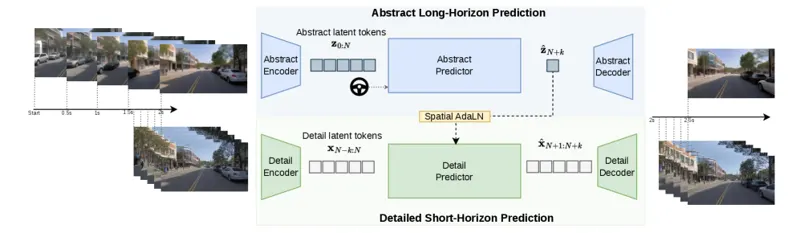
Current world models operate at a single level of abstraction, with most prioritizing perceptual fidelity while lacking the spatial reasoning and semantic understanding required for real-world downstream tasks. We present a hierarchical driving world model that factorizes future prediction across two levels operating at distinct temporal and abstraction scales: a high-level predictor that forecasts coarse scene structure over extended temporal horizons, and a low-level generator that produces detailed predictions conditioned on the high-level output. This decomposition yields high perceptual fidelity while also capturing strong spatial and semantic representations. We further show that pretraining with a diffusion forcing objective yields substantially richer internal representations than the standard teacher forcing objective, while teacher forcing – predicting only the next frame from clean context – produces more stable autoregressive rollouts. We therefore introduce a generic two-stage training paradigm that pretrains the model with diffusion forcing and fine-tunes with teacher forcing, combining the representational benefits of the former with the rollout stability of the latter. Our approach achieves state-of-the-art results across the standard suite of driving world model evaluations on established benchmarks, including long-horizon generation fidelity, steering responsiveness evaluated on counterfactual scenarios, and internal representation quality. Project page with code, demo, checkpoints and qualitative results: https://lmb-freiburg.github.io/orbis2.github.io/
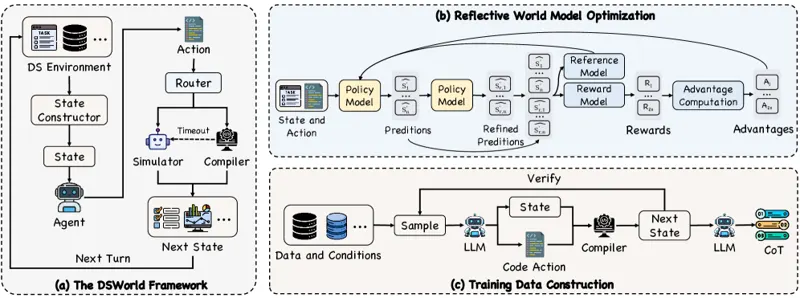
Despite strong capabilities in data understanding and decision-making, autonomous data science agents still heavily rely on trial-and-error workflows that involve expensive computation. This bottleneck motivates models that can anticipate the effects of data science operations before real execution. In this paper, we introduce the concept of Data Science World Model, which model the data science execution environment by predicting environment state transitions conditioned on current workflow states and candidate operations. We further propose DSWorld, a practical framework that combines structured state construction, cost-aware routing, lightweight real execution, and an LLM-based simulator for expensive operations. To support training, we construct an 8K-scale transition trajectory dataset and introduce Reflective World Model Optimization, an error-aware reinforcement learning strategy for improving transition prediction. Experiments show that DSWorld accelerates RL-based agent training by approximately 14× and search-based inference by approximately $3$-6× while maintaining competitive performance, and outperforms the strongest LLM baseline by 35.6% on transition prediction tasks. The code is available at https://anonymous.4open.science/r/DSWorld.
DexPoint uses point cloud representations for generalizable dexterous manipulation without CAD models, showing strong sim-to-real transfer.
GR00T N1 is NVIDIA's humanoid foundation model combining vision-language understanding with action generation for cross-platform transfer.
Octo is an open-source generalist robot policy using Transformers, enabling rapid fine-tuning across diverse robot platforms with multimodal inputs.
RT-2 converts pretrained VLMs into robotic policies, enabling zero-shot generalization to novel instructions and objects.
Helix is an end-to-end neural framework for humanoid whole-body perception and manipulation, achieving high generalization through large-scale sim data and real-world fine-tuning.