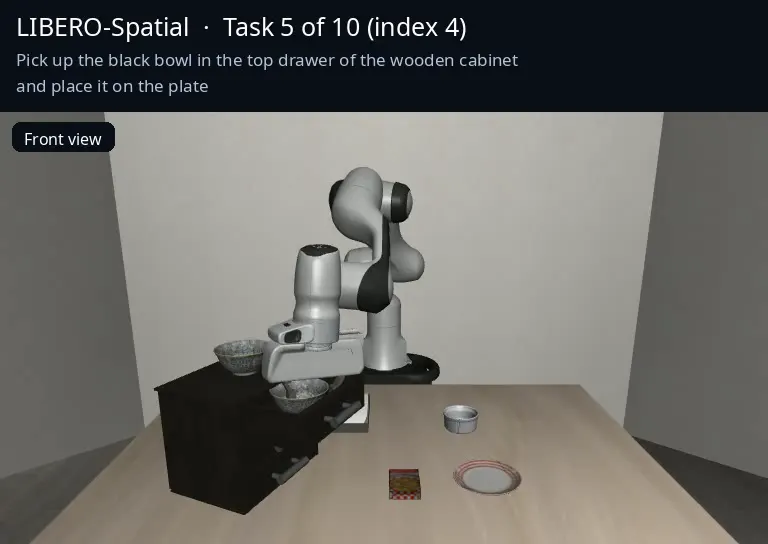
Many recent robot policies pursue stronger control by using large pretrained vision-language models (VLMs) as the action backbone. We introduce WorldDiT, a unified diffusion transformer architecture that couples action generation with visual world modeling and achieves strong performance without a large pretrained VLM action backbone. During training, a single diffusion transformer generates continuous action chunks and predicts normalized RGB patch targets from future camera frames. Across four LIBERO simulation suites, WorldDiT lies on the reported Pareto frontier for total model parameters and mean success among methods reporting all four suites. These results provide a strong sub-billion-parameter baseline for future scaling studies.
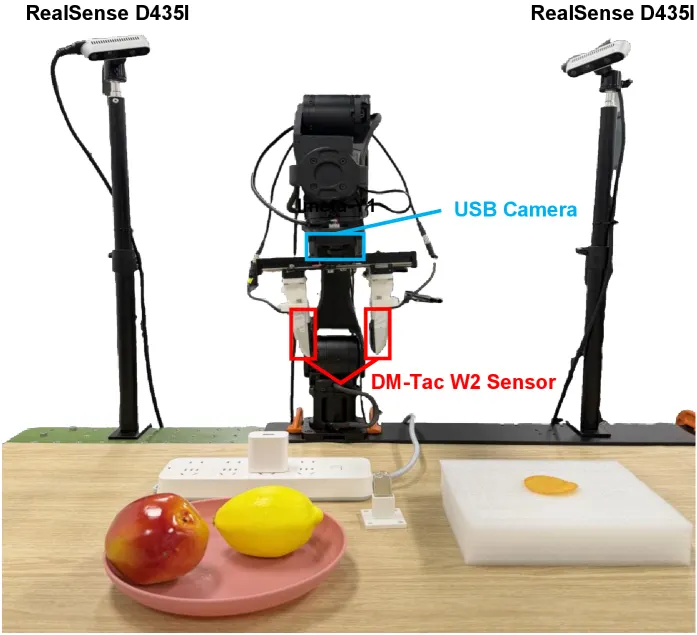
Humans plan physical interactions by imagining the possible outcomes of candidate actions. However, existing visual world models primarily capture appearance dynamics while overlooking the tactile states that govern contact-rich interactions, potentially producing imagined futures that appear visually plausible but violate physical dynamics. We introduce FeelWorld, a hierarchical visuo-tactile world model that jointly predicts future visual latents and three tactile states. FeelWorld organizes these states hierarchically as contact state, a 3D tactile latent that encodes force-related information, and slip state. These states are jointly predicted by a shared latent dynamics model with explicit supervision. To prevent irrelevant tactile signals during free-space motion from degrading visual prediction, we introduce a contact-gated asymmetric attention mechanism that maintains a visual-only prediction pathway before contact and enables joint visuo-tactile dynamics prediction during contact. The model is further trained with autoregressive rollouts and context noise injection to improve robustness to compounding errors. The predicted contact and slip states also support contact-aware CEM planning. Experiments on chip grasping, fruit grasping, and USB insertion show that FeelWorld reduces 10-step LPIPS from 0.084 to 0.058 and maintains an LPIPS that is 61% lower than that of the visual baseline after an 80-step autoregressive rollout. FeelWorld also achieves an average zero-shot planning success rate of 81.7%, providing an effective approach for incorporating tactile sensing into world models.
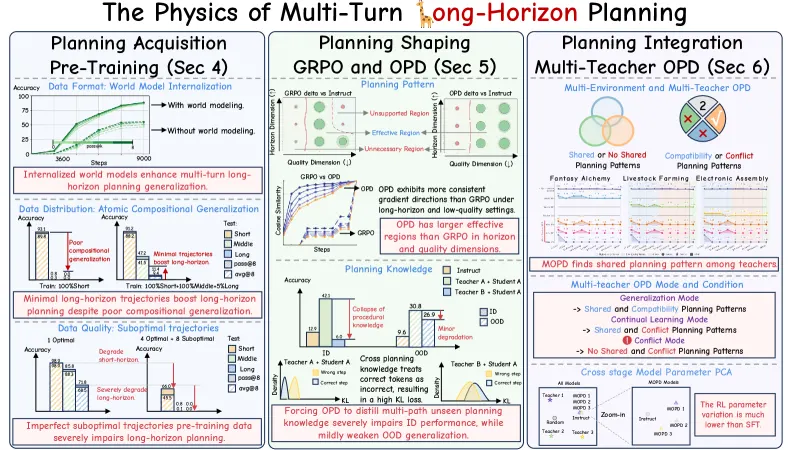
Multi-turn long-horizon planning is critical for foundation model agents, yet how to fundamentally improve it remains unclear. Existing models are trained on uncontrollable and opaque Internet data, making it difficult to identify how planning ability is acquired, shaped, and integrated. To address this challenge, we introduce a unified and controlled multi-turn environment that enables precise control. It allows systematically study long-horizon planning across three stages. (1) Planning ability acquisition during pre-training. We study data format, distribution, and quality. Explicit world model construction through CoT state transition modeling yields stronger long-horizon generalization. Atomic skills alone are insufficient for compositional generalization, whereas a litte long-horizon data works. Moreover, suboptimal trajectories severely impair performance because errors amplify over long horizons. (2) Planning ability shaping via GRPO and OPD post-training. Through mutual information, we distinguish general planning patterns from task-specific planning knowledge. For planning patterns, we identify three application regions of post-training: unnecessary, effective, and unsupported. OPD has a broader effective region than GRPO under low-quality and long-horizon settings, as it provides more consistent update directions. For planning knowledge, distilling unseen procedures from a teacher with different knowledge may impair student's prior world modeling without fully establishing new knowledge. (3) Planning ability integration through MOPD post-training. We show that multi-teacher on-policy distillation (MOPD) integrates capabilities by converging to shared planning-pattern across environments. Compatible patterns enable cross-environment generalization, partially shared patterns support continual learning, while completely conflicting patterns cause severe interference.
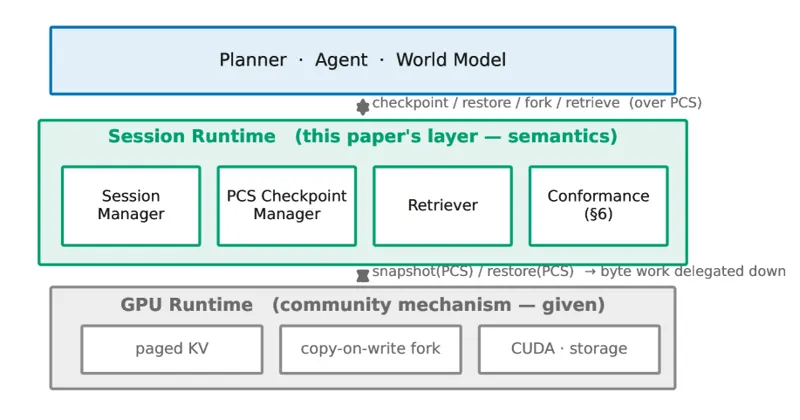
Generative world models are increasingly driven as simulators: a planner forks a state, rolls out futures, backtracks, and returns to a visited viewpoint. Recent benchmarks establish that current video world models fail this usage, and attribute it to the model, prescribing new architectures and training objectives. We show this attribution is incomplete, and for an important class of models simply wrong. Snapshotting the state the runtime already holds – an observation plus RNG state, a memory bank, or a windowed KV context, by architecture – and restoring it after a genuine excursion reproduces the never-left continuation byte-identically on all three; corrupting only the RNG degrades it. The capability was never missing: request-centric serving discarded it, inheriting from language-model serving the assumption that runtime state is recomputable – but world-model state carries a non-recomputable kernel. We define Persistent Computational State (PCS), the minimal non-recomputable state that must survive across requests, show it can be discovered by measurement, and build a session-centric runtime over it. Checkpoint and restore cost 0.012 ms against a 1.85 s generation step; resident sessions become host- rather than device-bounded (measured to 1,024); and world memory must be evicted by relevance to the return, not recency – the inverse of LLM practice.
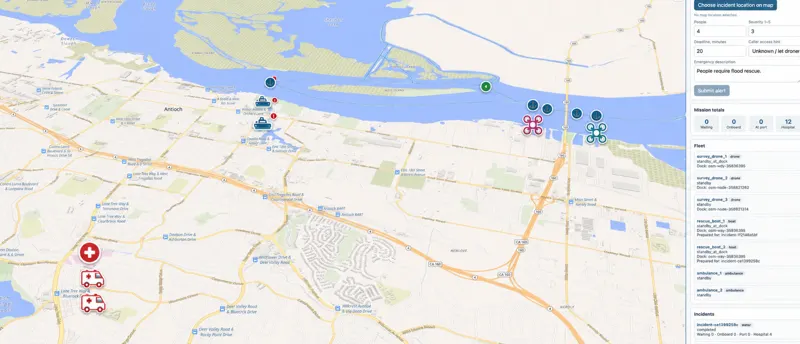
TRACE-RealWorld addresses a core data-management problem: maintaining an actionable materialized view over a continuously changing physical world when reads of the base state are priced, delayed, heterogeneous, and fallible. Its data-management contributions are a commitment-level validity abstraction for materialized predictions; consequence-conditioned adaptive view maintenance; transaction-style, dependency-scoped compensation for commitments invalidated after authorization; and append-only provenance supporting exact replay. The work builds directly on materialized-view maintenance, adaptive stream synchronization, transaction recovery, sagas, data freshness, and provenance. The end-to-end Flood-SAR evaluation treats sensing as physical data acquisition and measures freshness, verification cost, stale reads, recovery scope, restoration failure, and replayability through six pre-registered questions with held-out seeds. The contribution is therefore not a new predictive model, but a consistency, recovery, and accountability contract for deploying learned world representations as operational data systems.
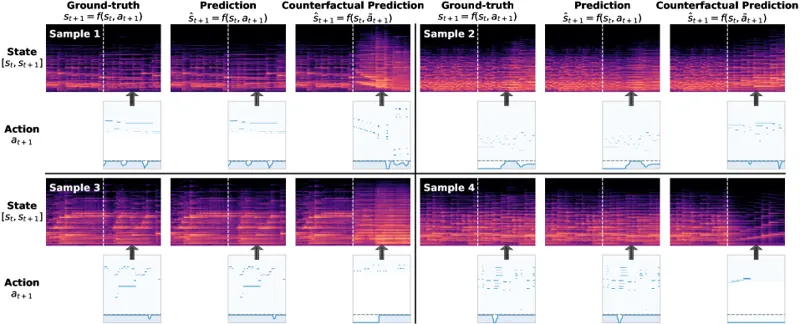
Joint Embedding Predictive Architectures (JEPA) have recently emerged as a paradigm for learning world models by predicting latent representations, offering a promising direction for self-supervised learning. While initial attempts have applied JEPA to the music domain, it remains unclear how such frameworks can naturally support the formation of a world model for music. In this work, we propose to learn a world model of piano sound using JEPA by framing music as an action-conditioned system: the audio is treated as the state, and the pianoroll as the instrument action. Given a current audio state and an action, the model predicts the resulting future audio state, mirroring how humans learn musical sound through interaction. The model is trained in a fully offline setting using paired audio-pianoroll data, without environment interaction. Experiments show that the learned model captures the relationships between musical actions and their resulting sound. The resulting representations support downstream tasks, including beat tracking, composer identification, and key estimation, and enable piano transcription via planning, by searching for actions that best explain a target sound.
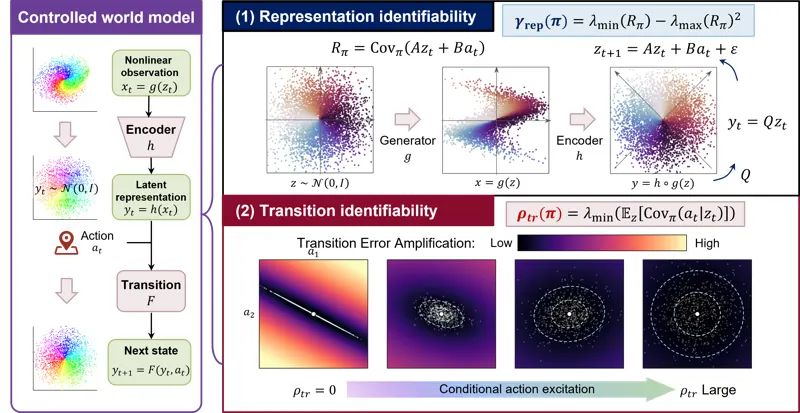
Learning world models that infer environment dynamics from high-dimensional observations and predict outcomes under candidate actions is central to planning and control. Joint-Embedding Predictive Architectures (JEPAs) provide a compelling framework for learning such models in representation space. Recent action-conditioned extensions perform promisingly in visual control and latent-space planning, but leave a fundamental question unresolved: when does controlled latent prediction identify both the underlying state and the controlled dynamics? This is challenging under nonlinear observations and behavior policies with limited conditional action variation, where state-dependent evolution and action effects can be statistically confounded. We establish a joint identifiability theory for controlled world models with Gaussian latent states under state-dependent Gaussian behavior policies. We identify two policy-dependent conditions: spectral separation of the predictable signal governs representation identifiability, while non-degenerate conditional action variation governs transition identifiability. We prove that when both conditions hold, every global minimizer of the JEPA objective identifies the latent state and controlled transition up to an orthogonal transformation. We further derive quantitative bounds on representation and transition identifiability under approximate optimization. Finally, we construct predictor perturbations along weakly excited action directions whose counterfactual-to-on-policy error ratio is the inverse transition-identifiability margin, revealing the cost of limited action coverage. Experiments across nonlinear observation maps and behavior policies corroborate the theory and demonstrate implications for transition identifiability, counterfactual prediction, and goal-conditioned latent planning.
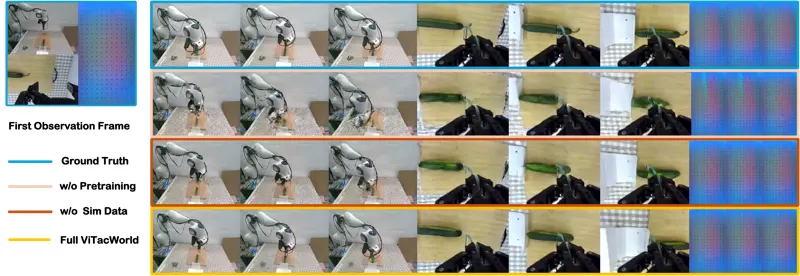
Contact-rich robot manipulation requires physical interaction cues that are often invisible to cameras, making tactile sensing essential for robust control. However, scaling visuo-tactile robot learning remains difficult because real tactile interaction data are expensive to collect, hardware-dependent, and limited in task and scene diversity. We present ViTacWorld, an action-conditioned visuo-tactile world model for scalable contact-rich robot manipulation. ViTacWorld leverages public real tactile datasets and a constructed simulation environment to scale visuo-tactile-action data, exploiting the fact that tactile signals are directly grounded in physical contact and can exhibit a smaller simulation-to-real gap than purely visual observations. The model is first pretrained with large-scale real and simulated visuo-tactile trajectories, and then finetuned with real-world policy rollouts to better match downstream manipulation behaviors. Given robot actions, ViTacWorld predicts temporally aligned visual observations and tactile feedback, enabling visuo-tactile-action rollout generation. To the best of our knowledge, ViTacWorld is the first framework that uses a world model for robot visuo-tactile-action trajectory generation and policy evaluation. It serves two roles: synthesizing rollouts to improve downstream tactile policies, and evaluating policies by predicting action-conditioned visuo-tactile outcomes under controlled action sequences. Experiments on contact-rich manipulation tasks show that ViTacWorld generates physically meaningful rollouts, improves policy performance through scalable data augmentation, and enables action-conditioned policy evaluation. Project page: https://vitacworld.github.io/
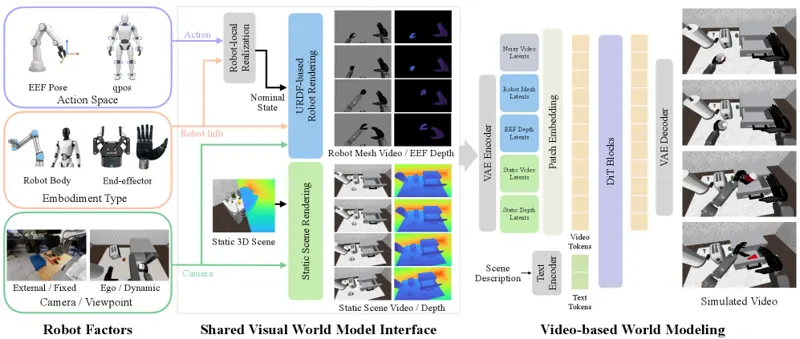
Action-conditioned video world models predict future observations from an initial observation and an action signal. In robotics, actions influence future observations through two distinct processes: they are first realized into robot motion by the robot body and controller, and the scene then responds through contact and object motion. Conditioning directly on action commands asks the world model to learn the realization process itself, while conditioning on logged future states leaks the interaction outcomes it is meant to predict. We propose robot-factored world models, which move two robot-specific factors outside the world model. First, action realization: each command is rolled through the robot's own controller and kinematics into a deployment-available nominal trajectory, a middle signal that avoids both action-realization learning and future-state leakage. Second, robot rendering: this nominal trajectory is rendered through the robot URDF, factoring the robot's geometry, kinematics, and appearance out of the model and into explicit rendered robot geometry. To resolve depth ambiguity, we pair end-effector depth with scene depth, giving geometric cues for contact and occlusion beyond image-plane overlap. Together, camera-aware static RGB/depth context and rendered robot geometry form a shared visual world-model interface that stays consistent across viewpoints and robot embodiments, so the model sees the action only as visible robot geometry and learns how objects respond to it. Our experiments show that the rendered interface outperforms vector-conditioned baselines and generalizes to unseen robot embodiments at inference. We further demonstrate that our model generates robot manipulation videos from human demonstrations by retargeting and rendering the hand motion as robot geometry.
Action-conditioned world models are a key component of embodied AI, serving as scalable policy evaluators that reduce reliance on expensive real-world rollouts. To accurately capture diverse action-induced dynamics, such models should satisfy three key objectives-Physical Plausibility (P), Action Adherence (A), and Visual Fidelity (V), collectively referred to as PAV-while remaining robust to both in-distribution (ID) expert demonstrations and out-of-distribution (OOD) actions. However, existing methods primarily rely on ID action-video pairs and pixel-level reconstruction losses, which do not explicitly optimize PAV objectives and generalize poorly beyond expert data. To address this, we propose PAVXploreRL, a reinforcement learning framework built on a pretrained latent world model that explicitly optimizes PAV objectives through reward-driven training. To improve action generalization, our method jointly leverages ID trajectories and noise-driven OOD action exploration, without paired video supervision. Experiments show that PAVXploreRL consistently outperforms pretrained baselines, achieving a 5.6% average gain across benchmarks and producing higher-quality PAV properties. As a policy evaluator, it also yields more reliable performance estimates and reduces the overestimation bias of prior expert-only world models such as Ctrl-World. Code: https://github.com/Social-AI-Studio/PAVXploreRL
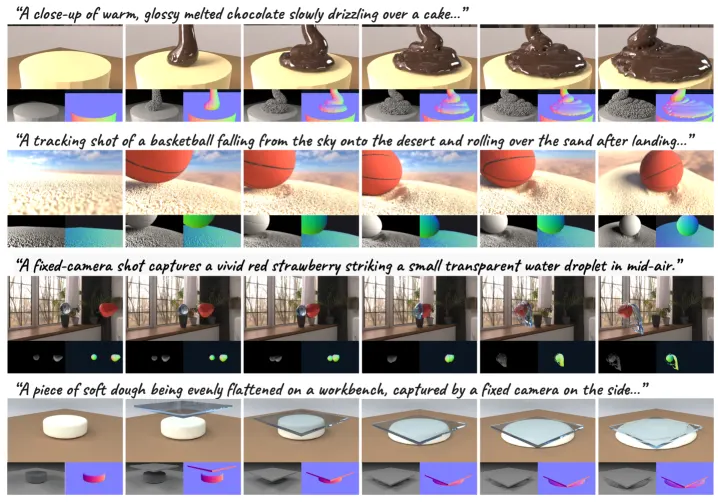
Creating dynamic and physically realistic 4D worlds from natural language descriptions is both fascinating and challenging. Traditional computer graphics methods rely on manual creation, requiring extensive human effort to fine-tune materials, motions, and visual fidelity. Recent advances in generative foundation models have sparked interest in learning to generate such 4D worlds from large-scale data; however, existing methods still struggle to ensure physical plausibility and controllability. In this work, we take a different path by leveraging foundation models to construct an agentic system that emulates how humans traditionally create 4D worlds, yet automates the entire process. We present GS-Agent, an end-to-end multi-agent framework that integrates physics engines in the loop to generate realistic, dynamic, and controllable 4D physical worlds from natural language. Inspired by how humans build 4D worlds, GS-Agent decomposes the task into entity management, covering 3D asset curation, material tuning, placement, and motion control, and rendering configuration, including camera and lighting manipulation. Multiple agents with distinct expertise interact with the physics engine via code, seek multimodal feedback, and collaborate to iteratively construct 4D worlds that align with the given descriptions. Experimental results show that GS-Agent effectively converts natural language into diverse and physically plausible 4D worlds exhibiting rich interactions among liquids, deformable objects, and rigid bodies, while achieving cinematic camera and lighting control. We envision GS-Agent as a foundation for a new paradigm in 4D world generation, empowering creative content creation and physical AI. Project page at https://umass-embodied-agi.github.io/gs-agent/
The gap between simulation and reality remains a fundamental challenge in deploying simulation-trained robotic policies in the real world. Real-to-sim methods narrow this gap from the real side, learning transition dynamics from real data to build a more realistic digital world. Learned dynamics models are their dominant instance. Such methods, however, face a partial observability problem: the same observation may branch to different transitions due to unobservable factors. Existing methods assume these factors can be recovered from observation history. However, this may fail whenever observation history is uninformative, such as a sudden contact event with no prior warning. To address this limitation, we propose World Translation, which exploits a complementary strength of simulators and learned dynamics. Simulators are deterministic but physically imperfect, while learned models are accurate but underdetermined under partial observability. Rather than predicting transitions forward from history, we extract the unobservable dynamics information backward from an observed transition, then translate this feature across simulation and reality as an unpaired domain-translation problem that preserves dynamics content while transferring domain style. Experiments across humanoid, quadruped, and manipulator platforms show that our method achieves more accurate dynamics modeling than baselines, with the largest gains when unobservable factors cannot be recovered from observation history. Real-robot deployment on Go2 quadruped confirms improved policy transfer.