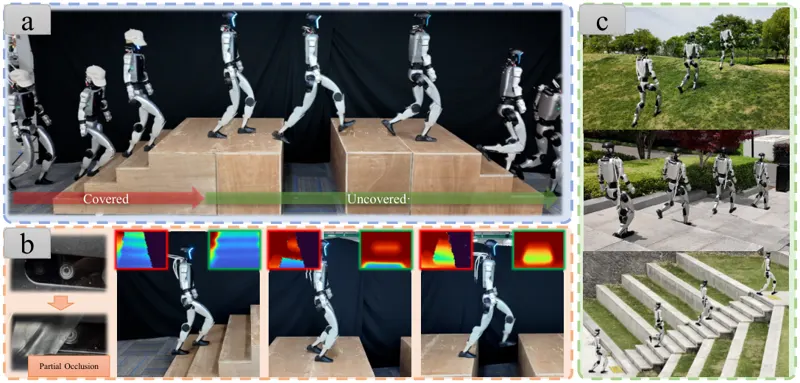
Humanoid locomotion across complex terrain demands forward-looking exteroception to anticipate obstacles, yet this signal is unreliable in real-world deployment, failing partially and intermittently. Existing perceptive policies often assume that depth observations remain clean and in-distribution, while recent attempts to unify perceptive and blind control typically route or switch between separate sub-policies, leaving recoverable information in partially corrupted depth unexploited. We instead propose CAP, a single-stage humanoid locomotion policy that recovers this signal with a perceptive world-model encoder trained as a learned denoiser to reconstruct clean depth from a corrupted input, together with a co-active proprioceptive variational encoder that supplies depth-free body-state information. A coupled training recipe pairs a depth-noise curriculum on the world-model input with world-model feature dropout on the policy-facing latent, exposing the policy to failures across the entire perception-quality spectrum. In simulation, CAP matches or improves upon perceptive baselines when depth remains informative, and degrades more smoothly than a binary-switching baseline as perception worsens. On the Unitree G1, controlled trials and indoor-outdoor deployments demonstrate perception-robust locomotion under intermittent occlusion, real-sensor corruption, and outdoor depth artifacts.
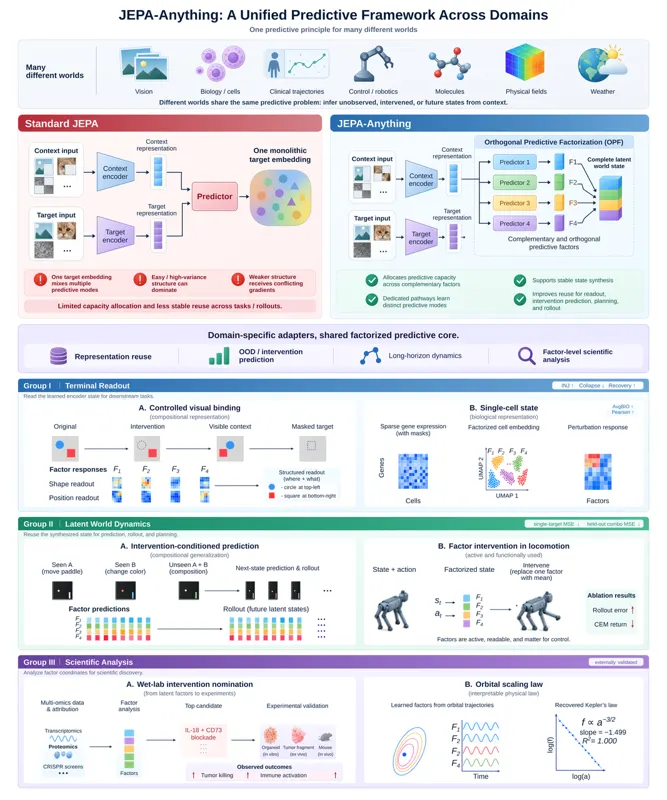
JEPA-Anything introduces orthogonal predictive factorization for domain-agnostic world modeling, splitting latent targets into complementary factors with dedicated predictive pathways. Across seven domains, it improves matched dynamics tasks and supports intervention, OOD generalization, and long-horizon forecasting.
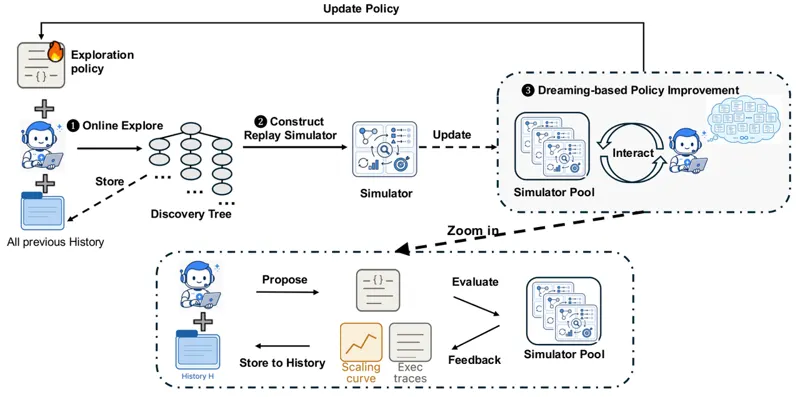
Recursive self-improvement is becoming increasingly vital for autonomous AI agents, where progress hinges on discovering high-value solutions across complex domains. The driver of this process is effective exploration, however, managing and improving exploration strategies remains a major bottleneck. Current systems face a fundamental dilemma: fixed strategies fail to adapt as search spaces scale, while online policy optimization requires navigating vast meta-search spaces under delayed and expensive feedback over long-horizon rollouts. We introduce {Dream-RSI}, a framework for scalable and recursively self-improving exploration. A lightweight orchestration layer makes exploration explicit and programmable while leaving the underlying coding agent unchanged. Our key insight is that accumulated discovery history can serve as a replay simulator over the realized search space. By performing dreaming in the replay simulator constructed from historical discovery trees, {Dream-RSI} secures immediate, low-cost off-policy feedback to evaluate and refine exploration policies without invoking repetitive, expensive online evaluations. The improved policy is subsequently redeployed online to drive further discovery, continuously expanding the simulator pool in a self-improving loop. Across algorithm engineering, mathematical optimization, and GPU kernel engineering, {Dream-RSI} achieves competitive or improved discovery quality while substantially reducing discovery cost in several settings.
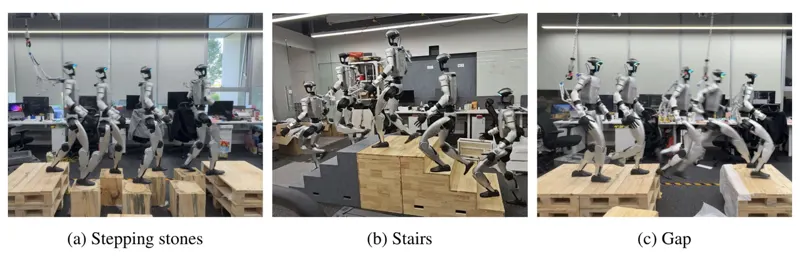
Foothold-constrained terrain is characterized by sparse, discontinuous, or geometrically restricted feasible foot contacts, as encountered on stepping stones, across gaps, and on narrow stair treads. On such terrain, a single misstep often leaves little room to recover, so policies that base foot-placement decisions primarily on the immediately visible terrain are prone to failure. We ask whether a learned predictive summary of near-future observations and rewards can provide the anticipatory information required in such settings. We present World-Model-Augmented Visual Locomotion (WM-LOCO), which jointly trains a recurrent world model and a PPO policy. Conditioned on proprioception and a single onboard depth image, the world model produces a predictive recurrent feature that guides the policy, without explicit foothold labels. In simulation, WM-LOCO succeeds on gaps and stepping stones where a matched baseline fails completely, and matches the baseline's success rate on stairs while improving stride efficiency and reducing pelvis acceleration. We deploy the same policy onboard a physical Unitree G1 humanoid using onboard proprioception and a single depth stream; it traverses all three terrain classes with an average success rate of 93.3%.
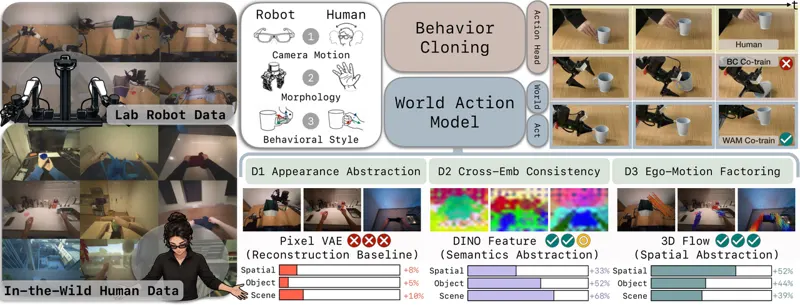
Egocentric human data offers scalable supervision for robot manipulation. However, behavior cloning entangles transferable content like objects, scenes, and task semantics, with non-transferable factors like human morphology, head motion, and behavioral style. We study whether World Action Models (WAMs) provide a better training signal by requiring policies to predict not only actions, but also how the scene evolves. The central question is what world representation best enables human-to-robot transfer. We hypothesize that an effective world target should abstract appearance, capture agent-invariant physical effects, and separate camera motion from environment change. We introduce EgoWAM, a controlled human-robot co-training framework that fixes the policy backbone, action head, and data mixture while varying only the world prediction target, comparing Pixel, DINO, and 3D motion flow. Across three real-world bimanual tasks, WAM co-training scales more effectively with in-the-wild egocentric human data than behavior cloning. Pixel-based prediction transfers weakly, while DINO and 3D flow yield substantial gains: DINO improves out-of-distribution object and scene generalization by up to 4x, and 3D flow improves in-domain performance by 20-30%. More details: https://gatech-rl2.github.io/egowam.github.io
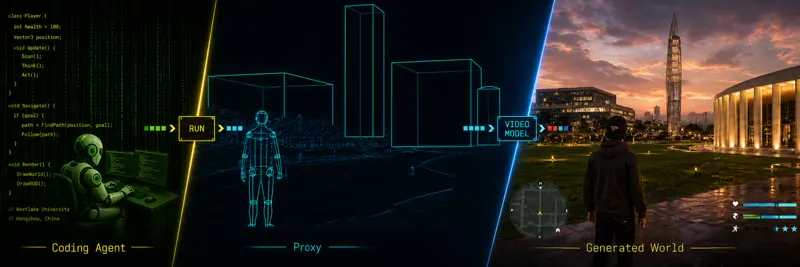
A coding agent maintains persistent executable world state, while a frame-aligned proxy carries spatiotemporal constraints to a video model for high-fidelity visual realization.
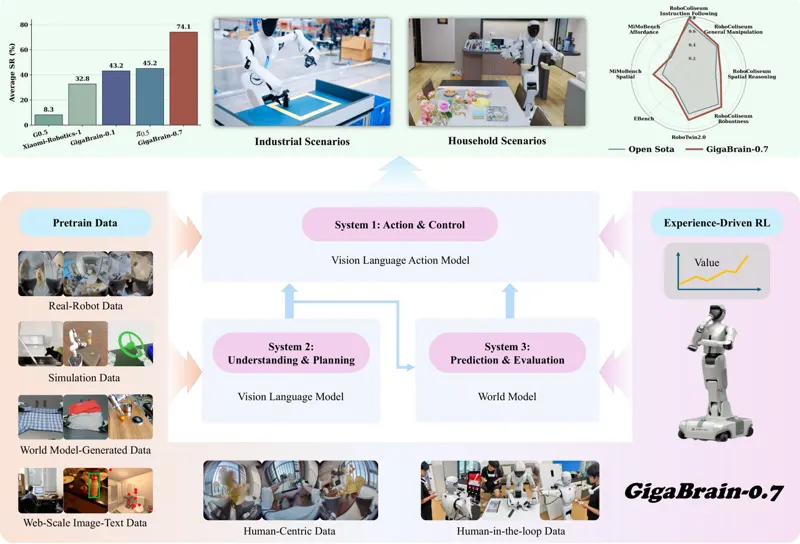
Vision-language-action (VLA) models have become a dominant paradigm for generalist embodied agents, demonstrating strong complex and long-horizon task completion in structured settings. Yet it remains an open question whether current VLA systems can benefit from more effective architectural design, scale to substantially larger and more heterogeneous data regimes, and achieve broader generalization across tasks and embodiments. To this end, we present GigaBrain-0.7, an embodied foundation model with substantially improved generalization across diverse robot embodiments. Specifically, GigaBrain-0.7 unifies understanding, prediction, and action through a three-system architecture, scales pretraining to over 37,000 hours of heterogeneous embodied data, and introduces one-stage alignment training that jointly optimizes vision-language understanding and multi-embodiment action generation. Compared with the preceding GigaBrain-0 series and prior state-of-the-art models including π_0.5, GigaBrain-0.7 achieves substantial improvements in foundation zero-shot capabilities, language-conditioned instruction following, and post-training task success rates. In particular, on our in-house Maker H01 platform and mainstream robot embodiments, GigaBrain-0.7 demonstrates strong task adaptability and completion ability across both home and industrial scenarios. All training code and pretrained model weights will be released.
LeVJEPA performs video self-supervised pretraining with a single encoder, a single loss and one fixed hyperparameter (λ=0.02): an invariance loss plus SIGReg regularization provably rule out representation collapse, with no target encoder, predictor, stop-gradient or pixel reconstruction. It uses 5.6–20.8× less training compute than V-JEPA 2, leads by 7.6 points on ImageNet-1K under a FLOP-matched budget, and gets block-causal attention for free — paving the way to streaming perception and autoregressive world models.
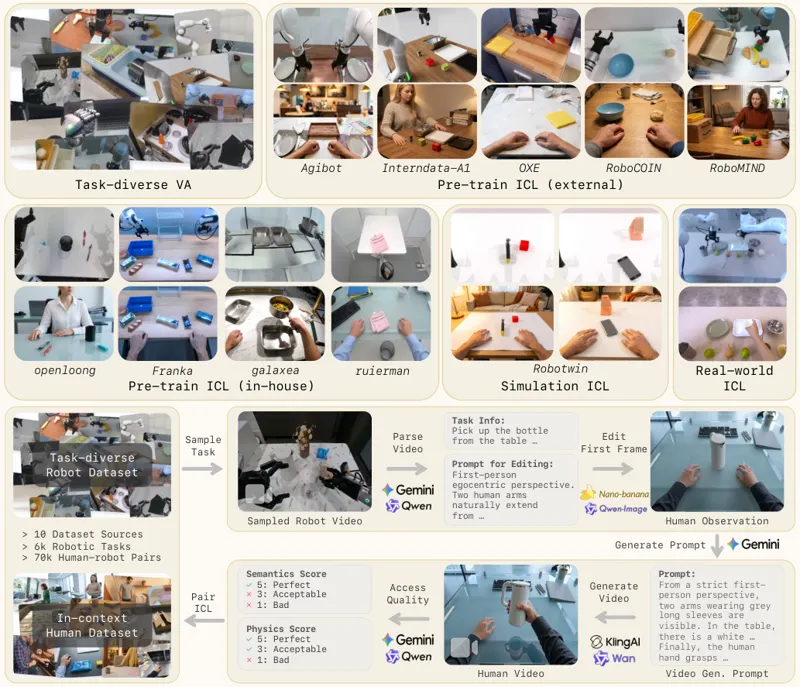
Zero-shot cross-task generalization, where a policy must execute manipulation tasks never seen during training, remains a central challenge in robot learning. In large language models, a novel task can be performed simply by specifying it in the context, without any parameter update. This form of in-context learning (ICL) turns generalization into a problem of task specification. To achieve cross-task generalization, we bring this paradigm to robotic manipulation, and argue that the natural task specification for manipulation is a human video: unlike language, it provides rich visual cues about the intended task evolution. We present Zero-WAM, a causal video-action model that executes unseen tasks by following in-context human video guidance. To address the scarcity of task-rich paired human-robot data, we propose an automatic pipeline that converts task-sampled robot trajectories into semantically matched human videos, yielding HumanGen, a dataset of 74.2K human-robot ICL pairs across 8.6K tasks. For model training, we further introduce an in-context future chunk prediction (IFP) objective that suppresses shortcuts learned from seen tasks and forces the policy to draw task information from the video prompt. On seven unseen tasks in RoboTwin 2.0 simulation, Zero-WAM achieves a 47.0% average success rate, an absolute improvement of 29.5 percentage points over the strongest video-action baseline. In real-world evaluations, it follows human video guidance to generalize to unseen task configurations involving multi-object scenes, long-horizon manipulation, and fine-grained insertion.
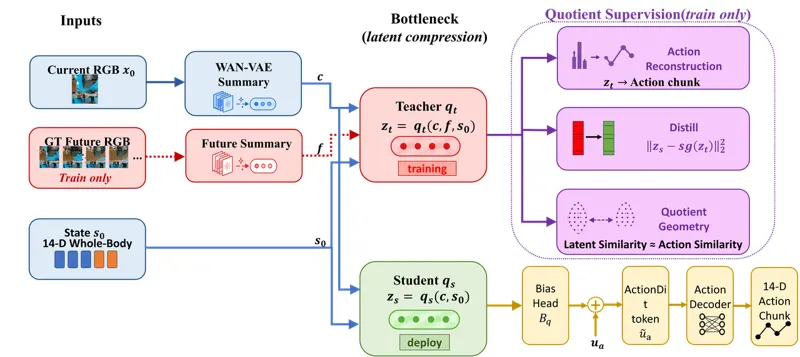
DECOWAM adapts a frozen FastWAM video-action backbone to legged mobile manipulation via decoupled interfaces — an action-equivalent future bottleneck, adversarial base/arm factorization, and ego-motion-aware video conditioning — cutting Stage-2 trainable parameters 232x while leading real-robot deployment at 58.2% success.
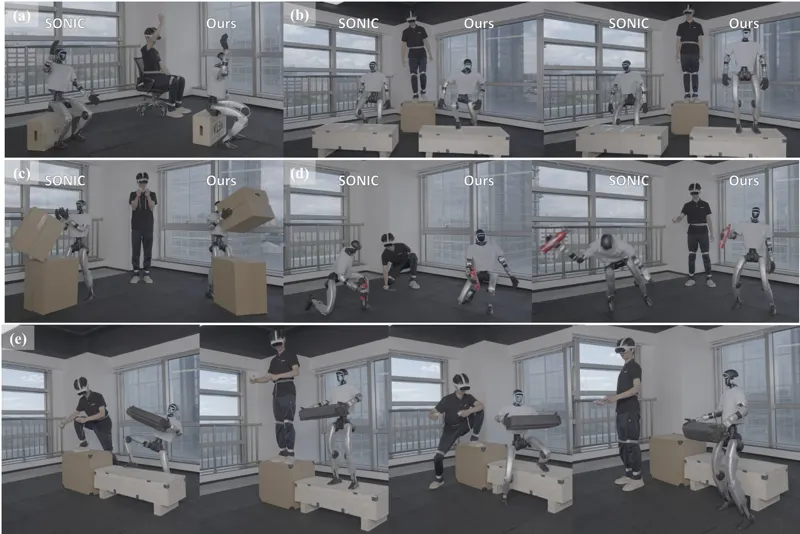
The first Behavior World Model (BWM) for humanoid whole-body control. A causal Transformer jointly predicts next action, state, and latent behavior command distribution, enabling the policy network to model how the environment shapes actions. Automatic terrain-annotation pipeline recovers 3D contact geometry from retargeted motion. At deployment, implausible commands are detected and retracted onto learned behaviors. Achieves highest success rate across all four regimes: 81.3% terrain interaction, 83.1% under implausible commands, 99.3% fall recovery. Unitree G1 checkpoint transfers to Maker L01 robot.
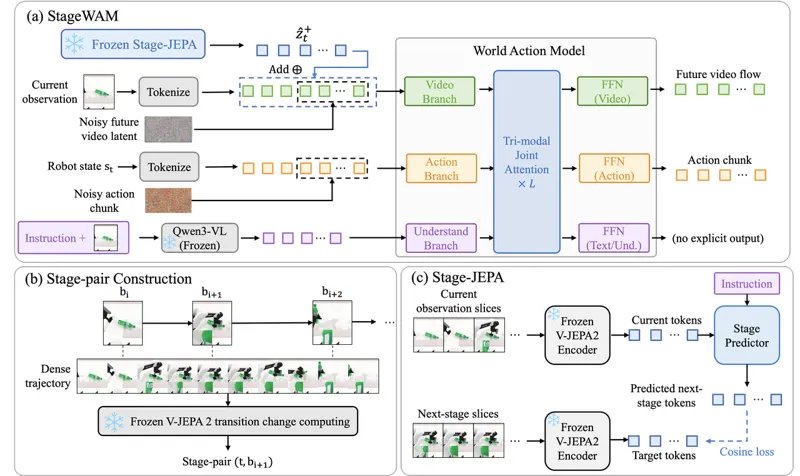
Generalist robot policies aim to map multimodal observations and linguistic task instructions to actions across diverse tasks. However, existing methods typically represent the future as a fixed, short video-action chunk. This short-term future captures local scene evolution for action execution, but it does not explicitly describe the stage-level future that specifies how a task should progress from its current stage to the next. We therefore distinguish two complementary futures for robot manipulation: a short-term physical future to capture local scene evolution and a stage-level semantic future to represent task progress. We introduce StageWAM, which augments a Motus-based World Action Model (WAM) with Stage-JEPA, a goal-conditioned Joint-Embedding Predictive Architecture (JEPA) predictor. Given the current observation and task instruction, Stage-JEPA uses a frozen V-JEPA2 encoder to extract the current-state representation and predicts the latent target of the next inferred stage. Across 50 RoboTwin 2.0 tasks in clean and randomized environments, StageWAM achieves 90.25% overall success and reduces the mean number of execution steps in successful rollouts by 5.97% relative to the strongest baseline.