Skip to content
TANGO: Humanoid Navigation in Cluttered Environments with a Whole-Body Vision-Language-Action Model

TANGO: Humanoid Navigation in Cluttered Environments with a Whole-Body Vision-Language-Action Model

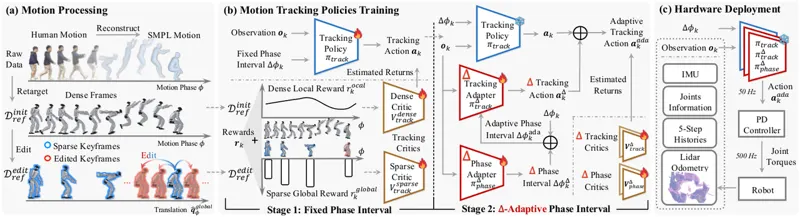
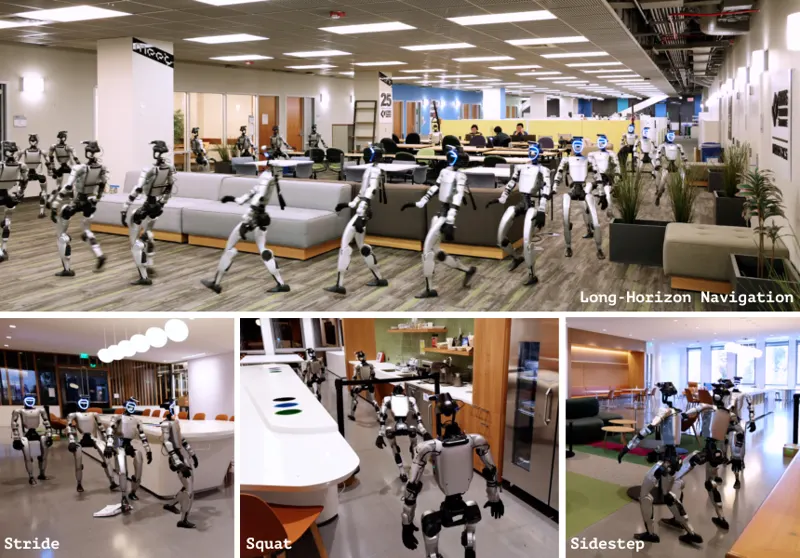
We study the problem of navigating cluttered indoor environments with a humanoid robot. Unlike conventional methods that model navigation as a 2D path planning problem, humanoid traversal in cluttered environments requires continuous geometry-aware whole-body adaptation, including coordinated arm placement, torso adjustment, and gait modulation for collision-free movement through complex 3D spaces. We introduce TANGO, the first whole-body vision-language navigation framework for language-conditioned humanoid traversal in cluttered environments. Given a natural-language instruction and egocentric RGB observations, TANGO directly predicts 29-DoF joint-space actions for downstream whole-body control. We train TANGO entirely in simulation by synthesizing diverse collision-free traversal behaviors via global path planning, kinematic whole-body motion generation, obstacle-aware motion editing, and RL-based tracking. This pipeline provides dynamically feasible action supervision for learning language-conditioned whole-body policies. In extensive simulation experiments, TANGO demonstrates state-of-the-art performance in vision-language navigation, while outperforming strong modular baselines in navigating challenging scenes requiring obstacle negotiation. Lastly, we deploy TANGO zero-shot on a Unitree G1 humanoid robot, and observe robust language-guided traversal in cluttered real-world scenes without training on any real-world navigation data.

HumanoidVLA
Anqi Li, Yuxin Chen, Zhaobo Li · 1.3k views · Sep 8, 2026
Hiking in the Wild: A Scalable Perceptive Parkour Framework for Humanoids

Hiking in the Wild: A Scalable Perceptive Parkour Framework for Humanoids

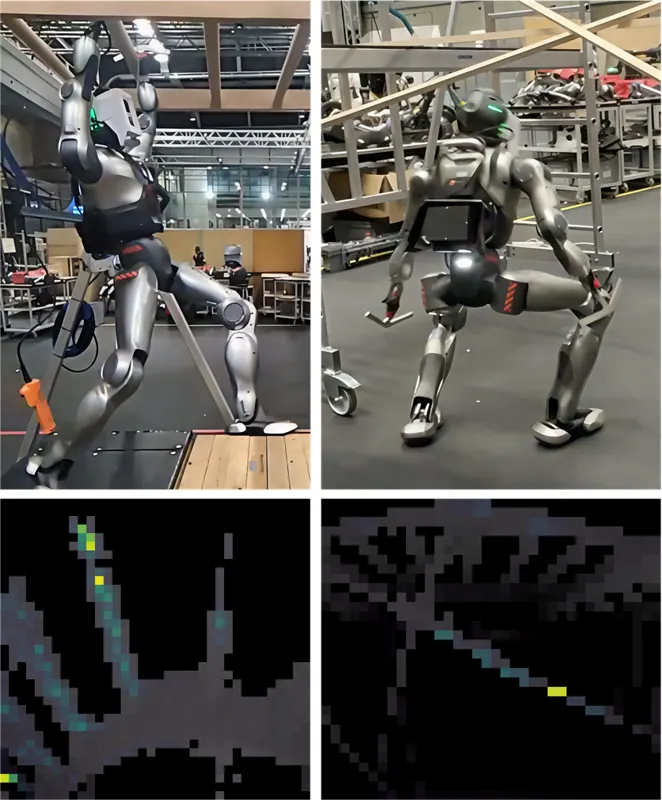
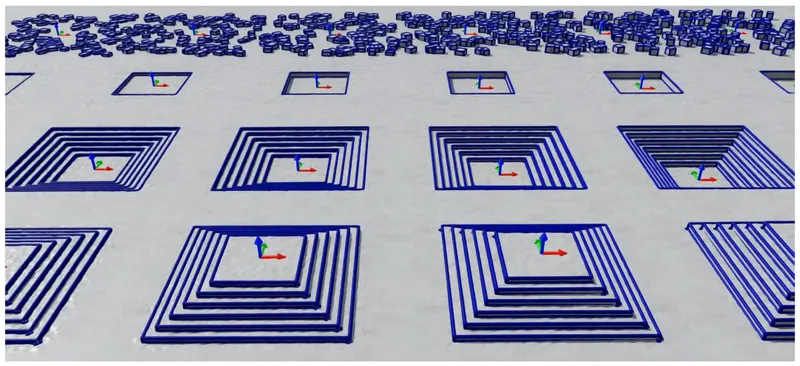
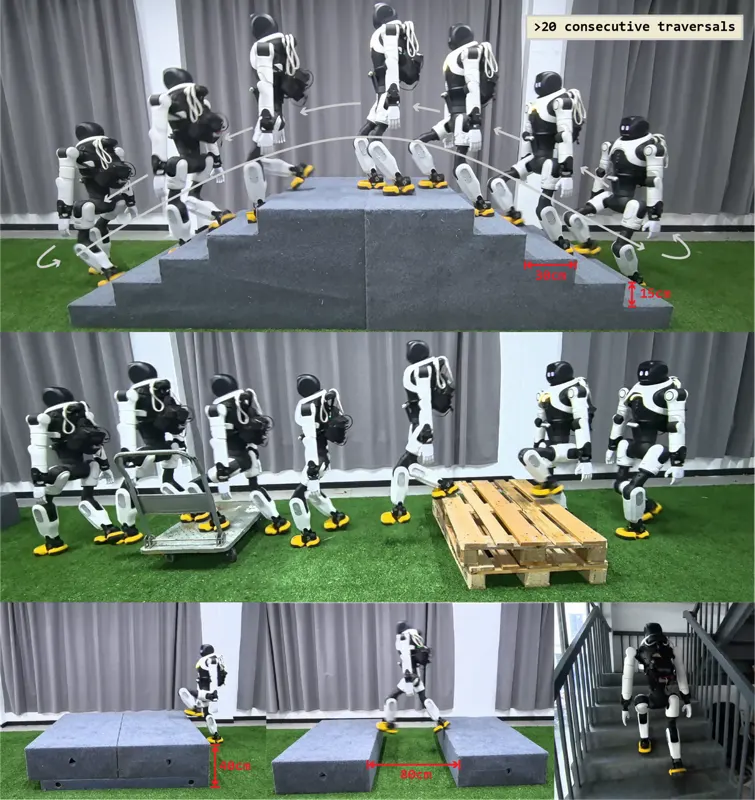
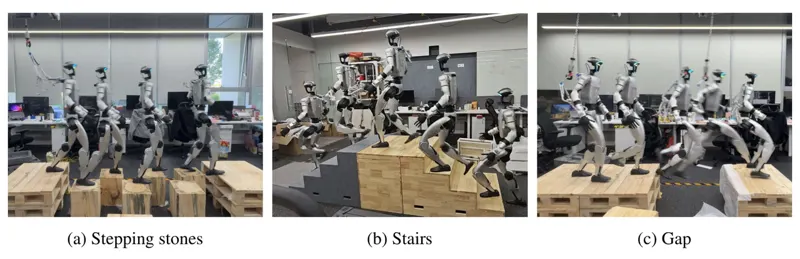
Achieving robust humanoid hiking in complex, unstructured environments requires transitioning from reactive proprioception to proactive perception. However, integrating exteroception remains a significant challenge: mapping-based methods suffer from state estimation drift; for instance, LiDAR-based methods do not handle torso jitter well. Existing end-to-end approaches often struggle with scalability and training complexity; specifically, some previous works using virtual obstacles are implemented case-by-case. In this work, we present Hiking in the Wild, a scalable, end-to-end parkour perceptive framework designed for robust humanoid hiking. To ensure safety and training stability, we introduce two key mechanisms: a foothold safety mechanism combining scalable Terrain Edge Detection with Foot Volume Points to prevent catastrophic slippage on edges, and a Flat Patch Sampling strategy that mitigates reward hacking by generating feasible navigation targets. Our approach utilizes a single-stage reinforcement learning scheme, mapping raw depth inputs and proprioception directly to joint actions, without relying on external state estimation. Extensive field experiments on a full-size humanoid demonstrate that our policy enables robust traversal of complex terrains at speeds up to 2.5 m/s. The training and deployment code is open-sourced to facilitate reproducible research and deployment on real robots with minimal hardware modifications.

HumanoidHiking
Shaoting Zhu, Ziwen Zhuang, Mengjie Zhao · 1.1k views · Jan 12, 2026
ZEST: Zero-shot Embodied Skill Transfer for Athletic Robot Control

ZEST: Zero-shot Embodied Skill Transfer for Athletic Robot Control

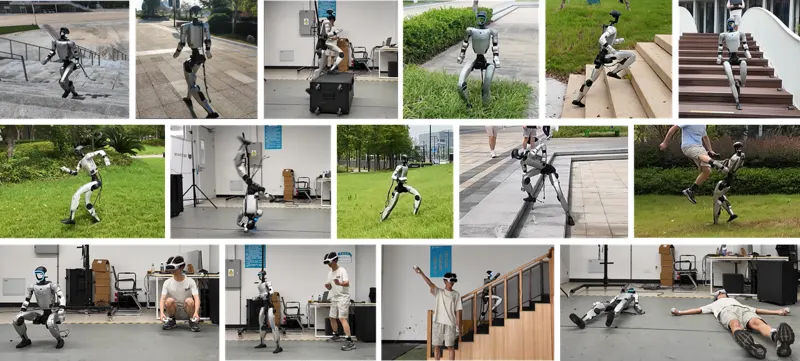
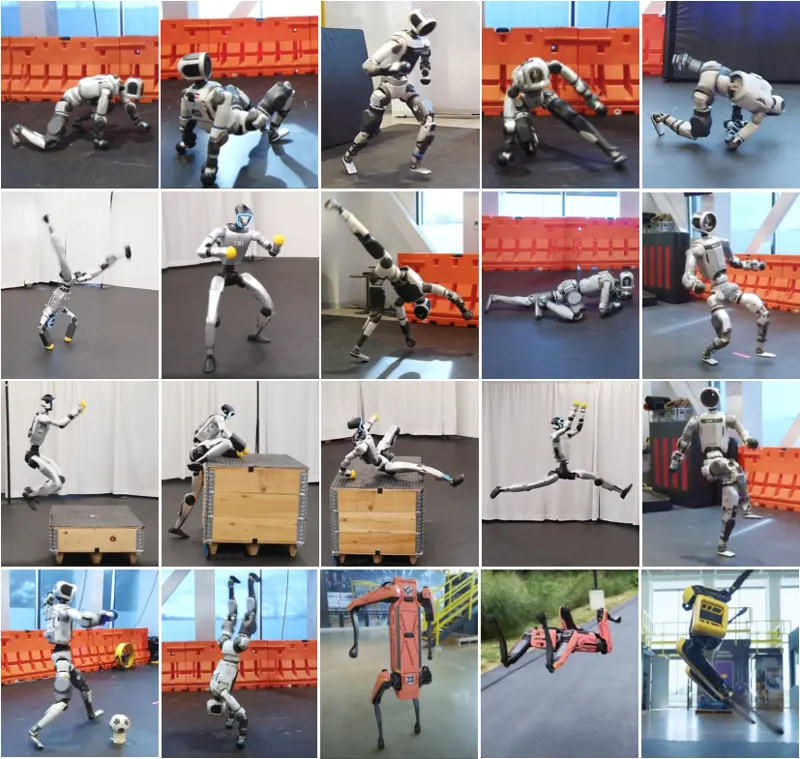
Achieving robust, human-like whole-body control on humanoid robots for agile, contact-rich behaviors remains a central challenge, demanding heavy per-skill engineering and a brittle process of tuning controllers. We introduce ZEST (Zero-shot Embodied Skill Transfer), a streamlined motion-imitation framework that trains policies via reinforcement learning from diverse sources – high-fidelity motion capture, noisy monocular video, and non-physics-constrained animation – and deploys them to hardware zero-shot. ZEST generalizes across behaviors and platforms while avoiding contact labels, reference or observation windows, state estimators, and extensive reward shaping. Its training pipeline combines adaptive sampling, which focuses training on difficult motion segments, and an automatic curriculum using a model-based assistive wrench, together enabling dynamic, long-horizon maneuvers. We further provide a procedure for selecting joint-level gains from approximate analytical armature values for closed-chain actuators, along with a refined model of actuators. Trained entirely in simulation with moderate domain randomization, ZEST demonstrates remarkable generality. On Boston Dynamics' Atlas humanoid, ZEST learns dynamic, multi-contact skills (e.g., army crawl, breakdancing) from motion capture. It transfers expressive dance and scene-interaction skills, such as box-climbing, directly from videos to Atlas and the Unitree G1. Furthermore, it extends across morphologies to the Spot quadruped, enabling acrobatics, such as a continuous backflip, through animation. Together, these results demonstrate robust zero-shot deployment across heterogeneous data sources and embodiments, establishing ZEST as a scalable interface between biological movements and their robotic counterparts.
ZESTSim-to-Real
Jean Pierre Sleiman, He Li, Alphonsus Adu-Bredu · 993 views · Jan 30, 2026

As an Amazon Associate, we earn from qualifying purchases.