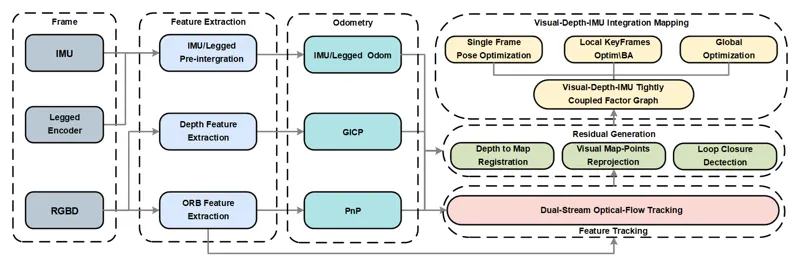
GeoFlow-SLAM targets the feature-matching, initialization, and texture-robustness failures that arise when legged robots move aggressively at high frequency. It tightly couples dual-stream optical flow, legged odometry, PnP, GICP, and depth-to-map geometric constraints in one optimization framework. Experiments on Unitree Go2 and G1 robots plus OpenLORIS, ScanNet, and TUM datasets show state-of-the-art robustness and accuracy.
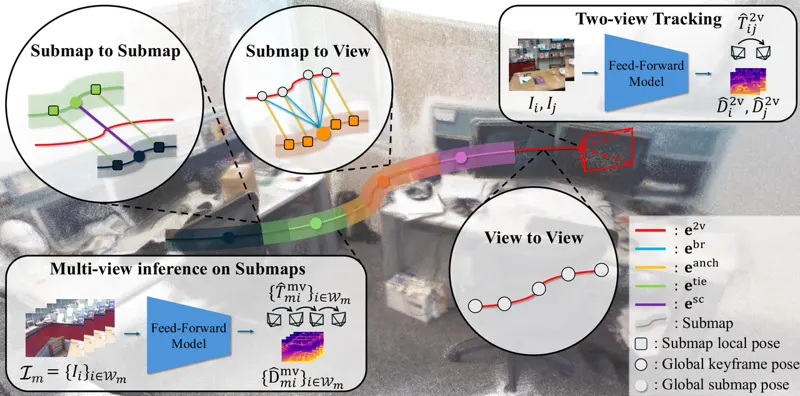
Recent geometric foundation models enable feed-forward inference for SLAM, but their predictions are strongly dependent on the input view set, which leads to geometric inconsistencies and trajectory drift when results are chained over long sequences. Online deployment further exposes a trade-off between the low latency of two-view tracking and the constraint richness of multi-view inference. We introduce UniSim-SLAM, an integrated system that runs lightweight two-view keyframe tracking in the frontend and performs periodic multi-view submap refinement in the backend. To combine predictions defined in heterogeneous local coordinates with inconsistent scales, we formulate a unified multi-level factor graph on Sim(3) that jointly optimizes global keyframe poses and submap poses. The graph integrates temporal view-to-view odometry edges, view-to-submap bridge edges with depth-statistics scale anchoring, and submap-to-submap tie and scale constraints to enforce consistent similarity relations across submaps. Experiments on TUM RGB-D and 7-Scenes show that UniSim-SLAM achieves state-of-the-art accuracy in the uncalibrated setting, reducing trajectory error by 38.5% on TUM RGB-D and 45.9% on 7-Scenes compared to prior best results. Project page: https://vision3d-lab.github.io/unisim-slam/
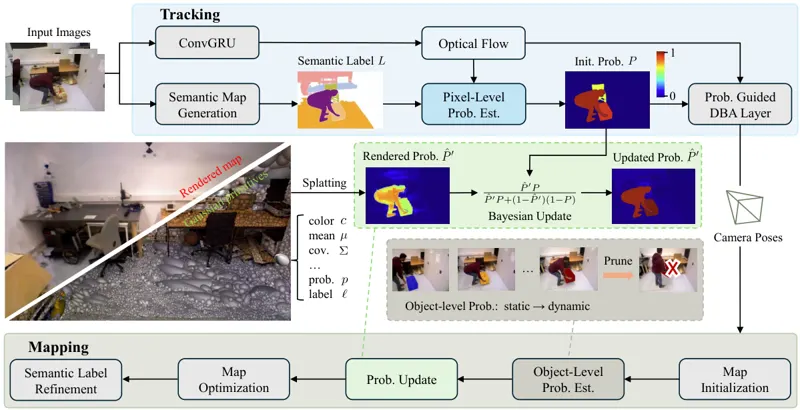
Recent advances in 3D Gaussian Splatting (3DGS) have enabled significant progress in dense dynamic Simultaneous Localization And Mapping (SLAM). Prevailing methods typically discard predefined dynamic objects, ignoring that transiently static objects offer valuable geometric constraints for pose estimation. A recent work attempts to leverage this potential by employing per-pixel uncertainty maps to quantify the magnitude of motion. While this approach enables transiently static objects to enhance pose estimation, it erroneously integrates these objects into the static map, resulting in persistent artifacts. Moreover, its reliance on purely geometric information leads to ambiguous object boundaries in the uncertainty maps. To overcome these limitations, we present DL-SLAM, a monocular Gaussian Splatting SLAM system built upon a novel dual-level probabilistic framework. Our method computes dynamic probability maps by combining semantic and geometric information. These pixel-level probabilities are lifted to 3D and aggregated to derive an object-level dynamic probability for each instance. Object-level probability enables the categorical pruning of dynamic Gaussians, resulting in an artifact-free static map. The static map, in turn, provides a geometrically consistent guidance to refine the pixel-wise probabilities, enhancing their reliability. Experimental results demonstrate that DL-SLAM outperforms existing approaches, improving tracking accuracy by up to 13% while generating high-fidelity semantic maps.
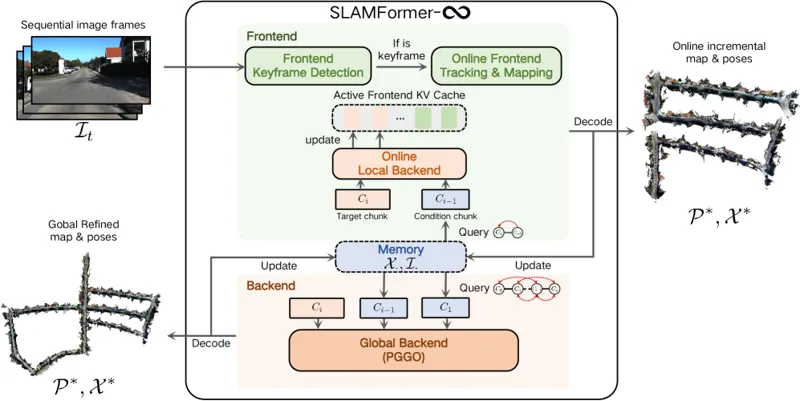
We introduce the Infinite SLAM Transformer (SLAMFormer-∞), the first geometric transformer capable of supporting both long-range frontend and backend processing without an explicit distance bound. Instead of relying on a first-frame-anchored formulation, SLAMFormer-∞ employs memory conditions to define flexible coordinate systems and scales for input frames, enabling more expressive structural conditioning. Built upon this formulation, the frontend preserves efficient local computation, while the backend jointly optimizes long-range trajectories and scene geometry in a globally consistent manner. Experimental results demonstrate that SLAMFormer-∞ achieves superior or highly competitive performance in both trajectory estimation and scene reconstruction across large-scale datasets. Notably, SLAMFormer-∞ generalizes to extremely long trajectories, successfully operating on sequences exceeding 17km.
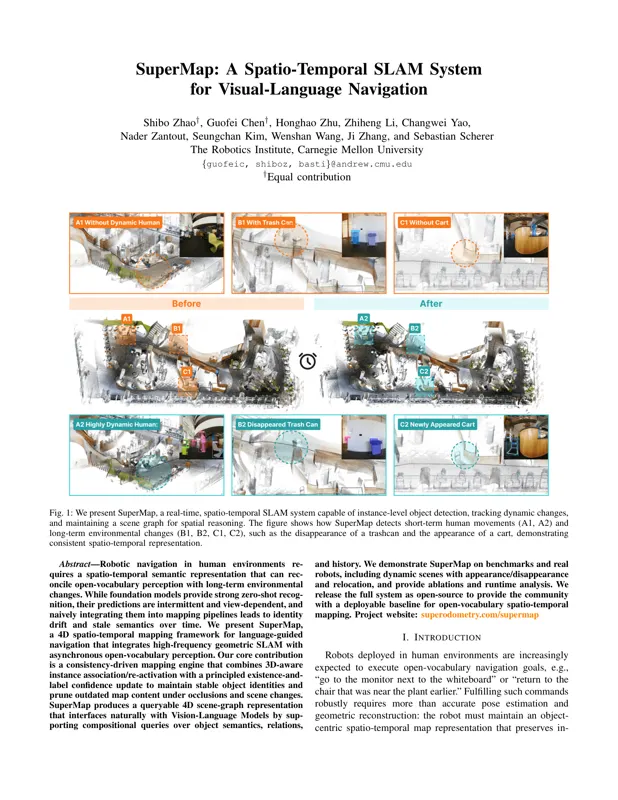
SuperMap is a real-time 4D spatio-temporal mapping framework from CMU that integrates high-frequency geometric SLAM with asynchronous open-vocabulary perception. Its consistency-driven mapping engine maintains stable object identities and prunes outdated content under occlusions and scene changes, producing a queryable 4D scene-graph interface for VLM-based zero-shot reasoning and language-guided navigation.
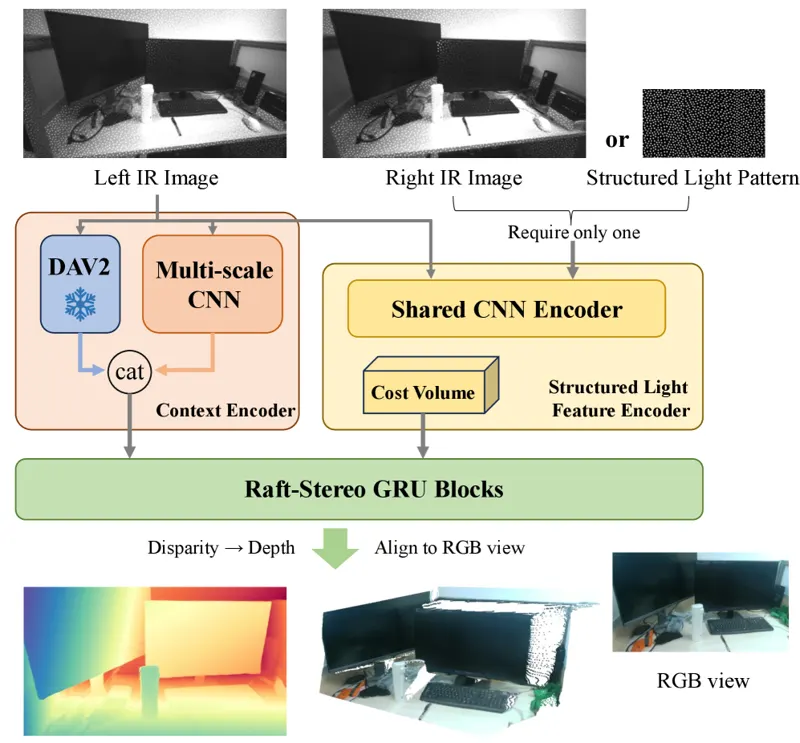
Structured-light (SL) cameras power depth sensing in millions of devices, and recent neural SL decoding methods have substantially improved their depth quality. SLAM systems can benefit greatly from such strong depth sensing, where reliable geometry enables stable tracking and faithful reconstruction. In this work, we present NSL-SLAM, a practical SLAM system tailored for high-fidelity structured-light depth. We first strengthen SL depth sensing: inspired by the neural structured-light (NSL) method, we further incorporate strong monocular depth priors into the SL stereo decoding, reducing depth RMSE by 35% on Replica-SL compared to NSL. We then build a depth-centric SLAM pipeline with this stronger depth: because structured-light geometry is dense and metrically accurate, we keep it as the primary tracking signal, and add only sparse visual correspondences for geometrically degenerate cases and lightweight bundle adjustment for long-range drift. Our depth estimator and SLAM design reinforce each other: stronger depth makes a simple SLAM pipeline effective, and the depth-centric pipeline ensures this advantage transfers to downstream reconstruction. Experimentally, on the synthetic Replica-SL benchmark, NSL-SLAM achieves the best tracking accuracy and improves reconstruction F-score by 1.6 points over the SOTA baseline under a shared-depth protocol. On a real benchmark of 8 challenging scenes, it is the only method that avoids catastrophic failure on all sequences while achieving 43.3% lower trajectory deviation than selected baselines. The SLAM system runs online at 20.9 FPS, demonstrating that stronger structured-light depth and depth-centric system design together enable practical, robust SLAM.
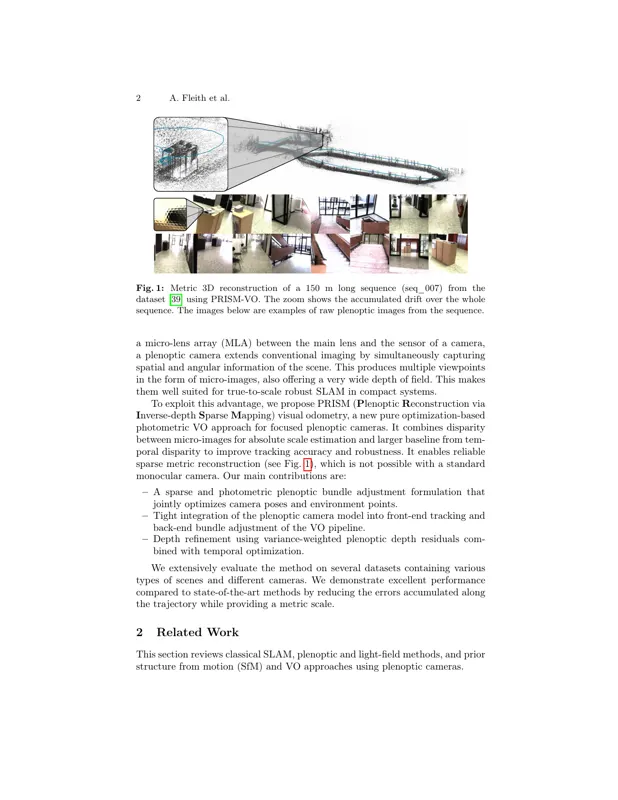
We introduce PRISM-VO, a novel pure optimization-based sparse photometric visual odometry framework for focused plenoptic cameras. The core of PRISM-VO is a novel photometric plenoptic bundle adjustment which jointly optimizes camera poses and inverse depth values of points in a sliding window. By combining geometric depth from a single plenoptic image with temporal multi-view constraints, PRISM-VO achieves accurate and drift-resilient motion estimation. Through explicit modeling of the plenoptic projection, PRISM-VO provides reliable metric-scale reconstructions, overcoming the scale ambiguity of monocular SLAM algorithms. Importantly, our approach relies solely on a single plenoptic sensor and avoids complex initialization, as depth priors are computed directly from plenoptic imaging. Experiments show that PRISM-VO outperforms the current state-of-the-art plenoptic visual odometry method on indoor and outdoor scenes. The proposed approach rivals other optimization- and learning-based methods while accurately and reliably recovering a metric scale of the scene. Project page: https://prism-vo.github.io/
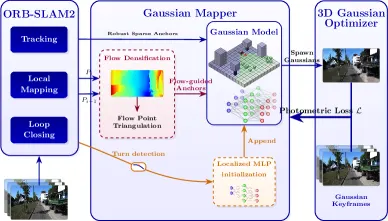
Existing Gaussian-splatting-based monocular Simultaneous Localization and Mapping (SLAM) systems are either tailored to short sequences, are not real-time, or suffer from prohibitive GPU memory requirements, limiting their applicability in realistic, long-horizon scenarios. To address this, we present GLAM-SLAM, a real-time, decoupled Gaussian-splatting SLAM system designed for large-scale outdoor scenes. We ensure lightweight tracking using a robust, feature-based SLAM frontend, while for mapping, we adopt a structured, sparse anchor grid representation that ensures scalable operation and maintains scene coherence across long-term sequences. To satisfy the dense initialization requirements of 3D Gaussian Splatting (3DGS), we introduce a geometry-based flow-densification anchoring strategy using epipolar constraints. Furthermore, by treating mapping as a multi-scene problem, we propose a scene-partitioning strategy that introduces a strong spatial inductive bias via MLP initializations to generate localized Gaussians. We evaluate our system on the challenging, long-sequence KITTI Odometry, Oxford RobotCar, and M'alaga datasets. Extensive ablations and comparisons demonstrate a 15% improvement in reconstruction quality over the second-best performer, while maintaining real-time performance and the ability to scale to longer sequences. Code is publicly available for the benefit of the community.