Skip to content
Tags

#Benchmarks (10)

N₀-Foundation: Towards the Age of Tactile Intelligence

N₀-Foundation: Towards the Age of Tactile Intelligence

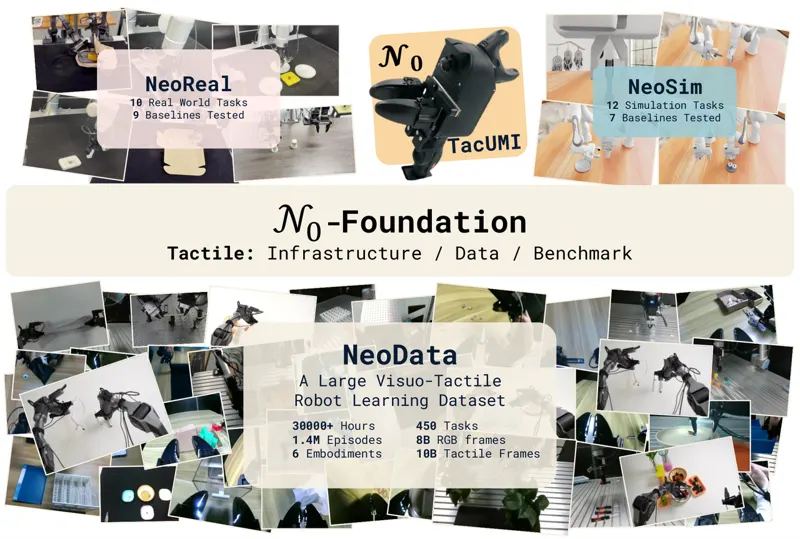
We present N₀-Foundation, a paradigm for tactile-enabled embodied manipulation, which integrates tactile sensing hardware, large-scale multimodal data, tactile representation learning, and standardized evaluation. First, we engineer the infrastructure for scalable data collection, including a vision-based tactile sensor, a tactile Universal Manipulation Interface (UMI), and a synchronized visuo-tactile data collection system supporting both robot embodiments and UMI-based demonstrations. Leveraging this infrastructure, we construct NeoData, which contains more than 30000 hours of synchronized visual and tactile demonstrations, spanning six embodiments, 450 tasks, and billions of paired RGB and tactile frames collected through a mixture of real-robot teleoperation and UMI-based demonstrations. To facilitate open research, we further release OpenNeoData, a 5000-hour open-source subset of NeoData. The dataset addresses a central limitation of existing manipulation corpora, critical for deformable-object manipulation, precise assembly, delicate force control, and sustained surface interaction. Capitalizing on the large-scale, heterogeneous tactile measurements, we propose NeoForce, a visuo-tactile representation model that learn transferable tactile representations across different sensor designs. To enable systematic evaluation of tactile embodied models built upon our infrastructure, datasets and tactile representations, we further propose a comprehensive benchmark, which combines the real-world NeoReal suite and the simulated NeoSim suite for standardized evaluation. Experiments across both suites show that policies benefit from the physical contact state rather than from the device-specific appearance of the tactile signal. We release the dataset, the representation, and the benchmark, aiming at supporting future work on tactile-enabled embodied manipulation.

NeoteAI Team, Fudan TEAI TeamAug 30, 2026
UMIVLATactile PerceptionAug 30, 2026
ABot-AgentOS: A General Robotic Agent OS with Lifelong Multi-modal Memory

ABot-AgentOS: A General Robotic Agent OS with Lifelong Multi-modal Memory

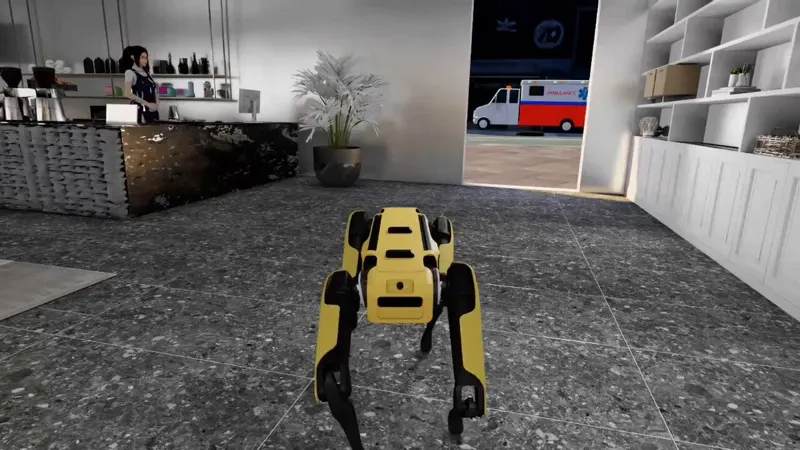
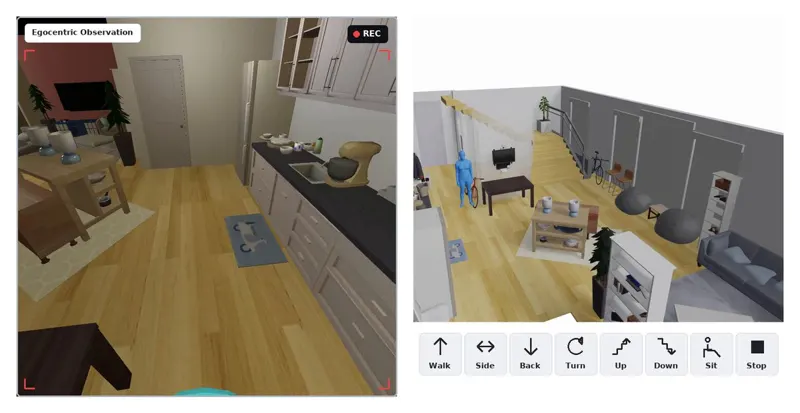
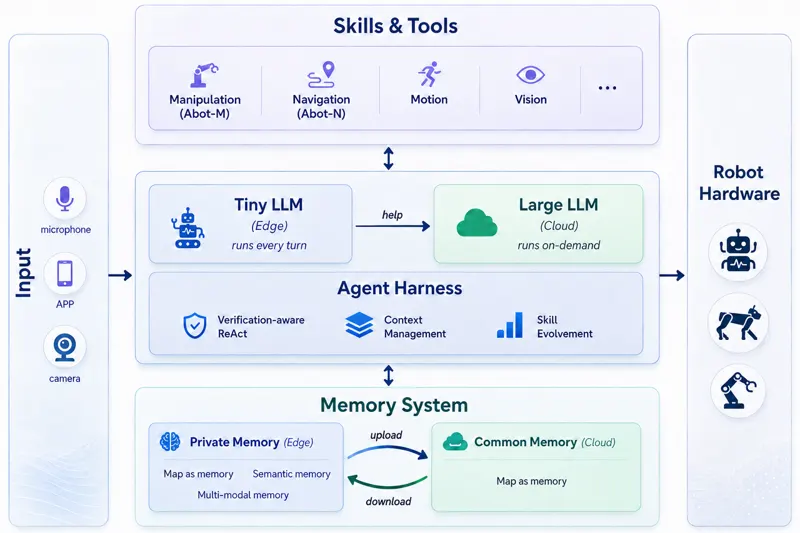
Recent VLM and VLA systems have improved robotic perception and action prediction, yet long-horizon embodied agents still require a general runtime layer for reasoning, memory, tool use, verification, and cross-embodiment execution. We present ABot-AgentOS, a general robotic Agent Operating System that sits above low-level controllers and provides a deliberative agent layer for scene-conditioned planning, context-isolated skill execution, multi-stage verification, multi-modal memory, and edge-cloud collaboration. To evaluate such systems, we introduce EmbodiedWorldBench, an executable benchmark with 16 indoor, outdoor, and hybrid scenes, four difficulty levels, and over 200 tasks involving navigation, object search, NPC dialogue, dynamic events, and trace-grounded scoring. ABot-AgentOS further introduces Universal Multi-modal Graph Memory, a persistent source-grounded substrate that converts dialogue, visual observations, spatial context, temporal relations, and task traces into typed nodes and edges. A failure-driven self-evolution loop converts diagnosed memory failures into gated runtime evo-assets that are promoted only to later evaluation splits, preventing current-split ground-truth leakage while enabling continual improvement. On an initial EmbodiedWorldBench subset, ABot-AgentOS improves over a single-controller baseline in both task success and goal completion. Across memory benchmarks, ABot-AgentOS Static achieves 87.5 on LoCoMo, 59.9 on OpenEQA EM-EQA, 88.6 on Mem-Gallery, and 76.5 Acc@All on NExT-QA; self-evolution further improves LoCoMo to 88.7, OpenEQA to 60.4, and Mem-Gallery to 89.0. These results suggest that a general Agent OS layer can improve long-horizon embodied execution while providing persistent, auditable memory for continual interaction.

Jiayi Tian, Shiao Liu, Yuting XuJul 11, 2026
AgentOSEmbodiedWorldBenchVLAJul 11, 2026
Industrial Dexterity Benchmark: A Hardware-Software Benchmarking Platform for Industrial Dexterous Manipulation

Industrial Dexterity Benchmark: A Hardware-Software Benchmarking Platform for Industrial Dexterous Manipulation

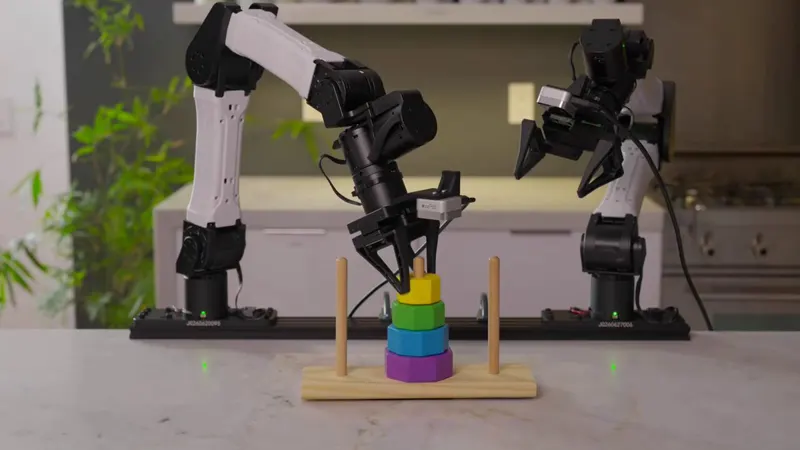
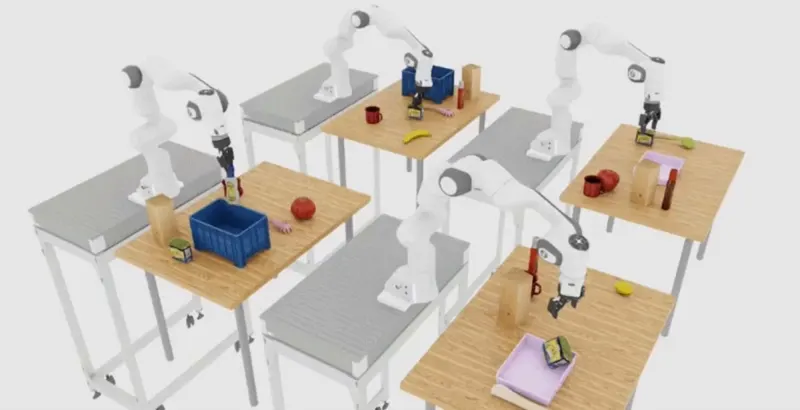
Dexterous manipulation remains a critical bottleneck in industrial automation; tasks such as cable routing, connector insertion, and precision assembly still rely heavily on manual labor despite decades of robotics research. This work presents a progression from classical, modular robotics pipelines toward an end-to-end multimodal imitation-learning framework for industrial dexterous manipulation. As a part of this work, we introduce three key contributions: a set of Industrial Dexterity Benchmark (IDB) boards aimed to mimic datacenter cable management, automotive cable harnesses, and gearbox assembly tasks; a scalable imitation learning framework (DAG-ROS); and a multimodal diffusion-based policy framework (AG-iDP3) that creates models fusing RGB images, point clouds, joint positions, and wrist-frame wrench data. Focusing on the datacenter cable manipulation board, we evaluate the performance of a task involving cleaning a single cable over variations of an end-to-end AI policy using 48 trials per configuration. The best performing configuration, a multimodal expansion Diffusion Policy (DP), includes a multi-view RGB image source passed through an R3M encoder and reaches a 78% grasp and insert combined task success rate. This performance marks a significant improvement over the 36% observed from the single-camera RGB DP baseline. Each of the tested configurations requires only approximately 100 teleoperated demonstrations per task phase. These results indicate that the correct learned policy can outperform classical vision and control robotic methods in robustness, generalization, and deployment efficiency, justifying a shift toward scalable robotic automation for high up-time industrial environments.

Honglu He, Jacob Laufer, Zhiwu ZhengJul 15, 2026
Dexterous ManipulationIndustrialBenchmarksJul 15, 2026
ToolVerse: Unlocking Massive Environments and Long-Horizon Tasks for Agentic Reinforcement Learning

ToolVerse: Unlocking Massive Environments and Long-Horizon Tasks for Agentic Reinforcement Learning

While LLM agents demonstrate strong reasoning abilities in compact and well-defined scenarios, they struggle to maintain robustness and effectiveness when faced with large-scale, diverse, and dynamic real-world environments that demand seamless tool integration. To address this gap, we introduce ToolVerse, a comprehensive framework that scales up agentic RL environments and enables agents to perform complex long-horizon reasoning in Tool-Integrated Reasoning (TIR) tasks. First, ToolVerse automatically builds the massive executable agent training environments from nearly 400 real-world Model Context Protocols (MCPs) that contain about 4500 tools. Second, we propose a task design strategy based on a tool dependency graph, utilizing Dynamic Unlocking Sampling Algorithm to generate long-horizon tasks, and produce GUST (Graph Unlocking Sampling Tasks) dataset. Third, to alleviate the credit assigment problem in long-horizon agentic RL, we propose a fine-grained Turn-Aware Relative Advantage algorithm. We conduct extensive Agentic RL training using ToolVerse and evaluate our framework on serveral agentic benchmarks. Experimental results demonstrate that our framework significantly strengthens LLMs' capabilities in long-horizon tool use, achieving a marked performance boost and showcasing robust reasoning within dynamic environments.

Shuaiyu Zhou, Fengpeng Yue, Zengjie HuJul 17, 2026
Autonomous DrivingDatasetsBenchmarksJul 17, 2026