Skip to content
Tags

#Datasets (11)

EgoHTR: Egocentric 4D Demonstrations of Human Terrain Traversal

EgoHTR: Egocentric 4D Demonstrations of Human Terrain Traversal

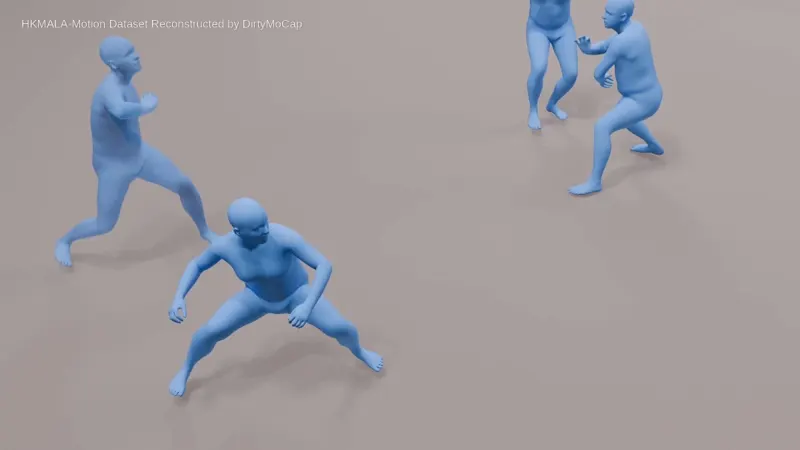
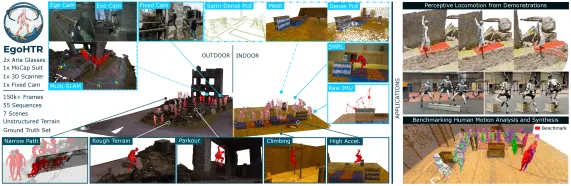
Deploying humanoid robots in unstructured terrain remains an open problem. While classic reinforcement learning struggles with the sheer complexity of real-world interactions, more promising methods leveraging human priors remain limited to models lacking contextual awareness. The restricted motion synthesis is a direct consequence of existing dataset pipelines failing to capture human-scene sequences in challenging environments. To bridge this gap between humanoid learning and scene reconstruction, we introduce the Egocentric Human-Terrain Reconstruction (EgoHTR) dataset. We develop and open-source a reconstruction pipeline capturing 55 scene-aligned 4D human motion sequences in diverse, complex environments using a multi-sensor setup of egocentric wearables and a portable 3D scanner. The resulting dataset comprises over 150k frames, which we evaluate against motion-capture ground truth, demonstrating state-of-the-art accuracy and establishing a rigorous benchmark for human motion analysis and synthesis. Further, we leverage this data to train perceptive locomotion policies, demonstrating hardware deployment on a Unitree G1 for reconstructed reference motions. Our pipeline enables community-driven dataset extensions and factors the problem to help researchers build foundational, context-aware robots that reliably traverse uneven terrain.

Alex Brandes, Haig Conti Georges Sajelian, Manthan PatelJul 15, 2026
4DTerrain TraversalGait optimizationJul 15, 2026
Open-AoE: An Open Egocentric Manipulation Dataset and Toolchain for Embodied Learning

Open-AoE: An Open Egocentric Manipulation Dataset and Toolchain for Embodied Learning

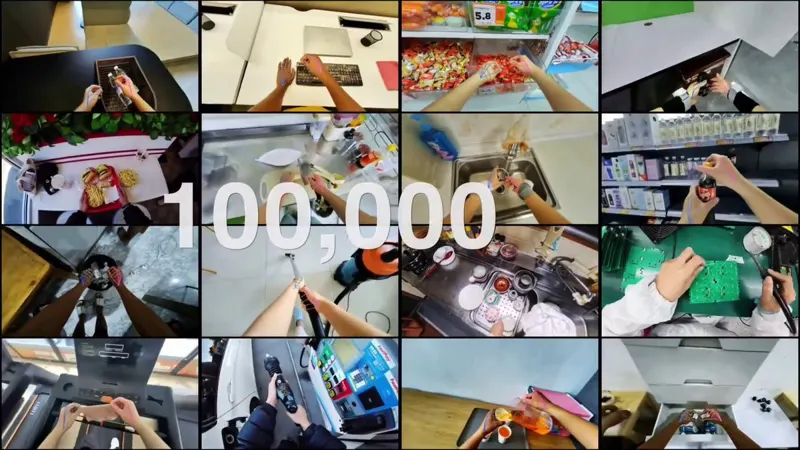
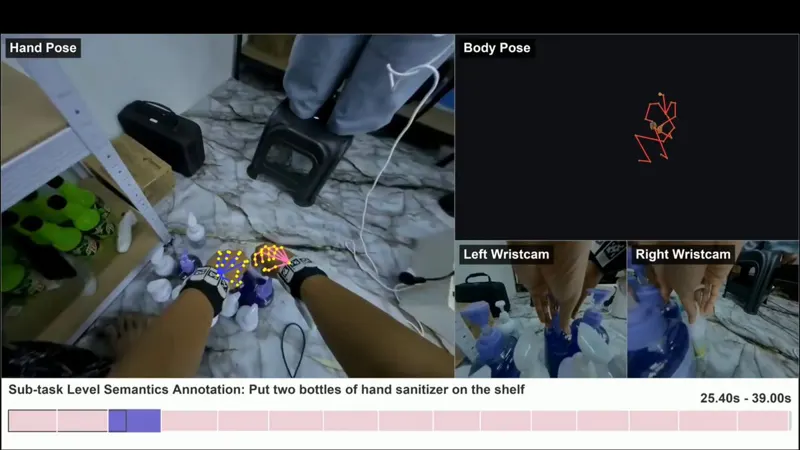
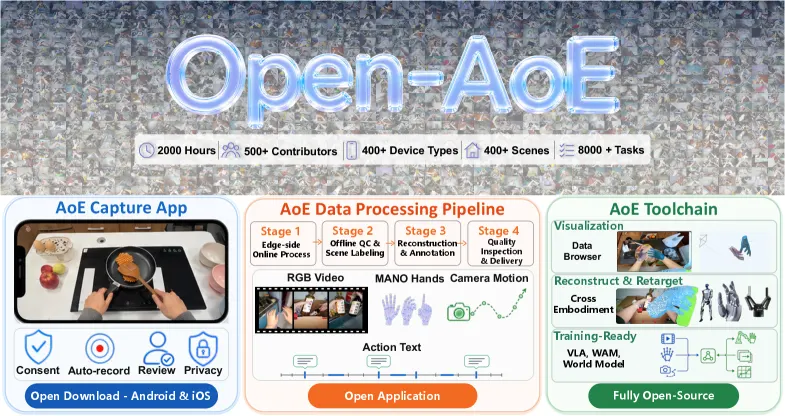
Egocentric videos of human manipulation provide scalable supervision for embodied intelligence, yet existing resources rarely combine low-cost continuous capture, manipulation-level structured annotations, and reusable tools for robot learning. We present Open-AoE, an open, community-oriented egocentric manipulation dataset and toolchain spanning the full pipeline from smartphone capture to model training. Its first release contains approximately 2,000 hours of manipulation video collected in natural environments by 500+ contributors using 400+ smartphones. The dataset provides text annotations, MANO-based hand poses, camera trajectories, and temporally localized atomic actions. Open-AoE further includes a data processing pipeline that transforms raw recordings into structured samples through temporal action segmentation, semantic annotation, hand reconstruction, and camera trajectory reconstruction. Meanwhile, we provide a separate downstream toolchain supports visualization, cross-embodiment retargeting, model-specific data conversion, and training recipes for VLA policies, WAMs, and World Models. By integrating scalable capture, structured processing, and downstream adaptation, Open-AoE reduces the barriers to both data contribution and reuse, providing practical open infrastructure for embodied model training, human-to-robot transfer, and world modeling.

Zishuo Li, Bowen Yang, Changtao MiaoJul 15, 2026
First-personEmbodied LearningDatasetsJul 15, 2026
ToolVerse: Unlocking Massive Environments and Long-Horizon Tasks for Agentic Reinforcement Learning

ToolVerse: Unlocking Massive Environments and Long-Horizon Tasks for Agentic Reinforcement Learning

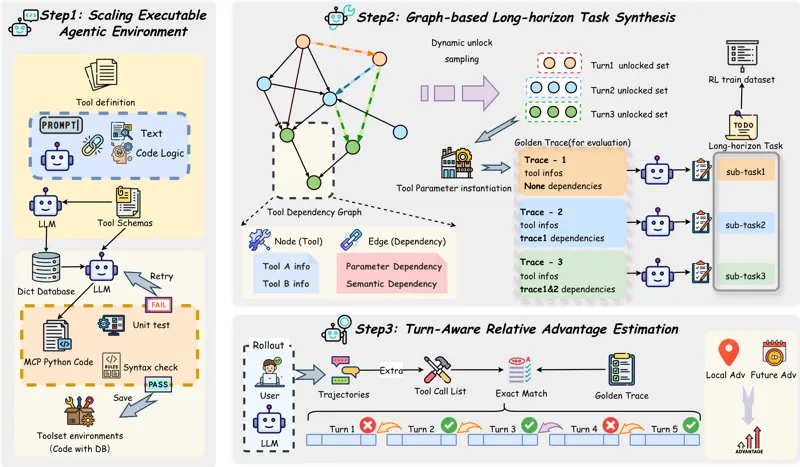
While LLM agents demonstrate strong reasoning abilities in compact and well-defined scenarios, they struggle to maintain robustness and effectiveness when faced with large-scale, diverse, and dynamic real-world environments that demand seamless tool integration. To address this gap, we introduce ToolVerse, a comprehensive framework that scales up agentic RL environments and enables agents to perform complex long-horizon reasoning in Tool-Integrated Reasoning (TIR) tasks. First, ToolVerse automatically builds the massive executable agent training environments from nearly 400 real-world Model Context Protocols (MCPs) that contain about 4500 tools. Second, we propose a task design strategy based on a tool dependency graph, utilizing Dynamic Unlocking Sampling Algorithm to generate long-horizon tasks, and produce GUST (Graph Unlocking Sampling Tasks) dataset. Third, to alleviate the credit assigment problem in long-horizon agentic RL, we propose a fine-grained Turn-Aware Relative Advantage algorithm. We conduct extensive Agentic RL training using ToolVerse and evaluate our framework on serveral agentic benchmarks. Experimental results demonstrate that our framework significantly strengthens LLMs' capabilities in long-horizon tool use, achieving a marked performance boost and showcasing robust reasoning within dynamic environments.

Shuaiyu Zhou, Fengpeng Yue, Zengjie HuJul 17, 2026
Autonomous DrivingDatasetsBenchmarksJul 17, 2026